RSS

Blog

Commercial Door Operators: A Parts, Models, and Service Guide

Commercial door operators are the powered mechanisms that open and close a door automatically when triggered by a push button, motion sensor, or access control signal. They're not door closers. A door closer holds the door shut after manual opening. A door operator actively opens the door under power, then closes it under controlled return. The two get confused constantly on hardware schedules, and that confusion causes the wrong parts to get ordered.

This guide covers what door operators actually do, the LCN and Norton models most commonly installed on commercial buildings, how to identify the unit in front of you, and where to source replacement parts when one fails. If you're working on a manual door closer instead, see the LCN door closer parts guide for that line.

What Commercial Door Operators Do

A commercial door operator is a motorized device mounted on or in the door frame that swings the door open when energized. The operator carries an internal motor (usually electric, sometimes hydraulic on heavy-duty industrial models) and a control board that manages opening speed, hold-open time, and closing return. Most commercial door operators run on 120V AC for the unit itself, with low-voltage activation signals (12V or 24V) coming in from access control, push plates, or wave sensors.

The two functional categories you'll encounter most:

Low-energy door operators. These swing the door at a controlled speed governed by ANSI/BHMA A156.19. Low-energy means the door's opening force and speed stay under a threshold that doesn't require safety sensors or guard rails. Common on accessible restrooms, single-occupancy entries, and ADA-compliant office doors.

Full-energy automatic door operators. Higher opening force and faster swing. Governed by ANSI/BHMA A156.10. Requires presence sensors, safety beams, or guard rails because the door moves with enough force to injure if someone walks into it. Common on retail entrances, hospitals, and high-traffic commercial buildings.

Most door operators on commercial schedules in North America are low-energy units. They're cheaper, code-compliant for most applications, and don't require the sensor stack that full-energy operators do.

Major Commercial Door Operator Models

LCN 4640 Series (Senior Swing). The most-installed low-energy door operator on commercial schedules in North America. Surface-mounted, hydraulic-assist, electric drive. Standard on accessible restrooms, conference rooms, and ADA office doors. Specified across K-12, healthcare, and government buildings.

LCN 4642 Series. Heavy-duty version of the 4640 platform. Higher operating force, more durable internal components, longer service interval. Specified where the door sees high cycle counts or wind load.

LCN 4630/4631 Series. Mid-range models in the LCN low-energy line. Less common than the 4640/4642 but still in active service on installs from the last fifteen years.

Norton 5700 Series. Norton's primary low-energy door operator. Functionally comparable to the LCN 4640. Common on Norton-branded hardware schedules.

Norton 5800 ADAEZ Pro. A more recent Norton operator built specifically for ADA-compliant restroom and accessible-entry applications.

Stanley Magic Force / Magic Swing. Older Stanley low-energy operators still found on legacy installs. Stanley sold the line to dormakaba years ago, so service support has narrowed.

Horton 7000 Series. Heavy commercial swing door operator. Used on hospitals, retail entrances, transportation facilities.

For most replacement work on commercial buildings under twenty years old, the parts you'll need are LCN 4640/4642 or Norton 5700.

How to Identify Your Door Operator Before Ordering Parts

Five checks before placing a parts order. Each one prevents a return.

Read the model number off the unit. Most commercial door operators stamp the model number on the cover or inside the housing. LCN 4640, 4642, Norton 5700, Stanley Magic, all label themselves. The cover usually comes off with a single screw or quarter-turn fastener.

Identify the mounting style. Surface-applied (mounted to the face of the frame or door), concealed overhead (recessed into the header), or in-floor (mounted in the floor under the door pivot). Mounting style determines which parts cross between models.

Note the drive type. Electric (motor-driven), hydraulic-assist (motor plus hydraulic dampers), or pneumatic (older units, less common in modern commercial). Drive type determines what internal components are in the unit.

Confirm the voltage. Most commercial door operators run 120V AC for the main unit. Activation signals come in low-voltage (12V or 24V). Some legacy units run different voltage, so confirm at the unit before ordering electrical components.

Pull the cycle count if available. High-cycle doors (retail, hospital entrances) wear different parts than low-cycle doors (conference rooms, single-occupancy restrooms). Cycle count helps predict which component actually failed versus what looks worn cosmetically.

Common Door Operator Service Issues and What to Replace

Four failure patterns account for most door operator service calls.

Door doesn't open on signal. Usually a control board issue, a low-voltage wiring fault, or a failed motor. Test the activation signal at the operator's low-voltage input first. If signal is present and the motor doesn't run, the control board is the next suspect. If the board is good and the motor still doesn't actuate, replace the motor.

Door opens but doesn't close fully. Hydraulic damper issue or arm linkage wear. On LCN 4640 and 4642 units, the hydraulic damper assembly is the wear component. Replace as a single unit rather than rebuilding internals.

Door slams shut or closes too fast. Closing speed adjustment is out of range, or the closing valve has failed. Adjust the valve first. If the adjustment doesn't hold, replace the valve assembly.

Door operator binds, hesitates, or makes unusual noise. Internal mechanical wear, usually on the spindle or drive gear. On older units (10-plus years), full operator replacement is often more economical than rebuilding internals.

Door Operator Parts Categories

The component breakdown across LCN and Norton low-energy door operators follows a common architecture. The parts categories you'll source from:

Motor and drive assembly. The motor itself and the gear train that connects motor torque to the spindle.

Control board. Manages opening signal, hold-open time, closing speed, and obstruction sensing. Brand and model specific.

Hydraulic damper assembly. Handles controlled closing. Common wear part on hydraulic-assist units.

Arm and linkage. Connects the operator spindle to the door. Standard arm for push-side mount, parallel arm for pull-side, slide track for narrow header installations.

Activation devices. Push plates, wave sensors, motion detectors, push buttons. These are usually separate accessories, not internal operator components.

Cover and housing. Cosmetic and protective. Field-replaceable on most units.

Spindle and pinion. Internal mechanical components. Replaced as part of a major service or operator overhaul.

Power supply and transformer. Some units integrate the transformer in the housing. Others use an external transformer. Voltage-specific.

Door Operators vs Door Closers: Don't Confuse Them on Parts Orders

This is the single most common mistake on door operator parts orders. A door closer (LCN 4040XP, 4041, 4111, Norton 1601, Sargent 351) is a passive hydraulic device that closes a door after someone manually opens it. It doesn't open the door under power. Door closers don't have motors, control boards, or activation inputs.

A door operator opens the door under power. It carries a motor, a control board, and accepts activation signals.

If you're ordering "door closer parts" for what's actually a door operator, the parts won't fit. If you're ordering "door operator parts" for what's actually a heavy-duty door closer, same problem. Confirm the unit type before sourcing, especially on older buildings where the same opening may have housed both types over the years.

The door closer parts catalog handles manual closers. The automatic operator section handles powered units.

How to Source Door Operator Replacement Parts

For LCN 4640 and 4642 door operators, Security Parts stocks the LCN brand line including operator components, hydraulic dampers, arms, and control boards. Same-day shipping on stocked components.

For Norton 5700 and 5800 door operators, source from a Norton-authorized distributor or through Security Parts depending on stock. Norton control boards are model-specific and shouldn't be cross-substituted between series.

For Stanley Magic Force and Magic Swing legacy units, parts availability has narrowed since the dormakaba acquisition. On older Stanley units, replacement of the full operator with a current LCN or Norton model is often more economical than chasing legacy parts.

Before ordering any door operator part, confirm the unit's model number, mounting configuration, and voltage. For configurations not visible online, call 845-935-0301. Two minutes of spec verification prevents the wrong-part return cycle on a service call that probably doesn't have those days to spare.

Why Choose Security Parts for Door Operator Components and Replacement

Security Parts has been the go-to source for commercial door hardware components in the United States since 2001. That's more than two decades of stocking, shipping, and verifying parts for the exact hardware that fails on commercial buildings. Door operators are a category where that experience matters more than catalog breadth, because the wrong part costs a service call and a day of building downtime. The right one ships the same day and gets the door back in service before lunch.

What sets the team apart is the depth on Allegion brands. As a long-standing distributor for LCN, Von Duprin, Schlage, and Falcon hardware, Security Parts carries the LCN 4640, 4642, and broader Senior Swing door operator parts in stock, not on a three-week drop ship. Hydraulic damper assemblies, control boards, arm and linkage components, motors, covers, and replacement spindles all ship the same day on stocked SKUs.

Spec verification is the part most distributors don't do. If you're not sure whether the unit on the door is a 4640 or a 4642, whether the control board you need is original or a current replacement, or whether the operator can be retrofitted with a current ADA-compliant unit, the team will work through it with you on the phone before the order ships. That's how the wrong-part return cycle gets prevented, and it's the single biggest cost-saver on commercial service calls where a misordered part means another business day with a manual door.

For facility managers, locksmiths, access control integrators, and contractors sourcing door operator parts across an institutional portfolio, Security Parts combines stocked depth, brand specialization, and the technical bench to verify configurations. That combination is what builds the long-term sourcing relationships the team has held with K-12 districts, healthcare networks, and government facilities for over twenty years.

Closing

Commercial door operators are infrastructure. They cycle thousands of times a year on busy openings and stay in service for two decades when they're maintained. When one fails, the door becomes either a manual-only opening (frustrating for users) or a security gap (if the operator is part of an access-controlled entry). Either way, the fix needs to be fast and the parts need to be right.

Identify the unit model before ordering. Distinguish door operator from door closer. Confirm voltage and mounting configuration. Then source from a distributor that stocks the specific LCN or Norton line your building runs on. Security Parts has carried LCN commercial hardware since 2001, with verified configurations and spec guidance by phone at 845-935-0301.

Frequently Asked Questions

What's the difference between a door operator and a door closer?

 A door operator opens the door automatically under power and controls the close. A door closer is a passive device that only closes the door after manual opening. Door operators carry a motor, control board, and activation inputs. Door closers do not.

Which door operators are most common on commercial buildings?

 LCN 4640 (Senior Swing) and 4642 are the most-installed low-energy door operators in North America. Norton 5700 series is the next most common. Together these account for the majority of low-energy commercial door operator installs in the last two decades.

Are door operators required to meet ADA standards?

 On accessible openings, yes. Door operators on ADA-compliant entries must meet ANSI/BHMA A156.19 for low-energy units, which governs opening speed and force to ensure the door is safe and operable for users with mobility limitations.

Can a door operator be added to an existing manual door? 

Yes, on most commercial doors. Low-energy door operators like the LCN 4640 are surface-mounted and can retrofit an existing door without frame modification, provided the door has structural mounting points and access to 120V AC for the operator unit.

How long do commercial door operators last?

 Properly installed and maintained door operators typically last 15 to 20 years on low-cycle openings. High-cycle doors (retail entries, hospital corridors) may see 7 to 10 years before major service. Hydraulic dampers, control boards, and motors are the components that fail first.

What voltage does a commercial door operator require? 

Most commercial door operators run on 120V AC for the main unit, with low-voltage activation signals at 12V or 24V coming from push plates, sensors, or access control panels. Confirm voltage at the unit before ordering electrical components.

Where can I source door operator parts?

 Security Parts stocks commercial door operator components including LCN 4640 and 4642 parts, control boards, hydraulic dampers, and arm assemblies. Call 845-935-0301 for configurations not visible online.


Schlage L9580 vs Electric Strike: Which One Should Go on the Door

The Schlage L9580 vs electric strike decision comes down to one question most spec sheets never frame clearly: do you modify the lock, or do you modify the frame? An electric strike releases the door by swinging open a keeper cut into the frame. The L9580 releases the door by retracting the latchbolt inside the lock itself. Both get you electronic access control. They get you there in very different ways, with different costs, security levels, and code implications.

This guide compares them on the factors that actually decide a spec. If you need the full breakdown of the lock itself, see our Schlage L9580 guide. This piece is about choosing between the two approaches.

The Core Difference in How They Work

An electric strike replaces the fixed strike plate in the door frame. When the access control panel sends a signal, the keeper pivots and lets the latchbolt swing free, so the door can be pulled or pushed open. The lock on the door never changes state. Its latch stays extended the whole time.

The Schlage L9580 works the opposite way. The lock body stays in the frame as a standard mortise lock, and a motor inside the chassis physically pulls the latchbolt back into the case on a 24V DC signal. The frame's strike never moves. The door becomes pushable because the latch is gone, not because the keeper released.

That single mechanical difference drives everything else in the comparison.

Frame Impact: The Biggest Practical Divider

Electric strikes require the frame to be cut and routed for the strike body and its wiring. On new construction with hollow metal frames prepped at the factory, that's simple. On a retrofit, it's invasive. Cutting an existing frame for a strike is labor, it can weaken the frame, and on fire-rated assemblies it often isn't permitted at all without a tested, listed fire-rated strike.

The L9580 retrofits the same mortise pocket that already holds a mechanical L9080 or any L9000 lock. The frame is never touched. Wiring runs through the door via an electric hinge or door loop. For any building where the frames are already prepped for mortise locks, this is the cleaner path by a wide margin.

If your project is a renovation with existing mortise-prepped doors, frame impact alone often settles the decision in favor of the L9580.

Security: Latch Retracted vs Keeper Released

With an electric strike, the lock's latchbolt stays fully extended. Only the frame keeper releases. That's secure enough for most interior openings, but the weak point is the frame cutout. A strike plate routed into a frame is structurally less robust than an intact frame holding a deadlocking latch.

The L9580 keeps a one-piece Grade 1 mortise body and a deadlocking auxiliary latch, which prevents shimming when the door is closed. On openings that face genuine forced-entry risk, perimeter doors, cash rooms, pharmacies, server rooms, the mortise lock approach is the tougher build.

For low-risk interior doors, the security gap is small enough that other factors decide. For high-security openings, the L9580 wins on physical security.

Noise: A Real Factor in Healthcare and Quiet Spaces

This one gets overlooked until it becomes a complaint. AC-powered electric strikes buzz when energized. DC strikes click. In a hospital corridor at 3 a.m., a library, a courthouse, or any space sensitive to repeated sound, that buzz or click on every access event is a problem.

The L9580 uses an ultra-quiet motor. Latch retraction is near silent. This is a major reason Allegion positions the motorized latch retraction line for healthcare and education, where doors cycle constantly and noise discipline matters. If the opening is in a quiet-sensitive environment, the L9580 has a clear edge.

Fire-Rated Openings: Code Narrows Your Options

On a fire-rated door assembly, an electric strike has to be a tested, listed fire-rated strike, and on a fire door it must fail secure (latched on power loss) so the door stays a barrier during a fire. Many standard electric strikes don't qualify, which limits your selection.

The L9580 is built on an L Series chassis UL listed for 3-hour fire door assemblies. Because it's latch-retraction-only, it defaults to its mechanical storeroom behavior when power is removed, the latch extends and the door secures, which aligns with fire-door requirements under NFPA 80. For fire-rated openings, the L9580 is often the simpler path to a compliant install.

Aesthetics: Visible Hardware vs Clean Lines

An electric strike adds a visible faceplate in the frame. In utility spaces, nobody cares. In a hotel lobby, a healthcare reception area, or a high-end commercial interior, that faceplate matters to the architect.

The L9580 looks identical to a standard mechanical mortise lock from the outside. No visible electronic component, no frame faceplate. If the design intent is to hide the access control layer, the mortise lock approach wins.

Cost Factors Without the Sticker Price

The hardware comparison isn't apples to apples, and the real cost lives in the install, not the part. Electric strikes generally carry a lower hardware cost, but frame cutting, fire-rated strike requirements, and wiring labor can close that gap fast on a retrofit. The L9580 carries a higher hardware cost but a lower install burden on mortise-prepped doors because the frame stays untouched.

The honest way to evaluate it: on new construction with factory-prepped frames, the electric strike often costs less installed. On retrofits with existing mortise doors, the L9580 frequently comes out even or ahead once frame labor and fire compliance are counted. Run the comparison per opening, not per catalog line.

When Each One Wins

The electric strike is the better call when the door uses cylindrical hardware you want to keep, when the budget is tight on simple interior openings, when the frame is already prepped for a strike, or when you only need to add access control to an existing lock without replacing it.

The L9580 is the better call on mortise-prepped retrofits where the frame can't be cut, on fire-rated openings, on quiet-sensitive environments like healthcare, on high-security doors, on auto operator and hands-free applications where the latch needs to fully clear, and anywhere the access control layer needs to stay visually invisible.

Frequently Asked Questions

Is the Schlage L9580 more secure than an electric strike?

 On high-risk openings, yes. The L9580 keeps a one-piece Grade 1 mortise body with a deadlocking auxiliary latch, while an electric strike relies on a keeper routed into the frame. For low-risk interior doors, the difference is minimal.

Can the L9580 replace an electric strike on a fire-rated door?

 Often, yes. The L Series chassis is UL listed for 3-hour fire assemblies and fails secure on power loss, which aligns with fire-door code. Electric strikes on fire doors must be specifically fire-rated and fail secure, which limits the options.

Why is the L9580 quieter than an electric strike? 

The L9580 retracts its latch with an ultra-quiet motor. AC electric strikes buzz and DC strikes click on each access event, which makes the L9580 preferable in healthcare, libraries, and other quiet-sensitive spaces.

Is an electric strike cheaper than the L9580? 

The hardware usually costs less, but frame cutting, wiring labor, and fire-rated strike requirements can erase that gap on retrofits. Evaluate installed cost per opening, not hardware cost alone.

Which one works better with auto operators? 

The L9580. It fully retracts the latch so the door clears cleanly for hands-free operation, which is why it's specified for accessible restrooms and infection-control corridors.

Closing

The Schlage L9580 vs electric strike choice isn't about which technology is better in the abstract. It's about which one fits the opening. Frame condition, fire rating, security level, and noise sensitivity decide it more than hardware cost does. For mortise-prepped retrofits, fire-rated doors, and quiet environments, the L9580 usually wins. For simple interior openings and frames already cut for a strike, the electric strike still earns its place.

Spec it per door. When you're ready to source either side, Security Parts stocks commercial mortise locks and electric strikes, and the team has verified configurations on commercial hardware since 2001. Reach them at 845-935-0301.


Schlage L9580: The Storeroom Mortise Lock with Motorized Latch Retraction Explained

The Schlage L9580 is a Grade 1 mortise lock from Allegion's L Series running the storeroom function with motorized latch retraction (MLR), single outside cylinder, and 24V DC operation. Allegion released it to market in March 2025 for access-controlled commercial openings where the door has to release on signal without anyone touching the lever. Auto operators, card readers, push-button stations, infection-control corridors, K-12 visitor entries, accessible restrooms.

That's the role. What spec sheets skip is the practical detail: how to wire it, how to size the power supply, and how to order the right configuration the first time. Here's the working breakdown.

What the Schlage L9580 Does

The L9580 runs the storeroom function: outside lever stays fixed (key-only entry from outside), inside lever is always free for egress. Standard institutional setup for IT rooms, supply closets, mechanical rooms, and access-controlled service corridors.

Motorized latch retraction adds one capability on top: a 24V DC signal to the chassis tells an internal motor to retract the latchbolt. The door becomes pushable without anyone using the lever or key. When the signal stops, the latch springs back out. The lock secures itself the next time the door closes.

The unit also includes a deadlocking auxiliary latch, so the main latch can't be retracted by a credit-card shim once the door is closed. That's a Grade 1 physical security detail you don't get on lighter electrified hardware.

Where the L9580 Fits in the L Series Family

Allegion's MLR line splits into two groups. Latch-retraction-only: L9510 (passage), L9580 (storeroom), L9582 (institution). Latch-retraction-plus-lever-control: L9692EL/EU, L9695EL/EU, L9696EL/EU.

The L9580 sits in the first group. It retracts the latch on signal but doesn't electrify the lever itself. If your project needs the lever to lock or unlock electronically, you want the L9692/95/96 line instead.

The L9580 shares chassis dimensions with the broader Schlage L Series mortise lock platform, which means it retrofits the same mortise pocket as a mechanical L9080. Frame stays intact. Wiring runs through the door.

Trim, finish, lever style, and keyway options carry across the entire L Series. Standard keyway is patented Everest 29 S123, with Primus available for upgraded geographic exclusivity. Cylinder formats include FSIC, SFIC, conventional, and less-cylinder. Twelve finishes cover 605, 612, 619, 622, 625, 626, 629, 630, and 643e among others.

Electrical Specifications That Determine Power Supply Sizing

24V DC only. Not 12V, not multi-voltage, not AC. A 12V panel won't actuate it. AC will damage the motor.

Peak current draws roughly 1.4 amps at the moment of latch retraction, then drops to around 0.1 amps holding current while the latch stays retracted. Sizing matters on multi-lock circuits: two L9580s firing simultaneously can pull close to 3 amps for a fraction of a second, even though average draw stays under one. UL 294 certified access control power supplies handle this if specified properly.

Critical install warning most distributors skip: don't share a circuit with solenoid-based devices unless transient voltage is suppressed. Solenoids generate voltage spikes when they de-energize, and those spikes damage the L9580 motor. Schlage's installation document specifies a varistor rated at 35V (peak recurrent) installed at the equipment producing the transient. Leave it out, and the motor fails inside a year.

Fail-Safe vs Fail-Secure: Why the L9580 Operates Differently

Most electrified L Series locks have a field-selectable fail-safe / fail-secure switch in the chassis. The L9580, L9510, and L9582 do not. They're latch-retraction-only and operate in a single mode: powered means latch retracted, no power means latch extended.

Functionally that's similar to fail-secure (loss of power equals locked). But it's not switchable. If the application requires fail-safe behavior under code (some egress doors, certain stairwells, specific assembly occupancies), the L9580 is the wrong function. A lever-control variant from the same family covers that case.

The underlying L Series chassis is UL listed for 3-hour fire door assemblies, which makes the L9580 appropriate for fire-rated openings under NFPA 80 inspection requirements.

RX vs LX: Which Monitor Option Fits Your Access Control System

The L9580 takes two optional switches.

RX (request to exit) closes when the inside lever rotates, telling the access control panel that someone is exiting legitimately. Suppresses forced-entry alarms and logs valid exits. Most access control systems integrating with L9580 storerooms want RX.

LX (latchbolt monitor) signals whether the latchbolt is extended or retracted at any moment. Tells the panel whether the door is actually latched, not just closed. Specified for high-security openings where door position switch (DPS) data alone isn't enough.

Both can be ordered together. Security Parts stocks the L9580 motorized latch retraction chassis with RX as the primary configuration.

Choosing Between the L9580 and Other Access Control Options

The L9580 isn't always the right answer. If the door faces a choice between an electrified mortise lock and an electric strike, the trade-offs in frame impact, security, and noise matter. That comparison gets its own full breakdown in our guide on the Schlage L9580 vs an electric strike, worth reading before you spec a door either way.

Install Mistakes That Damage the Lock

Three field errors cause most L9580 failures inside the first year:

Sharing a circuit with solenoid hardware without a 35V varistor for transient voltage suppression. This is the single biggest cause of premature motor failure.

Wrong voltage at the lock terminals. 24V DC, correct polarity, no AC component. Multi-voltage panels feeding 12V to the lock won't actuate it, and the unit gets returned as defective when nothing was wrong.

Improper coordination with panic hardware on the same door. UL listing requires the L9580 to be installed so it doesn't interfere with exit device operation. On openings with both, mount them so they operate independently. The commercial exit device parts guide covers panic hardware specification if both are being sourced together.

How to Source the Right L9580 Configuration

Every L9580 order needs five specs locked in: trim and lever style, cylinder option (P, L, B, BD, R, F, T), finish, door thickness if anything other than 1-3/4 inch, and monitor option (RX, LX, or both). Handing is field-reversible, so it doesn't have to be specified at order.

For new spec, start at the L9580 motorized latch retraction chassis page and build the configuration up from there. For replacements, pull the model number and trim code off the existing lock face and match the same chassis variant. The Schlage L Series parts and diagrams guide covers component-level sourcing if a single part failed instead of the full chassis.

For LX-only configurations, less common finishes, or extended door thickness, call 845-935-0301 to verify availability before placing the order.

Frequently Asked Questions

Is the Schlage L9580 fail-safe or fail-secure?

 Latch-retraction-only, not field-selectable. Powered equals latch retracted. No power equals latch extended and lock secured. Functionally similar to fail-secure but not the same as a switchable setting.

What voltage does the Schlage L9580 require?

 24V DC, single voltage, no AC component. Peak current is approximately 1.4 amps at retraction, holding current approximately 0.1 amps.

Can the L9580 retrofit an existing L9000 mortise pocket? 

Yes. Same chassis dimensions as the L9000 series. Drops in without frame modification. Wiring runs through the door.

Does the Schlage L9580 work with auto operators?

 Yes. Auto operator integration is one of the primary applications. The operator signals the lock to retract, then activates the door swing. Standard for accessible restrooms and hands-free corridors.

What's the difference between L9580 with RX and L9580 with LX? 

RX is a request-to-exit switch that signals when the inside lever rotates. LX is a latchbolt monitor that signals whether the latch is extended or retracted. RX integrates with most access control panels. LX verifies door secured status.

Is the Schlage L9580 UL fire rated?

 The underlying L Series chassis is UL listed for 3-hour fire door assemblies. Confirm fire rating compatibility against the specific opening's UL listing before ordering.

Closing

The Schlage L9580 gives a Grade 1 mortise storeroom lock the ability to release on signal without compromising security or appearance. Source it as a complete configuration. Confirm chassis, trim, finish, monitor option, and door thickness before the order ships. Security Parts has stocked Schlage commercial hardware since 2001, and the team is reachable for spec verification at 845-935-0301.

Von Duprin Exit Device Series Comparison: Which Series Belongs on Which Door

A Von Duprin exit device series comparison is not just a product selection exercise. It is a specification decision that determines code compliance, maintenance costs, electrified options availability, and parts compatibility for the life of the opening. Von Duprin has been manufacturing panic exit hardware since 1908, and today its active product lineup covers fourteen series. Each one was engineered for a specific set of conditions no other series addresses equally well. The cost of specifying the wrong series shows up at installation when the device physically does not fit, at the first NFPA 80 inspection when the fire rating fails, and every time a maintenance order ships the wrong part because the series was never correctly confirmed.

Four Questions That Narrow the Field Before You Look at a Catalog

Is the door fire-rated?

 If yes, the exit device must positively latch every time the door closes. Fire-rated Von Duprin configurations add "-F" to the model number and remove the hex dogging function. The device must also carry a UL fire door listing.

Single door or double door without a center post?

 Single doors and paired doors with a mullion use rim configurations. Double doors without a center post require surface vertical rod (SVR) or concealed vertical rod (CVR) configurations.

What is the stile width? 

Aluminum storefront and glass doors with stile widths as narrow as 1-3/4 inches require narrow-stile devices. Standard hollow metal commercial doors use wide-stile devices.

Is electrified access control required now or anticipated? 

The crossbar series (55 and 88) are mechanical-only by design. If electronic integration will ever be needed at the device level, a push pad or touchbar series with electrified options must be specified.

The Complete Series Comparison

22 Series: Mid-Range Grade 1

Applications: Employee entrances, parking garage stairwells, healthcare clinics, multi-family corridors, back-of-house retail.

Why: ANSI A156.3 Grade 1 performance at a lower specification cost than the 98/99. Not as deep an electrified options catalog, but covers the essentials: ALK alarm kit, QEL modular conversion, MEL motorized latch retraction, RX request to exit.

Parts note: Center case 109012 (rim) or 109358 (2227 SVR). Pre-1998 devices use old-style dogging assemblies; convert with part 050709. Dogging hole is only 1/4 inch deep, long 5/32-inch hex key is mandatory.

33A/35A Series: Narrow-Stile Touchbar

Applications: Aluminum storefronts, narrow-stile glass doors, applications where a full-width touchbar is specified over a push pad. Minimum stile width: 1-3/4 inches.

Why: The narrow-stile sibling of the 98/99 for aluminum frame and glass doors. The touchbar runs the full width of the door, engaging the release mechanism anywhere along its length. The 35A adds an integral door position switch.

Electrified: Second-deepest options catalog outside the 98/99. Chexit delayed egress, E7500 electrified mortise lock, pneumatic options, Allegion Connect, electric power transfers.

55 Series: Narrow-Stile Crossbar

Applications: Historic renovations, ornate institutional lobbies, applications requiring crossbar aesthetics on a narrow-stile door.

Why: Cast brass or bronze plated to finish specification. Integrates the 7500 mortise lock body. Specified where the architectural context demands a traditional crossbar appearance in a narrow-stile frame.

No electrified options at the device level.

75 Series: Standard Commercial Grade 1

Applications: Healthcare facilities, standard commercial offices, light institutional openings requiring Grade 1 performance without full institutional specification cost.

Why: Sits between the 22 and 98/99 in specification depth and cost. Rim, SVR, and CVR configurations. Electrified options: ALK, MEL, QEL modular conversion, Allegion Connect. The center case reinforcing bracket on the 75 Series adds structural support on high-use corridor openings.

78 Series: Narrow-Stile Push Pad

Applications: Aluminum storefront and glass doors where a push pad is specified over a touchbar. Minimum stile clearance: 1-3/4 inches.

Why: The push pad equivalent of the 33A/35A for narrow-stile applications. Rim, SVR, CVR, and WDC configurations. Electrified options: ALK, MEL, QEL modular conversion, Allegion Connect.

Critical parts note: 78 Series components are not interchangeable with any wide-stile Von Duprin series. Narrow-stile form factor throughout.

88 Series: Wide-Stile Crossbar, Abuse-Resistant

Applications: Correctional facilities, behavioral health units, secure government floors, any application where hardware faces deliberate sustained force.

Why: In continuous production since the 1950s. Ships with a 42-inch field-sizeable crossbar. Non-handed. ANSI A156.3 Grade 1. UL Listed. Fire-rated versions (88-F) carry 3-hour UL 10C rating. No electrified options by design: in correctional and behavioral health environments, electronic components at the device level are not appropriate.

Configurations: Rim (88/88-F), SVR (8827/8827-F), CVR (8847-F), Mortise (8875/8875-F).

94/95 INPACT Series: Recessed Push Pad

Applications: High-traffic openings where the push pad requires protection from cart, equipment, or deliberate impact damage.

Why: Recessed push pad design reduces impact exposure in environments where a standard protruding push pad would be repeatedly struck.

98/99 Series: Institutional Flagship

Applications: Schools, hospitals, universities, government buildings, any high-traffic institutional opening requiring the highest specification depth.

Why: The dominant institutional specification in North America. ANSI A156.3 2014 Grade 1. UL Listed for panic and fire exit hardware. Made in the USA. Five configurations: rim, SVR (9827/9927), CVR (9947), WDC (wide door cable), and the 9875/9975 mortise device using the 7500 mortise lock body.

Forward compatibility: A mechanical 98/99 specified today can be upgraded to full electrified access control years later without replacing the device body. This is why architects and security consultants default to the 98/99 on complex institutional projects with phased access control implementation.

Electrified options: The deepest catalog in the Von Duprin lineup: QEL, HD-QEL, MEL, Chexit, ELR, Allegion Connect, RX, RX2, WP-RX, LX, LX-RX, SS Signal Switch, electric power transfers, and more.

Guard-X 2670: Alarmed Secondary Exit

Applications: Secondary exits in restaurants, retail, grocery, drug stores, any commercial space needing unauthorized exit deterrence.

Why: Not a standard exit device with an alarm add-on. Purpose-built with a 100-decibel alarm, stainless steel deadbolt rated to 1,600 pounds, armed indicator light, and Schlage SC-1 cylinder. NFPA 101 compliant. UL Listed. 10-year mechanical warranty, 1-year electrical warranty.


Side-by-Side Comparison

Series

Stile

Format

Fire-Rated

Electrified

Best Application

22 Series

Wide

Push pad, SVR

Yes (-F)

ALK, QEL, MEL, RX

Healthcare, multi-family, retail back doors

33A/35A

Narrow

Touchbar

Yes (-F)

Chexit, QEL, MEL, Allegion Connect

Aluminum storefront, narrow-stile glass

55 Series

Narrow

Crossbar

Yes (-F)

None

Historic, ornate, narrow-stile

75 Series

Wide

Push pad, SVR, CVR

Yes (-F)

ALK, QEL, MEL, Allegion Connect

Standard commercial, office, healthcare

78 Series

Narrow

Push pad

Yes (-F)

ALK, QEL, MEL, Allegion Connect

Aluminum storefront push pad

88 Series

Wide

Crossbar

Yes (-F)

None

Correctional, behavioral health, secure government

94/95 INPACT

Wide

Recessed push pad

Yes

Limited

High-impact traffic applications

98/99 Series

Wide

Push pad, SVR, CVR, WDC, Mortise

Yes (-F)

Full catalog

Institutional: schools, hospitals, government

Guard-X 2670

Wide

Alarmed deadbolt

Yes

Alarm only

Retail and restaurant secondary exits


Why Series Selection Affects Parts Sourcing for Life

Every series has its own parts tree. Components do not cross between series. A 78 Series arm does not fit a 33A/35A device. A 22 Series center case does not fit a 75 Series device. Specifying the wrong series at the project stage creates parts sourcing problems at every maintenance cycle for the full service life of the opening.

Security Parts organizes the complete Von Duprin exit device series comparison catalog by series and model, with interactive diagrams on every model page. The exit devices section covers every series in the same model-specific structure. Pre-order compatibility support at 845-935-0301 or [email protected].

Conclusion

The Von Duprin exit device series comparison starts with four decisions: fire rating, single vs double door configuration, stile width, and electrified options requirement. Those four answers eliminate most series immediately. The 98/99 for institutional depth and forward compatibility. The 22 for mid-range Grade 1 cost efficiency. The 33A/35A and 78 for narrow-stile aluminum and glass. The 88 for crossbar abuse resistance without electronics. The 55 for narrow-stile crossbar aesthetics. The Guard-X for alarmed secondary exits. Every series has its own non-interchangeable parts tree. Getting the series right at specification time is what keeps every future maintenance order, every parts replacement, and every code inspection on the correct path.

FAQs

What is the primary difference between the Von Duprin 22 and 98/99 Series?

 The 98/99 is the institutional flagship with the deepest electrified options catalog, five configurations, and Made in USA production. The 22 is mid-range Grade 1 for medium-traffic commercial at a lower specification cost.

When should I specify the 78 Series instead of the 33A/35A?

 Both fit narrow-stile aluminum and glass doors at 1-3/4 inch minimum stile width. Specify the 78 when a push pad is required. Specify the 33A/35A when a full-width touchbar is required or preferred.

Does the Von Duprin 88 Series support electrified access control? 

No. The 88 Series is mechanical-only by design. It is specified in correctional and behavioral health environments where device-level electronic components are not appropriate.

What is the 98/99 forward compatibility advantage? 

A mechanical 98/99 specified today can be upgraded to QEL, MEL, Chexit, Allegion Connect, or other electrified options years later without replacing the device body. This makes it the default institutional choice when phased access control is anticipated.

Are Von Duprin series parts interchangeable between models?

 No. Every series has its own non-interchangeable parts tree. A 78 Series arm does not fit a 33A/35A. A 22 Series center case does not fit a 75 Series. Series selection at specification time determines parts compatibility for the life of the opening.

Rim Exit Devices: How They Work, When to Use Them, and Everything the 98/99 Series Spec Requires

Rim exit devices are the most widely installed panic hardware configuration in commercial construction, and the Von Duprin 98/99 Series is the institutional standard for that category. The 98 and 99 Series devices are certified to ANSI A156.3 2014 Grade 1, UL Listed for panic exit hardware and fire exit hardware, manufactured under ISO 9001 Quality Management System standards, and made in the USA. They are non-handed from the factory in most configurations, ship with a 299 rim strike standard, cover hollow metal doors with 86 or 161 cutouts, and support the deepest electrified options catalog in the Von Duprin lineup. Understanding what makes a rim device the right specification, and what makes it the wrong one, is what prevents the most common exit hardware specification error in commercial construction.

How a Rim Exit Device Works

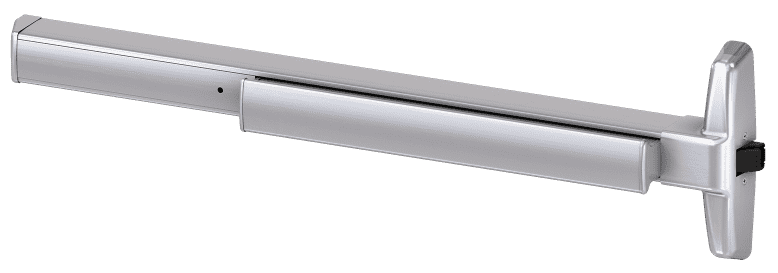
The mechanism is simple by design. When a person presses the push bar, a lever arm inside the center case depresses and retracts the latch bolt from the rim strike pocket on the frame. When the bar is released, a return spring extends the latch bolt again. When the door swings shut, the beveled nose of the latch bolt rides over the strike lip and drops into the strike pocket automatically.

This simplicity is why rim devices dominate commercial construction. No rods penetrating the door floor. No mortise pocket cut into the door edge. The full mechanism sits on the face of the door, visible and accessible for maintenance without disassembly.

Fire-rated configurations remove the hex dogging function. On fire-rated openings, the latch must extend automatically every time the door closes. The "-F" suffix in the model number designates fire-rated configurations.

When Rim Is Right and When It Is Not

Rim is the correct specification for:

Single doors meeting a fixed frame. Paired doors with a center mullion, where each leaf latches to the mullion. Standard hollow metal commercial doors with 86 or 161 door prep cutouts.

Rim is the wrong specification for:

Double doors without a center post. When two active leaves must latch against each other at a center meeting point, a surface vertical rod (SVR) device adds top and bottom rod engagement for three-point latching. The 2227 SVR (22 Series), 9827/9927 SVR (98/99 Series), and 8827 SVR (88 Series) cover this application.

Applications requiring concealed hardware. When surface-mounted hardware is architecturally unacceptable, the concealed vertical rod (CVR) configurations route hardware inside the door.

Applications needing mortise lock security depth. The 98/9975 mortise exit device integrates the 7500 mortise lock body for maximum security at the door edge.

98 vs 99: The Only Difference That Matters

The 98 Series has a smooth mechanism case. The 99 Series has a grooved mechanism case. Every internal component is identical and fully interchangeable between the two. Every parts number that applies to a 98 rim device applies equally to a 99 rim device. The distinction is aesthetic only and produces no difference in performance, function, or Grade 1 certification.

Key Specifications Every Specifier Needs

ANSI certification: ANSI A156.3 2014 Grade 1 (the 2014 edition is the current standard, not the 2001 edition cited in older specifications).

UL listing: UL Listed for panic exit hardware and fire exit hardware. Fire-rated configurations carry a 3-hour UL 10C listing on single doors.

Non-handed status: The 98/99 rim device ships non-handed from the factory in most configurations. It becomes handed when ordered with SD (special dogging), -2 (double cylinder), or SS (signal switch) options.

Available finishes: US3, US3A, US4, US4A, US10, US26, US26D, US26D-AM Antimicrobial, US28, 313, 315, and 643E. The antimicrobial finish (US26D-AM) is specified in healthcare applications where touch surface hygiene is a design requirement.

Strike: 299 rim strike on non-fire-rated devices. 299F on fire-rated. The 299 measures 1-1/4 inches wide by 2-7/8 inches high with 2-1/8-inch slotted hole spacing.

Door lengths: 3-foot (36-inch) and 4-foot (48-inch) push bar lengths.

Trim Functions Available

The trim suffix in the model number determines outside hardware function:

  • EO: Exit only. No outside operation. Most common on exterior egress-only openings.
  • NL: Night latch. Key retracts latchbolt from outside. Uses rim cylinder and 1-1/4-inch mortise cylinder.
  • NLOP: Night latch with pull required. Key retracts latch, then a pull action is required to open.
  • TP: Thumbpiece. Key locks and unlocks outside thumbpiece.
  • L: Lever. ADA-compliant outside entry function. Most common on accessible egress routes.
  • DT: Dummy trim. Non-functional outside pull for aesthetic matching on inactive leaves.

Electrified Options on the 98/99 Rim Device

The 98/99 Series carries the most complete electrified options catalog in Von Duprin's lineup:

  • QEL: Quiet electric latch retraction. Modular field-installable conversion. Silent outside entry without a key.
  • HD-QEL: QEL with hex dogging retained. Allows mechanical dogging and electric latch retraction on the same device.
  • MEL: Motorized electric latch retraction. Motor-driven for silent operation in noise-sensitive environments.
  • Chexit: 15-second alarm-plus-delay for controlled egress and retail loss prevention.
  • ELR: Standard solenoid-driven electric latch retraction.
  • RX: Request to exit switch. Signals access control panel on egress activity.
  • RX2: Double request to exit, two RX switches.
  • WP-RX: Waterproof request to exit. Available with the OUT option for rim and surface vertical rod.
  • LX: Latch monitor switch. Monitors latch bolt position for door status verification.
  • LX-LC: Latch monitoring low current version.
  • LX-RX: Combined request to exit and latch monitoring.
  • SS (Signal Switch): Monitors both push pad and latch bolt simultaneously. Makes the latch bolt tamper-resistant. Rated up to 2.0 amp at 24VDC. Makes the device handed when specified.
  • ALK: 9-volt battery-powered alarm exit kit.

Parts That Fail First on High-Cycle Openings

Dogging assemblies (post-1997 devices): Dogging shaft 090040 (long 5/32-inch hex key mandatory, 1/4-inch shaft depth). Dogging hook 090044. Dogging spring 090041. Pre-1997 devices use old-style components; part 050709 is the conversion kit.

Center case: Part 050021 replaces all earlier non-fire-rated 98/99 rim center cases, with approximately 40-year backward compatibility.

299 strike: Strike shift from door sag or frame movement produces latch alignment problems. Strike replacement is among the most common rim device service items.

Push bar end guide (090049): Reduces noise and friction at the push bar assembly end. Missed on most service visits until noise develops.

Sourcing 98/99 Rim Device Parts at Security Parts

Security Parts organizes the complete 98/99 Series parts catalog by model and configuration, with interactive diagrams on every page. The exit devices catalog covers every Von Duprin series with the same model-specific structure. Pre-order compatibility support at 845-935-0301 or [email protected].

Conclusion

Rim exit devices are ANSI A156.3 2014 Grade 1, UL Listed, manufactured to ISO 9001 standards, and made in the USA. The 98 and 99 Series are internally identical. The device is non-handed except when SD, -2, or SS options are specified. Twelve finishes are available including US26D-AM antimicrobial for healthcare. The HD-QEL option retains hex dogging while adding electric latch retraction. The SS Signal Switch monitors both push pad and latch bolt and makes the device handed. Every 98/99 rim device parts order starts with confirming the center case variant by trim function before the catalog opens.

FAQs

What is the ANSI grade of the Von Duprin 98/99 rim exit device?

 ANSI A156.3 2014 Grade 1. The 2014 edition is the current standard. UL Listed for both panic exit hardware and fire exit hardware.

When does the 98/99 rim device become handed?

When ordered with SD (special dogging), -2 (double cylinder), or SS (signal switch) options. Standard configurations without these options are non-handed.

What is HD-QEL on the 98/99 Series? 

Quiet Electric Latch Retraction with hex dogging retained. It allows mechanical dogging and electric outside entry on the same device simultaneously.

What is the SS Signal Switch option? 

It monitors both the push pad and the latch bolt, signals unauthorized use to the access control system, makes the latch bolt tamper-resistant, and is rated up to 2.0 amp at 24VDC. It also makes the device handed.

Are 98 and 99 Series parts interchangeable? 

Yes, completely. The 98 has a smooth case and the 99 has a grooved case. Every internal component is identical between the two.

Exit Alarms Parts and Diagrams: The Von Duprin Guard-X Component Guide

Most facility managers only think about exit alarms parts and diagrams when the alarm fails to sound, the battery dies, or a disarming label gets peeled off. The Von Duprin Guard-X 2670 is the most widely installed commercial alarmed exit device in North America. It is not a standard exit device with an alarm kit added on. It is a purpose-built alarmed exit lock that integrates a stainless steel deadbolt rated to 1,600 pounds of force resistance, a 100-decibel alarm, an armed indicator light, and a Schlage SC-1 cylinder into a single housing. It complies with NFPA 101 Life Safety Code, is UL Listed for both panic exit hardware and fire exit hardware, carries a 10-year limited mechanical warranty and a 1-year limited electrical warranty, and ships non-handed in satin aluminum 628/US28 finish. The 2609 is the double door version.

What the Guard-X Was Built For

The Guard-X 2670 exists for one specific application: secondary exits where unauthorized use needs to be deterred without eliminating code-compliant egress. It identifies the door as an emergency exit and secures the opening against unauthorized entry or exit. Typical applications include back doors at restaurants, retail stores, discount stores, grocery stores, drug stores, clothing stores, and sporting goods stores where employee or customer misuse of a secondary exit is an operational problem.

Two features define the deterrent function:

The stainless steel deadbolt does not retract unless the key disarms the device first. It is tested to withstand 1,600 pounds of force, making it significantly more resistant to defeat than a standard latch bolt. The 100-decibel alarm sounds immediately when the push bar is activated without prior key disarming. The armed indicator light on the device face shows the armed state before any attempt is made to open the door.

The standard device ships with an SC-1 Schlage cylinder included. The 2609 double door variant coordinates alarm functions between two active leaves on a paired opening.

Every Replaceable Component in the Guard-X 2670

Alarm Battery

This is the most frequently replaced component on every Guard-X installation. The device uses a standard 9-volt battery to power the alarm circuit. When the battery fails, the device operates mechanically but produces no alarm sound on push bar activation, which is the worst failure mode for a deterrent device. Proactive replacement every six months on high-use secondary exits prevents silent failure without waiting for the symptom.

Schlage SC-1 Cylinder

The cylinder is what disarms the alarm before an authorized door use. The SC-1 keyway is Schlage's standard 5-pin tumbler residential and light commercial cylinder. It ships included with the Guard-X 2670. Replacement is needed when the cylinder wears from heavy use, when a key is lost, or when the building's key system is being re-keyed. The SC-1 keyway is widely available from Schlage-authorized locksmiths and can be ordered factory-keyed to a master key system.

Retainer Nut

The retainer nut secures the cylinder in the device housing. A loose retainer nut allows the cylinder to rotate in the housing rather than staying fixed, which prevents the alarm from disarming correctly when the key is turned. Retainer nuts are the most commonly overlooked service item on Guard-X devices. A torque check at every service visit takes 30 seconds and prevents the most frustrating "alarm won't disarm" service call.

Disarming Label

The "EMERGENCY EXIT ONLY, ALARM WILL SOUND" label is both an NFPA 101 code requirement and a deterrent element. Labels fade, peel, or are deliberately removed. A missing label removes a code compliance element and reduces deterrent effectiveness. Replacement labels are stocked individually.

Alarm Housing Assembly

The housing contains the sounder element and the circuit board that controls alarm timing and the indicator light. When the alarm sounds erratically, fails to sound despite a fresh battery, or the indicator light malfunctions, the housing assembly requires replacement. This is less common than battery or cylinder service but becomes necessary as devices age past their electrical warranty period.

Push Bar Assembly

The push bar completes the alarm circuit when depressed without prior disarming. Push bar wear from physical abuse or forced entry attempts requires assembly replacement. The push bar is replaceable without removing the full device from the door.

Deadbolt Assembly

The stainless steel deadbolt is the mechanical security element. Replacement is required when the bolt is physically damaged from a forced entry attempt significant enough to defeat the 1,600-pound resistance rating. This is not common but does occur in high-risk retail applications.

Sourcing Guard-X Parts at Security Parts

Security Parts organizes the complete Guard-X exit alarm parts catalog with model-specific components for the 2670 and 2609. The Von Duprin brand page covers the Guard-X alongside every other Von Duprin exit device series. Pre-order compatibility support at 845-935-0301 or [email protected]. Same-day shipping on stocked components.

Conclusion

The Von Duprin Guard-X 2670 is a purpose-built alarmed exit device with a 10-year mechanical warranty and a 1-year electrical warranty. Six primary replaceable components: 9-volt alarm battery, Schlage SC-1 cylinder, retainer nut, disarming label, alarm housing assembly, and push bar assembly. The battery is replaced most often. The retainer nut is inspected least often. The 2609 double door version shares all the same component specifications. Sourcing from the exit alarms parts and diagrams catalog at Security Parts starts with confirming single door (2670) or double door (2609), then navigating to the model-specific parts page with same-day shipping on stocked items.

FAQs

What alarm volume does the Von Duprin Guard-X produce? 

100 decibels. It activates immediately when the push bar is pressed without prior key disarming. The armed indicator light shows armed status before any door use attempt.

What force resistance does the Guard-X deadbolt have? 

1,600 pounds, per Von Duprin testing. This significantly exceeds standard latch bolt resistance and prevents the door from being forced open without triggering the alarm first.

What battery does the Guard-X 2670 use? 

A standard 9-volt battery. Replace proactively every six months on high-use secondary exits. Battery failure causes silent operation with no alarm on push bar activation.

What cylinder ships with the Guard-X 2670?

 A Schlage SC-1 5-pin tumbler cylinder. Re-keyable by any Schlage-authorized locksmith. Can be ordered factory-keyed to a building's master key system.

What warranty does the Guard-X carry?

 10-year limited mechanical warranty, 1-year limited warranty on electrical components.

Von Duprin 7500 Parts Manual: Functions, Components, and Replacement Parts Guide

The Von Duprin 7500 parts manual covers the mortise lock that pairs with the Von Duprin 88 Series mortise exit device line. The 7500 itself is a field-reversible mortise lock with a non-handed auxiliary bolt for deadlocking, an adjustable-bevel faceplate, and field-selectable TP and K functions. The E7500 is the electrified variant with electric locking or unlocking options. The SS-7500 is the stainless steel build.

That's the short version. If you're pulling parts off a hardware schedule or troubleshooting a service call, the longer version is what determines whether you order the right component the first time. This guide walks through the 7500 mortise lock anatomy, function selection, exit device pairing, electric strike compatibility, and how to source replacement parts without misordering.

What the Von Duprin 7500 Mortise Lock Is

The Von Duprin 7500 is the mortise lock designed to operate as the inside locking mechanism for the Von Duprin 88 Series mortise exit device. The 88 Series is the panic hardware on the door. The 7500 is the mortise lock body that handles the latch and bolt work behind it. They're sold and specified together as a system on commercial doors that need both panic egress and mortise-lock security.

Three things make the 7500 unusual compared to a generic mortise lock. The lock is field reversible without removing it from the door, which cuts install and service time substantially. The auxiliary bolt is non-handed, which means it works on either swing direction. And the faceplate carries an adjustable bevel, so the lock can adapt to door edge angles without ordering a different SKU. Those three properties together are why the 7500 stays on spec sheets even as newer mortise hardware enters the market.

7500 vs E7500 vs SS-7500: Identifying the Variant You Have

The Von Duprin 7500 ships in three primary variants, and the parts manual breakdown is different for each one.

The standard 7500 is the mechanical mortise lock. No electrification, no monitoring switches. This is the variant on most older Von Duprin 88 Series installs.

The E7500 is the electrified version. It carries the same chassis as the mechanical 7500 but adds electric locking or unlocking through the outside trim. Two SPDT signals monitor trim condition and latchbolt status. Power options include 12V DC, 24V DC, and AC variants with available solenoid kits (SO12, SO24). The E7500 is what's specified on access-controlled commercial openings.

The SS-7500 is the stainless steel build. Same function set as the standard 7500 but with the corrosion-resistant body and faceplate. Common in coastal installs, food processing facilities, and any environment where the mortise lock has to survive humidity and washdown.

Pull the lock face off the existing door and read the model designation before ordering parts. The 7500, E7500, and SS-7500 share many components but not all of them. Cylinder housings, trim spindles, and latch assemblies cross. Solenoid assemblies, electrical kits, and monitoring switches are E7500 specific.

Function Options on the Von Duprin 7500

The 7500 ships with field-selectable functions, which is one of its strongest features for inventory and service. The two primary functions are TP (thumbpiece) and K (keyed). Function selection happens through a set screw in the mortise lock body. Turning the set screw down switches between TP and K function without disassembling the lock.

That field selectability matters when you're servicing a building with mixed openings. One stocked 7500 can be configured for either function at the door, instead of stocking two SKUs. For procurement teams managing replacement parts across a portfolio of buildings, this drops inventory complexity meaningfully.

The E7500 adds electric lock and electric unlock function variants on top of the mechanical function selection. The choice between electric lock (the trim is normally unlocked, locks when energized) and electric unlock (the trim is normally locked, unlocks when energized) is set at order, not field selectable.

Components in the Von Duprin 7500 Parts Manual

The 7500 mortise lock breaks down into these core component groups, listed in the order you'll typically encounter them during service:

Mortise lock case with internal mechanism. The lock body itself. Replaced as a complete unit on most failures.

Faceplate with adjustable bevel. Field replaceable. Bevel adjusts to door edge angle.

Auxiliary bolt (non-handed). Deadlocks the main latch when the door is closed. One of the highest-wear components on heavily cycled doors.

Main latchbolt. The latch that engages the strike. Stainless steel on most production runs.

Trim spindles and connecting hardware. Link the inside and outside trim to the lock body. Worn spindles cause loose trim feel and eventually lever droop.

Cylinder housing. Accepts the keyway cylinder. The 7500 typically takes a Schlage-prep mortise cylinder, which means common Everest 29 or Primus cylinders fit directly.

Set screw for function selection. Located in the lock body. Turns to switch between TP and K functions.

Solenoid assembly (E7500 only). Drives the electric lock or unlock mechanism. Solenoid power draw varies by voltage: roughly 0.38 amps at 12V DC, 0.19 amps at 24V DC.

Monitor switches (E7500 only). Two SPDT signals for trim and latchbolt status. Wired to the access control panel.

Strike pocket insert. Specified for 7500 mortise lock compatibility with Von Duprin 6212WF and similar electric strikes. Furnished with the strike, not the lock.

Compatible Exit Devices and Electric Strikes

The Von Duprin 7500 mortise lock was designed to work with the Von Duprin 88 Series mortise exit devices. That's the canonical pairing. The 8875-F mortise lock fire exit device pairs directly with the 7500 for UL-listed 3-hour fire door assemblies on single and double 4-foot by 8-foot openings.

For electric strike compatibility, the Von Duprin 6200 Series strikes are the matched pair. Specifically, the 6211, 6211AL, 6211WF, 6212, 6213, 6214, 6215, 6221, 6222, 6223, 6224, 6224AL, 6225, and 6226 strikes are factory-listed as 7500 mortise lock compatible. The 6210 strike is the direct replacement for legacy Von Duprin 3146 applications and also pairs with the 7500. The 6212WF includes a strike pocket insert specifically engineered for 7500 mortise lock mounting.

When sourcing an electric strike for a 7500 mortise lock door, confirm the strike compatibility chart on the strike's spec sheet before ordering. The mounting tabs and pocket dimensions differ between Von Duprin's own strike lines and surface-applied alternatives.

How to Identify a Von Duprin 7500 Before Ordering Replacement Parts

Three checks before placing a parts order. Each one prevents a return.

First, confirm it's a 7500 and not a 7400 or other Von Duprin mortise line. The 7500 family stamps the model number on the lock face. Remove the trim, look at the lock face for the model designation, and read it directly.

Second, identify the variant. Mechanical 7500, electrified E7500, or stainless SS-7500. The body finish gives you the SS variant immediately. The presence of wiring leads coming out of the lock body identifies the E7500.

Third, identify the function. TP function (thumbpiece trim) vs K function (keyed trim). Look at the existing outside trim. A thumbpiece-style trim is TP. A keyed lever or knob with no thumbpiece is K. If the function needs to change during service, the set screw inside the lock body switches it without ordering different parts.

Common Service Issues and Which Parts to Replace

Three failure patterns dominate Von Duprin 7500 service calls.

Auxiliary bolt wear. The deadlocking auxiliary bolt sees high cycle counts on heavily used doors and eventually loses spring tension or shows visible wear at the engagement face. Replace as a single component.

Trim spindle wear or loose lever feel. The spindle connecting outside trim to the lock body wears over time, particularly on doors that get pulled rather than pushed. The lever or thumbpiece develops play. Replace the spindle assembly rather than the full lock body.

E7500 solenoid failure. Most often traced to wrong voltage at the lock terminals, transient voltage from solenoid-based hardware on the same circuit, or simple end-of-life on a high-cycle door. Confirm voltage and transient suppression before replacing the solenoid. A motor that fails inside a year is usually an install problem, not a hardware defect.

How to Source Von Duprin 7500 Replacement Parts

For mechanical 7500 components, source by part type: faceplate, auxiliary bolt, latchbolt, trim spindle, cylinder housing. Each is available as an individual replacement. The Von Duprin parts catalog on Security Parts indexes by series.

For E7500 electrical components, confirm voltage (12V DC, 24V DC, or AC) before ordering. Solenoid assemblies are voltage-specific. Order the matching SO12 or SO24 kit for AC operation. Note that 16V DC and 28V DC solenoids are stocked as replacement parts only for existing legacy strikes, not new builds.

For complete 7500 mortise lock replacement, order by full SKU including function (TP or K) and finish. Stainless variants (SS-7500) carry their own ordering line. Cross-reference exit device compatibility with the Von Duprin 88 Series exit devices when replacing the lock as part of a system service.

For electric strike replacement matched to a 7500, the Von Duprin electric strike line carries the 6200 Series strikes that pair with the 7500 mortise lock. Confirm strike model number against the 7500 compatibility chart before ordering.

For configurations not visible online, call 845-935-0301. Two minutes of spec verification on the phone prevents the wrong-configuration return cycle on a service call that probably doesn't have those days to spare.

Frequently Asked Questions

What is the Von Duprin 7500 used for?

 The Von Duprin 7500 is a mortise lock designed to pair with the Von Duprin 88 Series mortise exit devices. It handles the latch and bolt work on commercial doors that need both panic egress hardware and a mortise lock body.

Is the Von Duprin 7500 field reversible?

 Yes. The 7500 mortise lock can be reversed for opposite hand without removing the lock from the door. The auxiliary bolt is non-handed, which means it operates correctly in either swing direction.

What's the difference between Von Duprin 7500 and E7500? 

The 7500 is the mechanical mortise lock. The E7500 is the electrified variant with electric locking or unlocking through the outside trim, plus two SPDT signals for trim and latchbolt monitoring. The E7500 ships in 12V DC, 24V DC, or AC configurations.

How do I switch between TP and K function on a Von Duprin 7500? 

Function selection is field-adjustable through a set screw in the mortise lock body. Turning the set screw down switches between TP (thumbpiece) and K (keyed) function without disassembling the lock.

Which electric strikes work with a Von Duprin 7500? 

The Von Duprin 6200 Series strikes are factory-listed as 7500 compatible. Specifically the 6210, 6211, 6212, 6213, 6214, 6215, 6221, 6222, 6223, 6224, 6225, and 6226 strikes. The 6212WF includes a strike pocket insert engineered for 7500 mortise lock mounting.

Is the Von Duprin 7500 fire rated?

 The 7500 mortise lock is used on UL-listed fire door assemblies when paired with the 8875-F mortise lock fire exit device, supporting 3-hour fire ratings on single and double 4-foot by 8-foot openings.

What voltage does the E7500 solenoid require? 

The E7500 ships in 12V DC, 24V DC, and AC variants. Power requirements are approximately 0.38 amps at 12V DC and 0.19 amps at 24V DC. AC operation requires the SO12 or SO24 solenoid kit.

Where can I source Von Duprin 7500 replacement parts? 

Security Parts stocks the Von Duprin 7500 mortise lock and component-level parts including auxiliary bolts, faceplates, trim spindles, cylinder housings, and E7500 solenoid kits. Call 845-935-0301 for configurations not visible online.

Closing

The Von Duprin 7500 mortise lock is one of the longest-running commercial mortise lines still on active service catalogs. It's on hardware schedules across institutional buildings, healthcare facilities, and K-12 schools that were built or renovated in the last twenty years. When a 7500 needs service, the parts manual breakdown above is what determines whether the right component gets ordered or whether the door stays out of service for an extra week.

Source it from a distributor that stocks both the 7500 mortise lock and the matched 88 Series exit devices on the same line. Security Parts has carried Von Duprin commercial hardware since 2001, with same-day shipping on stocked components and spec verification by phone at 845-935-0301 for configurations that need a second set of eyes.


Electric Strikes Parts and Diagrams: Von Duprin 6000 Series Component Guide for Commercial Openings

Understanding electric strikes parts and diagrams saves facilities teams from a common and expensive problem: replacing an entire electric strike when only the solenoid has failed. Von Duprin's 6000 Series electric strike line, covering the 5100, 6100, 6200, and 6300 models, is the most widely installed commercial electric strike in North America. These devices are built to be field-serviceable, with the solenoid as the primary replaceable component. The Von Duprin 050240 solenoid kit fits every model in the 6000 Series at 24VDC (with 12VDC in 050237 and 16VDC in 050239), which means one stocked solenoid kit covers the most common failure across the entire product line. But accurate sourcing requires understanding the full component diagram, knowing the difference between fail-safe and fail-secure operation, and confirming the voltage and finish before ordering any finish-specific parts.

How an Electric Strike Works: The Four-Component System

An electric strike replaces a conventional strike plate in the door frame. Instead of a fixed pocket for the latch bolt, the electric strike uses a spring-loaded keeper (also called the lip or gate) that can either stay engaged to keep the door latched or release to allow the door to open without retracting the latch bolt. This is the essential distinction from an electric lock: the electric strike releases from the frame side, so the latch bolt on the door hardware does not need to move.

The four primary components visible in the Von Duprin 6000 Series diagram are:

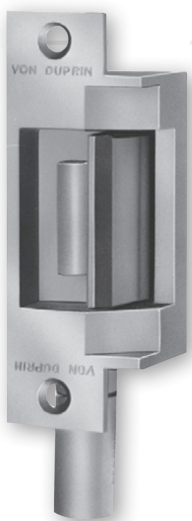
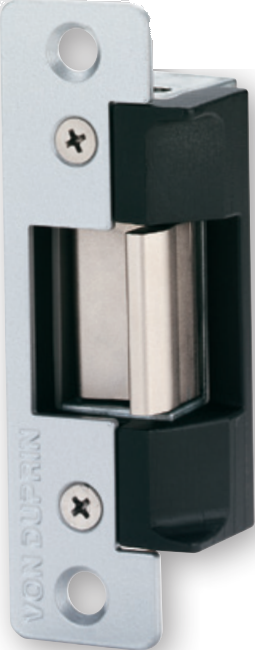
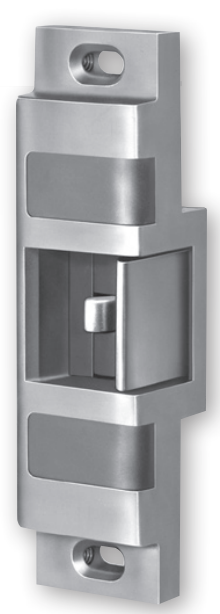
Strike Body: The main housing that mounts into the door frame cutout. The strike body contains the solenoid, the keeper mechanism, the latch pocket, and the mounting hardware. Strike body dimensions are specific to the strike model and the frame prep. The 6100 and 6200 Series are designed for new construction applications. Retrofit applications may require frame modification when replacing a competitive or older Von Duprin strike.

Solenoid Assembly: The electromechanical component that drives the keeper release. When energized, the solenoid plunger moves, releasing the keeper so the door can swing open. On fail-safe strikes, the solenoid must be energized (power applied) to hold the keeper in the locked position. On fail-secure strikes, the solenoid must be energized to release the keeper.

The Von Duprin solenoid kits by voltage: 050237 (12VDC), 050239 (16VDC), 050240 (24VDC). All three fit every model in the 6000 Series. Note: 16VDC and 28VDC solenoids are sold only as replacement parts for existing strikes in the field. They are not specified for new installations. For AC power operation, the Von Duprin SO12 (12VAC) or SO24 (24VAC) rectifier kit converts AC to the DC the solenoid requires.

Keeper (Strike Lip or Gate): The pivoting component that the latch bolt rides over when the door closes and that either holds or releases the latch when the solenoid is energized or de-energized. The keeper on the 6000 Series is spring-loaded to return to the locked position when the solenoid de-energizes. This spring is a separate serviceable component in the 6000 Series refurbish kit.

Cover Plate and Mounting Hardware: The visible face plate that conceals the strike housing in the frame. Finish must match the installed hardware. Finish-specific items in the 6000 Series are designated with an "X in Finish column" notation in the parts manual, meaning the finish code must be specified when ordering.

Fail-Safe vs Fail-Secure: The Most Operationally Important Distinction in Electric Strike Parts

This distinction affects which solenoid behavior is correct for the installation and has direct code compliance implications for fire door and life safety applications.

Fail-secure operation: The door is normally locked. Power must be applied to unlock (release the keeper). When power is lost (power failure, fire alarm cutoff), the door remains locked. Fail-secure strikes are available for fire-rated openings. The Von Duprin 6100 fail-secure is specified FSE at time of order.

Fail-safe operation: The door is normally unlocked when powered. Power must be removed to lock (engage the keeper). When power is lost, the door unlocks. Fail-safe strikes are commonly used for life safety applications and are non-fire-rated. This is because a fire door must be able to latch under fire conditions, and a fail-safe strike that opens when power is cut would prevent latching during a fire event when building power may be compromised.

When the solenoid fails in a fail-secure installation, the door will typically remain locked regardless of any input signal. When the solenoid fails in a fail-safe installation, the door may fail open or may fail in an intermediate position depending on the spring return and keeper condition.

The entry buzzer (EB) option is available only with fail-secure strikes. It is installed in the frame in parallel with the strike circuit and provides an audible signal to the visitor when the door can be opened.

The Six Series in the Von Duprin Electric Strike Lineup

5100 Series: Standard commercial electric strike for rim exit devices on single doors and pairs. Designed for Von Duprin rim panic hardware applications specifically. Not for use with mortise or cylindrical locks.

6100 Series: Standard commercial electric strike for mortise locks and cylindrical locks. Available in fail-safe and fail-secure. Standard 24VDC. Optional 12VDC and AC operation. Power requirements: 12VDC at 0.38 amp, 24VDC at 0.19 amp. Compatible with a wide range of frame preps.

6200 Series: The high-security electric strike with ANSI/BHMA 156.5 Grade 1 certification and 1500-pound holding force rating. UL 294 Listed, UL 1034 Listed for burglary-resistant electric door strikes. Fire rated UL 10C to 3 hours on single doors, 90 minutes on pair doors with inactive leaf. Compatible with Schlage, Von Duprin, and Falcon cylindrical and mortise locksets as well as many other manufacturers' products. Available for new construction and retrofit applications. The 6200 Series can retrofit a number of competitive and older model Von Duprin electric door strikes.

6300 Series: The widest compatibility electric strike in the Von Duprin lineup, designed for applications where the specific lock manufacturer or model cannot be easily specified at time of order. Covers cylindrical, mortise, and panic hardware applications in a single platform.

J2 Series (6111, 6112, 6113): Specifically engineered for wood frame applications. The 6211WF is recommended on wood frames for new installations. For retrofit applications on wood frames replacing Folger Adam competitive strikes, the J2 Series maintains dimensional compatibility with legacy frame preps.

Monitor Strike Option: What It Adds

The monitor strike option adds a switch inside the strike body that monitors both latch bolt position (whether the latch is in the strike pocket) and lock status (whether the keeper is in the locked position). This allows the access control system to confirm that the door is both closed and latched, rather than just confirming that the strike released. Monitor strike configurations are designated "M" in the model number and require wiring for both the solenoid circuit and the monitor switch circuit.

The monitor option is specified in security-sensitive applications including government access control, healthcare, and financial institutions where door status verification is required by the access control specification.

The 6000 Series Refurbish Kit

Von Duprin produces a 6000 Series refurbish kit that contains the spring-loaded keeper, the pivot pin, and the mounting hardware needed to restore a worn or damaged 6000 Series strike body to full function without replacing the full unit. The refurbish kit is the correct maintenance approach when the keeper is worn, the spring return is weak, or the pivot pin is corroded, but the strike body housing and solenoid are otherwise functional.

The refurbish kit does not include the solenoid. If both the keeper mechanism and the solenoid are failed, the solenoid must be ordered separately alongside the refurbish kit.

Sourcing Electric Strike Parts Accurately

Security Parts organizes the complete electric strikes parts and diagrams catalog for Von Duprin 5100, 6100, 6200, and 6300 Series. Every series page carries component-level organization with interactive diagrams. The Von Duprin Von Duprin brand page covers the full electric strike lineup alongside exit devices and other Von Duprin hardware.

Two ordering notes specific to 6000 Series parts: finish-specific items require the finish code. Items without a finish designation ship in the manufacturer's standard finish, which may not match the installation. Second, 16VDC and 28VDC solenoids are replacement-only parts and cannot be ordered for new applications. Pre-order compatibility support at 845-935-0301 or [email protected] for frame prep confirmation and lock compatibility questions before an order is placed.

Conclusion

The Von Duprin 6000 Series electric strike is a four-component system: the strike body, the solenoid, the keeper, and the cover plate. The solenoid kit in the correct voltage (050237 for 12VDC, 050239 for 16VDC, 050240 for 24VDC) fits every model in the series and is the most common single repair in the field. Fail-secure strikes are available for fire-rated openings. Fail-safe strikes are non-fire-rated. The 6200 Series carries a 1500-pound holding force and 3-hour UL 10C fire rating on single doors. The refurbish kit restores keeper and spring function without replacing the full unit. Sourcing correct electric strikes parts and diagrams starts with confirming the series, the voltage, the fail mode, and the finish before the order is placed. Security Parts stocks every 6000 Series component with same-day shipping and pre-order support at 845-935-0301.

FAQs

What is the Von Duprin 050240 solenoid kit? 

The 24VDC replacement solenoid for all Von Duprin 6000 Series electric strikes. Available in 12VDC (050237) and 16VDC (050239). Note: 16VDC is a replacement-only voltage not available for new installations.

What is the difference between fail-safe and fail-secure electric strikes? 

Fail-secure stays locked without power, unlocks when power is applied. Fire-rated strikes are fail-secure. Fail-safe stays unlocked without power, locks when power is applied. Fail-safe strikes are non-fire-rated and are used for life safety applications.

What is the holding force rating on the Von Duprin 6200 Series? 

1500 pounds, ANSI/BHMA 156.5 Grade 1. The 6200 Series carries UL 294, UL 1034 (burglary-resistant), and UL 10C (fire) listings with a 3-hour rating on single doors.

What does the 6000 Series refurbish kit include? 

The spring-loaded keeper, pivot pin, and mounting hardware for restoring a worn 6000 Series strike body. The solenoid is not included and must be ordered separately if the solenoid has also failed.

What is a monitor strike? 

An electric strike with an internal switch that monitors both latch bolt position (closed) and lock status (latched). Required in access control specifications where door status verification rather than just release signal confirmation is needed.


Cylindrical Locks Parts and Diagrams: The Complete Schlage ND Series Component Guide

Cylindrical locks parts and diagrams are the starting point for every field technician or facility manager who needs to replace a component without replacing the full lockset. The Schlage ND Series is the standard commercial cylindrical lock in North America, carrying ANSI/BHMA A156.2-2011, Series 4000, Grade 1 certification and UL listing for 3-hour fire doors (single 4'0" x 10'0", pair 8'0" x 10'0"). The ND Series service manual published exploded view diagrams that broke the lock into its ten primary visible components: Adjustment Plate, Outside Lever, Chassis, Latch, Strike, Anti-Rotation Plate, Optional Spacer, Mounting Screws, Inside Lever, Rose, and Inside Spring Cage. Understanding what each of these components does, what fails first in each category, and how the model number determines which parts apply to a specific installation is the knowledge base that makes parts sourcing accurate and fast.

Reading the Schlage ND Series Exploded View Diagram

The exploded view diagram in the ND Series service manual shows all ten components separated along the axis of the door, from the outside lever on the left to the inside lever and spring cage on the right, with the chassis and latch assembly in the center. This layout directly corresponds to the physical installation sequence and is the fastest way to identify a failed component visually.

Here is what each component does:

Outside Lever: The lever handle on the exterior side of the door. Lever styles for the ND Series include ATH (Athens), BRK (Boardwalk), BRW (Broadway), LAT (Latitude), LON (Longitude), OME (Omega), RHO (Rhodes), SPA (Sparta), and TLR (Tubular). Dimensions vary by style: Athens is 4.56 inches wide by 3.31 inches projection, Boardwalk is 4.94 by 3.06, Omega is 5.06 by 3.31. The Rhodes lever includes an optional breakaway feature that allows the handheld portion to separate from the shank under extreme torque, protecting the spring cage and locking mechanism from forced entry.

Chassis: The internal body of the lock that houses the locking mechanism, the cylinder interface, and the latch retractor. The chassis determines the lock function. Schlage produces separate chassis for each ND Series function (ND10, ND12, ND30, ND40, ND50, ND60, ND70, ND80, ND96, and more). Chassis are not interchangeable between functions.

Latch: The spring-loaded bolt that projects from the door edge and engages the strike on the door frame. Standard backset is 2-3/4 inches. Short backset is 2-3/8 inches. For 5-inch backset, a 43-005 extension is available. The latch includes a slide clip that the installer must engage correctly during installation: "Push latch to center of slide" is a critical step in the ND Series installation instructions that is frequently missed and produces misalignment in the latch bolt.

Strike: The frame-mounted receptacle for the latch bolt. The default Schlage ND Series strike is 10-025: ANSI, no box, 1-1/4 inch by 4-7/8 inch. Finish must be specified. For fire-rated assemblies, a T strike is available. For applications requiring a deeper pocket, a box strike provides additional latch engagement depth.

Anti-Rotation Plate: A thin metal plate that prevents the chassis from rotating inside the door bore under lever torque. On the ND Series, the anti-rotation plate tab must be aligned with the indent on the hub during installation. Misalignment produces a lock that drifts out of position over time.

Optional Spacer: Schlage provides spacers for ND Series locks installed on doors other than the standard 1-3/4 inch thickness. No spacer is required for 1-3/4 inch doors. Spacers are required for 1-3/8 inch doors. For 1-5/8 inch, 2 inch, or 2-1/8 inch doors, the adjustment plate must be repositioned rather than using spacers.

Rose: The circular cover plate that conceals the mounting hardware and the through-bore hole on the door face. Standard ND Series rose diameter is 3.44 inches. The rose is available in multiple finishes and must be finish-matched when ordering a replacement.

Inside Spring Cage: The spring cage assembly on the inside of the lock that provides lever return force and contains the button or thumbturn mechanism for inside lever control functions. When an inside lever is floppy or fails to return to horizontal, the spring cage is typically the failed component.

Mounting Screws: Two screws that draw the inside and outside trim together through the door thickness. Length must match the door thickness. XN12-012 provides standard trim chassis spacers. XN12-307 provides lead-lining spacers for special applications.

Adjustment Plate: The plate that allows the outside lever assembly to be positioned correctly relative to the door face. On ND Series locks manufactured after January 31, 2017, the adjustment plate design changed. Parts for pre-2017 and post-2017 locks are not fully interchangeable.

ND Series Function Designations: What They Mean for Parts

The ND Series function number is part of the model number and determines which chassis applies and whether electrified options are relevant.

ND10: Passage function. Latch retracted from either side at all times. No locking function. No cylinder outside.

ND12: Exit lock. Outside lever fixed (cannot retract latch). Inside lever always free. Key unlocks outside lever from outside. Electrified versions: ND12EL (electrically locked, fail safe) and ND12EU (electrically unlocked, fail secure).

ND30: Privacy lock. Push-button on inside locks outside lever. Emergency coin release from outside.

ND40: Bedroom/bath privacy. Push-button on inside locks outside lever. Emergency pin tool release from outside.

ND50 and ND53: Entrance lock. Outside lever locked/unlocked by key. Push-button on inside controls outside.

ND70: Classroom function. Key outside locks and unlocks outside lever without opening door. Inside lever always free.

ND80: Storeroom function. Outside lever always inoperative. Entry requires key only. Inside lever always free.

ND96: Combination entrance and storeroom. Available with electrified options (ND96EL and ND96EU). RX (request to exit) switch available on ND10, ND12, ND80, ND81, and ND96 functions.

Cylinder Types and Why They Affect Parts Ordering

The cylinder suffix in the ND Series model number determines which cylinder is installed:

Standard cylinder (no suffix): Conventional Schlage mortise cylinder. Uses SC1 5-pin or SC4 6-pin keyway. The standard residential and commercial specification.

FSIC (Full-Size Interchangeable Core): Allows the core to be removed and re-keyed without disassembling the lock body. The core uses a control key to insert and remove the core from the housing.

SFIC (Small Format Interchangeable Core): Best Primus-compatible small format IC standard. The core is smaller than FSIC. Common in institutional environments where a master key system uses SFIC throughout the building.

For keyed IC outside levers (FSIC only), the ND Series installation instructions include a specific note: "IMPORTANT! DO NOT install IC cylinder! Follow steps in ND-Series Timing Guide!" The timing guide must be consulted before cylinder installation on keyed IC functions. Ignoring this step is the most common cause of a new ND Series installation that does not function correctly after assembly.

The electrified ND Series uses a motor, not a solenoid, to provide quiet operation and energy efficiency. Maximum current draw is 0.24 amp, allowing more locks to run from a single power supply. The low 0.010 amp holding current eliminates the risk of lever heating in long-duration electrically locked applications.

Lock Timing and What It Means for Servicing

Certain ND Series functions require timing, meaning the position and adjustment of internal components must be set before the lock will operate correctly. Functions requiring timing are listed in the ND Series Timing Guide (P517-432), which ships with the lock.

On serviced locks where the chassis has been disassembled, the timing must be reset before the lock is reinstalled. A lock that functions mechanically but does not respond to a key, or one that operates in the wrong direction, almost always has a timing error rather than a failed component.

Sourcing ND Series Parts Accurately

Security Parts organizes the complete cylindrical locks parts and diagrams catalog with model-specific pages for the Schlage ND Series. Every parts page carries an interactive diagram aligned to the exploded view format used in the official ND Series service manual. Navigate to the function designation (ND10, ND12, ND70, etc.), open the diagram, identify the failed component visually, and confirm the part number before ordering.

The Schlage brand catalog extends this organization across every Schlage line beyond the ND Series. Pre-order compatibility support at 845-935-0301 or [email protected], particularly for confirming whether a lock is pre-2017 or post-2017 manufacture before ordering an adjustment plate or inside spring cage.

Conclusion

The Schlage ND Series diagram shows ten components. Each one has a specific function and a specific failure mode. The chassis is function-specific and cannot be swapped between ND10, ND70, ND80, or any other designation. The anti-rotation plate tab must align with the hub indent or the lock drifts. The latch slide clip must be engaged at center or the latch misaligns. For keyed IC functions, the timing guide must be consulted before cylinder installation. Sourcing correct cylindrical locks parts and diagrams starts with the function designation, then the cylinder type, then the door thickness, and then the finish code. Security Parts stocks every ND Series component with same-day shipping and pre-order support at 845-935-0301.

FAQs

What are the ten components in the Schlage ND Series exploded view diagram? 

Adjustment Plate, Outside Lever, Chassis, Latch, Strike, Anti-Rotation Plate, Optional Spacer (for non-standard door thickness), Mounting Screws, Inside Lever, Rose, and Inside Spring Cage.

What door thickness does the Schlage ND Series support?

 1-3/8 inch to 2-1/8 inch. Standard installation is 1-3/4 inch with no spacers required. Spacers are provided for 1-3/8 inch doors. The adjustment plate repositions for 1-5/8, 2, and 2-1/8 inch doors.

Why is the "timing guide" important for some ND Series functions?

 Certain ND Series lock functions require internal components to be set to a specific position before the lock operates correctly. The ND Series Timing Guide (P517-432) must be followed before cylinder installation on these functions, or the lock will not operate after assembly.

What is the default Schlage ND Series backset?

 2-3/4 inches standard. 2-3/8 inch short backset is available. A 43-005 extension provides a 5-inch backset for applications where the standard dimensions do not reach the door edge.

What does the RX option add to a Schlage ND Series lock?

 A micro-switch inside the chassis monitors lever rotation and signals the use of the opening to the access control system. Available on ND10, ND12, ND80, ND81, and ND96 functions.

Exit Alarms Parts and Diagrams: The Von Duprin Guard-X Component Guide

Most facility managers only think about exit alarms parts and diagrams when the alarm fails to sound, the battery dies, or a disarming label gets peeled off. The Von Duprin Guard-X 2670 is the most widely installed commercial alarmed exit device in North America. It is not a standard exit device with an alarm kit added on. It is a purpose-built alarmed exit lock that integrates a stainless steel deadbolt rated to 1,600 pounds of force resistance, a 100-decibel alarm, an armed indicator light, and a Schlage SC-1 cylinder into a single housing. It complies with NFPA 101 Life Safety Code, is UL Listed for both panic exit hardware and fire exit hardware, carries a 10-year limited mechanical warranty and a 1-year limited electrical warranty, and ships non-handed in satin aluminum 628/US28 finish. The 2609 is the double door version.

What the Guard-X Was Built For

The Guard-X 2670 exists for one specific application: secondary exits where unauthorized use needs to be deterred without eliminating code-compliant egress. It identifies the door as an emergency exit and secures the opening against unauthorized entry or exit. Typical applications include back doors at restaurants, retail stores, discount stores, grocery stores, drug stores, clothing stores, and sporting goods stores where employee or customer misuse of a secondary exit is an operational problem.

Two features define the deterrent function:

The stainless steel deadbolt does not retract unless the key disarms the device first. It is tested to withstand 1,600 pounds of force, making it significantly more resistant to defeat than a standard latch bolt. The 100-decibel alarm sounds immediately when the push bar is activated without prior key disarming. The armed indicator light on the device face shows the armed state before any attempt is made to open the door.

The standard device ships with an SC-1 Schlage cylinder included. The 2609 double door variant coordinates alarm functions between two active leaves on a paired opening.

Every Replaceable Component in the Guard-X 2670

Alarm Battery

This is the most frequently replaced component on every Guard-X installation. The device uses a standard 9-volt battery to power the alarm circuit. When the battery fails, the device operates mechanically but produces no alarm sound on push bar activation, which is the worst failure mode for a deterrent device. Proactive replacement every six months on high-use secondary exits prevents silent failure without waiting for the symptom.

Schlage SC-1 Cylinder

The cylinder is what disarms the alarm before an authorized door use. The SC-1 keyway is Schlage's standard 5-pin tumbler residential and light commercial cylinder. It ships included with the Guard-X 2670. Replacement is needed when the cylinder wears from heavy use, when a key is lost, or when the building's key system is being re-keyed. The SC-1 keyway is widely available from Schlage-authorized locksmiths and can be ordered factory-keyed to a master key system.

Retainer Nut

The retainer nut secures the cylinder in the device housing. A loose retainer nut allows the cylinder to rotate in the housing rather than staying fixed, which prevents the alarm from disarming correctly when the key is turned. Retainer nuts are the most commonly overlooked service item on Guard-X devices. A torque check at every service visit takes 30 seconds and prevents the most frustrating "alarm won't disarm" service call.

Disarming Label

The "EMERGENCY EXIT ONLY, ALARM WILL SOUND" label is both an NFPA 101 code requirement and a deterrent element. Labels fade, peel, or are deliberately removed. A missing label removes a code compliance element and reduces deterrent effectiveness. Replacement labels are stocked individually.

Alarm Housing Assembly

The housing contains the sounder element and the circuit board that controls alarm timing and the indicator light. When the alarm sounds erratically, fails to sound despite a fresh battery, or the indicator light malfunctions, the housing assembly requires replacement. This is less common than battery or cylinder service but becomes necessary as devices age past their electrical warranty period.

Push Bar Assembly

The push bar completes the alarm circuit when depressed without prior disarming. Push bar wear from physical abuse or forced entry attempts requires assembly replacement. The push bar is replaceable without removing the full device from the door.

Deadbolt Assembly

The stainless steel deadbolt is the mechanical security element. Replacement is required when the bolt is physically damaged from a forced entry attempt significant enough to defeat the 1,600-pound resistance rating. This is not common but does occur in high-risk retail applications.

Sourcing Guard-X Parts at Security Parts

Security Parts organizes the complete Guard-X exit alarm parts catalog with model-specific components for the 2670 and 2609. The Von Duprin brand page covers the Guard-X alongside every other Von Duprin exit device series. Pre-order compatibility support at 845-935-0301 or [email protected]. Same-day shipping on stocked components.

Conclusion

The Von Duprin Guard-X 2670 is a purpose-built alarmed exit device with a 10-year mechanical warranty and a 1-year electrical warranty. Six primary replaceable components: 9-volt alarm battery, Schlage SC-1 cylinder, retainer nut, disarming label, alarm housing assembly, and push bar assembly. The battery is replaced most often. The retainer nut is inspected least often. The 2609 double door version shares all the same component specifications. Sourcing from the exit alarms parts and diagrams catalog at Security Parts starts with confirming single door (2670) or double door (2609), then navigating to the model-specific parts page with same-day shipping on stocked items.

FAQs

What alarm volume does the Von Duprin Guard-X produce? 

100 decibels. It activates immediately when the push bar is pressed without prior key disarming. The armed indicator light shows armed status before any door use attempt.

What force resistance does the Guard-X deadbolt have? 

1,600 pounds, per Von Duprin testing. This significantly exceeds standard latch bolt resistance and prevents the door from being forced open without triggering the alarm first.

What battery does the Guard-X 2670 use? 

A standard 9-volt battery. Replace proactively every six months on high-use secondary exits. Battery failure causes silent operation with no alarm on push bar activation.

What cylinder ships with the Guard-X 2670?

 A Schlage SC-1 5-pin tumbler cylinder. Re-keyable by any Schlage-authorized locksmith. Can be ordered factory-keyed to a building's master key system.

What warranty does the Guard-X carry?

 10-year limited mechanical warranty, 1-year limited warranty on electrical components.

Door Closers Parts: What Every LCN Component Does and How to Source It Without a Wrong-Part Return

Most maintenance teams only think about door closers parts when a closer arm cracks, a cover plate falls off, or the door starts slamming hard enough to loosen the hinges. By that point, the device has usually been failing gradually for weeks. A sweeping door that moves inconsistently, a latch that engages but does not pull cleanly, a door that drifts open when the building pressurizes, these are all early signals from a specific component that is wearing out. LCN, manufacturing commercial door control hardware since 1877, produces the most widely installed institutional closer line in North America. Its parts catalog spans surface-mounted closers (1460, 4040XP), overhead concealed closers (3030/3130, 2010/5010), high-security closers (2210), and the COMPACT operator (6400). Every component in every series is ordered with four specifications: Finish (F), Size (S), Hand (H), and Voltage (V) where applicable. Missing any one of them produces a part that ships incorrectly.

How to Find the Model Number Before Opening the Parts Catalog

The model number on LCN mechanical closers is stamped near the packing nut at the base of the pinion shaft, where the arm connects to the closer body. The month and year of manufacture are also stamped there. For concealed closers and automatic operators, the information is on a label on the housing.

One thing that trips up a lot of first-time LCN parts orders: casting and forging numbers stamped or raised on the component surface, such as "71" or "320G" on a cylinder assembly, are manufacturing reference numbers, not part numbers. They cannot be used to identify or order a replacement. Use the model number from the closer body and the current LCN parts manual for correct identification.

The Seven Component Categories That Cover Most LCN Door Closer Repairs

Arm Assemblies

The arm is the most frequently replaced component on surface-mounted LCN closers. It connects the closer body to the door or frame and translates spring energy into controlled door movement. Arm failure most often presents as a cracked casting at the pivot point or a stripped connection at the shoe.

LCN produces several arm configurations across the surface-mounted lineup:

  • Regular arm (3077): The standard pull-side arm. Connects the closer body to the frame with a fixed pivot. Used in regular arm mounting where the closer is on the pull side of the door.
  • Parallel arm with shoe (3027PA): For push-side door face mounting. The arm runs parallel to the frame when the door is closed, protecting it from direct force and reducing projection.
  • Slide track arm (3077T): Rides in a track mounted to the frame. Allows hold-open at any door position. The track roller is a separate serviceable component.
  • Extra duty arm (EDA): Reinforced construction for abuse-resistant applications.
  • Fusible link arm: For fire-rated hold-open applications where the arm releases and allows the door to close when a heat-sensitive fusible link melts.

For the 4040XP specifically, the standard regular arm is 4040XP-3077 and the parallel arm drop plate combination is 4040XP-18PA. For the 3130 concealed closer, the track arm is 3130-3034, with the track roller as a separate part at 3130-3034-689.

The long rod and shoe combination 4040XP-79LR covers applications where the standard arm cannot reach the required frame mounting point due to door width or frame geometry.

Cover Plates and Body Housing

The cover protects the internal hydraulic and spring mechanism. On the 4040XP, the metal door closer cover is right-hand (RH) and left-hand (LH) specific. The 4040SE series uses a 4040SE-72MC-RH-689 metal cover for right-hand installations.

Cover plates are finish-specific. When ordering a replacement cover, the finish code must match the installed hardware. Standard LCN finishes include 689 (aluminum), 693 (bronze), 690 (dark bronze), and 628 (satin aluminum).

Drop Plates and Mounting Hardware

Drop plates reposition the closer body when the standard mounting geometry cannot be used due to a window transom, a non-standard header dimension, or a frame profile that does not accommodate direct mounting. The 4040XP-18PA is the parallel arm drop plate for top rail-less applications. Drop plates are application-specific and cannot be substituted between different mounting configurations.

Mounting screws are door-material specific. Metal door mounting uses machine screws. Wood door mounting uses wood screws. Using incorrect fasteners creates play in the installation that accelerates wear on every internal component.

Cylinder Assembly and Pinion

The cylinder assembly is the internal hydraulic unit inside the closer body. It contains the piston, the spring, and the hydraulic fluid that controls the closing speed. On standard surface closers, the cylinder is not individually serviceable: when the hydraulic fluid leaks from the body or the internal seals fail, the entire unit requires replacement rather than component repair.

The packing nut sits at the base of the pinion shaft. The pinion is the shaft that connects the arm to the internal spring mechanism. If the arm is secure but the door does not close properly, the pinion connection is a point to inspect before condemning the full unit.

Track Roller

The track roller is the component that rides inside the slide track on track arm closers. It is one of the highest-wear components on track arm installations because it absorbs the rotational force of every door cycle through direct contact with the track surface. Squealing or scuffing sounds during closer operation are the most common indicator of a worn track roller.

LCN track rollers are series-specific:

  • 4010T-3034: For the 4010T surface closer
  • 3130-3034-689: For the 3130 concealed closer
  • 4630-3034-689: For the 4630 Auto Equalizer operator
  • 2030-3034H: For hold-open or non-hold-open track configurations on the 2030 concealed closer

Spring and Green Dial Adjustment (1460 Series)

The LCN 1460 Series includes the patented Green Dial spring power adjustment system. This allows the spring power to be adjusted in the field without disassembling the closer body. The Green Dial eliminates the need to stock multiple spring sizes to cover different door weights and backcheck requirements. When the door is closing with inadequate force or latching inconsistently, adjusting the Green Dial is the correct first step before ordering any replacement component on a 1460 Series closer.

For closers without the Green Dial, the spring power is determined at the time of order and is set internally at the factory. Field adjustment of spring power on these models requires replacement of the entire cylinder assembly.

Sentronic Electronic Hold-Open Arm

The LCN Sentronic series integrates an electronic hold-open function into the door closer arm. When powered, the arm locks in the hold-open position. When power is interrupted (by a fire alarm signal, for example), the arm releases and the closer brings the door to the latched position. The Sentronic arm hold-open track is a replaceable component: 4040SEH-3038 is the 24V hold-open track, non-handed, non-sized.

What Failure Signs Map to Which Component

Symptom

Most likely cause

Component

Door slams after being pulled open forcefully

Failed or missing backcheck

Hydraulic valve adjustment or cylinder

Door drifts to the open position

Spring power inadequate or arm loose

Green Dial (1460) or arm connection

Squealing during operation

Track roller wear

Track roller part number by series

Door does not latch on closing

Latch speed valve off or door weight

Hydraulic valve adjustment

Closer cover fell off or cracked

Physical impact or vibration

Cover plate replacement

Arm cracked at pivot or shoe

Forced opening or door wedge abuse

Arm assembly replacement


Sourcing LCN Closer Parts Correctly

Security Parts organizes the complete door closer parts catalog by series with interactive diagrams on every model page. The LCN door closer parts guide covers the full component tree for surface-mounted, concealed, and COMPACT operator models. The four ordering specifications, Finish (F), Size (S), Hand (H), and Voltage (V), are required for every finish-specific, size-specific, handed, or electrified component. Confirming all four before placing the order is what prevents the most common wrong-part returns on LCN products.

Pre-order compatibility support at 845-935-0301 or [email protected].

Conclusion

LCN door closers parts are series-specific, finish-specific, and in many cases hand-specific. The model number is at the packing nut. Casting numbers on components are not part numbers. Track rollers, arm assemblies, cover plates, and Sentronic hold-open tracks are the most common individual replacement components. The Green Dial spring adjustment on the 1460 Series should be the first adjustment attempted before any parts order on a 1460 closer with inconsistent closing behavior. Every parts order requires Finish, Size, Hand, and Voltage specifications. Security Parts stocks every LCN series component with same-day shipping on in-stock items and pre-order support at 845-935-0301.

FAQs

Where is the LCN door closer model number located? 

Stamped near the packing nut at the base of the pinion shaft on mechanical closers. The manufacturing date is also stamped there. For concealed closers and automatic operators, the information is on a label on the housing.

Are casting numbers on LCN components the same as part numbers? 

No. Numbers like "71" or "320G" stamped on LCN cylinder assemblies are manufacturing reference numbers and cannot be used to order replacement parts. Use the model number from the closer body and the LCN parts manual.

What four specifications are required to order an LCN door closer part? 

Finish (F), Size (S), Hand (H), and Voltage (V) where applicable. Missing any one of these produces an incorrectly specified part.

What causes the squealing sound on an LCN track arm door closer? 

Track roller wear from high-cycle use. The track roller is a serviceable replacement component specific to each LCN series. It is not universal across series models.

What is the LCN Green Dial?

 A patented spring power adjustment system on the 1460 Series that allows the spring power to be adjusted in the field without disassembling the closer body, eliminating the need to stock multiple spring-size closers.

Deadbolts Parts: The Complete Guide to Schlage B Series Components and How to Order Right

When deadbolts parts need replacing on a commercial building, the sourcing process has one non-negotiable starting point: knowing the exact Schlage B Series model installed, because the cylinder type, the backset, the strike dimensions, and the tailpiece profile all vary between the B250, B260, B350, and B360 lines. The Schlage B Series has been the commercial and institutional deadbolt standard for decades. It carries ANSI/BHMA Grade 1 and Grade 2 ratings depending on the model, a 1-inch deadbolt throw on Grade 1 configurations, and a parts catalog that has remained largely consistent, which means a component ordered today is compatible with a B Series deadbolt installed in the 1990s. But getting the specific part right still requires reading the model number, confirming the backset, and knowing which cylinder type is installed before anything goes in a cart.

The Schlage B Series Lineup and What Separates Each Model

Understanding which model is installed determines every subsequent parts decision.

B250 and B252: The Grade 1 single-cylinder deadbolt (B250) and double-cylinder (B252). Single cylinder means inside thumbturn, outside key. Double cylinder means key operation on both sides. The 1-inch throw bolt meets Grade 1 bolt extension requirements. The B252 is the specification for glass-panel doors and applications where reaching through a broken pane to operate a thumbturn is a security concern.

B350 and B352: The commercial Grade 2 versions of the same configurations. 5/8-inch throw bolt rather than 1 inch. Specified on lower-security applications where Grade 1 performance is not required.

B360: The vertical deadbolt, where the bolt throws vertically rather than horizontally. Specified on applications where a door is subject to prying force that could defeat a horizontal bolt, common on hollow metal exterior doors with minimal frame engagement.

The backset is the distance from the door edge to the center of the cylinder hole. Schlage B Series ships standard at 2-3/8 inch and 2-3/4 inch backsets. Confirming which backset is installed is the sourcing step that determines the correct latch and strike combination.

Every Replaceable Component in the Schlage B Series

The Deadbolt Cylinder

The cylinder is the component that translates the correct key into bolt rotation. It is the most commonly replaced part in the Schlage B Series because it absorbs the wear of every key insertion and rotation across the deadbolt's service life.

Schlage B Series cylinders are available in several configurations:

Standard 5-pin cylinder (SC1 keyway): The residential and light commercial standard. The SC1 "C" keyway is the most widely available and the most easily rekeyed in the field.

6-pin cylinder (SC4 keyway): Provides one additional pin stack for slightly increased pick resistance. Specified where a small security upgrade is required without changing the entire keyway system.

Primus high-security cylinder: Incorporates an additional set of side pins and a sidebar mechanism, requiring a key with a corresponding milled channel. Significantly increases resistance to picking and unauthorized key duplication. The Primus cylinder cannot be picked or bumped by standard methods and the keyway is patented, meaning unauthorized key copying requires a certified dealer.

The cylinder is held in the deadbolt body by a small set screw or retaining pin typically located on the side of the bolt assembly near the cross bore hole. The tailpiece, the flat metal bar extending from the back of the cylinder, must be correctly oriented to engage the bolt rotation mechanism when the replacement cylinder is installed.

The Latch Bolt and Throw Assembly

On Grade 1 B Series models, the deadbolt itself is a 1-inch hardened steel bolt with an anti-saw pin. On Grade 2 models, the throw is 5/8 inch. The bolt housing contains the mechanism that converts rotational motion from the cylinder or thumbturn into the horizontal throwing action of the bolt.

Latch bolt failure is typically caused by physical damage from door slamming against a misaligned strike rather than from internal component wear. A bent or deformed bolt that does not retract cleanly is the most common indicator.

The Strike Plate

The Schlage B Series ships with several standard strike options. The specific strike needed for any replacement order depends on the door frame material, the backset, and whether a security strike upgrade is required.

  • 10-025: ANSI standard strike, no box, 1-1/4 inch by 4-7/8 inch. The standard specification strike for most commercial applications.
  • 10-026: Full lip strike, 1-5/8 inch by 2-1/4 inch, square corners. Used where a shorter lip is acceptable and the door frame does not accommodate the full ANSI strike.
  • 10-027: Full lip strike, 1-5/8 inch by 2-1/4 inch, 1/4-inch radius corners. Aesthetic version of the 10-026 for applications where corner radius is specified.
  • B520283 Dust Box: The standard deadbolt strike dust box that mounts in the door frame strike cutout, providing a pocket for the bolt to enter and protecting the frame material. Finish must be specified.

The Thumbturn

The thumbturn is the interior component that operates the bolt without a key on single-cylinder models. Thumbturn failure is usually caused by the mechanism wearing out at the pivot point or by physical force applied to the inside of the door. The Schlage B Series thumbturn assembly connects directly to the bolt mechanism and is a field-replaceable component.

Spindle and Rose Plate

The rose plate covers the cylinder hole and mounting hardware on the door face. On the B Series, the exterior rose plate is available in multiple finishes and must be finish-matched when ordering a replacement. The spindle connects the thumbturn to the internal bolt mechanism on single-cylinder models.

Mounting Screws

The B Series ships with mounting screws specific to the door thickness. Standard screws cover 1-3/4 inch doors. The Schlage 61-075 thick door kit provides longer screws and mounting extensions for doors up to 2-1/4 inches thick, used when the standard screws do not provide adequate bite.

Common Failure Signs and What Each Indicates

Cylinder turns but bolt does not move: The tailpiece is not engaging the bolt mechanism correctly. Either the replacement cylinder has the wrong tailpiece orientation or the internal bolt mechanism has worn out.

Bolt extends but does not retract cleanly: Typically indicates a bent bolt, a deformed strike pocket, or door frame movement that misaligns the bolt and strike. The strike should be removed and the alignment checked before replacing any internal components.

Key difficult to turn but still operates: Pin stack wear inside the cylinder, or a bent key that has deformed the driver pins. A cylinder replacement addresses both causes.

Bolt not extending to full throw: Internal spring fatigue inside the bolt mechanism, or physical interference from frame material swelling around the strike box.

Thumbturn loose or clicking: The thumbturn pivot spring has failed. The spring assembly is replaceable without removing the full cylinder.

Why Finish Must Be Specified on Every Schlage B Series Parts Order

Every finish-specific Schlage B Series part, including the rose plate, strike, thumbturn, and exterior trim, requires a finish designation when ordering. Standard Schlage finishes include US26D (satin chrome), US26 (polished chrome), US3 (polished brass), US4 (satin brass), US10B (oil-rubbed bronze), US10 (satin bronze), and US15 (satin nickel). Ordering without a finish designation produces a part that ships in the manufacturer's default and may not match the installed hardware. The model number on the installed deadbolt usually includes the finish code as the last designation in the number.

Sourcing Schlage B Series Parts at Security Parts

Security Parts organizes the complete Schlage deadbolt parts catalog by model, with each B Series model on its own page. The Schlage brand catalog covers every active Schlage line with the same model-specific structure. For deadbolts installed in multi-family, healthcare, or government applications where the cylinder is part of a master key system, confirming the keyway before ordering a replacement cylinder is essential. Pre-order compatibility support at 845-935-0301 or [email protected].

Conclusion

Schlage B Series deadbolts are the most widely installed commercial deadbolts in North America, and their deadbolts parts catalog has remained consistent enough that components sourced today apply to devices installed years ago. The cylinder keyway, the bolt throw length, the backset, the strike dimensions, and the finish code are the five variables that determine every parts order on these devices. Confirming them from the model number on the installed deadbolt is the step that keeps a straightforward maintenance job from becoming a return cycle. Same-day shipping on stocked components. Pre-order support at 845-935-0301.

FAQs

What is the bolt throw length on a Schlage Grade 1 B Series deadbolt?

 One inch. The Grade 1 B250 and B252 models project a 1-inch hardened steel deadbolt with an anti-saw pin. Grade 2 models (B350/B352) use a 5/8-inch throw.

What is the difference between a single-cylinder and double-cylinder Schlage deadbolt?

 Single-cylinder (B250, B350) uses a thumbturn inside and key outside. Double-cylinder (B252, B352) requires a key on both sides, specified where inside key override through a broken pane is a security concern.

What Schlage B Series strike is standard for commercial applications? 

The 10-025 ANSI strike, 1-1/4 inch by 4-7/8 inch, no box, is the standard commercial specification. Finish must be specified when ordering.

Why won't my Schlage cylinder turn after replacement? 

The tailpiece orientation is incorrect. The tailpiece must be aligned to engage the bolt rotation mechanism before the set screw is tightened. Refer to the Schlage B Series installation instructions for the correct tailpiece position for the specific function.

What is the Schlage Primus cylinder?

 A high-security cylinder with side pins and a sidebar mechanism requiring a milled channel on the key. Significantly more resistant to picking and bumping than standard 5-pin cylinders. Available as a factory-specified cylinder on B Series commercial applications.

Mortise Locks Parts: How to Identify Every Component in the Schlage L Series and Order Right

If you're maintaining commercial doors, mortise locks parts are among the most complex components you'll source. The Schlage L Series alone covers more than 67 mechanical functions, 33 lever designs, and 12 finishes, and its parts tree splits into chassis components, cylinder components, trim components, and function-specific parts that are not interchangeable even within the same L Series family. A lever return spring for an L9010 passage function is not the same servicing need as a spindle assembly for an L9080 storeroom function. The mortise cylinder cam that applies to a standard Schlage mortise cylinder does not apply to a modular mortise cylinder. And the escutcheon trim on one function may need to be replaced entirely if the function changes, while the rose (sectional) trim on the same door requires no additional parts. Getting any one of these wrong wastes a service call and delays a repair on a door that may be in a fire stair, a healthcare corridor, or a government facility.

How to Read a Schlage L Series Model Number

The model number decodes every specification needed to source replacement parts correctly. The format follows this structure:

L / LV + function group + deadbolt indicator + cylinder suffix

  • L = standard L Series chassis
  • LV = Vandlgard chassis, designed for applications subject to abuse or vandalism. The Vandlgard prevents damage to internal lock components caused by forced lever manipulation.
  • Function group (e.g., 9080): The specific lock function. L9080 is the storeroom function where the outside lever is always inoperative, entry requires a key, and the inside lever is always free. L9010 is passage. L9050 is entrance/office. L9070 is classroom.
  • Deadbolt indicator: 0 in the function number means no deadbolt. 4 means with deadbolt. L9460 Series adds a deadbolt to the basic functions.
  • Cylinder suffix: P = 6-pin full-face mortise cylinder with Schlage logo. L = less cylinder. C = concealed mortise cylinder. W = less concealed cylinder. R = full-size interchangeable core.

The L9050 universal case is worth a specific note: Schlage designed it to be transformed into nine different functions with just a few additional parts. This means a facility that stocks the L9050 universal case can reconfigure it for multiple function requirements with the appropriate additional components rather than stocking nine separate cases.

The Six Component Categories in Mortise Lock Parts

Lock Chassis and Internal Components

The chassis is the case body that houses all internal mechanism components and mounts inside the door edge mortise pocket. The standard L Series chassis and the Vandlgard LV chassis are dimensionally compatible but use different internal component tolerances designed for different use environments.

Internal components commonly replaced include:

  • Latchbolt with anti-friction tongue: The primary latch that engages the strike. The anti-friction tongue releases easily when the door is pushed closed, then the full latch bolt projects. This protects the strike face from wear on high-cycle openings.
  • Auxiliary guarded latch: Deadlocks the latchbolt when the door is fully closed, preventing credit card or shimmy-type forced entry. Present on most L Series functions.
  • Deadbolt: Present on L9460 and related deadbolt functions. Operated by thumbturn from inside or key from outside.
  • Stopworks functions by turn-piece: A mechanical stop mechanism on specific functions that prevents the thumbturn from being operated from outside.

Lever Return Spring (L283-040)

The L283-040 lever return spring is one of the most commonly replaced individual components in the Schlage L Series. It returns the lever to the horizontal position after being operated. One spring is required for each side of the door where a lever is installed. On a standard L9050 entrance function with levers on both sides, two springs are required.

Spindle and Spring Assembly (L283-060)

The L283-060 spindle and spring assembly is used on standard L Series mortise locks for door thicknesses of 1-3/8 to 1-7/8 inches. The spindle is the shaft that connects the trim lever to the internal lock mechanism. When a lever operates but the latch does not retract, the spindle or its connection to the retractor is usually the fault point.

Cylinder Components and Cams

The mortise cylinder sits in the cylinder hole in the chassis face and operates the lock from outside with a key. The cam on the back of the cylinder is what translates rotation into the lock's retractor movement. The correct cam depends on the cylinder type and the lock function.

  • L583-254: Mortise cylinder cam for standard Schlage L Series cylinders (not modular). Fits on the back of conventional Schlage mortise cylinders.
  • L583-446: Replacement cam for Schlage modular mortise cylinders. Works with cylinder lengths 1-1/8, 1-3/8, and 1-5/8 inches.
  • L583-476: Alternative standard cam for Schlage modular mortise cylinders.
  • K510-730: Standard cam for IC (interchangeable core) housings. Also works with Schlage K Series (discontinued), Falcon non-deadbolt functions, Von Duprin exit devices, and Adams Rite 2331 deadlocks.

The cam type must match the cylinder type installed. Using a standard cam on a modular cylinder or an IC cam on a conventional cylinder produces a lock that either fails to operate or operates in the wrong direction.

Trim Components: Rose vs Escutcheon

Trim covers the lever mounting hardware visible on the door face. Schlage L Series offers two trim types with different parts implications:

Rose (sectional) trim: Individual circular rose plates that mount the lever to the door. When servicing rose trim, the existing rose trim hardware does not need to be replaced for function changes in most cases. The lock chassis underneath can be updated to a new function with the appropriate internal parts.

Escutcheon trim: Full-length plates that cover the lever and cylinder area. When changing functions on escutcheon-trimmed locks, both inside and outside escutcheons may need to be replaced. The L Series installation instructions are specific about which functions require full escutcheon replacement.

Specific trim parts include:

  • 09-509 Thumbturn: The standard Schlage L Series T-turn in satin chrome (626). Replaces a worn or damaged thumbturn that operates the deadbolt or privacy deadlocking function.
  • L285-150 Mounting Plate: Used on institutional functions (L9080, L9082) where the inside lever is installed without a thumbturn. Required when the chassis is in the locked position and the inside lever must be mounted separately.
  • Shear pin: The component designed to break if the lever handle is forced. Protects the trim assembly from destruction. Used across multiple L Series trim configurations.

Strikes

The L Series strike selection depends on the door type (wood vs hollow metal), the frame material, and whether a fire-rated strike is required. Strike types include T-square corner strikes, flat square corner strikes, rabbeted strikes for rabbeted frames, and the L9000 Series-specific deadbolt strikes. Finish must be specified when ordering any strike.

Function-Specific Parts and the Universal Transformation

One of the most useful and most overlooked features of the L Series for facilities teams is the universal transformation capability of the L9050 case. Schlage designed this case so that nine different functions can be achieved from a single case with specific additional parts. This means a facility manager maintaining a building with multiple L Series functions can stock a single case type and adapt it to the function required, rather than keeping nine different cases in inventory.

The transformation instructions specify exactly which additional parts are required for each function conversion and whether the existing trim components transfer or need to be replaced. Some functions require the thumbturn assembly to be removed. Some require the clover leaf cylinder cam to be replaced with a straight cam. The instructions are function-specific and available in the Schlage Universal Transformation Guide.

Why Model-First Sourcing Matters for Mortise Lock Parts

Mortise lock parts from a general catalog listing present the same compatibility risk as exit device parts. A lever return spring listed as "L Series spring" without the specific part number and function context could apply to any of 67 mechanical functions. A cam listed as "mortise cylinder cam" without specifying whether it applies to standard or modular cylinders produces an incompatible part.

Security Parts organizes the complete mortise locks parts catalog with model-specific pages for the Schlage L Series and supporting hardware. The Schlage brand catalog covers every active Schlage lock line with the same model-specific organization. The Schlage L Series parts and diagrams page carries interactive diagrams for L Series mortise lock models organized by function group.

Pre-order compatibility support is available at 845-935-0301 or [email protected], particularly useful for identifying the correct cam type, confirming the spindle length for the door thickness, or identifying which trim parts transfer when a function changes.

Conclusion

The Schlage L Series is the most flexible and most parts-intensive mortise lock line in commercial hardware. More than 67 functions, 33 lever designs, and a chassis that can be transformed into nine configurations from a single case. Sourcing any component correctly requires reading the model number (L vs LV, function group, deadbolt indicator, cylinder suffix), identifying whether rose or escutcheon trim is installed, confirming whether the cylinder is standard or modular before selecting a cam, and knowing whether the specific function requires a mounting plate or a shear pin for correct assembly. Starting with the mortise locks parts catalog organized by model and function at Security Parts, using the interactive diagram to confirm each component visually, is what makes the repair accurate without a service callback.

FAQs

What is the difference between the Schlage L Series and LV Series chassis? 

The L is the standard chassis. The LV (Vandlgard) is for abuse-prone environments, engineered to prevent damage to internal components from forced lever manipulation. Dimensionally compatible but with different internal tolerances.

What is the Schlage L9050 universal case?

 The L9050 universal case can be transformed into nine different lock functions with specific additional parts, allowing a single case to serve multiple function requirements without stocking nine separate cases.

How do I identify the correct mortise cylinder cam? 

L583-254 is for standard Schlage L Series conventional mortise cylinders. L583-446 and L583-476 are for modular mortise cylinders. K510-730 is for IC housings. Cam selection depends on which cylinder type is installed.

What is the Schlage L283-040 lever return spring? 

It is the spring that returns the lever to the horizontal position after being operated. One spring is required for each lever installed. Available for individual replacement without disassembling the full chassis.

When does escutcheon trim need to be replaced on a function change?

 On escutcheon-trimmed L Series locks, both inside and outside escutcheons may need replacement when the lock function changes. Rose (sectional) trim typically does not require replacement for function changes.

What is an auxiliary guarded latch on a mortise lock? 

A secondary latch that deadlocks the primary latchbolt when the door is fully closed, preventing credit card or shimmy-type forced entry. Present on most Schlage L Series functions.


Door Operators Parts: What Fails, How to Identify It, and How to Source the Right Component

Door operators parts are not the same as door closer parts, even when the operator uses a mechanical closer as part of its assembly. An automatic door operator is an electromechanical or electrohydraulic system that includes a motor or hydraulic drive unit, a controller, an arm assembly, an actuator, and a power supply, all working together to open and hold a door on a signal. When one component in that chain fails, the symptom can look like any one of several issues: the door opens too slowly, it reverses before fully opening, it fails to latch on closing, it makes grinding or squealing sounds, or it simply stops responding to the actuator. Each symptom points to a different component category, and sourcing the replacement correctly requires knowing which category is responsible. LCN, manufacturing commercial door control hardware since 1877, produces the most widely installed commercial automatic door operator line in North America. This guide covers every LCN door operator component category, what failure looks like in each one, and how to source accurately.

Understanding the Four LCN Door Operator Series

Parts compatibility in LCN door operators is series-specific, which means the first diagnostic step is confirming which series is installed. The date of manufacture label is on the operator body. For automatic operators, LCN places it on the label itself rather than stamping it near the packing nut as on mechanical closers.

LCN 4630/4640 Auto Equalizer Series: Designed for primarily manual applications that sometimes require automatic opening, primarily for accessibility. The 4630 mounts top jamb on the pull side with a single lever track arm. The 4640 mounts top jamb on the push side with a double lever regular arm. Both carry ANSI/BHMA 156.19 certification, UL and cUL listing, and ADA/ANSI A117.1 compliance. The "No Destruct" drive system is a specific feature of this series, providing resistance to mechanical damage from forced opening or door being held open against the operator.

LCN 9130/9140/9150 Benchmark Series: The low-to-medium traffic surface-mounted operator line. The 9130 mounts on the pull side with a single lever track arm. The 9140 mounts on the push side with a double lever arm. The 9150 mounts top jamb on the push side for independent or simultaneous pair applications. Features Push 'N Go activation, which takes over when a pedestrian manually opens the door to 5 degrees, then holds the door fully open for 1 to 30 seconds of adjustable time delay. Power Boost provides additional closing force under wind load.

LCN 6400 COMPACT Series: The low-energy operator designed for retrofitting existing LCN 4040XP Series mechanical closers. The motor gearbox assembly connects to the existing 4040XP with just four screws and a mounting plate. This is the most cost-effective way to automate an existing opening without removing and replacing the mechanical closer already installed. The existing 4040XP closer cylinder, including delayed action models, remains in place. Electronic features including opening speed, hold open duration, power boost, motor on/off, fire signal receipt, and actuation signal receipt are all configurable.

LCN Senior Swing Series (9500IQ/2800IQ): The current-generation high-performance operator featuring AdaptivIQ technology, which continuously self-adjusts the operator's opening and closing parameters to account for seasonal temperature changes, door weight variations, and wind load. The 9500IQ is the surface-mounted version. The 2800IQ is the concealed version. Both reduce seasonal service calls because the electronic controller compensates for environmental changes without manual valve adjustment.

The Seven Component Categories in LCN Door Operator Parts

Motor Gearbox Assembly

The motor gearbox is the drive unit that physically opens the door. On the COMPACT Series, the motor gearbox assembly mounts directly onto the 4040XP Series closer body. On the Auto Equalizer and Benchmark Series, it is integrated into the operator housing. The gearbox converts motor rotation into arm movement through a gear reduction system. When the motor runs but the door does not open, the gearbox is the first component to inspect.

Track Arm Assemblies

LCN produces several arm configurations for door operators, each designed for a specific mounting and door type:

  • Standard track arm: rides in a track mounted to the door frame, allowing hold-open at any position
  • Double lever arm: fixed pivot configuration for push-side mounting
  • Single lever track arm: for pull-side and top jamb applications
  • Long arm: for doors requiring extended reach from the closer body to the frame

The 4630 Series track roller part is LCN 4630-3034-689. The standard track is LCN 4630-3038-689. These are finish-specific and must be specified when ordering. Arm compatibility is series-specific: a 9500IQ arm assembly does not cross to the 4630/4640 series.

Controller and Digital Control Box

The controller is the electronic brain of the door operator. It manages opening speed, hold-open duration, power boost threshold, fire alarm interface, and actuator signal input. The 4630/4640 Series digital control box provides fast and accurate adjustments with a physical interface. The Senior Swing's controller runs the AdaptivIQ algorithm, which means it stores learned parameters. When a controller fails, these parameters are lost and must be recalibrated after replacement.

The LCN 9550 Series controller replacement part is 9550-3462-115V for the 115V version. Controllers for the COMPACT 6440 Series are available as part of the COMPACT Low Energy Auto Door Operator Module Parts Kit (LCN 6440).

Actuators: Push Plates and Touchless Sensors

The actuator is what signals the operator to open. Push plate actuators require physical contact. LCN's 8310 Series touchless actuators detect hand motion within sensor range, triggering the opening cycle without physical contact. The 8310-865 is a compact receiver that complies with federal radio frequency regulations and receives signals through barriers.

Two wireless options are available: 900 MHz and 433 MHz, providing wireless actuation without hardwiring the actuator directly to the operator. Both are compatible with LCN's touchless actuation offerings.

Actuator failure typically presents as a door that does not respond to the push plate but operates correctly when tested through a direct controller signal. This isolates the actuator circuit rather than the operator itself.

Power Supply

Door operators require a dedicated power supply. On low-energy operators like the COMPACT and Benchmark Series, the power supply is typically 120V AC or 24V DC depending on the installation. Power supply failure produces a completely non-functional operator even when all other components test correctly. The power supply should be the first component checked when an operator stops responding entirely.

Spring and Hydraulic Components (Mechanical Elements)

For operators that incorporate a mechanical closer as part of the assembly (specifically the COMPACT Series using the 4040XP), the mechanical closer components remain serviceable independently of the motor assembly. The 4040XP cylinder, spring, and hydraulic valves can be adjusted or replaced without disassembling the operator module. Existing 4040XP components including delayed action cylinders are compatible with the COMPACT operator.

Sensors and Accessories

Motion sensors, hold-open sensors, and safety sensors are auxiliary components that affect operator behavior without being part of the drive assembly. A safety sensor detecting an obstruction will prevent the door from fully closing. A malfunctioning hold-open sensor may cause the door to close prematurely. The 8310 Series sensor accessories are designed to integrate with LCN's touchless and automatic operator lineup.

How to Identify a Failed Component Before Ordering

A door that opens too slowly with normal sound usually indicates a spring or valve adjustment, not a parts failure. A door that makes grinding or squealing during operation typically needs the arm and track assembly inspected for wear or misalignment. A door that opens but fails to latch points to the mechanical closer components, particularly the latch speed valve or the latch bolt engagement on the paired lock. A door that fails to respond to the actuator but works on manual override points to the actuator or controller circuit, not the motor. A door that operates once but does not reset for the next cycle is often a power supply issue.

Why Model-Specific Sourcing Prevents the Most Common Errors

LCN operator parts are finish-specific, size-specific, and in many cases voltage-specific. LCN's own guidance on ordering requires specifying Finish (F), Size (S), Hand (H), and Voltage (V) for any part where these variables apply. Missing any one of them produces a part that ships but does not fit or does not function in the installation.

The casting or forging numbers stamped on LCN components, such as "71" or "320G" on cylinder assemblies, are manufacturing reference numbers, not part numbers. They cannot be used to order a replacement. The model number on the operator body and the current LCN parts manual are the correct identification sources.

Security Parts carries the complete door closer and operator parts catalog for LCN products organized by series, with interactive diagrams. The LCN door closer parts guide covers the mechanical closer components that support COMPACT operator installations. Pre-order compatibility support is available at 845-935-0301 or [email protected].

Conclusion

Door operators parts sourcing requires knowing the operator series, the component category responsible for the observed failure, and the four ordering specifications that LCN requires for any finish-, size-, hand-, or voltage-specific component. The AdaptivIQ controller on the Senior Swing stores learned operating parameters that are lost when the controller fails and replaced. The COMPACT Series reuses existing 4040XP mechanical closer components, making it the most serviceable retrofit operator on the market. Casting numbers on LCN components are not part numbers. The model label on the operator body and the series-specific parts page are the correct starting points for every door operators parts order. Same-day shipping on stocked components. Pre-order support at 845-935-0301.

FAQs

Are LCN door operator parts the same as LCN door closer parts? 

No. Operators include motors, controllers, actuators, and power supplies that mechanical closers do not have. The COMPACT Series reuses 4040XP mechanical closer components alongside an operator module, creating the most crossover between the two categories.

How do I find the model number on an LCN automatic door operator? 

The date of manufacture and model information are on a label on the operator body. For mechanical LCN closers, the date is stamped near the packing nut at the base of the pinion. Operators use a label rather than a stamp.

What does AdaptivIQ mean on the LCN Senior Swing?

 It is LCN's self-adjusting controller technology that continuously monitors and adjusts opening speed, hold-open time, and closing force to account for seasonal temperature changes and door condition changes without manual valve adjustment.

Why does the door make squealing sounds during automatic operation? 

Squealing or scuffing during operation typically indicates wear or misalignment in the track roller assembly or the arm connection. LCN provides specific adjustment guidance for this condition, and the track roller is a serviceable replacement component on most operator series.

Can I reuse my existing 4040XP closer if I install the COMPACT operator? 

Yes. The LCN 6400 COMPACT motor gearbox assembly connects directly to an existing 4040XP Series closer body with just four screws. Existing cylinders, including delayed action models, are compatible and remain in place.


Exit Devices Parts: What Every Component Does and How to Order the Right One

If you manage commercial doors long enough, you end up sourcing exit devices parts more often than you plan for. A dogging assembly stripped out on a high-traffic corridor door. A center case that stopped latching cleanly on a healthcare egress opening. An end cap bracket cracked after someone propped the door open one too many times. These are not rare events. They are predictable maintenance realities on any building running Von Duprin hardware, which is most commercial buildings in North America. What separates a fast, accurate repair from a week-long wrong-part return cycle is knowing which component category you're dealing with, which part number applies to your specific series and configuration, and why the long version of the hex key matters more than most people think.

Why Exit Device Parts Are Series-Specific, Never Universal

This is the single most important fact to internalize before opening any parts catalog. Von Duprin's exit device lineup covers fourteen active series across push pad, touchbar, crossbar, and mortise configurations. Each series uses components engineered to its own dimensional and mechanical specifications. A dogging assembly from the 22 Series does not fit the 75 Series. A center case for the 98/99 rim configuration is a different part from the center case for the 98/9947 CVR configuration.

The model number stamped on the mechanism case or baseplate is the starting point for every parts order. The first two or four digits identify the series. The function suffix identifies the trim function and configuration. A "-F" suffix means fire-rated, which removes the hex dogging function entirely. Get the model number before the catalog opens.

The Six Component Categories That Cover Most Repairs

Dogging Assemblies

Dogging is the mechanism that holds the push bar in the depressed position, keeping the latch bolt retracted so the door operates freely without latching. Standard on non-fire-rated 22, 33A, 35A, 98, and 99 Series rim devices. The dogging assembly on devices made after 1997 consists of four parts that are commonly replaced individually:

  • 090040 Dogging Shaft: The piece the 5/32-inch hex key inserts into. The hole depth is only approximately 1/4 inch. The long version of the hex key is mandatory. Short keys round out the hex engagement over repeated use. This is the single most common dogging failure in the field.
  • 090041 Dogging Spring: Activates the dogging hook. Occasionally fails and is sold individually.
  • 090042 Dogging Adapter Spring: Clips the dogging adapter into the mounting bracket.
  • 090043 Dogging Adapter: The housing the shaft and spring fit through.
  • 090044 Dogging Hook: Grabs the push bar mechanism and holds the dogged position on 22, 33A, 35A, 98, and 99 Series devices made after 1997.

For devices made before 1997, the old-style dogging shaft has a different dimensional profile. Part 050709 is the conversion kit that updates pre-1997 devices to current spec components.

The 88 Series crossbar devices use a 5/32-inch hex key for a different purpose: the wedgetite screw and dog screw in the lever arm assembly. This is not the same dogging operation as the push pad series, and the 88 Series dogging parts do not cross to push pad series.

Center Cases and Mechanism Cases

The center case is the primary mechanical housing of the exit device. It contains the latch mechanism, the dogging engagement, and the connection to the trim function. Center case specs differ by trim function within the same series, which is where most wrong-part orders happen.

The 22 Series rim center case (part 109012) has been in production for approximately 40 years and replaces all non-fire-rated 22 Series rim center cases with hex key dogging on the hinge-side cover plate. The 2227 SVR center case (part 109358) has been consistent for approximately 30 years. The 88 rim center case 050409 applies to EO, DT, and NL trim functions only. Lever, knob, and thumbpiece versions each use a different specification.

Push Bar and Crossbar Components

The push bar on push pad devices and the crossbar on crossbar devices absorb direct operational load on every door use. Push bar end guides (part on 33A and 98/99 devices) reduce noise and friction at the end of the push bar assembly. Crossbar tube attaching wedges (090020) and rings (090021) secure the crossbar to the device body on the 88 and 55 Series.

Push bar retrofit kits are available for 22 Series rim devices in 36-inch and 48-inch configurations, replacing the push bar assembly without requiring a full device swap.

Strikes

Strike selection depends entirely on the device configuration and fire rating status:

  • 299: Standard rim strike for 22, 88, 98, and 99 Series rim devices. Also used as the top strike on 2227, 8827, 9827, and 9927 SVR devices. Measures 1-1/4 inches wide by 2-7/8 inches high, slotted hole spacing 2-1/8 inches.
  • 299F: Fire-rated version for the same devices. Same dimensions. Not interchangeable with the 299 on fire-rated assemblies.
  • 264: Low-profile alternative rim strike for 22, 88, 98, and 99 devices. Measures 2-7/8 inches tall by 1-1/4 inches wide, roller projection 9/16 inches.
  • 304L: Standard floor-mounted SVR bottom strike for 2227, 8827, 9827, and 9927. Square flange outer dimension 1-7/8 by 1-7/8 inches.
  • 248L-4: Bottom surface-mounted strike for the same SVR series. Measures 9/16 inch wide by 2-1/2 inches high, hole spacing 1-7/8 inches.
  • 1609: Used on double door applications without a center post, combining one SVR leaf and one rim leaf. Not rated for fire doors.

Lever Arms and Axle Components (88 Series)

The 88 Series lever arm is replaced more frequently than any other mechanical component on crossbar devices. The cause is nearly always the same: the dogging screw strips out due to the wedgetite screw seating incorrectly. The right-hand lever arm kit is part 050438. The left-hand kit is 050439. Each includes the wedge, wedge ring, wedgetite screw, and dog screw.

Top Latch and SVR Latch Components

For SVR configurations, top latch bracket replacement kits (050091 for 22/98/9927 Series) replace worn top latch assemblies. The 8827 bottom latch case (050461) covers all non-fire-rated 8827 SVR devices. Latch covers 050464 cover the top and bottom latches on the 8827 and the bottom latch only on the 8827-F fire-rated version.

Electrified Upgrade Parts

Three electrified upgrade kits appear most often in parts orders on commercial facilities:

QEL Modular Conversion Kit (114317-00): Adds quiet electric latch retraction to a mechanical 22, 33A, 35A, or 98/99 Series device. Field-installable without opening the device body on current-generation hardware.

ALK Alarm Kit: Converts the 22, 33A, 35A, 98, or 99 Series to an alarmed exit device. Powered by a standard 9-volt battery. Controlled by a mortise cylinder (sold separately).

QEL Baseplate Conversion Kits: The QELA baseplate conversion kits (040063 for 36-inch devices, 040068 for 48-inch devices) are required on some older devices when adding QEL. The HD-QELA versions (040064 and 040068) cover heavy-duty applications.

How to Source Exit Device Parts Without a Wrong-Part Return

Most wrong-part orders on exit device parts come from searching by component name rather than by model. A dogging assembly listed under "Von Duprin dogging assembly" without a series designation could apply to a pre-1997 device, a post-1997 push pad device, or a crossbar device. The correct part depends on the series and generation.

Security Parts organizes the complete Von Duprin exit devices catalog by series and model. Every model page carries an interactive parts diagram showing the full assembly. Navigate to the correct series, open the diagram, confirm the component visually against the physical device, and place the order from the model-specific parts list. The 98/99 Series, 22 Series, and 88 Series each have their own dedicated pages with complete parts breakdowns.

Same-day shipping on stocked components. Pre-order compatibility support at 845-935-0301 or [email protected].

Conclusion

Exit device parts sourcing is a model-first process, not a category search. The series, the configuration (rim vs SVR vs CVR vs mortise), the manufacturing year (pre-1997 vs post-1997 for dogging assemblies), and the trim function all determine which specific component applies to the device on the door. The dogging shaft 090040 requires the long hex key. The center case specification depends on the trim function, not just the series. The 1609 strike is not rated for fire doors. Starting with the model number before opening the exit devices parts catalog is what makes the first order the right order.

FAQs

Are exit device parts interchangeable between Von Duprin series?

 No. Parts are series-specific and often configuration-specific within the same series. A 22 Series center case does not fit a 75 Series device. Always confirm the model number before ordering.

What hex key size is used for Von Duprin dogging? 

5/32-inch hex key for push pad devices (22, 33A, 35A, 98, 99 Series). The dogging hole is only 1/4 inch deep, so the long version is required. Short keys round out the shaft engagement over time.

What is the difference between the 299 and 299F strike? 

The 299 is the standard rim strike for non-fire-rated devices. The 299F is the fire-rated version. Same dimensions, not interchangeable. The 299F carries the UL fire door listing required on fire-rated assemblies.

What causes an 88 Series lever arm to need replacement? 

The most common cause is the dogging screw stripping out when the wedgetite screw is not seated correctly. The lever arm kit includes the wedge, wedge ring, wedgetite screw, and dog screw.

What is the QEL modular conversion kit?

 Part 114317-00 adds quiet electric latch retraction to an existing mechanical Von Duprin device, allowing electronic outside entry without a full device replacement. Compatible with 22, 33A, 35A, and 98/99 Series.


Panic Hardware for Commercial Doors: Types, Code Requirements, and How to Choose the Right Device

Panic hardware for commercial doors is a code-defined life safety system with specific occupancy triggers, installation dimensions, fire rating distinctions, and device type requirements that vary by building use and adopted code. The model codes define it precisely: a door-latching assembly that releases the latch upon the application of a force in the direction of egress travel. The Iroquois Theatre fire on December 30, 1903 in Chicago killed 596 people, many unable to exit through doors requiring deliberate unlocking under pressure. That event directly produced the first panic release device, developed by Carl Prinzler and Henry DuPrin. Building codes adopted panic hardware requirements in the decades following, and today the requirement is embedded in both the International Building Code and NFPA 101. Getting the specification right requires understanding three things: when code mandates it, which device type fits the door, and what separates standard panic hardware from fire exit hardware.

When Is Panic Hardware Required: IBC vs NFPA 101

This distinction causes more specification errors than any other in commercial door hardware. Panic hardware is not required on every commercial door. It is triggered by occupancy type and calculated occupant load.

Under the International Building Code (IBC), panic hardware is required on egress doors equipped with a lock or latch serving:

  • Assembly occupancies (Group A): 50 or more people
  • Educational occupancies (Group E): 50 or more people
  • High-hazard occupancies (Group H): regardless of occupant load

Under NFPA 101 Life Safety Code, the threshold is different:

  • Assembly, educational, and day care occupancies: 100 or more people
  • High-hazard occupancies: more than 5 people

The IBC uses 50 people. NFPA 101 uses 100. The authority having jurisdiction (AHJ) determines which code applies in a given location. Many US jurisdictions follow the IBC. Others adopt NFPA 101. Some adopt both with local amendments. Always confirm which code version is in force before making any panic hardware determination.

The means of egress extends beyond the immediate room exit door. The IBC defines it as a continuous and unobstructed path of vertical and horizontal egress travel from any occupied portion of a building to a public way, consisting of the exit access, the exit, and the exit discharge. All doors in that path that are equipped with a lock or latch and serve the qualifying occupancy and occupant load must carry panic hardware.

Standard Panic Hardware vs Fire Exit Hardware

This is the distinction most commonly misapplied in the field. Not all panic hardware is appropriate for fire-rated doors.

Standard panic hardware is tested and listed for panic exit applications. It can include mechanical dogging, which holds the push bar in the depressed position so the door operates as a push/pull entry without latching. Mechanical dogging is acceptable on non-fire-rated egress doors.

Fire exit hardware is tested and listed for both panic exit and fire door applications. The defining requirement is positive latching: the device must latch automatically every time the door closes. Mechanical dogging is not permitted on fire exit hardware because a dogged-open fire door cannot provide the compartmentalization that the fire door assembly requires. Fire-rated Von Duprin configurations carry the "-F" suffix in the model number (98-F, 22-F, 88-F). These devices have no hex dogging function.

For applications where a fire door needs to be held open operationally, electric latch retraction (QEL or ELR) tied to the fire alarm is the acceptable solution. When the fire alarm activates, the electric dogging releases and the door latches automatically.

The Four Device Types and When Each Applies

Rim devices are the most common panic hardware in commercial construction. The closer body and latch bolt mount on the door face. The entire mechanism is visible, surface-mounted, and directly accessible for maintenance. Fits single doors and paired doors with a center mullion. Available on the Von Duprin 22, 75, 88, 98/99, and 33/35A Series.

Surface vertical rod (SVR) devices add top and bottom engagement points via surface-mounted rods running vertically on the door face. Used on double door openings without a center mullion where rim device single-point engagement is insufficient. The 2227, 8827, and 9827/9927 configurations cover this application across Von Duprin series.

Concealed vertical rod (CVR) devices provide the same three-point engagement as SVR but route the rod hardware inside the door. Specified when surface-mounted rods are architecturally unacceptable: hotels, healthcare interiors, high-end commercial spaces. More installation-intensive and more costly to maintain.

Mortise devices integrate a full mortise lock body into the panic hardware chassis. The latch bolt is housed inside a mortise pocket cut into the door edge, providing maximum security depth alongside panic egress. The Von Duprin 98/9975 and 8875 configurations use the 7500 mortise lock body, which has been in service since approximately 1977 and measures 5-7/8 inches high by 4-1/2 inches deep by 1 inch thick.

Installation Requirements

Regardless of device type, the model codes and OSHA specify:

  • Mounted between 34 and 48 inches above the finished floor or threshold
  • Push bar must span at least half the door width
  • Single-motion operation: one push releases the latch, no secondary action required
  • No secondary locking device (chain, padlock) that would prevent operation

ADA requirements add a maximum 5-pound opening force for interior doors on accessible egress routes and single-motion operability without tight grasping, pinching, or twisting.

Electrified Options for Access Control Integration

The 98/99, 22, 33/35A, and 75 Series all support electrified integration at the device level:

  • QEL (Quiet Electric Latch Retraction): Modular field-installable conversion that retracts the latch on an authorized signal, silently
  • MEL (Motorized Electric Latch Retraction): Motor-driven retraction for applications where solenoid noise is unacceptable
  • Chexit Delayed Egress: Holds the door latched for 15 seconds after push bar activation, with a local alarm during the delay
  • ALK (Alarm Exit Kit): Converts the device to an alarmed exit; powered by a 9-volt battery, controlled by a mortise cylinder
  • RX (Request to Exit): Switch in the push bar signals the access control system when the bar is pressed


Selection Decision Framework

Application

Fire-Rated

Traffic

Correct Series

Employee entrance, stairwell

Sometimes

Low to moderate

Von Duprin 22 Series

Standard commercial building

Often

Moderate

Von Duprin 75 Series

Institutional: hospital, school

Often

High

Von Duprin 98/99 Series

Correctional, behavioral health

Yes

High abuse

Von Duprin 88 Series

Aluminum storefront, glass door

Sometimes

Moderate

Von Duprin 33/35A or 78 Series

High-security perimeter door

Yes

Varies

Von Duprin 55 or 98/9975 mortise

Conclusion

Selecting the correct panic hardware for commercial doors requires resolving four decisions in sequence: which code applies in the jurisdiction, what the calculated occupant load of the space is, whether the door is fire-rated (which determines the standard panic hardware vs fire exit hardware distinction), and which device type fits the door configuration. Security Parts organizes the complete Von Duprin panic hardware catalog by series with model-specific parts pages, interactive diagrams, and same-day shipping on stocked components. Pre-order support at 845-935-0301 or [email protected] for specification questions before the order is placed.

FAQs

When is panic hardware required under the IBC?

 Assembly (Group A) and educational (Group E) occupancies with a calculated occupant load of 50 or more people, and high-hazard occupancies (Group H) regardless of occupant load, when egress doors are equipped with a lock or latch.

What is the difference between panic hardware and fire exit hardware? 

Standard panic hardware can include mechanical dogging and is listed for panic applications. Fire exit hardware is listed for both panic and fire door applications, must positively latch every time, and has no mechanical dogging. On Von Duprin devices, the "-F" suffix designates fire exit hardware.

Does the IBC or NFPA 101 set the higher occupant load threshold?

 NFPA 101 sets the higher threshold at 100 people. The IBC sets it at 50. The authority having jurisdiction determines which code applies in a specific project location.

Can a fire door be held open if it has panic hardware? 

Not with mechanical dogging. Electric dogging (QEL, ELR) connected to the fire alarm is the accepted method. The door latches automatically when the fire alarm activates.

What is the ADA opening force requirement for panic hardware on accessible routes? 

Maximum 5 pounds for interior non-fire-rated doors. Single-motion operation without tight grasping, pinching, or twisting is required.

Von Duprin 22 Series Parts and Applications: The Complete Guide for Commercial and Mid-Traffic Openings

The Von Duprin 22 Series parts and applications catalog covers a practical, cost-effective Grade 1 panic exit device built for mid-traffic commercial openings where the full institutional specification depth of the 98/99 Series is not required but code-compliant panic egress is. Employee entrances, parking garage stairwells, healthcare clinics, multi-family residential corridors, and back-of-house retail doors. The 22 Series carries ANSI/BHMA A156.3 Grade 1 certification (2014 edition), UL listing for both panic exit hardware and fire exit hardware, and a parts catalog that has remained largely consistent for decades, which means components ordered today apply correctly to 22 Series devices installed in the early 1990s.

What the 22 Series Is Built For

Von Duprin developed the 22 Series as the value-tier Grade 1 exit device in its lineup. The designation "22" reflects its position in the Von Duprin family below the institutional 98/99 and above residential-grade hardware. It is the most widely installed panic device in mid-traffic commercial and multi-family applications across the US.

The device ships non-handed, meaning it can be installed on left-hand or right-hand swing doors without modification. It fits door stiles as narrow as 3-13/16 inches on standard non-fire-rated configurations and 4-3/8 inches on fire-rated configurations. Compatible door thicknesses are 1-3/4 inches and 2-1/4 inches for both wood and metal doors. Available in 36-inch (3') and 48-inch (4') lengths to suit standard commercial door widths.

The center case measures 4-1/4 inches by 1-3/8 inches by 2-3/8 inches (108 x 41 x 60 mm). The mechanism case measures 2 inches by 3-3/4 inches (51 x 95 mm). Push bar projection is 3-3/4 inches (95 mm) at neutral and 3 inches (76 mm) when depressed. The touchbar height is 39-13/16 inches (1011 mm) standard, and 39-11/16 inches (1008 mm) when used with a mullion.

Configurations: Rim and Surface Vertical Rod

22 Rim Device

The rim configuration is the standard 22 Series device for single doors and paired doors with a center mullion. The latch bolt projects from the device body on the door face and engages the 299 rim strike mounted on the door frame. The device ships with the 299 strike in dull black finish, a 5/32-inch hex dogging key, and all mounting fasteners for both 1-3/4 inch and 2-1/4 inch door thicknesses. Optional sex nuts and bolts (SNB) are available for through-bolt mounting.

The device covers stock hollow metal doors with 161 door prep cutouts.

2227 Surface Vertical Rod Device

The 2227 is the surface vertical rod configuration of the 22 Series, used on double door openings without a center mullion. The top rod engages a strike at the door header, the bottom rod engages the floor or threshold, providing three-point engagement. The 2227 uses a separate center case (part 109358) from the rim device (part 109012). These cases are not interchangeable, and confirming the configuration before ordering a center case kit is the step that prevents the most common wrong-part order on 22 Series maintenance.

Trim Functions and Outside Hardware

The 22 Series ships ready for multiple outside trim functions. Understanding the function suffix is what determines which outside trim component applies to the opening:

  • EO (Exit Only): No outside trim. The push bar operates egress from inside only. No outside entry function.
  • DT (Dummy Trim): Outside pull only, no locking function. Used on non-secured egress doors where an outside handle is needed for aesthetics.
  • NL (Night Latch): Key locks and unlocks the push bar from outside. The 230NL trim plate measures 3 inches wide by 12-1/16 inches high by 3/32 inches thick.
  • TP (Thumbpiece): Outside thumbpiece unlocks the push bar. Used where key access is not required but outside entry control is needed.
  • K (Knob): Outside knob trim. Economy application.
  • L (Lever): Outside lever trim. The 230L trim was redesigned in 2008, moving the cylinder from inside the lever to a position above the lever. Current 230L dimensions: 3 inches wide by 6-3/8 inches high, 15/16 inches thick.

The 230 Series is the full-size trim line for the 22 and 2227 devices. The 210 Series is the economy trim line. The 230L and 210L levers use a shear pin (3/16-inch diameter by 5/8-inch overall length) at the lever base, designed to break if the lever is forced. This protects the trim assembly from damage on high-abuse applications. Shear pins are stocked as individual replacement components.

The 22 Series Parts That Require Most Replacement

Center Cases

The 22 Rim center case part 109012 has been in production for approximately 40 years. It replaces all non-fire-rated 22 Series rim center cases, which means any 22EO device with hex key dogging on the hinge-side cover plate uses this case. This backward compatibility is valuable for facilities maintaining 22 Series devices installed in the 1980s and 1990s.

The 2227 SVR center case part 109358 has been consistent for approximately 30 years and replaces all worn 2227 SVR center cases.

Dogging Assembly

Hex key dogging is standard on all non-fire-rated 22 Series rim devices. The dogging assembly consists of three components that are commonly ordered individually or as a kit:

  • 090040 Dogging Shaft: The piece the 5/32-inch hex key inserts into. Critical installation note: the hole depth is only approximately 1/4 inch. The long version of the 5/32-inch hex key must be used. Short keys do not reach the full depth of the shaft and round out the hex over time, which is the most common cause of dogging failure on 22 Series devices in the field.
  • 090042 Dogging Adapter Spring: Locks the dogging adapter into the mounting bracket.
  • 090043 Dogging Adapter: The housing the shaft and spring fit through.

For 22 Series devices manufactured before 1998, the old-style dogging shaft has a different dimensional profile. Part 050709 is the conversion kit that updates pre-1998 devices to current spec dogging components.

End Cap and Bracket

The plastic end cap on the hinge side of the 22 Series device is historically the component most likely to fail on high-use applications. When the end cap breaks, the dogging cover plate slides off and the device loses weather and debris protection. In 2016, Von Duprin introduced the 900397 metal end cap kit, replacing the plastic end cap with a metal version. This kit includes the end cap, bracket, and mounting screws. The full end cap and bracket assembly 900981 is the replacement for broken plastic end cap and bracket combinations. As of October 2014, Von Duprin no longer sells the plastic cap only; the complete assembly ships in its place.

Push Bar Retrofit Kits

Push bar retrofit kits are available for 22 Series rim devices in both 3-foot (36-inch) and 4-foot (48-inch) configurations. These kits replace the push bar assembly without requiring a full device swap, which is the correct maintenance approach when the push bar itself is bent or damaged but the mechanism case is functional.

Finishes

22 Series devices and trim are available in: powder-coated aluminum (689), powder-coated dark bronze (695), powder-coated chrome (526), powder-coated matte black (622), SP28, and SP313. Finish must be specified when ordering most trim components.

Electrified Options for the 22 Series

The 22 Series was designed for mid-traffic openings, but its electrified options catalog supports meaningful access control integration:

RX (Request to Exit): A switch placed in the push bar sends a signal to the access control panel when the push bar is depressed. This monitors egress activity on the opening without controlling it.

LX (Latch Monitor Switch): Monitors the position of the latch bolt itself, signaling when the door is not properly latched.

RX2 (Double Pushpad Monitor): Covers both push bar and pushpad monitoring in a single device.

QEL (Quiet Electric Latch Retraction): A modular field-installable conversion that adds electric latch retraction to a mechanical 22 Series device. When an authorized credential is presented or a remote release signal is received, the latch retracts silently, allowing entry from the outside without a key.

ALK (Alarm Exit Kit): Converts the 22 Series device to an alarmed exit device. Powered by a standard 9-volt battery. Controlled by a mortise cylinder (not included with the kit). When the push bar is depressed, the alarm sounds.

CON (Allegion Connect): Integrates the device into the Allegion wireless ecosystem for remote monitoring and control.

The QM SVR Device Retrofit Kit is available for 2227 configurations, converting older surface vertical rod devices to current-generation specifications without a full device replacement.

Why Security Parts Is the Right Source for 22 Series Components

The 22 Series parts catalog is both consistent and generationally stable. This works in both directions. The center case part 109012 applies to a 22 Series device installed today and to one installed in 1985. The dogging assembly components 090040, 090042, and 090043 apply to devices manufactured after 1998 across the 22, 33A, 35A, 98, and 99 Series. That consistency means a technician can confirm compatibility by confirming the series and the manufacturing year rather than hunting for a discontinued part number.

Security Parts organizes the complete Von Duprin 22 Series parts and applications catalog by model, with interactive parts diagrams for the 22 rim device and the 2227 SVR device. The diagram on each model page shows every component in the assembly, allowing visual confirmation of the part before the order is placed. This is the step that prevents the 109012 rim center case from being ordered for a 2227 SVR device that requires the 109358.

For the full Von Duprin lineup beyond the 22 Series, the Von Duprin brand catalog and exit devices section cover every active series with the same model-specific parts organization. Same-day shipping on stocked components from US warehouses. Pre-order compatibility support at 845-935-0301 or [email protected].

Conclusion

The Von Duprin 22 Series delivers Grade 1 panic exit performance for the broad middle tier of commercial, healthcare, multi-family, and retail applications where the full institutional specification of the 98/99 Series is not required. The rim and 2227 SVR configurations cover the full range of single and paired door openings. Center cases have been consistent for decades. The dogging shaft 090040 requires the long version of the 5/32-inch hex key. The metal end cap kit 900397 resolves the historically weak plastic end cap. And the electrified options catalog, from RX monitoring through QEL modular conversion, supports meaningful access control integration on any 22 Series opening. Sourcing replacement parts starts with confirming the configuration (rim vs SVR) and the manufacturing year, then navigating to the correct model page in the Von Duprin 22 Series parts and applications catalog at Security Parts where diagrams confirm every component before the order is placed.

FAQs

What applications is the Von Duprin 22 Series designed for?

 Employee entrances, parking garage stairwells, healthcare clinics, multi-family residential corridors, and retail back-of-house doors. It is the mid-traffic Grade 1 specification in the Von Duprin lineup, below the institutional 98/99 Series in specification depth.

What is the difference between the 22 rim and 2227 SVR configurations? 

The 22 rim device latches at a single frame-side strike and is used on single doors or paired doors with a center mullion. The 2227 SVR device uses top and bottom rods for three-point engagement on double door openings without a center post.

Are 22 Series center cases interchangeable with 2227 SVR center cases? 

No. The 22 rim center case is part 109012. The 2227 SVR center case is part 109358. These are different components and cannot be swapped between configurations.

Why does the 22 Series dogging key stop working over time? 

The dogging shaft hole (part 090040) is approximately 1/4 inch deep. Using a short 5/32-inch hex key that does not reach full depth rounds out the hex engagement over repeated use. Always use the long version of the 5/32-inch key, pressing the key fully into the shaft before turning.

Does the Von Duprin 22 Series support electrified access control?

 Yes. QEL modular conversion adds quiet electric latch retraction. RX and LX options add monitoring switches. The ALK alarm kit converts the device to an alarmed exit. CON integrates the device into the Allegion Connect ecosystem.

What is the metal end cap kit for the 22 Series?

 Von Duprin introduced the 900397 metal end cap kit in 2016, replacing the historically fragile plastic end cap with a metal version. The kit includes the end cap, bracket, and mounting screws. As of October 2014, the plastic cap alone is no longer sold separately.


Commercial Door Closers: Types, ANSI Grades, and How to Choose the Right One

Commercial door closers are not interchangeable. The surface-mounted closer on an office interior door is a different device category from the overhead concealed closer on an architectural lobby entry, which is again different from the floor spring closer on a heavy all-glass storefront. ADA lawsuits related to door closer violations have increased in recent years, and the fire door inspection failure most commonly cited in commercial facilities involves a closer that is either the wrong ANSI grade for the assembly or incorrectly adjusted. Specifying or replacing the wrong type does not just create a maintenance problem. It creates a compliance liability. This guide covers every commercial door closer type, how ANSI/BHMA grades work, how the four hydraulic valve functions control the closing cycle, and how to match the right closer to the right application.

The Four Main Types of Commercial Door Closers

Surface-Mounted Closers

Surface-mounted closers are the most common commercial installation. The closer body mounts to the face of the door or frame and is visible after installation. The mechanism inside most surface closers uses a rack-and-pinion system: a piston riding on a rack turns a pinion shaft connected to the spring. When the door opens, the spring compresses and stores energy. When released, hydraulic fluid controls how fast the spring drives the door closed.

Four arm configurations are available:

  • Regular arm (pull side): Closer body on the pull side of the door, arm extends to the frame. Most common interior door setup. Strongest closing force, most visible projection.
  • Parallel arm (push side): Closer body on the push side of the door, arm runs parallel to the frame when the door is closed. Lowest projection from the door face. Protects the arm from deliberate force. Standard on exterior commercial doors.
  • Top jamb (push side frame): Closer body mounts on the frame head on the push side, arm connects to the door. Correct when the pull side is inaccessible or when the closer must mount on the frame. Common on aluminum storefront and narrow-top-rail glass doors.
  • Slide track arm: The arm rides in a metal track on the frame rather than a fixed pivot, allowing the door to hold open at any position. Used in hospital corridors, loading docks, and any application requiring variable hold-open.

The most common arm geometry error in the field: the shoe mounted too far from the hinge side creates excessive stress on the arm pivot. Too close reduces mechanical advantage. The shoe must be set at the position specified in the manufacturer's template for the closer to perform correctly and last through its rated cycle life.

LCN has manufactured commercial door closers since 1877. The 1460 Series is the universal medium-duty closer for commercial and institutional applications, meeting ANSI/BHMA A156.4 Grade 1 and ADA requirements, with a 30-year limited warranty. The LCN patented Green Dial system on the 1460 removes the guesswork from spring power adjustment. The 4040XP is the heavy-duty specification for institutional and industrial openings.

Overhead Concealed Closers

Overhead concealed closers mount inside the door frame transom or the top rail of the door, hiding the mechanism when the door is closed. These are specified on aesthetic-driven applications: hotel lobbies, healthcare interiors, high-end office buildings, and government facilities where surface hardware is architecturally unacceptable.

Installation requires greater precision than surface-mounted closers because the frame transom must accommodate the closer body and the door rail must accept the arm channel.

LCN's 3030/3130 Series is the Grade 1 overhead concealed closer for interior doors in medium to high-traffic applications. The 3030 uses an exposed double-lever arm. The 3130 uses a concealed single-lever arm with a low-friction track and roller assembly. Both carry ANSI/BHMA A156.4 Grade 1 rating and a 15-year limited warranty.

For institutional and high-traffic installations or those exposed to weather or abuse, the 2010/5010 Series provides heavy-duty concealed performance. The 2010 conceals both the body in the frame and the track in the door. The 5010 conceals the body in the frame with an exposed double-lever arm.

The 2210 Series is LCN's high-security concealed closer for correctional facilities and institutional buildings requiring vandalism resistance. It uses forged steel, a single-lever arm, a heavy steel mounting plate, and tamper-resistant components.

Floor Spring Closers

Floor spring closers embed in a cement case in the floor beneath the door, placing the pivot mechanism at the door base rather than at the top. They are specified for heavy glass doors, balanced doors, all-glass rail and patch-fitted entries, and applications where no visible closer hardware is acceptable on the door or frame.

Some floor spring models support doors up to 300 pounds. They are the most durable and longest-lasting closer type for very heavy-traffic applications because the mechanism is protected inside the floor. The primary drawback is that installation requires cutting into the floor slab, making floor springs impractical for retrofits in most existing buildings.

Automatic Door Operators

Automatic operators use an electric motor triggered by a push pad, motion sensor, or access control signal. They are required under NFPA 101 in healthcare patient care areas, in assembly occupancies where conventional closers cannot achieve ADA compliance due to door weight and wind load, and in any touchless entry application.

ANSI/BHMA A156.4 Grades and Hydraulic Systems

Grade 1: Rated for 2 million cycles. Required on all fire-rated door assemblies and high-traffic commercial openings. Grade 1 closers must also carry a UL fire door listing for use on fire-rated assemblies. At 500 cycles per day, a Grade 1 unit provides approximately 11 years of rated cycle life.

Grade 2: Rated for 1 million cycles. Suitable for moderate-traffic interior doors where no fire rating is required.

Grade 3: Rated for 500,000 cycles. Not appropriate for commercial applications with a fire door requirement. At the same 500 cycles per day, a Grade 3 unit reaches mechanical fatigue in under 3 years.

Most commercial closers combine a hydraulic system with a mechanical spring. Standard hydraulic fluid performs reliably in typical interior conditions. All-weather hydraulic fluid maintains consistent viscosity from -40 degrees Celsius to 80 degrees Celsius and is required on exterior doors, vestibule applications, and any installation exposed to temperature extremes. As temperature rises and standard hydraulic fluid thins, the closer may fail to latch. All-weather fluid prevents this.

The Four Hydraulic Valve Functions

Every hydraulic commercial closer has four adjustment valves. Understanding each prevents the most common installation errors.

Sweep speed: Controls door movement from fully open to approximately 12 to 15 degrees from closed. This is the longest phase of the arc and the one most responsible for slamming.

Latch speed: Controls the final degrees from 12 to 15 degrees to fully latched. Must be fast enough to engage the latch bolt positively. On fire doors, this latching is the code requirement.

Backcheck: Controls the hydraulic resistance against forceful opening beyond approximately 70 to 80 degrees, protecting hinges, frame, and wall from impact.

Delayed action: When present, holds the door open at approximately 70 degrees for an adjustable delay before the closing cycle begins. Used in healthcare and any application where equipment must clear the door frame.

Every closer should be adjusted in the field after mounting based on actual door weight, wind exposure, and latch requirements. Factory default settings rarely match field conditions.

ADA Compliance Requirements

The Americans with Disabilities Act requires:

  • Maximum 5 pounds of opening force for interior non-fire-rated doors
  • Minimum 5 seconds from 90 degrees open to 12 degrees open for closing speed
  • California state ADA requires the 5-pound limit on both interior and exterior doors

A closer adjusted for fast latching on a busy corridor will typically fail the 5-second measurement. On accessible egress routes, the sweep speed valve must be set for the full 5-second minimum. Where door weight and wind load make the 5-pound opening force limit physically unachievable with a conventional closer, an automatic operator or balanced door system is the correct solution.

Selection Decision Table

Application

Fire-Rated Required

Traffic

Correct Type

Office interior door

No

Low to moderate

Surface-mounted, Grade 1 or 2

Hospital corridor

Often

High

Surface-mounted or concealed, Grade 1, all-weather fluid

Architectural lobby

Often

High

Overhead concealed, Grade 1

Aluminum storefront

Sometimes

Moderate

Surface-mounted, top jamb or parallel arm, Grade 1

All-glass entrance

Rarely

High

Floor spring or overhead concealed

Correctional facility

Yes

High abuse

LCN 2210 concealed, Grade 1, tamper-resistant

Exterior entrance

Often

High

Parallel arm, Grade 1, all-weather fluid


Sourcing Parts for the Closer Already on Your Door

Every closer type and series in this guide has its own parts tree. The model number on an LCN closer is located under the cover on a sticker on the cylinder body. On mechanical closers, the manufacturing date is stamped near the packing nut at the base of the pinion shaft. This number determines which arm, which drop plate, and which cover plate applies to that specific device.

Security Parts organizes the complete door closer parts catalog by model across LCN 1000 Series, 4000 Series, and 3030/3130 concealed closers. The LCN door closer parts guide covers specific component categories with interactive diagrams on every model page. Pre-order compatibility support at 845-935-0301 or [email protected].

Conclusion

Commercial door closer selection follows a clear sequence: fire rating requirement first, then aesthetics, then traffic level, then frame geometry and door material. ANSI/BHMA A156.4 Grade 1 with a UL fire listing is non-negotiable on rated fire door assemblies. Surface-mounted closers are the practical standard for most commercial applications. Overhead concealed closers address aesthetic requirements without sacrificing Grade 1 performance. Floor springs handle the heaviest glass and balanced door applications. The four hydraulic valve functions control operational quality and must be adjusted in the field. All-weather fluid is required for exterior and temperature-exposed installations. Sourcing replacement parts starts with the model number under the closer cover, not with a component name or brand search. Browse the complete commercial door closers catalog at Security Parts with model-specific diagrams and same-day shipping.

FAQs

What are the ANSI/BHMA grades for commercial door closers? 

Grade 1 is rated for 2 million cycles, required on fire-rated assemblies and high-traffic commercial openings. Grade 2 covers 1 million cycles for moderate-traffic interior doors without fire ratings. Grade 3 covers 500,000 cycles and is not appropriate for commercial fire door applications.

What is the ADA opening force requirement for commercial door closers? 

Maximum 5 pounds for interior non-fire-rated doors. Minimum 5 seconds from 90 degrees to 12 degrees for closing speed. California requires the 5-pound limit for both interior and exterior doors under state code.

What is the difference between standard and all-weather hydraulic fluid in door closers?

 Standard hydraulic fluid works in controlled interior environments. All-weather hydraulic fluid maintains consistent viscosity from -40 to 80 degrees Celsius. Required for exterior doors and any installation exposed to temperature extremes where standard fluid would thin and fail to latch the door.

When is a floor spring closer the correct specification? 

Heavy glass doors, all-glass rail and patch-fitted entries, and balanced doors where no surface mounting location is available. Some models support doors up to 300 pounds. Installation requires cutting into the floor slab, making them impractical for most retrofit applications.

What are the four hydraulic valves on a commercial door closer?

 Sweep speed controls the main arc from open to near-closed. Latch speed controls the final degrees before latching. Backcheck controls resistance against forceful opening. Delayed action holds the door open briefly before the closing cycle begins.

Can any Grade 1 door closer be used on a fire-rated door assembly?

 No. The closer must be both Grade 1 rated and UL listed for fire door assemblies. Closers with mechanical hold-open features that do not include a fire alarm release are not acceptable on fire-rated doors.

Rim Exit Devices: The Facility Manager's Guide to Inspection, Maintenance, and Code Compliance

Most facility managers know what a rim exit device is. Far fewer know the exact NFPA 80 documentation requirement, which failure signs require same-day action, why oil-based lubricants accelerate failure, or what happens when the wrong replacement part gets ordered because the model number was not confirmed first. This guide covers all four. It is written for the facility manager responsible for keeping egress hardware compliant, functional, and documented across a commercial building.

What Makes Rim Exit Devices the Most Commonly Maintained Egress Hardware

A rim exit device is surface-mounted on the face of the door. The latch bolt projects from the device body itself, engages a strike plate on the frame, and the entire mechanism is visible, accessible, and exposed to daily operational conditions. That visibility is an operational advantage: problems are observable before they become failures. A stiff push bar, a latch that fails to retract cleanly, or a dogging mechanism that no longer holds are all diagnosable without disassembly.

ANSI A156.3 Grade 1 certified devices, which covers the Von Duprin 98/99, 22, and 75 Series running on the majority of commercial doors, are rated for 2 million operation cycles. That rating assumes correct installation, appropriate lubrication, and fastener integrity maintained over the device's service life. A consistent three-tier inspection schedule is what keeps the device performing to that standard.

The Three-Tier Inspection Schedule

Monthly Visual Checklist

Item

Pass

Fail

Push bar moves freely without stiffness

No binding

Bar resists or drags

Latch bolt retracts fully when bar is pressed

Full retraction

Partial retraction

Door opens without resistance when bar activates

Smooth swing

Door sticks or catches

No visible cracks, bends, or impact damage on body or bar

Clean surfaces

Any deformation

Strike plate flush with frame, no gap or misalignment

Flush mount

Gap visible

No rust, corrosion, or finish deterioration

Clean finish

Any oxidation

Dogging function holds correctly with hex key (non-fire devices only)

Holds position

Releases spontaneously

Monthly inspections take under two minutes per door. The purpose is catching developing problems. A push bar showing early stiffness is a lubrication job. A push bar that is binding and failing to latch consistently is a code compliance issue. Catching the difference monthly prevents the second from appearing on an inspection report.

Quarterly: Fasteners and Lubrication

Every quarter, check and tighten all mounting fasteners on the device body, baseplate, and strike plate. Loose fasteners create play in the installation that accelerates wear on every internal component. Do not over-torque: fastener specifications are in the Von Duprin installation instructions for each series and are application-specific across wood door, hollow metal door, and metal frame installations.

Lubrication is the most frequently mishandled maintenance step on rim exit devices. Use a dry lubricant, typically a graphite or PTFE-based product, on the latch bolt, the dogging shaft, and the push bar pivot points. Do not use oil-based lubricants. Oil attracts dust and debris, which forms a paste in the mechanism over time and produces the binding behavior it was applied to prevent. On the Von Duprin 98/99 and 22 Series, the dogging shaft (part 090040) and the dogging hook (part 090044) are the highest-turnover components on high-cycle openings, and they benefit most from consistent dry lubrication.

Annual: NFPA 80 Inspection

For fire-rated doors, NFPA 80 Section 5.2 (2022 edition) requires an annual inspection of the complete fire door assembly by a qualified person. For the exit device specifically, the annual inspection must verify:

  • The device is the correct UL-listed unit for the fire door assembly
  • The device positively latches without manual assistance every time the door closes
  • No field modifications have been made to the device or strike that would void the UL listing
  • The door closer is present and operational (NFPA 101 Life Safety Code requires a closer on every fire door to prevent smoke and flame spread)
  • No evidence of dogging on a fire-rated device (fire-rated devices carry the "-F" suffix in the model number and have no dogging function by design)

IBC Section 1010.2.8 covers panic hardware requirements in the means of egress. For assembly and educational occupancies with a calculated occupant load of 50 or more, doors equipped with a latch or lock must carry panic hardware across the entire means of egress path, not just the immediate room exit.

Documentation requirement: NFPA 80 requires written records of the annual inspection including the date, the inspector's name, a description of hardware inspected, and any deficiencies found and corrected. Most jurisdictions require these records retained for a minimum of three years and available to the authority having jurisdiction (AHJ) on request.

Six Failure Signs That Require Immediate Action

These conditions require action when observed, regardless of when the last scheduled inspection occurred:

Door fails to latch when released. On a fire-rated door, this is an immediate NFPA 80 violation. Caused by a worn latch return spring (090039), a damaged center case, or a deformed latch bolt.

Push bar does not return to the extended position. Indicates a failed internal spring or a stuck dogging assembly. The door will not latch after the next operation cycle.

Visible gap between latch bolt and strike plate. The 299 rim strike on Von Duprin 98/99 and 22 Series devices measures 1-1/4 inches wide by 2-7/8 inches high with 2-1/8-inch slotted hole spacing. A gap indicates strike shift or door sag.

Grinding or clicking during operation. Lubrication resolves noise temporarily. Persistent noise after dry lubrication indicates internal component wear requiring part replacement, not repeat lubrication.

Physical impact damage. A bent push bar, cracked casting at any pivot point, or body deformation compromises structural integrity and voids the 2 million cycle performance assumption.

Unauthorized modification. Wedges propping the door open, zip ties holding the push bar depressed, or any field modification to the device or strike voids the UL listing on a fire-rated assembly. Requires immediate correction and documentation.

ADA Compliance on Accessible Egress Routes

The ADA sets a maximum opening force of 5 pounds for interior doors on accessible egress routes. Exit devices must be mounted between 34 and 48 inches above the finished floor. Single-motion operation with no tight grasping, pinching, or twisting is required.

Where ADA compliance problems surface most often in practice: the door closer, not the exit device. A closer set to too high a closing force makes an otherwise-compliant device functionally non-compliant. Annual inspection of the device on an accessible route must include an opening force measurement at the closer, not just an inspection of the device itself.

Ordering Replacement Parts: Model Number First, Always

The model number stamped on the mechanism case or baseplate is the sourcing key. It encodes the series, configuration, and trim function, all of which determine which replacement components apply. A center case kit for the 98/99 rim configuration is a different part from the center case kit for the 98/9947 CVR device. The 299 rim strike is not the same as the 299F fire-rated strike.

Security Parts organizes the complete Von Duprin parts catalog by series and model with interactive diagrams on every model page. Navigate to the specific series, including the 98/99 Series, 22 Series, and 88 Series, use the diagram to confirm the failing component visually, and place the order with the correct part number for that specific model. Pre-order compatibility support at 845-935-0301 or [email protected].

Conclusion

Rim exit devices are the most common and most maintained egress hardware in commercial facilities. Monthly visual checks catch developing problems early. Quarterly fastener tightening and dry lubrication prevent the premature component wear that shortens device service life. Annual NFPA 80 inspections cover fire-rated assemblies with documentation retained for three years. The six failure conditions require immediate action when observed. ADA compliance extends to the door closer, not just the device. And every replacement parts order starts with the model number on the mechanism case before the catalog opens. Running this schedule consistently is what keeps rim exit devices compliant, functional, and documented across the full service life of the hardware.

FAQs

How often should rim exit devices be inspected? 

Monthly visual checks for basic function and damage. Quarterly fastener tightening and dry lubrication. Annual NFPA 80 inspection for fire-rated door assemblies with written documentation retained for three years.

What does NFPA 80 require for rim exit device annual inspections? 

NFPA 80 Section 5.2 (2022 edition) requires annual inspection by a qualified person, covering the full fire door assembly including the device, closer, door, frame, and hardware, with written documentation of all findings.

What lubricant should I use on a rim exit device?

 Dry lubricant only, graphite-based or PTFE-based. Oil-based lubricants attract dust, form a paste in the mechanism over time, and cause the binding behavior they were applied to prevent.

Can a fire-rated rim exit device be dogged open?

 No. Fire-rated devices (identified by the "-F" suffix in the model number) have no dogging function. Dogging a fire door open violates the NFPA 80 fire door assembly listing and the UL certification of the device.

What is the ADA opening force requirement for rim exit devices? 

Maximum 5 pounds for interior doors on accessible egress routes. Mounted between 34 and 48 inches above the finished floor. Single-motion operation with no tight grasping, pinching, or twisting required.

What causes a rim exit device push bar to stop returning to the extended position?

 A failed latch return spring (090039), a damaged mechanism case, or a stuck dogging assembly. This condition prevents the door from latching after the next operation cycle and requires inspection and part replacement.

Von Duprin Panic Bar Selection Guide: Which Series Fits Your Door and Application

The Von Duprin panic bar lineup covers fourteen active series across push pad, touchbar, crossbar, and mortise configurations for single doors, paired doors, aluminum storefronts, correctional facilities, and every commercial application in between. Specifying the wrong series is not a cosmetic mistake. It produces a device that physically does not fit the door, fails code compliance on a fire-rated assembly, or creates an access control integration problem that does not surface until the opening is commissioned. This guide matches every active Von Duprin series to the application it was engineered for, with the specific door requirements, stile width constraints, and selection criteria that determine which series is correct before the order is placed.

The Four Device Format Decisions That Come Before Series Selection

Choosing a Von Duprin series starts with four decisions that narrow the field immediately. Getting these right eliminates most specification errors before a series number is even considered.

Rim, SVR, CVR, or mortise? Rim devices latch at a single strike on the door frame, the simplest installation, suitable for single doors and pairs with a center mullion. Surface vertical rod (SVR) devices add a top rod engaging the frame header and a bottom rod engaging the floor, providing three-point engagement on double doors without a center post. Concealed vertical rod (CVR) devices run the same three-point engagement with the rod hardware inside the door, for applications where surface rods are architecturally unacceptable. Mortise devices integrate a full mortise lock body into the exit device chassis, providing the deepest security engagement at the door edge.

Wide-stile or narrow-stile? Most commercial hollow metal doors use wide-stile devices. Aluminum storefronts and narrow-frame glass doors require narrow-stile devices with a minimum stile clearance as low as 1-3/4 inches. Using a wide-stile device on an aluminum storefront frame is a dimensional incompatibility: the fasteners run out of material before they engage. The series selection determines which stile width is supported.

Fire-rated or non-fire-rated? Fire-rated configurations carry UL listing for fire door assemblies and remove the dogging function, because fire doors must latch automatically every time the door closes. Specifying a non-fire-rated device on a fire-rated opening fails the UL assembly listing. Specifying a fire-rated device on a non-fire-rated opening costs the dogging function unnecessarily. The "-F" suffix in the model number designates fire-rated configuration.

Electrified or mechanical-only? Von Duprin produces electrified upgrade options including quiet electric latch retraction (QEL), motorized electric latch retraction (MEL), Chexit delayed egress, and Allegion Connect integration. These are available on most push pad and touchbar series. The crossbar series (55 and 88) are mechanical-only by design. If access control integration is required at the device level, the series selection must support electrified options.

The Push Pad Series: Matching Traffic Level and Institutional Requirement

Von Duprin 22 Series: Medium-Traffic Commercial Applications

The 22 Series is the cost-effective Grade 1 specification for medium-traffic commercial openings where proven reliability is needed without institutional-level specification depth. Employee entrances, parking stairwells, back-of-house retail doors, and multi-family corridors are its primary applications. It carries ANSI A156.3 Grade 1 certification and UL listing for panic and fire hardware.

Available in rim and SVR configurations. Electrified options include ALK alarm kits, QEL modular conversion, and MEL motorized latch retraction. Select the 22 Series when the opening is not a primary institutional egress point and the specification does not require the full electrified options depth of the 98/99 Series.

Von Duprin 75 Series: Standard Commercial Grade 1

The 75 Series is the specification for standard commercial buildings: healthcare facilities, offices, and light institutional openings that require Grade 1 performance without the full institutional specification weight of the 98/99. Rim, SVR, and CVR configurations are available. Electrified options include ALK, MEL, QEL modular conversion, and Allegion Connect. The 75 Series sits between the 22 and 98/99 in specification depth and cost, covering the wide middle ground of commercial construction.

Von Duprin 98/99 Series: Institutional Flagship

The 98/99 Series is the dominant institutional specification across North America. Schools, hospitals, universities, government buildings, and any opening where ANSI Grade 1 performance at the highest specification depth is required. The 98 Series has a smooth mechanism case; the 99 has a grooved case. Every internal component is interchangeable between the two.

Configurations: rim, SVR, CVR, WDC (wide door cable), and the 9875/9975 mortise device. Electrified options are the deepest in the Von Duprin lineup: QEL, MEL, Chexit delayed egress, Allegion Connect, signal switches, and electric power transfers. A mechanical 98/99 device specified today can be upgraded to electrified access control years later without replacing the device body. That forward compatibility is why architects and security consultants default to this series on complex institutional projects.

Select the 98/99 when the opening requires the highest specification tier, when electrified integration is required now or anticipated in the future, or when the facility is an institutional building with a contract hardware specification calling for the flagship series.

The Touchbar Series: When the Full-Width Bar Changes the Function

Von Duprin 33/35A Series: Narrow-Stile Touchbar

The 33/35A Series is the touchbar device for aluminum storefronts and narrow-stile applications. The touchbar runs the full width of the door, engaging the release mechanism anywhere along its length, not just at a pad. The 35A has a smooth mechanism case; the 33A has a grooved case. Both fit door stiles as narrow as 1-3/4 inches, which is exactly the stile dimension of most aluminum storefront frames.

This is the series that resolves the most common specification error in commercial glass door hardware: attempting to install a 98/99 Series wide-stile device on an aluminum storefront frame. The 98/99 will not mount properly on a 1-3/4-inch aluminum stile. The 33A/35A is the narrow-stile sibling of the 98/99 family, engineered for that specific application.

The 35A adds an integral door position switch. Configurations cover rim, SVR, CVR, WDC, and the 360/E360 control trim variants. The electrified options catalog is second only to the 98/99 in depth, including Chexit, E7500 electrified mortise lock, pneumatic options, and Allegion Connect. Select the 33A/35A for aluminum storefronts, narrow-stile wood doors, or any application where a touchbar across the full door width is specified over a push pad.

The Crossbar Series: Heavy-Duty Mechanical Applications

Von Duprin 55 Series: Narrow-Stile Crossbar With Mortise Lock Body

The 55 Series is the narrow-stile crossbar device for applications requiring the visual and mechanical profile of a traditional crossbar with the security depth of a mortise lock body. It is constructed of cast brass or bronze plated to the specified finish, which gives it the aesthetic weight appropriate for historic renovations, ornate institutional lobbies, and architectural settings where a utilitarian push pad device would be out of place. The 7500 mortise lock body runs inside the chassis. Configurations include rim, CVR, and the 5575 mortise device.

Von Duprin 88 Series: Wide-Stile Crossbar for Abuse-Resistant Applications

The 88 Series is the heavy-duty wide-stile crossbar device for correctional facilities, behavioral health units, secure government floors, and any application where hardware faces sustained deliberate force. The crossbar has been in continuous production since the 1950s. It ships at 42 inches and is field-cut to door width. It is mechanical-only by design, with no electrified options at the device level. That is a deliberate engineering choice, not a limitation: in environments where electronic components can be targeted or defeated, mechanical robustness is the specification.

Configurations: rim (88/88-F), SVR (8827/8827-F), CVR (8847-F), and mortise (8875/8875-F). Fire-rated versions carry a 3-hour UL listing. The 88 Series is the answer when the application is institutional, the hardware will face abuse, and electrified options are neither required nor appropriate.

The Narrow-Stile Push Pad Series

Von Duprin 78 Series: Aluminum Frame and Glass Storefront Push Pad

The 78 Series is the narrow-stile push pad device specifically engineered for aluminum-frame and all-glass storefront doors with stile widths as narrow as 1-3/4 inches. It is the push pad equivalent of the 33A/35A touchbar: the correct specification when a push pad format is required on a glass storefront door rather than a touchbar.

Configurations include rim, SVR, CVR, and WDC. Electrified options include ALK, MEL, QEL modular conversion, and Allegion Connect. Parts from standard wide-stile series do not cross to the 78 Series. If the opening is an aluminum storefront door and the specification calls for a push pad rather than a touchbar, the 78 Series is the correct selection.

The Mortise and Concealed Series

Von Duprin 94/95 Series: Concealed Vertical Rod for Aesthetic Applications

The 94/95 Series is the CVR device for applications where surface-mounted rods are not architecturally acceptable and the hardware must disappear inside the door. Hotels, premium healthcare interiors, high-end commercial spaces. Configurations cover the 94/9547 CVR device and the 9575 mortise device. Electrified options include the E7500 electrified mortise lock and QEL.

The Double Door Decision: When to Add a Mullion

On double door openings without a center post, the SVR configuration from the appropriate series handles three-point engagement at the header and floor. On openings where a center post is acceptable, the 54 Series Mullion provides the center strike point, allowing one leaf to run a rim device and the other to run an SVR, which is a cost-saving specification on some applications.

The 1609 strike is used specifically on double door applications without a center post, when one leaf uses an SVR and the other uses a rim device. The 1609 is not rated for fire doors, which matters on interior corridor specifications where fire rating is required.

The Complete Selection Decision Tree

Here is the framework that resolves most specification decisions:

Is the door an aluminum storefront or narrow-stile frame? 

Yes: 33A/35A (touchbar), 78 Series (push pad), or 55 Series (crossbar) No: continue below

Is the application correctional, behavioral health, or high-abuse?

 Yes: 88 Series (wide-stile crossbar, mechanical-only) No: continue below

Is access control integration required now or anticipated? 

Yes: 98/99 Series (deepest electrified options) No: continue below

Is this a high-traffic institutional building? 

Yes: 98/99 Series No: standard commercial, moderate traffic: 75 Series No: medium traffic, cost-sensitive: 22 Series

Does the opening require concealed hardware?

 Yes: 94/95 Series CVR, or CVR configuration within the appropriate series above

Why Sourcing Correctly Starts With Specification

Every series selection above has consequences for parts sourcing that compound over the device's service life. A 78 Series part will not fit a 33A/35A. An 88 Series center case kit does not cross to the 22 Series. Confirming the series at specification time is what makes every maintenance, repair, and upgrade decision for the life of the opening accurate.

Security Parts organizes the complete Von Duprin exit devices catalog by series and model, with interactive parts diagrams on every model page. The Von Duprin brand catalog covers all fourteen series with model-specific parts organization and same-day shipping on stocked components. Pre-order support at 845-935-0301 or [email protected] for specification questions before an order is placed.

Conclusion

The Von Duprin series lineup spans every commercial egress application from a standard office entry to an aluminum glass storefront to an institutional correctional facility. The 22, 75, and 98/99 Series cover the push pad spectrum from medium-traffic commercial through heavy institutional. The 33A/35A and 78 Series cover narrow-stile aluminum and glass doors in touchbar and push pad formats. The 55 and 88 Series cover crossbar applications in narrow-stile aesthetic and wide-stile abuse-resistant configurations. The 94/95 Series covers concealed vertical rod applications where surface rods are unacceptable. Every series selection determines parts compatibility, electrified upgrade paths, and fire rating eligibility for the life of the opening. Start at the door type, confirm the stile width, determine the traffic and security tier, and the series selection follows logically. Browse the complete Von Duprin series catalog with model-specific parts diagrams at Security Parts.

FAQs

What is the difference between the Von Duprin 22 and 98/99 Series?

 The 22 Series is the mid-range Grade 1 specification for medium-traffic commercial openings. The 98/99 Series is the institutional flagship with the deepest electrified options catalog and broadest configuration range. Both are ANSI A156.3 Grade 1 certified.

Which Von Duprin series fits aluminum storefront doors? 

The 33A/35A Series for touchbar devices and the 78 Series for push pad devices. Both accommodate stile widths as narrow as 1-3/4 inches. Standard wide-stile Von Duprin devices like the 98/99 will not mount correctly on aluminum storefront frames.

What Von Duprin series is specified for correctional facilities?

 The 88 Series. It is a heavy-duty wide-stile crossbar device built for abuse-resistant applications with no electrified options at the device level. It has been in continuous production since the 1950s and carries ANSI A156.3 Grade 1 certification.

Can I upgrade a mechanical Von Duprin device to electrified access control?

 On the 98/99, 22, 33A/35A, 75, and 78 Series, yes. QEL modular conversion kits and MEL motorized latch retraction are available as field-installable upgrades without replacing the device body. The 55 and 88 crossbar series do not support electrified device options.

What is the difference between a rim and SVR Von Duprin exit device? 

A rim device latches at a single frame-side strike, for single doors or pairs with a center mullion. A surface vertical rod (SVR) device adds top and bottom engagement points via surface-mounted rods, for double door openings without a center post.

Does the Von Duprin 55 or 88 Series fit aluminum storefront doors?

 No. The 55 Series is a narrow-stile crossbar in cast brass, for historic and aesthetic applications on non-aluminum doors. The 88 is a wide-stile crossbar for institutional applications. Aluminum storefront narrow-stile applications use the 33A/35A or 78 Series.


Von Duprin Panic Bar Parts: How to Identify What You Need and Order It Right

The most common ordering mistake on von duprin panic bar parts is skipping the model identification step and searching by component name alone. A dogging assembly for the 22 Series is not the same as one for the 88 Series. A center case kit for the 98/99 rim device is a different part from the center case kit for the 98/9947 CVR configuration. Von Duprin's exit device catalog covers fourteen active series, each with its own parts tree. Before any component goes into a cart, the series and device configuration on the door need to be confirmed. This guide covers how to do that, what the high-turnover component categories are, and which specific parts apply to which device.

Why Von Duprin Panic Bar Parts Are Series-Specific, Not Universal

Von Duprin has manufactured panic exit hardware since 1908. That century-plus of production created a lineup covering institutional buildings, correctional facilities, glass storefronts, healthcare campuses, and standard commercial construction, each engineered to different dimensional standards. Component compatibility is tied to the series and configuration within the series, not to a general component category.

The 22 Series is the mid-range commercial Grade 1 specification for employee entrances and mid-traffic openings. The 98/99 Series is the institutional flagship with the deepest electrified options catalog, covering rim, SVR, CVR, WDC, and mortise configurations. The 88 Series is the heavy-duty mechanical-only device for correctional and behavioral health environments. The 78 Series is the narrow-stile unit for aluminum-frame and glass storefront doors. Every series was built to its own dimensional and mechanical standard. Parts do not cross between them.

One important distinction that prevents ordering errors: the 98 Series has a smooth mechanism case and the 99 Series has a grooved case, but their internal components are fully interchangeable. A center case kit or dogging assembly that fits a 98 fits a 99 without modification.

The Five Component Categories That Cover Most Repairs

Dogging Assemblies

Dogging holds the push bar in the depressed position, keeping the latch bolt retracted. On push pad devices (22, 33A, 35A, 98, 99 series), dogging uses a 1/4-inch hex key. The crossbar devices in the 55 and 88 Series use a 5/32-inch hex key.

For 22/33/98/99 devices manufactured after July 1997, the relevant parts are:

  • 090040 dogging shaft: the piece the hex key inserts into. The shaft requires the long version of the hex key because the hole depth is only about 1/4 inch. Using a short key rounds out the hex over time, which is the most common dogging failure in the field.
  • 090042 dogging adapter spring: clips the shaft into the assembly
  • 090043 dogging adapter: the housing the shaft and spring fit through
  • 090044 dogging hook: grabs the push bar mechanism and holds the dogged position, used on 22, 33A, 35A, 98, and 99 devices made after 1997

For devices shipped before July 1997, the old-style dogging shaft has a different dimensional profile (approximately 1-1/2 inches long by 1/2 inch diameter). The 050709 dogging assembly is the retrofit kit that updates pre-1997 devices to current spec.

Center Case Kits and Mechanism Cases

The center case is the primary mechanical housing of the device. Center case specs differ by trim function within the same series, which is where most wrong-part orders originate.

On the 98/99 rim devices, the 050021 center case replaces all earlier versions of the 9827 and 9927 center cases. For the 98/9975 mortise configuration, the 050023 center case kit applies specifically to the 9875 and 9975 panic and fire-rated hardware. On the 88 Series rim device, the 050409 active case applies to EO, DT, and NL trim functions only. Lever, knob, and thumbpiece trim functions each use a different case.

Confirming the trim function before ordering the center case is mandatory. Ordering the wrong specification produces a part that physically fits the device body but does not engage the trim correctly.

Push Bar, Crossbar, and Latch Return Components

The 090039 baseplate latch return spring (2-1/4 inches long, 3/8-inch diameter) is used across 22, 33A, 35A, 98, and 99 devices and is one of the highest-turnover mechanical components on high-cycle commercial openings. It controls latch return after the push bar is released.

The 090049 push bar end guide fits the end of the push bar assembly on 33A and 98/99 devices, reducing noise and friction. It is frequently overlooked until noise or erratic bar movement appears.

On 88 Series crossbar devices, the crossbar ships at 42 inches and is cut to door width in the field. Crossbar tube attaching wedges (090020) and rings (090021) secure the crossbar to the device body. Wedgetite screws (090008) and dog screws (090004) are the highest-turnover fastener components on abuse-resistant institutional openings.

Vertical Rod and Latch Hardware

Surface vertical rod (SVR) configurations on the 9827, 9927, 8827, and 2227 models require door-height-specific rod kits. Top rod kits for 6'8" to 8'4" doors use the 050575 adjustable bottom rod on 9947 configurations. Confirm door height before ordering any rod kit because SVR rod kits do not cross between height ranges.

Strikes

Strike selection depends entirely on the device configuration and fire rating status. These are the specific strikes most commonly ordered:

  • 299: standard rim strike, ships with non-fire-rated rim devices, measures 1-1/4 inches wide by 2-7/8 inches high, slotted hole spacing of 2-1/8 inches
  • 299F: fire-rated rim strike for 22, 88, 98, and 99 fire-rated devices, same dimensions as the 299 with a roller projection of 13/16 inches
  • 304L: standard floor-mounted SVR bottom strike for 2227, 8827, 9827, and 9927 configurations, 1-7/8 by 1-7/8 inch outer dimension
  • 248L-4: panic-rated SVR bottom strike for 2227, 8827, 9827, and 9927, 9/16 inch wide by 2-1/2 inch high with 1-7/8-inch hole spacing

The 304L and 248L-4 are not interchangeable. The 248L-4 is the panic-rated version and is required on panic hardware applications.

How to Read a Von Duprin Model Number Before You Order

The model number is stamped on the mechanism case or baseplate, visible without disassembling the device. The first two or four digits identify the series. Numbers following the series designate the configuration and trim function. The "EO" suffix means exit only. "NL" means night latch. "L" means lever. "BE" means blank escutcheon. A fire-rated version adds "-F." Electrified options add "EL," "QEL," or "MEL."

Reading this correctly before opening the parts catalog is the single action that prevents the center case mismatch, the wrong strike, and the dogging assembly ordered for the wrong generation of device.

Parts Availability by Series at Security Parts

Security Parts organizes the complete Von Duprin lineup by series and model, with interactive diagrams on every model page:

  • 98/99 Series: center case kits, dogging assemblies, baseplate hardware, fire kits, electrified options
  • 22 Series: center case kits, dogging assemblies, SVR rod and latch hardware, QEL modular conversion
  • 88 Series: crossbar hardware, lever arm kits, axle security pins, dog screws, vertical rod kits
  • 33/35A Series: lever arm kits, cables, EL solenoid assemblies, fire latch hardware
  • 55 Series: 7500 mortise lock components, crossbars, soffit latch assemblies
  • 75 Series: center case kits, center case reinforcing brackets, dogging components
  • 78 Series: narrow-stile specific center case, baseplate, and cover plate hardware
  • 94/95 Series: latch retrofit kits, adjustable extension rod kits, ratchet release assemblies

The interactive diagram on each model page shows the full assembly. Clicking on a component in the diagram confirms the part number before anything goes to the cart. This is what prevents the wrong center case specification from shipping on a device where the trim function was not confirmed at order time.

Security Parts has been operating in commercial door hardware since 2001 and carries both current-generation and legacy parts. A device installed in 1991 may use old-style dogging components. A device installed in 2015 uses current-generation specifications. The catalog covers both without requiring a separate sourcing path. Pre-order compatibility support is available at 845-935-0301 or [email protected].

Conclusion

Von Duprin panic bar parts are series-specific and in many cases generation-specific within the same series. The 1997 manufacturing cutoff matters for dogging assemblies. The trim function matters for center case kits. The device configuration and fire rating status determine which strike applies. Reading the model number stamped on the mechanism case before opening the catalog is the step that makes everything downstream accurate. Navigate to the correct series page at the Von Duprin parts catalog, use the interactive model diagram to confirm the component, and place the order from the model-specific parts list. Same-day shipping on stocked components from US warehouses. Pre-order support at 845-935-0301 when compatibility needs confirming before the order commits.

FAQs

Are Von Duprin panic bar parts interchangeable between the 98 and 99 Series?

 Yes. The 98 has a smooth mechanism case and the 99 has a grooved case, but all internal components including dogging assemblies, center case kits, and latch hardware are fully interchangeable between the two.

What hex key size does a Von Duprin 22 or 99 Series dogging assembly use?

 A 1/4-inch hex key for push pad dogging on 22, 33A, 35A, 98, and 99 series devices. The 55 and 88 Series crossbar devices use a 5/32-inch hex key. Always use the long version because short keys do not reach the full depth of the dogging shaft.

How do I know if my Von Duprin device uses old-style or current-style dogging parts?

 Devices manufactured before July 1997 use the old-style dogging shaft (approximately 1-1/2 inches long by 1/2-inch diameter). Post-1997 devices use current-spec parts including the 090040 dogging shaft and 090044 dogging hook. The 050709 retrofit assembly updates pre-1997 devices.

What is the difference between the Von Duprin 304L and 248L-4 strikes? 

Both are SVR bottom strikes for 2227, 8827, 9827, and 9927 configurations. The 304L is the standard version. The 248L-4 is the panic-rated version and is required on panic hardware applications.

What does the "-F" suffix mean in a Von Duprin model number? 

Fire-rated configuration. Fire-rated devices remove the dogging function because fire doors must latch automatically every time. These devices carry a UL fire resistance listing for use on rated fire door assemblies.

Where can I find Von Duprin panic bar parts with model-specific diagrams? 

Security Parts carries the complete Von Duprin parts catalog organized by series and model with interactive diagrams, same-day shipping on stocked components, and pre-order compatibility support at 845-935-0301.


Schlage L9580: The Storeroom Mortise Lock with Motorized Latch Retraction Explained

The Schlage L9580 is a Grade 1 mortise lock from Allegion's L Series running the storeroom function with motorized latch retraction (MLR), single outside cylinder, and 24V DC operation. Allegion released it to market in March 2025 for access-controlled commercial openings where the door has to release on signal without anyone touching the lever. Auto operators, card readers, push-button stations, infection-control corridors, K-12 visitor entries, accessible restrooms.

That's the role. What spec sheets skip is when this lock actually beats an electric strike or a mechanical L9080, and when it doesn't. Here's the working breakdown from a commercial hardware sourcing perspective.

What the Schlage L9580 Does

The L9580 runs the storeroom function: outside lever stays fixed (key-only entry from outside), inside lever is always free for egress. Standard institutional configuration for IT rooms, supply closets, mechanical rooms, and access-controlled service corridors.

Motorized latch retraction adds one capability on top of the mechanical storeroom: a 24V DC signal to the chassis tells an internal motor to retract the latchbolt. The door becomes pushable without anyone using the lever or key. When the signal stops, the latch springs back out. The lock secures itself the next time the door closes.

The unit also includes a deadlocking auxiliary latch, so the main latch can't be retracted by a credit-card shim once the door is closed. That's a Grade 1 physical security detail you don't get on lighter electrified hardware.

Where the L9580 Fits in the L Series Family

Allegion's MLR line splits into two groups. Latch-retraction-only: L9510 (passage), L9580 (storeroom), L9582 (institution). Latch-retraction-plus-lever-control: L9692EL/EU, L9695EL/EU, L9696EL/EU.

The L9580 sits in the first group. It retracts the latch on signal but doesn't electrify the lever itself. If your project needs the lever to lock or unlock electronically, you want the L9692/95/96 line instead.

The L9580 shares chassis dimensions with the broader Schlage L Series mortise lock platform, which means it retrofits the same mortise pocket as a mechanical L9080. Frame stays intact. Wiring runs through the door. That's the structural reason this lock often wins over an electric strike on renovation work.

Trim, finish, lever style, and keyway options carry across the entire L Series. Standard keyway is patented Everest 29 S123, with Primus available for upgraded geographic exclusivity. Cylinder formats include FSIC, SFIC, conventional, and less-cylinder. Twelve finishes cover 605, 612, 619, 622, 625, 626, 629, 630, and 643e among others.

Electrical Specifications That Determine Power Supply Sizing

24V DC only. Not 12V, not multi-voltage, not AC. A 12V panel won't actuate it. AC will damage the motor.

Peak current draws roughly 1.4 amps at the moment of latch retraction, then drops to around 0.1 amps holding current while the latch stays retracted. Sizing matters on multi-lock circuits: two L9580s firing simultaneously can pull close to 3 amps for a fraction of a second, even though average draw stays under one. UL 294 certified access control power supplies handle this if specified properly.

Critical install warning that most distributors skip: don't share a circuit with solenoid-based devices unless transient voltage is suppressed. Solenoids generate voltage spikes when they de-energize, and those spikes damage the L9580 motor. Schlage's installation document specifies a varistor rated at 35V (peak recurrent) installed at the equipment producing the transient. Leave it out, and the motor fails inside a year.

Fail-Safe vs Fail-Secure: Why the L9580 Operates Differently

Most electrified L Series locks have a field-selectable fail-safe / fail-secure switch in the chassis. The L9580, L9510, and L9582 do not. They're latch-retraction-only and operate in a single mode: powered means latch retracted, no power means latch extended.

Functionally that's similar to fail-secure (loss of power equals locked). But it's not switchable. If the application requires fail-safe behavior under code (some egress doors, certain stairwells, specific assembly occupancies), the L9580 is the wrong function. A lever-control variant from the same family covers that case.

The underlying L Series chassis is UL listed for 3-hour fire door assemblies, which makes the L9580 appropriate for fire-rated openings under NFPA 80 inspection requirements.

When the Schlage L9580 Beats an Electric Strike

Three reasons it usually wins on commercial buildings:

Frame integrity. An electric strike installation requires the frame to be cut and routed for the strike body. On older hollow metal frames, particularly fire-rated assemblies, that cut can be prohibited or compromise the rating. The L9580 retrofits the existing L9000 mortise pocket without touching the frame.

Security depth. An electric strike releases the keeper, but the latch on the lock stays extended. That works for most applications. On doors that face attempted forced entry, an L9580 with a one-piece mortise body and deadlocking auxiliary latch is structurally tougher than a strike plate cut into a frame.

Aesthetics. Electric strikes show a visible faceplate in the frame. The L9580 looks identical to a mechanical L9080 from the outside. Healthcare interiors, hospitality, and high-end commercial often spec mortise hardware specifically for the visual continuity.

Where electric strikes still make sense: simple retrofits where the existing mechanical lock is being kept and only access control is being added, and applications using cylindrical hardware on the door instead of mortise.

When a Mechanical L9080 Storeroom Wins Instead

Three scenarios point at L9080 over L9580:

No access control planned now or later. The MLR premium only pays back when something actually signals the lock. A storeroom that always operates by key doesn't need it.

No power available at the door. Running 24V DC to an opening that doesn't have it is a real install cost. If the electrical contractor isn't already on site, that wiring run can outweigh the savings of avoiding an electric strike.

Power instability. Older facilities or those without backup on access control circuits will see the L9580 cycle in and out of operability through the day. A mechanical L9080 is immune to that.

RX vs LX: Which Monitor Option Fits Your Access Control System

The L9580 takes two optional switches.

RX (request to exit) closes when the inside lever rotates, telling the access control panel that someone is exiting legitimately. Suppresses forced-entry alarms and logs valid exits. Most access control systems integrating with L9580 storerooms want RX.

LX (latchbolt monitor) signals whether the latchbolt is extended or retracted at any moment. Tells the panel whether the door is actually latched, not just closed. Specified for high-security openings where door position switch (DPS) data alone isn't enough.

Both can be ordered together. Security Parts stocks the L9580 motorized latch retraction chassis with RX as the primary configuration. Call for LX-only or RX-plus-LX availability.

Install Mistakes That Damage the Lock

Three field errors cause most L9580 failures inside the first year:

Sharing a circuit with solenoid hardware without a 35V varistor for transient voltage suppression. Already covered. This is the single biggest cause of premature motor failure.

Wrong voltage at the lock terminals. 24V DC, correct polarity, no AC component. Multi-voltage panels feeding 12V to the lock won't actuate it, and the unit gets returned as defective when nothing was wrong.

Improper coordination with panic hardware on the same door. UL listing requires the L9580 to be installed so it doesn't interfere with exit device operation. On openings with both, mount them so they operate independently. The commercial exit device parts guide covers panic hardware specification if both are being sourced together.

How to Source the Right L9580 Configuration

Every L9580 order needs five specs locked in: trim and lever style, cylinder option (P, L, B, BD, R, F, T), finish, door thickness if anything other than 1-3/4 inch, and monitor option (RX, LX, or both). Handing is field-reversible so it doesn't have to be specified at order.

For new spec, start at the L9580 motorized latch retraction chassis page and build the configuration up from there. For replacements, pull the model number and trim code off the existing lock face and match the same chassis variant. The Schlage L Series parts and diagrams guide covers component-level sourcing if a single part (lever, escutcheon, cylinder) is what failed instead of the full chassis.

For LX-only configurations, less common finishes, or extended door thickness, call 845-935-0301 to verify availability before placing the order.

Frequently Asked Questions

Is the Schlage L9580 fail-safe or fail-secure? 

Latch-retraction-only, not field-selectable. Powered equals latch retracted. No power equals latch extended and lock secured. Functionally similar to fail-secure but not the same as a switchable setting on a lever-control lock.

What voltage does the Schlage L9580 require?

 24V DC, single voltage, no AC component. Peak current is approximately 1.4 amps at retraction, holding current approximately 0.1 amps.

Can the L9580 retrofit an existing L9000 mortise pocket?

 Yes. Same chassis dimensions as the L9000 series. Drops in without frame modification. Wiring runs through the door.

Does the Schlage L9580 work with auto operators?

 Yes. Auto operator integration is one of the primary applications. The operator signals the lock to retract, then activates the door swing. Standard for accessible restrooms, infection-control entries, and hands-free corridors.

What's the difference between L9580 with RX and L9580 with LX?

 RX is a request-to-exit switch that signals when the inside lever rotates. LX is a latchbolt monitor that signals whether the latch is extended or retracted. RX integrates with most access control panels for valid-exit logging. LX verifies door secured status for higher-security applications.

Can multiple L9580 locks share one power supply?

Yes, with proper sizing. Peak current is roughly 1.4 amps per lock at retraction. Size the UL 294 power supply for simultaneous peak draw across all connected locks.

Is the Schlage L9580 UL fire rated?

 The underlying L Series chassis is UL listed for 3-hour fire door assemblies. Confirm fire rating compatibility against the specific opening's UL listing requirements before ordering.

Where can I source a replacement L9580 chassis? 

Security Parts stocks the L9580 motorized latch retraction chassis with RX with same-day shipping on stocked components.

Closing

The Schlage L9580 does one job well: it gives a Grade 1 mortise storeroom lock the ability to release on signal without compromising security or appearance. That's the right call on retrofits where the frame can't be cut, on healthcare and clean-room openings where quiet operation matters, and on access-controlled commercial buildings where commercial mortise hardware needs to last twenty years.

Source it as a complete configuration. Confirm chassis, trim, finish, monitor option, and door thickness before the order ships. Security Parts has stocked Schlage commercial hardware since 2001. The team is reachable for spec verification at 845-935-0301. Two minutes on the phone prevents the wrong-configuration return cycle on a project that probably doesn't have those days to spare.

Von Duprin 88 Series: How to Choose the Right Configuration for Your Commercial Opening

The Von Duprin 88 Series is a wide-stile crossbar exit device that has been in continuous institutional use since the 1950s. It carries ANSI/BHMA A156.3 Grade 1 certification, which means it is tested to 2 million open and close cycles at rated performance. Every configuration in the series is UL listed for accident hazard installations, and fire-rated versions carry a 3-hour UL fire resistance listing. It runs in four distinct configurations covering rim, surface vertical rod, concealed vertical rod, and mortise applications across single doors, paired doors, and openings where the rod hardware must be concealed inside the door. Choosing the wrong configuration is the most common ordering mistake on this device. This guide walks through exactly which configuration applies to which opening.

What Sets the 88 Series Apart Before You Pick a Configuration

The 88 Series is the wide-stile version of Von Duprin's crossbar line. Its counterpart, the 55 Series, handles narrow-stile applications. The practical distinction is stile width. The 88 Series fits door stiles requiring wide-stile mounting, while the 55 handles narrower stile profiles. Parts do not cross between them. If you're working on a wide-stile opening and your application calls for a crossbar device over a push pad, you are in the 88 Series catalog.

What makes this series specifically different from the push pad dominated 98/99 Series is its lever-arm mechanism. The crossbar drives a simple, heavy lever-arm action to operate the latch, rather than the sliding mechanism used on push pad devices. Fewer moving parts across a mechanically robust assembly is why the 88 Series gets specified in correctional facilities, behavioral health units, historic renovations, and oversized institutional openings where the hardware faces sustained physical force and electrified options are neither required nor desirable.

The device ships field reversible with a 42-inch crossbar that is field-sizeable, meaning it cuts to exact door width on site. It is not handed from the factory. One unit services either a left-hand or right-hand opening, which eliminates stocking two separate versions on projects with mixed door swings.

Matching the Right Configuration to Your Opening

Single door to a fixed frame: 88 Rim or 88-F Rim

The rim device is the most widely installed configuration in the 88 Series. It mounts on the egress surface of a single active door and latches at the frame-side rim strike. It ships with the 299 strike standard. Non-fire-rated devices use 5/32-inch hex key dogging. Fire-rated 88-F devices remove the dogging function because a fire-rated assembly must latch positively every time the door closes. Available finishes include US26, US26D, US3, US4, US10B, US10, and SPBLK.

If the application is a standard single door egress point and the opening is not a double door pair, this is the model.

Double door pair without a center post: 8827 or 8827-F Surface Vertical Rod

The 8827 Series is the surface vertical rod (SVR) configuration for double door openings without a center mullion. The top rod engages a strike at the frame header, the bottom rod engages the floor or threshold, providing three-point latching across the door height. It fits door stiles as narrow as 3-1/2 inches on the standard version. The fire-rated 8827-F fits stiles as narrow as 3-3/4 inches (95mm) and carries the 3-hour UL fire rating required for fire door assemblies. The 8827-F ships with the standard 304L strike and all mounting fasteners.

One installation point that affects parts ordering: the fire-rated and non-fire-rated SVR versions use different top latch assemblies. The 8827-F requires the plunger release bracket (107765) to function correctly. Ordering the non-fire-rated center case for a fire-rated SVR device is the most common wrong-part error on this configuration.

Double door pair with concealed rods: 8847-F Concealed Vertical Rod

The 8847-F is the fire-rated concealed vertical rod (CVR) configuration. The rod hardware routes inside the door rather than running on the surface. It is specified when surface-mounted rods are architecturally unacceptable but a wide-stile crossbar device is still required. Hotels, healthcare interiors, and high-end office applications where the egress hardware needs to disappear into the door profile are the typical specification points. It fits door stiles as narrow as 4-3/4 inches (121mm) and ships with the 301L strike. This configuration is available fire-rated only.

High-security single or double door with mortise lock body: 8875 or 8875-F Mortise

The 8875 is the mortise device configuration, integrating the Von Duprin 7500 mortise lock body into the 88 Series chassis. It is specified when the opening requires the security depth of a full mortise lock combined with code-compliant panic egress. The 7500 body has been the Von Duprin standard mortise body since approximately 1977 and measures 5-7/8 inches high by 4-1/2 inches deep by 1 inch thick. The same body is used in the 98/9975 mortise device, so if the facility is already maintaining 98/99 Series mortise devices, the lock body components are consistent across both series.

Trim and Outside Hardware: What Ships and What to Add

Every 88 Series device leaves the factory with device hardware and the standard strike for its configuration. Outside trim is specified separately unless the device is ordered as a complete unit with trim suffix included.

The 880 trim plate is the standard outside trim for 88 Series rim devices, measuring 3 inches wide by 14-3/16 inches long with a 1-5/8-inch bore for cylinder. Function designations:

  • EO — Exit only, no outside trim operation
  • NL — Night latch, key locks and unlocks from outside
  • TP — Thumbpiece outside trim
  • L / L-BE — Lever with or without cylinder
  • K / K-BE — Knob with or without cylinder (rarely specified now given ADA requirements on most commercial egress doors)
  • DT — Dummy trim, non-functional aesthetic match

The 373 Series Control handles outside trim for 8827 SVR and 8875 mortise configurations. The 606, 608, and 609 trims cover specialty outside hardware requirements.

If no cylinder operation is required, add the BE (blank escutcheon) suffix. The trim is always operable without a cylinder when BE is specified. Matching dummy trim uses the DT suffix. On wood doors without sex bolts, specify the WDA cover plate. When sex bolts are used, the 889 cover plate is required.

Why Security Parts Is the Right Place to Source the 88 Series

The 88 Series has been in production for over 70 years. Buildings running this device today have units installed in 1988, 2003, and 2019 side by side. Part numbers have evolved across those generations, and a replacement component ordered without knowing the device generation can produce a part that does not fit the specific unit in service.

Security Parts has been in commercial door hardware since 2001 and carries the complete Von Duprin 88 Series catalog organized by model within the series. Every model has its own dedicated page with an interactive diagram of the full assembly. A technician can navigate to the exact device configuration, open the diagram, confirm the failing component visually, and place the order without a cross-reference step or a compatibility guess. The 8827 non-fire-rated center case and the 8827-F fire-rated top latch are on different model pages, which is what prevents that specific wrong-part order from shipping.

The catalog covers both current-generation and legacy hardware. The full Von Duprin brand catalog extends this model-specific organization across every active series for facilities managing mixed Von Duprin hardware across different opening types and security requirements. Same-day shipping on stocked components. Pre-order compatibility support at 845-935-0301 or [email protected].


Conclusion

The Von Duprin 88 Series covers every wide-stile crossbar exit device application from a standard single door egress point to a concealed vertical rod double door fire assembly. Four configurations, ten active models, ANSI/BHMA A156.3 Grade 1 certification, 2 million cycle testing, and 3-hour UL fire ratings on rated versions. The configuration decision, rim versus SVR versus CVR versus mortise, is what determines which model, which parts, and which outside trim applies to the opening. Getting that decision right before the order is placed is what keeps a commercial or institutional door installation on schedule and code-compliant from day one. Browse the full Von Duprin 88 Series catalog at Security Parts by model with interactive diagrams and same-day shipping on stocked parts.

FAQs

What is the Von Duprin 88 Series? 

A wide-stile crossbar exit device in production since the 1950s. ANSI/BHMA A156.3 Grade 1 certified, tested to 2 million cycles, UL listed for panic exit hardware and 3-hour fire resistance on rated configurations.

Which 88 Series configuration is right for my door? 

Rim for single doors to fixed frames. 8827 SVR for double door pairs without a center post. 8847-F CVR for double doors where concealed rods are required. 8875 mortise when mortise lock security depth is specified alongside panic egress.

What is the minimum stile width for the 88 Series?

 The 8827-F SVR fits stiles as narrow as 3-3/4 inches (95mm). The 8847-F CVR fits stiles as narrow as 4-3/4 inches (121mm). The rim device requires minimum stile for the 86 or 161 hollow metal door cutout.

Does the Von Duprin 88 Series have electrified options? 

No. The 88 Series is a mechanical-only device line. Electrified options including QEL, MEL, and Allegion Connect are available on the 98/99 and 33/35A Series.

Is the 88 Series field reversible?

 Yes. All configurations are non-handed from the factory and can be set for left-hand or right-hand swing on site without additional parts.

What fire rating does the Von Duprin 88 Series carry?

 Fire-rated configurations (8827-F, 8847-F, and 8875-F) carry a 3-hour UL fire resistance listing for use on rated fire door assemblies.

Where can I find Von Duprin 88 Series parts with model-specific diagrams?

 Security Parts carries the complete Von Duprin 88 Series catalog organized by model with interactive diagrams and same-day shipping on stocked components.


The Von Duprin 575-2: What It Is, When You Need It, and How to Order It Right

If you've ever stared at a hardware schedule wondering whether to order the 575 or the 575-2, you're in good company. Most catalog listings give you one line, "optional mortise strike for paired doors," and leave the rest to guesswork. The 575-2 mortise lock strike is an optional component for double door pair installations running the Von Duprin 7500 mortise lock body on 1-3/4 inch wood doors. It works across the 55, 88, 94/95, and 98/9975 series mortise exit device configurations. Knowing exactly when this part applies, and when it does not, is what keeps an installation from requiring a callback.

The Difference Between the 575 and the 575-2 That Most People Miss

This is where most ordering errors originate. The two part numbers look almost identical in a catalog and the difference is structural, not cosmetic.

The 575 serves a single active door leaf meeting a fixed frame. It is the standard optional mortise strike for single door applications.

The 575-2 serves double door pair installations where two active leaves meet at a center stile. The "-2" suffix designates the paired door configuration. On that type of opening, the active leaf needs a strike point at the door center, not at the frame. Without this component properly specified, the mortise latch bolt has nothing to engage correctly when the door closes.

This distinction is not about preference or upgrade. It is a functional requirement of the installation type. Getting it wrong means the mortise device does not latch at the center stile, which on a paired wood door opening is an immediate performance failure.

Which Devices and Door Types It Fits

The 575-2 is compatible with every Von Duprin exit device series that runs the same 7500 mortise lock body. That body has been the Von Duprin mortise standard since approximately 1977 and measures 5-7/8 inches high by 4-1/2 inches deep by 1 inch thick.

Compatible series:

  • 55 Series- 5575 and 5575-F mortise configurations
  • 88 Series- 8875 and 8875-F mortise configurations
  • 94/95 Series- 9475 and 9575 concealed vertical rod and mortise configurations
  • 98/99 Series- 98/9975 and 98/9975-F mortise exit device configurations

The application requirement is 1-3/4 inch wood doors. The strike is cut into the door edge at the center meeting stile, which requires wood door construction to support the mortise pocket correctly. Metal door pair applications require different hardware. This is not a universal strike.

Three Conditions That Must All Be True Before You Order

Before this component goes on an order, confirm all three apply to the opening. If any one of them is missing, a different specification is required.

Two active door leaves meeting at a center stile. The 575-2 is only correct for double door pair applications. A single active door meeting a fixed frame takes the 575.

A mortise exit device configuration from one of the compatible series. Rim devices, surface vertical rod devices, and CVR devices that do not use the 7500 mortise lock body do not use this strike.

1-3/4 inch wood door construction. The mortise pocket is cut into the wood door edge at the center meeting stile. Wood doors at this thickness support the correct pocket depth. Metal doors at the same thickness do not support this application.

All three confirmed? This component is the correct specification and it needs to be ordered separately from the exit device, since it does not ship with the device by default.

What Happens When You Get It Wrong

It is worth being specific about failure modes here, because the consequences of ordering the wrong strike on a double door pair installation are not subtle.

If the 575 single door version is ordered instead of the 575-2 for a paired installation, the geometry is wrong. The strike cannot align correctly to the center meeting stile because it was not designed for that configuration. The latch bolt either misses the pocket entirely or produces a partial engagement that does not meet the secure, consistent latching requirement for a fire-rated or commercial egress assembly. On a fire-rated door pair, this is a code compliance issue, not just a performance inconvenience.

If no mortise strike is specified at all on a double door pair, the latch bolt engagement at the center stile depends entirely on the door construction and the meeting stile geometry. In practice, this produces intermittent latching, added resistance on opening, and accelerated wear on the latch bolt itself over high-cycle use. The 575-2 is listed as optional in the Von Duprin catalog, but optional in this context means it is not a factory default shipment, not that it is unnecessary. On a properly specified paired wood door mortise installation, it belongs in the opening.

Ordering errors on this part also create project delays that are difficult to absorb. A commercial or institutional door opening with a paired mortise exit device is typically on a schedule with inspections and occupancy milestones attached to it. A wrong-strike return cycle on a component that ships separately from the device adds days to a timeline that usually has no room for them.

Why Security Parts Is the Right Source for Von Duprin Parts

Commercial door hardware sourcing has a specific and persistent problem that most platforms do not solve: parts are listed by name and part number, but the context that determines whether a part applies to your specific installation is buried in manufacturer documentation that most buyers do not have time to cross-reference on every order. The result is wrong-part orders, return cycles, and the kind of installation delays that damage a contractor's relationship with a general contractor or a facility manager's confidence in their own team.

Security Parts was built around a different approach, and after more than two decades in commercial door hardware, the difference is visible in how the catalog is organized. Every Von Duprin series has its own dedicated page. Every model within each series has its own parts breakdown, organized by component category and anchored by an interactive diagram of the full assembly. When you are sourcing a component for an 88 Series mortise device, you navigate to the 88 Series page, find the mortise device model, open the diagram, and click on the component you need. The part number is confirmed visually against the physical device before anything goes into a cart. That process eliminates the 575 versus 575-2 confusion because the diagram shows you exactly which strike belongs in a paired door assembly versus a single door assembly.

The platform carries this depth across every active Von Duprin series, including the 55, 88, 94/95, and 98/99 lines, plus the full LCN, Schlage, and Falcon catalogs for facilities managing mixed hardware across a building. The Von Duprin exit devices catalog and the broader Von Duprin brand page cover every series with the same model-first organization, interactive diagrams, and pre-order compatibility support.

Legacy hardware is not an afterthought here. Most commercial facilities are not running uniform current-generation hardware across all their openings. A hospital or government building with Von Duprin devices installed in 1988 still needs replacement components for those specific device generations, and the Security Parts catalog supports that depth. A 7500 mortise lock body installed in 1985 uses the same strike specification as one installed in 2022 because the body geometry has not changed. That consistency is part of why this strike has been in the catalog for as long as it has, and it is part of why Security Parts stocks it for both current and legacy applications.

The team is reachable at 845-935-0301 or [email protected] for compatibility questions before the order goes through. Same-day shipping applies to stocked components. For facility managers and contractors coordinating multi-door projects, that combination of catalog precision and shipping speed is the difference between a job that stays on schedule and one that does not.

Conclusion

The 575-2 is a small component that plays a specific and non-substitutable role in double door pair mortise exit device installations. It provides the center meeting stile engagement point that allows the active leaf's latch bolt to function correctly on a 1-3/4 inch wood door paired opening. It does not ship with the device, and it is not interchangeable with the single door 575. Confirm the three conditions, both active leaves present, mortise device configuration confirmed, wood door application verified, and this is the right part. Source it from the 575-2 mortise lock strike page at Security Parts with model-specific diagrams, same-day shipping on stocked components, and pre-order support when compatibility needs confirming.

FAQs

What is the Von Duprin 575-2 used for?

 It is the double door pair mortise strike for the 7500 lock body, providing the latch engagement point at the center meeting stile on 1-3/4 inch wood door paired installations.

What separates the 575 from the 575-2? 

The 575 is for single door applications. The 575-2 is for double door pairs with two active leaves meeting at a center stile. Functionally different, not interchangeable.

Does it ship with the Von Duprin mortise exit device?

 No. It is optional and must be specified and ordered separately when the installation is a double door pair application.

Which series is this component compatible with?

 55, 88, 94/95, and 98/99 Series mortise exit device configurations. All run the same 7500 mortise lock body, which this strike is designed to engage.

Does this component work on metal door pairs? 

No. The application is 1-3/4 inch wood doors only. Metal door paired applications require different strike hardware.

What happens if no mortise strike is specified on a paired door installation? 

Intermittent latching, accelerated latch bolt wear, and potential code compliance failure on fire-rated assemblies. On a paired wood door mortise installation, this component is functionally required.

How do I confirm compatibility before ordering? 

Security Parts carries this component within model-specific parts pages with interactive diagrams. Pre-order support is available at 845-935-0301 or [email protected].

Door Closer Parts Diagram: Every Component, What It Does, and How to Order Right

Quick Answer

A door closer parts diagram maps every component in the assembly to a specific part number for your exact model. Here is what you need to know before using one:

  • Identify your model first. LCN parts are series-specific and not interchangeable across models.
  • The arm is the most commonly replaced part. It must match the spindle profile of your exact series.
  • Three hydraulic valves (sweep speed, latch speed, and backcheck) are all externally adjustable without opening the body.
  • Every part order requires four specs: Finish (F), Size (S), Hand (H), and Voltage (V) for electrified components.
  • Hydraulic fluid is factory-sealed. A leaking closer needs full replacement, not a fluid top-off.
  • Security Parts carries interactive door closer parts diagrams by model for LCN 1000, 4000, and 3030/3130 Series closers.


Why a Door Closer Parts Diagram Matters Before You Order

A door closer parts diagram maps every component in the assembly to a specific part number. It sounds simple. The reason it matters is that LCN door closer components are model-specific in ways that are not obvious from the outside. Arms are machined to each series' spindle shape. A 1460 arm will not fit a 4040XP closer because the spindle profiles are different. Drop plates are series-specific. When a component is ordered without confirming the model, the mismatch gets discovered at installation.

The diagram eliminates that problem by connecting the physical device to the correct part before the order is placed. LCN, owned by Allegion and manufacturing door control hardware since 1926, is the default institutional specification in commercial buildings across North America. Here is every component in the diagram, what it does, and what it takes to order it correctly.

For a broader overview of how LCN door closer parts are organized across series, see the LCN door closer parts guide. For help choosing the right closer for a new installation, the LCN commercial door closer selection guide covers selection by door type, traffic level, and application.


How to Identify Your LCN Closer Before Reading the Diagram

This step comes before everything else. The model number is usually located under the cover, on a sticker on the cylinder body. For mechanical closers, the manufacturing date is stamped near the packing nut at the base of the pinion, which is where the arm attaches to the closer body. If the model number is not visible, remove the cover and photograph the internal components, particularly the spindle shape, before attempting to order any arm or internal component.

Security Parts organizes the complete door closer parts catalog by model across LCN 1000 Series, LCN 4000 Series, and LCN 3030/3130 closers. Every model page carries an interactive diagram so the component can be confirmed visually before ordering.


Door Closer Parts Diagram: What Every Component Actually Does

LCN 4000 Series surface mounted door closer parts diagram overview

LCN 4000 Series surface mounted closer parts. Browse LCN 4000 Series parts.


Closer Body

The cast iron or aluminum housing that contains every other component. It mounts to the door face, frame, or soffit depending on installation type. ANSI/BHMA Grade 1, the commercial standard, requires the unit to complete 2 million open and close cycles. The body itself rarely fails from wear. When the housing is cracked or dented from physical impact, replacement of the full unit is the correct call because the internal geometry that holds every other component in alignment is compromised.


Spring

The spring stores energy when the door opens and releases it to close the door. Spring power is adjustable through an external screw and is sized to the door width and weight on a scale from 1 through 6. A spring that has weakened over high-cycle use produces a door that moves too slowly to latch reliably. Adjust through the external screw as the first diagnostic step before pursuing component replacement.


Arm

The arm is the most frequently replaced component in the diagram. It connects the closer body to the door or frame and translates spring energy into controlled door movement. LCN produces five arm configurations for different installation requirements:

  • Parallel arm runs parallel to the door face when closed : the most common commercial configuration
  • Top jamb mounts to the top of the frame when the closer is on the pull side
  • Slide track rides in a metal track rather than a fixed pivot, holding the door open at any position along the track
  • CUSH N Stop integrates a friction shoe for built-in hold-open function
  • Extra Duty Arm (EDA) is reinforced construction for high-use applications

Arm failure is almost always caused by the door being propped open with a wedge and stress-loading the casting in the wrong direction until it cracks at the pivot. Arms are sold separately from the body. For the LCN 4040XP specifically, arm compatibility and template requirements are covered in the LCN 4040XP installation template guide.


Spindle

The spindle is the shaft that connects the internal spring to the external arm. This is the component that makes arm compatibility non-negotiable by series. The 1000 Series spindle profile, covering the 1260 and 1460 models, is different from the 4010, 4020, and 4110 profiles, which are in turn different from the 4040 and 4040XP profiles. Confirm the model before ordering any arm.


Hydraulic Valves

Three valves control three closing phases. Sweep speed manages how fast the door moves from fully open to nearly closed. Latch speed manages the final controlled pull into the latched position. Backcheck provides hydraulic resistance against forceful opening that would otherwise slam the door against a wall or frame. All three are externally adjustable without opening the closer body. For step-by-step valve adjustment procedures, see the commercial door closer adjustment guide.


Hydraulic Fluid

LCN closers are not field-refillable. The fluid is sealed inside the body at the factory. A closer that is leaking hydraulic fluid will produce increasingly erratic and unreliable closing behavior as the level drops. A leaking unit is at end of service life and requires full replacement rather than a parts order.


Drop Plates and Mounting Plates

Drop plates reposition the closer's mounting point when the standard geometry cannot be used due to a window, non-standard frame dimension, or arm geometry requirement. They are series-specific. A drop plate designed for the 4050 Series does not mount correctly on a 4030 Series closer.


Cover Plate and Fasteners

The cover protects internal components. Fasteners are application-specific across wood door, hollow metal door, and metal frame installations. LCN specifies the correct fastener for each application. Using incorrect fasteners creates play in the installation that accelerates wear on every internal component.


LCN Door Closer Series: Which Diagram Applies to Your Device

LCN produces several distinct closer families, each with its own parts diagram and model-specific components. Knowing which series you have determines which diagram to use and which part numbers apply.

LCN 1000 Series surface mounted door closer parts and components

LCN 1000 Series surface mounted closer parts. Browse LCN 1000 Series parts.


SeriesCommon ModelsMount TypesParts Guide
1000 Series1260, 1460Hinge, top jamb, parallel arm1000 Series guide
4000 Series4010, 4020, 4030, 4040, 4040XP, 4110Hinge, top jamb, parallel arm, track4000 Series guide
3030/31303030, 3130Concealed overhead3030/3130 guide
Sentronic (ME/HSA)2310ME, 4310ME, 4310HSA, 4410HSAFire/life safety, hold-open with releaseSentronic guide
Benchmark / Senior Swing9130, 9140, 9150Automatic operatorBenchmark/Senior Swing guide


Electrified and Sentronic Closer Components

Electrified closers and Sentronic fire/life safety models add electrical components to the standard mechanical closer diagram. These require the Voltage (V) specification at the time of order and involve additional components not found on standard mechanical closers.

LCN 2310ME 4310ME 4410ME Sentronic door closer parts diagram for fire and life safety applications

LCN Sentronic 2310ME, 4310ME, 4410ME closer parts. Browse Sentronic parts guide.


The Sentronic series uses a hold-open mechanism with magnetic or hydraulic release triggered by a fire alarm signal. The Voltage specification becomes required for the cylinder assembly, the on/off switch assembly, and the wiring harness. Sentronic components are not interchangeable with standard mechanical closer components even when mounted on the same door series.

The Smoothee and high security 2210/4210/4510 series carry their own parts diagrams with different cylinder assemblies and arm profiles. These are covered in the LCN Sentronic, SEH, Smoothee, and SEM7800 parts guide.


LCN 4210 4510 Smoothee high security door closer parts diagram

LCN 4210/4510 Smoothee high security closer parts. View Smoothee parts guide.


What You Need to Order Any LCN Door Closer Part Correctly

Every part order for an LCN door closer requires four specifications. Miss any one of them and the component ships wrong:

  • Finish (F): aluminum, dark bronze, light bronze, or the applicable finish code
  • Size (S): the spring power size matched to the door width and weight
  • Hand (H): right hand (RH) or left hand (LH) based on the door swing direction
  • Voltage (V): required for electrified components including electric hold-open arms and Sentronic models

Security Parts structures the door closer parts catalog to surface these requirements at the part level rather than leaving them for the buyer to discover after an incorrect order arrives. The interactive diagram on each model page shows the full assembly, letting you visually confirm the component before specifying finish, size, hand, and voltage.


Fire Door Closer Components and Compliance

Fire-rated doors require closers that are specifically listed for fire door use. The parts diagram for a fire-rated LCN closer differs from the standard version : fire-rated units do not support dogging or hold-open features because the door must latch on every closing cycle to maintain the fire barrier. Components pulled from a standard closer diagram will not satisfy a fire door installation.

ANSI/BHMA Grade 1 certification applies to both standard and fire-rated models. For a complete explanation of fire door rating requirements and how they affect closer selection and component ordering, see the fire door closer adjustment guide. For ongoing inspection and maintenance requirements, the commercial door hardware maintenance checklist covers closer inspection intervals and NFPA 80 requirements. For the full picture of how ANSI/BHMA grades apply to commercial door hardware selection, see the ANSI/BHMA door hardware standards guide.


How to Use the Interactive Door Closer Parts Diagram at Security Parts

Security Parts organizes every LCN closer model into an interactive parts diagram that mirrors the format of the LCN Illustrated Parts List : the manufacturer's own sourcing document : but is accessible online rather than requiring a PDF download.

Here is how to navigate it:

  1. Start with your model number. Go to the LCN parts hub and select your series.
  2. Open the diagram for your model. Each model page shows the assembly broken into component categories (cylinder assembly, arm assemblies, covers, mounting plates).
  3. Identify the failing component visually. Compare the failed part against the numbered diagram to confirm which assembly or individual part applies.
  4. Note the part suffix. LCN part numbers follow a series-plus-suffix format (for example, 1460-3077 for a 1460 Series regular arm). The suffix identifies the specific component.
  5. Specify finish, size, hand, and voltage. Confirm all four before adding to cart. If any is unclear, call 845-935-0301 before ordering.

For a walkthrough of how to install a replacement closer after ordering, see the commercial door closer installation guide. For an overview of all LCN closer types and which applications each serves, see the commercial door closers types guide.


About the Author

This guide was written by the Security Parts team, a commercial door hardware specialist serving locksmiths, facility managers, general contractors, and service technicians since 2001. Security Parts stocks OEM and aftermarket LCN door closer replacement parts across all active series, with same-day shipping on stocked items and pre-order parts identification support at 845-935-0301.

Von Duprin 88 Series Catalog: What You Need to Know Before You Order a Single Part

Quick Answer

The Von Duprin 88 Series catalog covers four wide-stile crossbar exit device configurations: rim, surface vertical rod (SVR), concealed vertical rod (CVR), and mortise. All are ANSI/BHMA A156.3 Grade 1 certified and UL listed for panic exit hardware. The series is mechanical-only by design, available in seven standard finishes, and built around a model-number system where a suffix string tells you the trim function, fire rating, and any special options. Getting the suffix wrong is the most common ordering mistake. This guide walks through every configuration, the trim and finish codes, how to read the model number, and which parts you end up replacing most often.

If you've spent any time maintaining commercial doors, you've worked on a Von Duprin 88 Series device. It's been in continuous production since the 1950s and is probably the most recognizable crossbar exit device in North America. The Von Duprin 88 Series catalog covers rim, surface vertical rod, concealed vertical rod, and mortise configurations, all wide-stile, all carrying ANSI/BHMA A156.3 Grade 1 certification and UL listing for panic exit hardware. It ships with a 42-inch field-sizeable crossbar and a 3/4-inch throw latch bolt. Knowing the model lineup and how the parts are structured is what keeps ordering accurate and returns to zero. Browse the full Von Duprin 88 Series parts catalog or read on for the complete field guide.


The Device That Put Von Duprin on the Map

That's not marketing copy. Contractors and locksmiths who have been in the field for decades will tell you the 88 Rim device was the product that established Von Duprin as the institutional standard. It's been on egress doors in schools, hospitals, government buildings, and correctional facilities for over 70 years because it solves a specific problem extremely well: it handles serious mechanical abuse without needing electronics to do it.

There are no standard electrified options in the 88 Series. No QEL, no MEL, no Allegion Connect integration. That's a design decision, not a gap. In correctional facilities and behavioral health units, you don't want electrified device components that can be targeted or defeated. You want a mechanical crossbar that's built heavy and stays functional under sustained physical force. That's what the 88 delivers, and it's why it still gets specified in environments where the 98/99 Series, with all its electronic integration options, simply isn't the right tool.

One thing worth knowing before we get into the models: the 88 is the wide-stile version of Von Duprin's crossbar line. The 55 Series is the narrow-stile version, commonly used in historic renovations and retro architecture. Both carry the same ANSI/BHMA A156.3 Grade 1 rating. If you're working on a wide-stile door, you're in the 88 catalog. If it's a narrow-stile, you're in the 55 catalog. Parts don't cross between them. For a side-by-side comparison of the full Von Duprin product line, see the Von Duprin series guide.


Von Duprin 88 Series Catalog: Models and Configurations Explained

The 88 Series runs in four configurations. Choosing the right one depends entirely on the door type, opening geometry, and whether the installation requires concealed rod hardware. Here is what each model covers and where it gets used. For a deeper walkthrough of how to match each configuration to a specific opening, see the 88 Series buyer's guide.


88 Rim and 88-F Rim

This is the original. Single-point latch bolt engagement at the frame-side rim strike. Field reversible, which means you can flip it to handle either hinge side without stocking two versions. It ships with the 299 rim strike and all mounting hardware. The non-fire-rated version uses hex key dogging with a 5/32-inch key. The fire-rated 88-F removes the dogging function because a fire door has to latch every single time it closes, no exceptions.

Physical specs: lock stile case measures 8-1/4 inches by 2-3/4 inches by 15/16 inches. Hinge stile case measures 6 inches by 1-3/4 inches by 15/16 inches. Crossbar tubing is 1 inch outside diameter. Neutral projection is 4-3/4 inches; depressed projection is 4 inches. The 88 Rim is part of the full exit devices lineup at Security Parts.


8827 SVR and 8827-F SVR

Surface vertical rod for double door openings without a center mullion. The top rod hits a strike at the door header, the bottom rod hits the floor or threshold. It ships with three strikes: the 299, the 304L standard vertical rod bottom strike, and the 248L-4 panic vertical rod bottom strike. Fits hollow metal doors with 86 or 161 cutouts, and works on door stiles as narrow as 3-1/2 inches on the standard version. The fire-rated 8827-F fits stiles as narrow as 3-3/4 inches (95mm) and carries a 3-hour UL fire resistance rating.

There's one thing on the 8827 that trips people up. The center case for a non-fire-rated 8827 is part number 050415. The fire-rated 8827-F uses a completely different top latch assembly, and the fire-rated version also needs the plunger release bracket (107765) to work correctly. If you order the non-fire-rated center case for a fire-rated device, you'll know about it when the bottom latch starts dragging on the floor. Don't skip that detail.

The 8827 also supports a Pullman latch option. With a Pullman latch, the latch bolt remains extended at all times, which is useful in applications using an electric strike with less bottom rod. Specify "Pullman Latch" at time of order if required.


8847-F CVR

Concealed vertical rod, fire-rated only. The rod hardware routes inside the door so you don't see it on the surface. Gets specified when surface rods aren't architecturally acceptable but the project still calls for a wide-stile crossbar device. Fits door stiles as narrow as 4-3/4 inches (121mm) and ships with the 301L fire-rated strike. Hotels, healthcare interiors, and high-end institutional applications where the egress hardware needs to disappear into the door profile are the typical specification points. The 8847-F is the only CVR configuration in the 88 Series and is available fire-rated only. For full product line context, see the Von Duprin series guide.


8875 Mortise and 8875-F Mortise

The mortise device version of the 88 Series integrates the 7500 mortise lock body, the same body used in the 9975 mortise device from the 98/99 Series. That body has been the Von Duprin mortise standard since around 1977 and measures 5-7/8 inches high by 4-1/2 inches deep by 1 inch thick. If you need no-cylinder operation on the 8875, you specify the BE (blank escutcheon) suffix. Dummy trim adds DT. Matching dummy trim for the knob version is 8875K-DT.

The 8875 is specified when the opening requires the security depth of a full mortise lock combined with code-compliant panic egress. The faceplate on the 7500 lock body has an adjustable bevel and is field reversible without removing the lock from the door. The fire-rated 8875-F is UL listed for 3 hours. For guidance on how hardware specifications apply across all device types, the commercial door hardware specification guide covers mortise and exit device applications.


Von Duprin 88 Series Configuration Quick Reference

ModelTypeDoor ApplicationMin Stile WidthFire Rating
88 / 88-FRimSingle door, fixed frame86 or 161 cutout88-F: 3-hour UL
8827 / 8827-FSurface Vertical RodDouble door, no center post3-1/2" (8827) / 3-3/4" (8827-F)8827-F: 3-hour UL
8847-FConcealed Vertical RodDouble door, concealed rods required4-3/4" (121mm)3-hour UL (fire only)
8875 / 8875-FMortiseSingle or double door, high security4-3/4" (121mm)8875-F: 3-hour UL


How to Read the Von Duprin 88 Series Model Number

The 88 Series model number follows a structured format. Understanding each position in the string prevents ordering the wrong device or trim. Here is the full decoder. For background on what ANSI/BHMA Grade 1 means in practice, see the ANSI/BHMA door hardware standards guide.

PositionWhat It MeansOptions
PrefixSpecial option or featureE (electric), RX (request-to-exit), KN (knurled crossbar), HH (wind/impact rated), HW (wind-only rated), RCB (reinforced crossbar), PL (Pullman latch), FL (flush transom)
SeriesDevice series88
TypeDevice configurationNone = Rim, 27 = Surface Vertical Rod, 47 = Concealed Vertical Rod, 75 = Mortise
Trim functionOutside hardware functionEO (exit only), DT (dummy trim), NL (night latch), TP (thumbpiece), L (lever), K (knob), TL (turn lever), LC (less control), LT (less trim)
ModifierCylinder optionBE = blank escutcheon (no cylinder, always operable)
RatingPanic or fire exitNone = panic, F = fire exit device
AccessoriesAdditional itemsLBR (less bottom rod), SNB (sex bolts), CYL (cylinders), RG-27 (rod and latch guard)

Example: RX8827TP-F = RX request-to-exit prefix, 88 Series, 27 surface vertical rod, TP thumbpiece trim, F fire-rated.

Example: KN88EO = KN knurled crossbar, 88 Series, rim device, EO exit-only trim, standard panic-rated.

For help confirming the right model for your specific opening before ordering, call Security Parts at 845-935-0301 or visit the contact page. For guidance on specifying the right configuration from the start, see the commercial door hardware specification guide.


The Trim Suffix System, Explained Simply

This is where most ordering mistakes happen. The suffix at the end of the model number tells you the trim function, and getting it wrong means the outside hardware doesn't work the way the opening requires.

  • BE means blank escutcheon, no cylinder, trim is always operable
  • DT is dummy trim, non-functional, used for aesthetic matching on the inactive door leaf
  • NL is night latch, outside trim locks and unlocks with a key
  • TP is thumbpiece outside trim
  • L / L-BE is lever function, with or without cylinder
  • K / K-BE is knob function. Still available in the catalog but rarely specified anymore because knob hardware doesn't comply with ADA door hardware requirements on most commercial egress doors
  • T / T-BE is thumbturn function
  • LC is less control, ordered without outside trim
  • LT is less trim, ordered without any trim assembly
  • EO is exit only, no outside trim at all

One thing specifically about the 8827 SVR: you can't get the NL function just by specifying 88NL on an SVR device. On the 8827 and 8827-F, night latch is only available through the 370 Series trim configured for NL function during installation, or by ordering the TP-NL or K-NL designation at time of order. If you miss it during spec, you'll be back-ordering the right trim assembly on a job that should have shipped complete. Browse all trim-related components in the 88 Series parts catalog.


Von Duprin 88 Series Trim Options

The 88 Series is compatible with several outside trim lines. Trim choice affects the escutcheon size, grip style, and cylinder type. The four most common are:

Trim SeriesStyleAvailable FunctionsNotes
88010-gauge brass/bronze/stainless, 3" x 14-3/16"EO, DT, NL, TP, KStandard trim; stainless steel version used on fire-rated rim devices on wood doors
608Narrow design, 3/16" thick, 1-5/8" x 13-1/2"DT, NL, TPFlat pull grip; specify 88NLx608NL when ordering with device
606KNarrow knob trim, 3/16" thickK functionKnob trim; limited ADA compliance on most egress doors
373L / 371LForged brass lever, 7/8" thick escutcheonL function; NL cylinder plate includedBE blank escutcheon available; specify 373L-BE


Von Duprin 88 Series Finishes

The 88 Series is available in seven standard finishes using current ANSI/BHMA finish codes. Not every finish is available on every configuration or trim combination. Confirm finish availability against the specific model at time of order.

ANSI CodeFinish NameLegacy US Code
605Bright BrassUS3
606Satin BrassUS4
612Satin BronzeUS10B
613Satin Bronze, Oil-RubbedUS10
625Bright ChromeUS26
626Satin ChromeUS26D
SPBLKSprayed BlackSPBLK

Special finishes including 643e Aged Bronze, 693 Painted Black, and antimicrobial Satin Chrome (626-AM) are available by special order. Contact Security Parts at 845-935-0301 to confirm special finish lead times before committing them to a project.


Von Duprin 88 Series Mechanical and Electronic Options

The 88 Series supports several mechanical and electronic options that are added at time of order. These are applied as prefixes or suffixes to the base model number.

Mechanical Options

  • HD (Hex Dogging): Standard on most configurations. Cannot be added to fire exit hardware.
  • KN (Knurled Crossbar): Adds a textured crossbar surface to provide a tactile warning for openings leading to hazardous areas such as stairs, loading platforms, or boiler rooms.
  • HH (Wind and Impact Rated): Hurricane-rated option for coastal or high-wind-load installations requiring both wind and impact resistance.
  • HW (Wind-Only Rated): Hurricane-rated option for installations requiring wind resistance without the impact rating.
  • RCB (Reinforced Crossbar): Adds structural reinforcement to the crossbar on high-abuse applications.
  • PL (Pullman Latch): Keeps the latch bolt extended at all times; typically used on 8827 SVR applications with electric strikes and less bottom rod.


Electronic Options

  • RX (Request to Exit / Crossbar Monitor): A switch placed in the exit device that signals when the crossbar is depressed. Used to monitor door use and connect to access control or alarm systems. Available as a standard prefix on most 88 Series configurations.
  • E8875 (Electric Mortise): Electric unlocking of the outside lever on the 8875 mortise configuration only. Available in Fail Secure (FSE) or Fail Safe (FS) modes. Standard voltage is 24VDC; 12VDC is available. Specify E prefix, FS or FSE, voltage, and handing (LHR or RHR) when ordering.

The 88 Series does not support QEL, MEL, or Allegion Connect electrification at the device body level. For full electrified device options, the 98/99 Series is the correct product line. If you're managing a mixed facility with both series, the Von Duprin series guide covers how the product lines align to opening requirements.


The Parts You Actually End Up Replacing

The Von Duprin 88 Series catalog at Security Parts organizes components by category within each model. Here's how each category breaks down and what sits inside it. For routine maintenance schedules and inspection intervals, the commercial door hardware maintenance checklist covers 88 Series devices in the exit device sections.


Crossbars and Crossbar Hardware

Von Duprin 050004 42-inch standard crossbar kit for 88 Series rim and vertical rod exit devices

Von Duprin 050004 standard crossbar kit. View product page and order.


Ships at 42 inches standard, cut to door width in the field. The crossbar reinforcement kit (050459) adds structural support on high-use doors. Tube attaching wedges (090020) and rings (090021) secure the crossbar to the device body. Wedgetite screws (090008 and 090081) and dog screws (090004 and 090083) are the highest-turnover mechanical components on heavily used 88 Series devices. Browse all crossbar hardware in the 88 Series parts catalog.


Lever Arms, Axles, and Security Pins

Lever arm replacement is almost always caused by the dogging screw stripping out. The arm assembly includes the wedge, wedge ring, wedgetite screw, and dog screw. Right-hand lever arm kits are 050438 and 050440. Axles come in pairs (090006) or packs of 10 (090082). Axle security pins are available in a standard pack (090007) or a pack of 50 (033022), which makes more sense if you're servicing multiple 88 Series devices across a large facility.


Vertical Rods for the 8827

The top rod kit for standard 6'8" to 8' doors is 050457. Extension kits cover 8-to-10 foot doors (051705) and 10-to-12 foot doors (050634). Bottom rod kit is 050458. Know the door height before ordering any rod kit because these don't cross between sizes. See the full vertical rod inventory in the 88 Series parts catalog.


End Case and Center Case Components

End case kits come in multiple configurations: 050435 and 050437. End case springs are 090003 in pairs or 090080 in packs of 10. Spring stop kits are 050451 and 050452. For the rim device center case, the 050409 active case applies to EO, DT, and NL trim functions only. Lever, knob, and thumbpiece versions each use a different case specification.


Strikes

Von Duprin 1609 rim strike for 88 Series rim exit devices

Von Duprin 1609 rim strike for 88 Series rim devices. View product page and order.


Rim strikes: 1609 and 1606. Vertical rod bottom strikes: 304L standard, 301L fire-rated, 248L-4 panic-rated. Strike selection depends on device configuration and fire rating status. For concealed vertical rod (8847-F) applications, the 301L fire-rated strike is the standard. Review the strike application chart in the 88 Series catalog for minimum stile width requirements before finalizing strike selection.


Von Duprin 304L standard vertical rod bottom strike for 8827 SVR exit devices

Von Duprin 304L vertical rod bottom strike for 8827 SVR applications. View product page and order.


Why the Right Catalog Source Actually Matters for the 88 Series

Here's a real problem that happens all the time with the 88 Series. A facility manager searches for a center case kit under "88 Series" at a general distributor, orders it, and gets a part that doesn't fit the trim function on the device being serviced. That's because the 88 EO center case and the 88 TP center case are different parts. Most general catalogs don't surface that distinction clearly enough to prevent the mistake.

Security Parts is built around the model-first logic that actually reflects how the 88 Series catalog works. Every device configuration has its own page. Every parts category within that configuration is separated so you're not sorting through a flat list trying to figure out what applies to your specific device. The interactive diagram on each model page shows the full assembly so you can identify the failing component visually and confirm the part number before anything goes in the cart.

The catalog also covers legacy parts for devices that have been running since the 1980s and 1990s. Most commercial facilities aren't replacing 88 Series devices on a schedule. A device installed in 1988 might still be running the original mechanism and just needs a lever arm or an end case spring. That cross-generation depth is part of what Security Parts has built over 23 years in commercial door hardware.

Same-day shipping on stocked components from US warehouses. Free shipping on orders over $450. If you're not sure whether a specific part applies to the device generation you're working on, call 845-935-0301 or visit the contact page before the order goes through, not after. The full Von Duprin catalog covers every other active series through the same model-specific structure if you're managing a facility with mixed Von Duprin hardware. For the complete catalog overview across all Von Duprin series, see the Von Duprin series guide.


Von Duprin 88 Series vs. 55 Series: Which One Do You Have?

Feature88 Series55 Series
Stile typeWide-stileNarrow-stile
Typical applicationStandard commercial/institutional doorsHistoric renovations, narrow-stile aluminum frames
ANSI GradeGrade 1Grade 1
Parts interchangeableNoNo
ConfigurationsRim, SVR, CVR, MortiseRim, SVR, CVR

If you're unsure which series is on the device, check the label on the device body or the crossbar tube. The series number is typically stamped on the end cap. Browse the 55 Series parts catalog if you've confirmed a narrow-stile device. The Von Duprin 22 Series guide covers the push-pad family if you are working on a non-crossbar device. Understanding which product line you're in before placing an order is the single fastest way to eliminate the wrong-part return cycle. For more context on all Von Duprin exit device series, see the 88 Series buyer's guide for a deeper look at configuration selection and application matching. You can also review the ANSI/BHMA door hardware standards guide for an explanation of Grade 1 testing requirements and what they mean for product selection.


About the Author

This guide was written by the Security Parts team, a commercial door hardware specialist serving locksmiths, facility managers, general contractors, and service technicians since 2001. Security Parts stocks OEM and aftermarket replacement components for Von Duprin and other leading commercial door hardware manufacturers, with same-day shipping on stocked items and pre-order parts identification support at 845-935-0301.

Knowing Your Von Duprin Series Before You Spec or Service a Single Door

Quick Answer

Von Duprin makes 14 active series of exit devices and electric strikes. Each series is built for a specific door type and application. Parts are series-specific and do not cross between lines. The 98/99 is the most common institutional series. The 88 is for correctional facilities. The 78 fits narrow aluminum storefronts. Use the Von Duprin parts catalog to find parts by series.

The Von Duprin series lineup is what most commercial door hardware conversations eventually come back to. The brand has been engineering panic exit devices since 1908, and today its products are installed on millions of commercial doors across hospitals, schools, correctional facilities, government buildings, hotels, and retail spaces. Fourteen active series cover everything from standard office entries to glass storefronts to abuse-resistant institutional openings. Each series has a distinct application, a distinct parts tree, and specific configurations that do not cross between lines. Knowing which series you are dealing with before you spec or order is the only way to get the right component the first time.


Von Duprin Series at a Glance: Which One Fits Your Door

Use this table to match the Von Duprin series to your door type, traffic level, and security requirement before going deeper into any individual series below.

SeriesPrimary ApplicationConfigurationsANSI GradeElectrified Options
98/99Institutional: hospitals, schools, governmentRim, SVR, CVR, WDC, MortiseGrade 1QEL, MEL, Chexit, ELR, Allegion Connect
22Mid-range commercial, multi-family, retail back doorsRim, SVRGrade 1QEL, MEL, ALK, RX
33/35AInstitutional touchbar, wide-stile doorsRim, SVR, CVR, WDCGrade 1QEL, MEL, Chexit, E7500, Allegion Connect
55High-security perimeter, mortise lock requiredRim, CVR, MortiseGrade 1Limited (mortise-level)
75Standard commercial: healthcare, retail, officeRim, SVR, CVRGrade 1QEL, MEL, ALK, Allegion Connect
78Narrow aluminum and all-glass storefrontsRim, SVR, CVR, WDCGrade 1QEL, MEL, ALK, Allegion Connect
88Correctional, behavioral health, high-securityRim, SVR, CVR, MortiseGrade 1None by design
94/95Concealed rod: hotels, premium healthcare, high-end commercialCVR, MortiseGrade 1QEL, E7500
54 MullionsDouble door center post hardwareFixed, RemovableN/AN/A
5100Standard commercial electric strikesElectric strikeGrade 1Fail-safe, fail-secure
6100Heavy-duty electric strikesElectric strikeGrade 1Fail-safe, fail-secure
6300Wide-compatibility electric strikesElectric strikeGrade 1Fail-safe, fail-secure
Guard-XAlarmed secondary exitsRim (integrated alarm)Grade 1Integrated 85dB alarm
ADVANTEXDelayed egress, electric latch retractionMultipleGrade 1Delayed egress, ELR, RX


Why the Von Duprin Series Numbering System Actually Tells You Everything

Before diving into individual series, one thing worth understanding is that Von Duprin's numbering is not arbitrary. The number encodes the application tier, the device configuration, and in some cases the door material compatibility. A technician who knows how to read a Von Duprin model number can identify the series, the mounting type, the fire rating status, and the electrified options in seconds. That knowledge is what separates a confident parts order from a five-day return cycle.

The series also defines the parts catalog. Components from the 88 Series are not compatible with the 22 Series. A center case kit for the 98/99 rim configuration is a different part from the center case kit for the 98/9947 CVR device. Getting this right starts at the series level, not the part number level. Here is every Von Duprin series currently available, what it was designed for, and what part categories sit inside it.


How to Read a Von Duprin Model Number

Every Von Duprin model number follows a consistent logic. Understanding it lets you identify the series, configuration, fire rating, and electrified options before opening any catalog or calling a distributor.

  • Series prefix: The leading number identifies the series. 98 and 99 = 98/99 Series. 22 = 22 Series. 33A/35A = 33/35A Series. 88 = 88 Series.
  • Configuration suffix: Numbers appended after the series indicate the configuration. For example, 9927 = 99 Series in SVR (surface vertical rod); 9947 = 99 Series in CVR (concealed vertical rod); 9975 = 99 Series with mortise lock.
  • Fire rating: An "F" in the model number suffix indicates a fire-rated configuration (for example, 22-F, 9899-F). Fire-rated devices meet UL 10C and NFPA 80 requirements.
  • Function code: Letters at the end indicate the outside trim function. EO = exit only. NL = night latch. DT = dummy trim. TP = thumbpiece.
  • Electric option code: Prefix letters indicate the electrified option installed. QEL = quiet electric latch retraction. MEL = motorized electric latch retraction. EL = standard electric latch retraction.

For deeper guidance on matching the right series to your application, see the Von Duprin panic bar selection guide.


Every Active Von Duprin Series, Explained

98/99 Series

Von Duprin 98/99 Series rim exit device for institutional commercial doors

Von Duprin 98/99 Series rim exit device. View diagrams and parts.


The 98/99 is the dominant commercial specification in North America. Walk into any major hospital, university, or government building built in the last 40 years and you will almost certainly find this device on the egress doors. The 98 uses a smooth mechanism case, the 99 a grooved case. Every internal component is identical and fully interchangeable between the two.

What makes this series the commercial standard is breadth. It covers five device configurations including rim, surface vertical rod (SVR), concealed vertical rod (CVR), wide door cable (WDC), and the 9875/9975 mortise exit device running the 7500 mortise lock body. Electrified options span quiet electric latch retraction (QEL), motorized electric latch retraction (MEL), Chexit delayed egress, Allegion Connect integration, signal switches, and electric power transfers. A building can spec a mechanical 98/99 device today and add electrified access control years later without replacing the device body. That long-term modularity is why it is the default institutional specification.

Parts include center case kits, dogging assemblies, mechanism cases, baseplate hardware, push bar components, end cap kits, latch hardware, fire kits, vertical rod assemblies, and the full trim catalog by function. Browse the 98/99 Series parts catalog or see the detailed Von Duprin 98/99 Series exit device parts guide.


22 Series

Von Duprin 22 Series rim exit device for medium-traffic commercial applications

Von Duprin 22 Series rim exit device. View diagrams and parts.


The 22 Series is the practical Grade 1 specification for mid-range commercial applications. Employee entrances, parking garage stairwells, multi-family corridors, back-of-house retail doors. It runs in rim and SVR configurations and carries ANSI A156.3 Grade 1 certification. Electrified options include ALK alarm kits, QEL modular conversion, MEL motorized latch retraction, and request-to-exit (RX) switch kits.

One useful item specific to this series is the QM SVR Device Retrofit Kit, which updates older SVR configurations to current specs without a full device replacement. Browse the 22 Series parts catalog or see the detailed Von Duprin 22 Series exit device parts guide.


33/35A Series

Von Duprin 33A 35A Series touchbar rim exit device with full-width bar

Von Duprin 33A/35A Series touchbar rim exit device. View diagrams and parts.


Where the 98/99 and 22 Series use a push pad, the 33/35A runs a continuous touchbar across the full door width. The release mechanism engages anywhere along the bar length, which matters in institutional settings where occupants may not know conventional hardware. The 35A variant adds an integral door position switch to the same chassis.

Configurations cover rim, SVR, CVR, WDC, and the 360/E360 control trim variants. The electrified options catalog is second only to the 98/99, including Chexit delayed egress, the E7500 electrified mortise lock, pneumatic options, Allegion Connect, and electric power transfers. Parts run deep into mechanism case assemblies, EL solenoid and plunger assemblies, SS housing components, cables, and fire latch hardware. Browse the 33/35A Series parts catalog.


55 Series

The 55 Series integrates a full mortise lock body with panic egress hardware, which is why it appears on high-security perimeter doors where architects need mortise lock integrity without compromising IBC egress code compliance. The 7500 mortise lock body sits at the center of this series. Configurations include rim, CVR, and the 5575 mortise device.

Parts go deep into mortise lock territory: latch bolt and axle assemblies, cam assemblies in left and right-hand configurations, lift members, lift member channels and levers, spring anchors, center case kits, crossbars, and soffit latch assemblies. Browse the 55 Series parts catalog.


75 Series

The 75 Series is the clean Grade 1 specification for standard commercial buildings where the institutional depth of the 98/99 is not required. Healthcare facilities, retail, offices, light institutional openings. Available in rim, SVR, and CVR configurations. Electrified options include ALK, MEL, QEL modular conversion, and Allegion Connect. The center case reinforcing bracket is a 75 Series-specific component that adds structural support to high-use devices on busy corridors. Browse the 75 Series parts catalog.


78 Series

Von Duprin 78 Series narrow stile rim exit device for aluminum storefront doors

Von Duprin 78 Series narrow stile rim exit device. View diagrams and parts.


The 78 Series exists for one application category: aluminum-frame and all-glass storefront doors where the stile is too narrow for any standard-width exit device body. Minimum stile clearance of 1-3/4 inches. Commercial lobbies, retail storefronts, glass office partitions. This is the narrowest form factor in the Von Duprin lineup and its parts are not interchangeable with any other series.

Configurations run rim, SVR, CVR, and WDC. The full electrified options catalog applies including ALK, MEL, QEL modular conversion, and Allegion Connect. Browse the 78 Series parts catalog.


88 Series

Von Duprin 88 Series heavy duty rim exit device for correctional and high security facilities

Von Duprin 88 Series heavy-duty rim exit device. View diagrams and parts.


Built specifically for abuse-resistant, high-security environments. Correctional facilities, behavioral health units, secure government floors, any opening where hardware faces deliberate force or sustained misuse. Construction is heavier throughout. No electrified options exist at the device level by design because mechanical robustness is the specification priority.

Configurations cover rim, SVR, CVR, and the 8875 mortise device. The parts catalog is the most mechanically dense in the Von Duprin line: lever arm kits and axles, axle security pins (individual and 50-packs), dog screws, crossbar reinforcement kits, wedgetite screws, end case kits in multiple configurations, end case springs, vertical rod kits for standard doors plus extension kits for 8-to-10 foot and 10-to-12 foot door heights, soffit latch assemblies, release guide covers, plunger release brackets, and backplate conversion kits. Browse the 88 Series parts catalog.


94/95 Series

Von Duprin 94 95 Series concealed vertical rod exit device for premium interior openings

Von Duprin 94/95 Series concealed vertical rod exit device. View diagrams and parts.


The 94/95 Series runs the latch hardware inside the door rather than on the surface, which makes it the specification of choice when visible rods are architecturally unacceptable. Hotel corridors, premium healthcare interiors, high-end commercial spaces. Configurations cover the 94/9547 CVR device and the 9575 mortise device. Electrified options include the E7500 electrified mortise lock and QEL.

Parts are concentrated in latch, rod, and concealment hardware: latch retrofit kits, latch mounting bracket kits, ratchet release assemblies, adjustable extension rod kits from 8'4" to 10', auxiliary fire latch strike hole plugs, and latch linkage pin components. These are precise, configuration-specific components that do not cross to other series. Browse the 94/95 Series parts catalog or see the detailed Von Duprin 94/95 Series exit device parts guide.


54 Series Mullions

Mullions are the center post components on double door openings where a vertical rod device on one leaf needs a strike point at the door center rather than the frame. The 54 Series covers fixed and removable configurations. Removable mullions allow the full double door width to open for large-format access, common on loading dock entries and large institutional openings. Parts include mounting hardware, locking assemblies, and strike components. Browse the 54 Series Mullion parts catalog.


Electric Strikes: Four Series Covering Four Security Tiers

Von Duprin manufactures four electric strike lines, each engineered for a different access control requirement at the door frame. The 5100 Series covers standard commercial cylindrical and mortise lock applications. The 6100 Series steps up to heavy-duty performance with broader lock compatibility. The 6200 Series delivers high-security fail-secure performance, maintaining the locked position during power failure rather than failing open. The 6300 Series carries the widest lock compatibility across cylindrical, mortise, and panic hardware in a single platform.

Parts across all four series include solenoid assemblies, strike plates, cover kits, and mounting hardware. Electric strike components are not cross-compatible between series. Browse the electric strikes parts catalog or see the electric strike parts guide. For detailed 6100 Series coverage, see the Von Duprin 6100 electric strike parts guide.


SeriesApplicationKey FeatureParts Catalog
5100Standard commercialCylindrical and mortise lock compatibility5100 Series
6100Heavy-duty commercialBroader lock compatibility, higher holding force6100 Series
6200High-securityFail-secure: remains locked on power lossSee 6100 Series page
6300Wide compatibilityCylindrical, mortise, and panic hardware in one platform6300 Series


Exit Alarm Guard-X

The Exit Alarm Guard-X is the alarmed exit device for secondary exits, stairwells, and storage room doors where a local alarm on door use is required but a full access control integration is not specified. The alarm is integrated directly into the panic bar hardware rather than added as a kit onto a standard device. Parts include alarm batteries, retainer nuts, and disarming labels. Browse the Guard-X parts catalog.


ADVANTEX Series: Delayed Egress and Electric Latch Retraction

The ADVANTEX series covers applications where delayed egress, electric latch retraction with request-to-exit monitoring, or exit alarm with battery backup are required as integrated functions, not field-added kits. ADVANTEX devices meet IBC and NFPA 101 requirements for delayed egress in facilities including healthcare, retail loss prevention, and secure government access points.

ADVANTEX is the right specification when a door needs to remain in a locked or controlled state for a defined delay period after the push bar is activated, giving facility security staff response time without blocking required egress. Browse the ADVANTEX parts catalog.


What Makes Security Parts the Right Place to Source Every One of These Lines

Most hardware distributors list Von Duprin parts by product name or part number without the model-specific context that tells you whether that component applies to the device generation installed on your door. A dogging spring listed under "22 Series" without a diagram of the device assembly it fits is still a potential wrong-part order.

Security Parts organizes the complete Von Duprin series catalog model-first. Every series has a dedicated page. Every model within that series has its own parts breakdown organized by component category. The interactive diagram on each model page shows the full assembly so a technician or facilities manager can identify a failing component visually before placing the order.

The platform has been operating in commercial door hardware since 2001 and supports legacy models alongside current-generation devices because commercial buildings run mixed hardware generations across their openings. A facility manager sourcing a replacement mechanism case for a 98/99 device installed in 2004 needs to know whether the current part number applies to that generation. That cross-generation depth is built into how the catalog is organized, not something you have to figure out by calling a distributor and hoping someone knows the answer.

Common components ship same business day from US warehouses. Pre-order compatibility confirmation is available at 845-935-0301 or through the contact page.


Von Duprin Series Parts: Where to Start Your Order

Parts are series-specific. Before placing any order, confirm your series, then confirm your configuration within that series. The same part number can mean different things across series. A center case for a 98/99 rim device is a different part from a center case for a 22 rim device, even though both are described as "rim device center cases."

Use these direct links to find replacement parts for your Von Duprin series:

Not sure which series you have? Use the Von Duprin panic bar parts identification guide to identify your device from the label, or call 845-935-0301 for pre-order compatibility support.

For broader guidance on panic hardware types, applications, and code requirements, see the panic hardware for commercial doors guide and the commercial door hardware replacement and repair guide.


Conclusion

Fourteen Von Duprin series cover the full spectrum of commercial egress hardware from standard office entries to correctional facility installations, glass storefronts, alarmed secondary exits, and electrified access-controlled openings. Each series has a distinct application logic, a distinct parts catalog, and specific configurations that do not cross between lines. Getting any repair or specification right starts at the series level.

Browse the full Von Duprin series catalog at Security Parts, select your series, use the model-specific diagram to confirm the component, and order with same-day shipping on stocked parts from US warehouses. For a complete breakdown of all Von Duprin components by series and category, see the Von Duprin complete parts guide.


About the Author

This guide was written by the Security Parts team, a commercial door hardware parts specialist serving locksmiths, facility managers, contractors, and service technicians since 2001. Security Parts stocks OEM and aftermarket replacement components for Von Duprin, LCN, Schlage, Falcon, Detex, and other leading commercial hardware manufacturers, with same-day shipping on stocked items and pre-order parts identification support at 845-935-0301.

Von Duprin Parts Guide: Every Series, Every Component You Need to Know

Von Duprin parts cover one of the most extensive commercial door hardware catalogs in North America. The brand's history starts in 1908 when Von Duprin developed the first panic exit device following the Iroquois Theatre fire in Chicago, which killed 602 people and directly triggered building code requirements for panic egress hardware. More than a century later, Von Duprin devices are still the dominant specification in hospitals, schools, government buildings, and correctional facilities across the country. Maintaining that hardware correctly requires knowing which series is installed, which component has failed, and which part number applies to your specific device generation. This guide covers every active Von Duprin series with direct links to the parts pages, the component categories inside each series, and the facts that make ordering accurate the first time.


Quick Answer

  • Von Duprin produces eleven active exit device series and four electric strike series. Each series has a distinct parts catalog. Components do not cross between series.
  • Always start with the model number stamped on the mechanism case or baseplate. That number drives every parts sourcing decision.
  • The most widely serviced series are the 98/99 (institutional flagship), 88 (abuse-resistant), and 78 (narrow-stile glass doors).
  • Electric strikes span four series: 5100 (cylindrical locks), 6100 (rim exit devices), 6200 (multi-application), and 6300 (surface mount).
  • Browse the full catalog at securityparts.com/von-duprin by series and model with interactive parts diagrams.
  •  

Why Part Number Precision Matters More Than Brand Recognition

Here's the thing most facility managers and contractors learn the hard way: Von Duprin part numbers are series-specific and in many cases configuration-specific within the same series. A dogging spring from the 22 Series won't fit a 75 Series device. A center case kit for the 98/99 rim configuration is a different part from the center case kit for the 98/9947 CVR device.

ANSI A156.3 Grade 1 certification, which Von Duprin's top-tier devices carry, requires each component to survive 2 million operation cycles. That standard is built into the manufacturing tolerances. Getting a close-enough substitute wrong by one spec can undermine compliance on a fire-rated door and create real liability. For a full explanation of what Grade 1 certification means and why it matters for replacement parts, see the ANSI/BHMA door hardware standards guide.

Always start with the model number stamped on the mechanism case or baseplate. That number drives every sourcing decision below.


How to Find Your Von Duprin Model Number

The model number on an exit device is stamped directly on the mechanism case, which is the metal body that houses the push bar or touchbar mechanism. On rim devices, it is typically visible on the case face near the push bar mounting point. On CVR devices, look at the top case where the latch rod exits the door edge. On mortise devices, the number appears on the case body near the baseplate.

The number will start with the series designation (22, 33, 55, 75, 78, 88, 94, 98, 99) and will be followed by additional digits indicating the specific function code and configuration. That full model number is what you bring to the parts page. For a series-by-series breakdown of what each number in the Von Duprin lineup means, see the Von Duprin exit device series comparison.


Von Duprin 98/99 Series: The Flagship Exit Device

Von Duprin hex dogging key replacement part for 98/99 22 78 88 series exit devices at SecurityParts.com

Von Duprin Hex Dogging Key Package (090085). One of the most frequently needed service items across multiple Von Duprin series. OEM part at SecurityParts.com.


The 98/99 Series is the most widely specified panic bar hardware in commercial construction. The 98 carries a smooth mechanism case, the 99 a grooved case. Every internal component is interchangeable between the two, which means a 99 Series center case kit works on a 98 Series device without modification. Configurations span rim, surface vertical rod (SVR), concealed vertical rod (CVR), wide door cable (WDC), and the 9875/9975 mortise exit device, which integrates the 7500 mortise lock body into a panic hardware chassis. This versatility is why the series appears in virtually every building type.

Key part categories include center case kits and mounting packages, dogging assemblies (hex dogging shafts, cylinder dogging kits, dogging conversion kits, dogging springs, dogging hooks and adaptors), mechanism cases, push bar guides, baseplate and cover plate hardware, end cap kits, latchbolt pins, control link pin kits, fire kits (LBR/LBL latch retrofit for fire-rated devices), vertical rod and latch assemblies, and the 7500 mortise lock component tree for mortise device configurations.

The electrified options catalog on the 98/99 is the deepest in the Von Duprin line: quiet electric latch retraction (QEL) modular conversion kits, motorized electric latch retraction (MEL), Chexit delayed egress assemblies, standard electric latch retraction (ELR) components, Allegion Connect integration modules, signal switch kits (RX/LX), and electric power transfer hardware. Trim covers lever, thumbturn, thumbpiece, night latch, and dummy trim functions across all configurations.

Browse the 98/99 Series parts catalog or the dedicated Von Duprin 98/99 Series exit device parts guide for model-specific breakdowns.


Von Duprin 22 Series: Grade 1 for Everyday Commercial Openings

The 22 Series carries ANSI A156.3 Grade 1 certification and handles medium to lower-traffic egress doors, employee entrances, parking stairwells, multi-family corridors, and back-of-house retail openings. Available in rim and SVR configurations.

Parts include center case kits, dogging assemblies, baseplate components, push bar kits, top and bottom latch kits, pullman latch kits, latch case cover kits, end cap kits, fire kits, vertical rod and latch hardware, and the alarm kit disarming label and retainer nut for ALK-equipped devices. Electrified options cover ALK alarm kits, QEL modular conversion kits, MEL motorized latch retraction, and request-to-exit (RX) switch kits including low-current variants. The 22 Series also includes the QM SVR Device Retrofit Kit, which converts older SVR configurations to current specifications without full device replacement.

Browse the 22 Series parts catalog at SecurityParts.com.


Von Duprin 33/35A Series: Touchbar Exit Devices

The 33/35A Series replaces the push pad with a continuous touchbar running the full width of the door opening. The 35A adds an integral door position switch. Configurations run from rim and SVR through CVR, WDC, and the 360/E360 control trim variants. This series carries the second-deepest electrified options catalog after the 98/99: Chexit delayed egress, the E7500 electrified mortise lock, pneumatic (PN) options, Allegion Connect, electric power transfers, and signal switches.

Mechanical parts cover center case kits, mechanism case assemblies, dogging components (all variants including hex and cylinder conversion kits), lever arm kits, baseplate and cover plate hardware, cables, EL solenoid and plunger assemblies, EL receptacle connectors, SS housing components, fire latch kits, and push bar hardware. Trim covers lever, lever dummy, night latch, and thumbturn functions.

Browse the 33/35A Series parts catalog at SecurityParts.com.


Von Duprin 55 Series: Mortise Exit Devices

The 55 Series integrates a full mortise lock body with panic egress hardware. It's specified on high-security perimeter doors where the architect or security consultant requires mortise lock integrity alongside code-compliant panic exit. Configurations include rim, CVR, and the 5575 mortise device. The 7500 mortise lock body is the core of this series.

Parts go deep into the mortise lock catalog: latch bolt with axle and spring assemblies, latch bolt axles, cam assemblies (right-hand and left-hand), axle retainers, spring anchors, lift members, lift member channels and levers, center case kits and mounting packages, crossbars, end case kits, lever arm kits, vertical rod components, and strikes. The soffit latch assembly and its mounting hardware are also carried in the 55 Series parts catalog.

Browse the 55 Series parts catalog at SecurityParts.com.


Von Duprin 75 Series: Standard Commercial Grade 1

The 75 Series is the go-to specification for standard commercial applications: healthcare facilities, retail, offices, and light institutional openings that need Grade 1 reliability without the full institutional depth of the 98/99. Configurations cover rim, SVR, and CVR.

Parts include center case kits, mechanism case assemblies, center case reinforcing brackets, dogging components, baseplate hardware, lever arm kits, end cap kits, push bar components, vertical rod and latch hardware, and fire kits. Electrified options cover ALK alarm kits, MEL motorized latch retraction, QEL modular conversion kits, Allegion Connect, and RX switch kits. Trim covers lever and lever blank, and thumbturn functions.

Browse the 75 Series parts catalog at SecurityParts.com.


Von Duprin 78 Series: Narrow-Stile Exit Devices

The 78 Series was engineered specifically for aluminum frame and all-glass storefront doors, where standard-width exit device bodies simply won't fit. The minimum stile width this series accommodates is 1-3/4 inches, which is exactly what commercial lobby glass doors typically require. This is the one series where ordering a component from a different line creates a guaranteed misfit. The form factor is fundamentally different from every other Von Duprin device.

Configurations run from rim and SVR through CVR and WDC. Parts cover center case kits and mounting packages, baseplate assemblies, cover plate hardware, dogging components (all variants), mechanism case parts, lever arm kits, push bar components, vertical rod and latch hardware, fire kits, end cap kits, and the full electrified options catalog including ALK, MEL, QEL modular conversion, Allegion Connect, and RX switch kits.

Browse the 78 Series parts catalog at SecurityParts.com. For a deeper look at how rim exit devices work and what parts wear first, see the rim exit devices guide.


Von Duprin 88 Series: Heavy-Duty Abuse-Resistant Hardware

Von Duprin 88 series mounting package replacement part at SecurityParts.com

Von Duprin Mounting Package (900561). Core hardware component for 88 Series and 98/99 Series exit device installations. OEM part at SecurityParts.com.


The 88 Series is specified wherever hardware faces deliberate force, misuse, or sustained abuse. Correctional facilities, behavioral health units, secure government floors. It's built heavier throughout, and by design there are no electrified options at the device level. Mechanical integrity is the priority. Configurations include rim, SVR, CVR, and the 8875 mortise device.

The parts catalog is the most mechanically detailed in the Von Duprin line: crossbar kits and reinforcement kits, lever arm kits and axles, axle security pins, dog screws (standard packs and 10-packs), crossbar tube attaching wedges and rings, wedgetite screws, end case kits (multiple configurations), end case springs and spring stop kits, vertical rod kits for standard door heights plus extension kits for 8 to 10 foot and 10 to 12 foot door applications, soffit latch assemblies and mounting packages, bottom guide packages, release guide covers, plunger release brackets, rod connector rivets, backplate conversion kits, and strikes including rim strikes, vertical rod top and bottom strikes, and fire-rated bottom strikes.

Browse the 88 Series parts catalog or the Von Duprin 88 Series buyers guide at SecurityParts.com.


Von Duprin 94/95 Series: Concealed Vertical Rod and Mortise

The 94/95 Series handles openings where surface-mounted rods aren't acceptable for aesthetic or security reasons. Hotel corridors, premium healthcare interiors, high-end commercial spaces. The hardware is concealed inside the door. Configurations cover the 94/9547 CVR device and the 9575 mortise device.

Parts are concentrated in latch, rod, and concealment hardware: top and bottom latch kits, latch retrofit kits for non-EL applications, latch mounting bracket kits, latch linkage pin retaining rings, latch link pins and springs, bolt return springs, extension rod kits adjustable from 8 feet 4 inches to 10 feet, ratchet release kits, ratchet lever springs and release screws, rod connecting screws, baseplate link pins, fire latch components including the auxiliary fire latch strike hole plug, center cases, end cap packages, and wood door mounting packages. Electrified options include the E7500 electrified mortise lock and QEL.

Browse the 94/95 Series parts catalog or the Von Duprin 94/95 Series exit device parts guide.


Von Duprin Electric Strike Parts: Four Series

Von Duprin manufactures four electric strike series, each targeting a different application and lock compatibility range. Understanding which series applies to the installed hardware is the first step before ordering any electric strike replacement part.

  • 5100 Series: Medium-duty electric strike for cylindrical lock and deadlatch applications on interior and exterior doors. Not fire rated. Browse the 5100 Series parts catalog or the Von Duprin 5100 electric strike parts guide.
  • 6100 Series: Heavy-duty stainless steel electric strike for rim exit device applications only. UL10C fire rated up to 3 hours on single doors. Standard 24VDC fail secure configuration. Browse the 6100 Series parts catalog or the Von Duprin 6100 electric strike parts guide.
  • 6200 Series: The most versatile series in the Von Duprin electric strike lineup. 17 configurations cover cylindrical lock, mortise lock, deadlatch, and rim exit device applications. Fire rated. The correct specification when the installed hardware is anything other than a rim exit device requiring the 6100.
  • 6300 Series: Heavy-duty surface-mount electric strike for rim exit device applications where flush frame mounting is not possible. Browse the 6300 Series parts catalog.

Parts across all four series include box assemblies (organized by fail mode and voltage), solenoid assemblies, strike plates, cover kits, and mounting hardware. For a complete guide covering all four Von Duprin electric strike series and how to choose between them, see the Von Duprin electric strike parts guide. Browse the full electric strikes catalog at SecurityParts.com.


54 Series Mullions

The 54 Series Mullions are the center post components for double door openings where a vertical rod device needs a strike point at the door center rather than the frame. Available in fixed and removable configurations with dedicated parts covering mounting hardware, locking assemblies, and strike components. If the opening uses a double door configuration with a center mullion and a Von Duprin vertical rod device, the 54 Series provides the mullion parts to support it.


Most Commonly Replaced Von Duprin Parts Across All Series

Across the full Von Duprin lineup, a small set of components accounts for the majority of service calls. Knowing which parts fail most often reduces diagnostic time and keeps the right inventory on hand.

  • Hex dogging keys and dogging assemblies: The most universal service item across the 98/99, 22, 33/35A, 75, 78, and 88 Series. Dogging components wear or get lost regularly on high-traffic openings. Part 090085 (hex dog key, pack of 10) is the most ordered single part across multiple series.
  • Center case kits: The internal mechanism housing. Fails after sustained high-cycle use. Series-specific and configuration-specific - always confirm the installed series and configuration (rim, SVR, CVR) before ordering.
  • End cap kits: Damaged by impact or forced entry attempts. Available across all exit device series. Series-specific.
  • Latch assemblies: Wear on high-use openings. Fire kits with LBR/LBL latches are required on fire-rated assemblies. Non-fire-rated latches cannot be substituted on fire door assemblies.
  • Dogging springs and shafts: Fail with heavy use on dogged openings. Hex dogging and cylinder dogging variants are not interchangeable.
  • Vertical rod kits: Wear on SVR/CVR installations. Height-specific on the 88 Series (standard, 8-10 foot, 10-12 foot door extensions).

For a full discussion of why OEM replacement parts are critical on ANSI Grade 1 certified hardware, see the OEM vs aftermarket commercial door hardware guide.


Getting the Right Von Duprin Part Without the Guesswork

The size of the Von Duprin catalog is exactly why model-specific sourcing matters so much. Security Parts organizes the full Von Duprin parts catalog by series, then by model within each series, then by component category within each model. Interactive parts diagrams on every model page let you confirm a component visually against the actual device assembly before anything goes to cart.

The platform carries legacy models alongside current-generation hardware. Commercial buildings aren't running uniform recent-vintage hardware across all openings, and the cross-generation depth at Security Parts reflects that reality. For a practical overview of every active Von Duprin series and how their applications differ, see the Von Duprin panic bar selection guide. For the full exit device catalog by series, see the exit devices catalog.

Same-day shipping applies to stocked components from multiple US warehouses. Free shipping on orders over $450. Compatibility questions handled before the order ships at 845-935-0301. Contact the team at SecurityParts.com/contactus.


Conclusion

Von Duprin panic hardware has been protecting commercial egress since 1908. The Von Duprin parts catalog that supports it today is one of the deepest in commercial door hardware, spanning eleven active exit device series, four electric strike lines, and a full range of electrified upgrade options. Getting the right component starts with the model number on the device, then the correct series page, then the visual diagram that confirms the part before ordering. For help comparing series before selecting a part, see the commercial exit device parts guide. Start at the full Von Duprin parts catalog, select your series, and use the diagram to get it right the first time.


About the Author

This guide is published by the commercial door hardware team at SecurityParts.com, a supplier of OEM Von Duprin, Schlage, LCN, Falcon, and Detex parts since 2001. All series descriptions, part categories, and compatibility details are verified against live SecurityParts.com product pages and official Von Duprin documentation. For Von Duprin parts identification and same-day shipping on stocked components, call 845-935-0301 or visit the SecurityParts.com contact page.


Schlage L Series Parts and Diagrams: The Complete Sourcing Guide for Commercial Mortise Locks

The Schlage L Series is the most widely specified commercial mortise lock platform in North America. It runs in hospitals, government buildings, universities, schools, and high-security facilities where the opening needs to do more than just lock, including manage access by function, support electrified control, and hold up under daily high-cycle use. Maintaining these devices correctly requires knowing which component belongs to which model, which parts cross-reference across functions, and where to source them accurately. The Schlage L Series parts and diagrams catalog covers over sixty distinct model functions, making accurate component identification the first requirement of any successful repair or maintenance program.


Quick Answer

  • The Schlage L Series is a heavy-duty ANSI/BHMA A156.13 Grade 1 commercial mortise lock. One chassis body supports over 60 locking functions by varying internal components and trim.
  • Function codes map directly to model numbers: L9010 (passage), L9070/L9071 (classroom), L9080/L9082 (storeroom/institutional), L9090-L9095 (electrified EL/EU).
  • Parts fall into seven categories: armor fronts, lock case components, thumbturns, strikes, rose and escutcheon trim, cylinders, and electrical components.
  • The most commonly replaced components are armor fronts, case cover screws, and strikes. ADA and standard thumbturns are not interchangeable even when they look identical.
  • Browse all available OEM parts at the Schlage L Series parts catalog at SecurityParts.com.


What the Schlage L Series Actually Covers

The L Series is a heavy-duty mortise lock line built around a single chassis that accommodates dozens of locking functions. That modularity is why it dominates institutional specifications. The same lock body supports passage, storeroom, classroom, corridor, privacy, institutional, and electrified configurations, with trim and internal components varied per function rather than requiring a completely different unit for each application.

The model numbering tells you the function. Every number in the Schlage L Series parts and diagrams catalog maps to a specific locking behavior:


L9000 Series Function Reference

  • L9010 - Passage latch, the simplest function, no locking from either side
  • L9025 / L9026 - Exit and communicating functions for cross-corridor control
  • L9040 / L9044 - Entrance and office functions with key outside, always free inside
  • L9050 / L9056 - Entrance and office functions with automatic unlocking options
  • L9060 / L9066 - Corridor functions with night latch capability
  • L9070 / L9071 - Classroom functions covering exterior-only lockdown (L9070) and interior/exterior lockdown (L9071). This distinction is critical in K-12 and higher education specifications.
  • L9076 / L9077 - Classroom security variants with additional cylinder configuration options
  • L9080 / L9082 - Storeroom and institutional functions where the outside lever is always fixed
  • L9090 to L9095 - Electrified EL/EU variants for electronic locking and unlocking, covered in the electrified section below
  • L9460 to L9466 - Adds a deadbolt to the mortise lock body for openings requiring both a latch and a deadbolt in a single unit


LM Series: Multi-Point Configurations

The LM Series extends the standard L Series into 2-point and 3-point latch configurations. LM9210 through LM9295 cover 2-point versions of the core functions. LM9310 through LM9380 cover 3-point versions. Multi-point latching is specified on high-security openings, oversized doors, and applications where single-point engagement is insufficient for the door size or security requirement.

Understanding which model is installed before ordering any part is not optional. An L9070 and an L9071 differ internally in ways that affect which cam assembly, which lever chassis, and which cylinder configuration applies. Ordering by function description rather than confirmed model number is how wrong-part errors happen on these devices. The model number is stamped on the lock case and is visible after removing the trim.


Schlage L Series Parts and Diagrams: Component Categories

The parts structure of the Schlage L Series organizes into logical categories that correspond directly to how the lock body is assembled. Knowing these categories makes finding a specific replacement component significantly faster whether you are working from a physical device or a spec page. All parts are available at the Schlage L Series parts catalog.


Armor Fronts and Faceplates

Schlage L Series latch and auxiliary latch armor front replacement part 09-669 at SecurityParts.com

Schlage L Series Armor Front 09-669 (latch and auxiliary latch configuration). OEM replacement at SecurityParts.com.


Armor fronts are the components visible on the door edge. They must match the exact latch configuration of the installed lock. Schlage produces four armor front variants for the L Series:

  • 09-669 - Latch and auxiliary latch (most common on standard entrance and office functions)
  • 09-670 - Latch and auxiliary latch, alternate trim configuration
  • 09-671 - Deadbolt only (for L9460 deadbolt functions)
  • 09-672 - Latch, auxiliary latch, and deadbolt combined (for multi-bolt applications)

Ordering the wrong armor front creates a faceplate gap or misalignment at the door edge that compromises both appearance and function. Always confirm the latch configuration before selecting an armor front. For a broader view of how mortise lock components work together, see the mortise lock parts guide.


Lock Case and Case Assembly Components

Schlage L Series case cover screw L583-454 replacement part at SecurityParts.com

Schlage L Series Case Cover Screw (L583-454). One of the most frequently replaced service items on high-use institutional openings. OEM part at SecurityParts.com.


The lock case houses the latch mechanism, the deadbolt where applicable, and the cam that transmits lever rotation into bolt movement. Case cover screws (L583-454) and case mounting screws sit in this category and are among the most frequently needed service items on high-use institutional openings. The cam assembly inside the case is function-specific and must match the installed model number exactly.


Thumbturns and Interior Control Elements

The L Series catalog carries standard thumbturns, ADA thumbturns, and large ADA thumbturns across multiple finishes. The emergency button and emergency key screwdriver tool for privacy indicators are also grouped here.

ADA thumbturns (the 09-544 series) are not interchangeable with standard thumbturns (the 09-509 series) even though they appear physically similar. The ADA variant has a larger grip diameter to meet lever force requirements under ADA accessibility guidelines. Confirm whether the opening requires ADA compliance before ordering any thumbturn replacement.

Strikes

Schlage L Series ANSI plastic strike box K510-066 replacement part at SecurityParts.com

Schlage L Series ANSI Plastic Strike Box (K510-066). OEM replacement at SecurityParts.com.


Strikes are the frame-side receptacles. The L Series uses T-square corner strikes, flat square corner strikes, rabbeted strikes, and deadbolt strikes specific to the L9460 series. Strike selection depends on door prep, frame material, and whether the application includes a deadbolt function:


  • T-square corner strikes (10-072 series) - Standard for most L Series applications on hollow metal frames
  • Flat square corner strikes - For specific frame preparations where the T-configuration does not apply
  • Rabbeted strike kit (10-075) - For rabbeted frame applications unique to the L9000 mortise lock series
  • Deadbolt strikes (10-144 / 10-145) - For SK1/SL1 trim configurations on L9460-L9466 deadbolt functions
  • ANSI plastic strike box (K510-066) - Standard dust box for all T-strike configurations
  • Strike screw pack (C203-736) - Replacement fasteners for ANSI strike installations

For fire-rated door assemblies, confirm that the strike carries the appropriate UL listing. Fire-rated assemblies have specific strike requirements under NFPA 80. For full fire door hardware compliance context, see the commercial door fire rating guide.


Rose, Escutcheon, and Trim Assembly Components

These are the exterior and interior face hardware components that support the lever and protect the cylinder. Rose and escutcheon components are finish-sensitive, meaning the replacement must match the installed finish code exactly to maintain architectural consistency. For L Series applications, FSIC (full-size interchangeable core) prep requires specific blocking rings that vary by function and door thickness. Confirm the blocking ring dimension from the cylinder length chart before ordering any cylinder-related trim.


The Electrified L Series: EL/EU Functions and Their Parts

The electrified variants of the L Series, the L9090 through L9095 range and the LM9290 through LM9295 multi-point equivalents, are where parts identification becomes most critical and most often done incorrectly. EL/EU stands for Electrically Locking/Unlocking. These functions allow the outside lever, inside lever, or both to be controlled by an external signal, typically from an access control panel, a fire alarm interface, or a remote switch station.

The cylinder configuration varies significantly across models:

  • L9090 - No cylinder on either side, relying entirely on electrical control
  • L9092 - Adds an outside cylinder while keeping electrical control of the outside lever
  • L9093 / L9095 - Involve both levers with cylinder options including double cylinder configurations

The electrified chassis assembly, the electrical components inside the case, and the cylinder collar configurations all differ between these models. A replacement part for an L9090 is not the same as one for an L9092, even though the two models are externally similar. Confirming the exact model number stamped on the lock body before sourcing any electrified component is the only reliable approach.

For motorized latch retraction variants of the L Series, which add electric latch retraction capability to standard L Series functions, see the dedicated guides for the Schlage L9580 motorized latch retraction and the Schlage L9692EU motorized latch retraction. For access control integration context and how EL/EU functions connect to broader access control systems, see the access control and commercial door hardware integration guide.

All ANSI standards and Grade 1 certification requirements for the L Series are covered in the ANSI/BHMA door hardware standards guide.


Most Commonly Replaced Schlage L Series Parts

On high-traffic institutional openings, certain L Series components wear or fail at predictably higher rates than others. Knowing which parts are most likely to need replacement reduces service call time and keeps spares inventory focused on the right components.

Schlage L Series ANSI strike screw pack C203-736 replacement part at SecurityParts.com

Schlage L Series ANSI Strike Screw Pack (C203-736). One of the most frequently replaced small components across all L Series installations. OEM part at SecurityParts.com.


High-Frequency Replacement Parts

  • Case cover screws (L583-454) - Loosen with high-cycle use on institutional openings. Among the most frequently ordered L Series parts.
  • Armor fronts (09-669 through 09-672) - Damaged by impact or corrosion. Must match exact latch configuration.
  • Strike screw pack (C203-736) - Lost or stripped during strike replacement or door adjustment.
  • ANSI plastic strike box (K510-066) - Cracked or worn on openings with heavy door use.
  • Thumbturns - Worn or damaged on privacy functions. Confirm ADA vs standard before ordering.

For OEM sourcing guidance and why aftermarket substitutes create risks on precision-fit components like cam assemblies and armor fronts, see the OEM vs aftermarket commercial door hardware guide.


Why Security Parts Is the Right Platform for Schlage L Series Parts

Sourcing L Series components through a general hardware distributor or a catalog not built around commercial mortise locks creates a specific and consistent problem: parts are listed by name without diagrams, compatibility is stated in general terms, and staff cannot confirm whether a specific strike, armor front, or chassis component applies to the exact model and function installed on the door.

Security Parts solves this at the catalog level. The Schlage L Series parts page organizes every supported model with parts sorted by component category within each model, and interactive diagrams that show precisely where each component sits in the assembly. Before anything goes into the cart, the part can be confirmed visually against the device being serviced.

On an institutional opening where a wrong-part order delays a fire door inspection or leaves a classroom lock non-functional during a school day, that confirmation step has real operational value. This is not a convenience feature. It is what separates a sourcing process built for commercial hardware professionals from one built for general consumers.

The L Series sits within a broader Schlage commercial hardware catalog that includes the ALX Series cylindrical locks, and the Schlage lock parts catalog spanning all product lines, all organized with the same model-specific structure. A facility running Schlage hardware across multiple product lines can source from one platform without switching between catalogs or distributors for different lock types.

For facilities maintaining cylindrical locks or deadbolts alongside L Series mortise hardware, those catalogs are structured identically. For key system context covering how cylinders, interchangeable cores, and keying options connect to L Series maintenance, see the Schlage key systems guide. For commercial mortise lock application context across all brands, see the commercial mortise locks guide.

Same-day shipping applies to stocked components from multiple US warehouses. For compatibility questions before placing an order, the team is reachable at 845-935-0301. Contact the team directly at SecurityParts.com/contactus.


Conclusion

The Schlage L Series is technically demanding to maintain correctly. Over sixty distinct model functions, multi-point variants, electrified configurations, ADA-specific components, and finish-sensitive trim items all require precise identification before any replacement is ordered. The Schlage L Series parts and diagrams page at SecurityParts.com makes that process accurate and fast, connecting the model number on the physical device directly to the components that apply to it.

Common parts ship same business day from US warehouses. Pre-order compatibility support is available by phone at 845-935-0301. For any facility managing Schlage L Series hardware at scale, that sourcing infrastructure is what keeps doors operational and compliant across the full service life of the hardware. Browse the full L Series catalog or the broader mortise locks section at SecurityParts.com.


About the Author

This guide is published by the commercial door hardware team at SecurityParts.com, a supplier of OEM Schlage, Von Duprin, LCN, Falcon, and Detex parts since 2001. All function codes, part numbers, and compatibility details are verified against live SecurityParts.com product pages and official Schlage L Series documentation. For L Series part identification and same-day shipping on stocked components, call 845-935-0301 or visit the SecurityParts.com contact page.


How Do Cal Royal Panic Bars and Exit Devices Compare to Other Brands?

When a project calls for panic hardware, the choice between Cal Royal and the brands that dominate institutional specifications comes down to more than price. Cal Royal has been manufacturing exit devices since 1983, and their Grade 1 certified lines are legitimate commercial hardware. But performance on a spec sheet and performance over a 15-year service life in a high-traffic building are two different conversations. This guide puts Cal Royal panic bars and exit devices directly against the leading commercial exit device brands, covering ANSI grading, fire ratings, retrofit compatibility, parts availability, and the factors that matter most to contractors, locksmiths, and facility managers making sourcing decisions that last.


Quick Answer

  • Cal Royal panic bars are ANSI A156.3 Grade 1 certified on the 7700 and 9800 Series. They meet the same compliance threshold as the leading brands on paper.
  • Cal Royal's strongest advantage is retrofit compatibility. The 7700 Series fits Von Duprin 98/99 hole patterns. The 9800 fits Sargent 8800 patterns. Neither requires door modification.
  • The gap shows up after installation in parts availability, electrified integration depth, and long-term service infrastructure. This is where institutional-spec brands create meaningful separation.
  • For component-level service on Von Duprin devices, replacing the failing part is faster and less costly than replacing the device with a Cal Royal unit. The Von Duprin parts catalog at SecurityParts.com covers current and legacy models with same-day shipping.
  • Browse the full exit devices catalog by brand and series at SecurityParts.com.


Cal Royal Exit Devices: Series Overview and Market Position

Cal Royal does not position itself against the leading institutional exit device brands on specification depth or premium commercial architecture. Their strategy is more precise than that, and it is a practical fit when applied to the right project.


Cal Royal Grade 1 Series

Their two strongest Grade 1 lines are the 7700 Series and the 9800 Series. Both carry ANSI A156.3 Grade 1 certification, both are UL listed for panic and fire exit hardware up to a 3-hour rating, and both meet ADA requirements at 5 lbs of opening force.

  • Cal Royal 7700 Series: Rim and surface vertical rod configurations. Built to retrofit Von Duprin 98/99 Series openings using the existing hole pattern. No additional door preparation required for a direct swap.
  • Cal Royal 9800 Series: Heavy-duty line designed to replace Sargent 8800 Series installations without door modification.
  • Cal Royal 2200 Series: Retrofits Sargent 2828 hardware.
  • Cal Royal GLS7700: Narrow-stile aluminum and glass storefront door variant at Grade 1. Covers openings where standard rail geometry does not fit.
  • Cal Royal 5000 Series: Drops to Grade 2 for lighter commercial and institutional applications where full-spec pricing is harder to justify.

That retrofit compatibility is where Cal Royal earns its market position honestly. A building replacing aging hardware at scale can use Cal Royal devices without additional door preparation, which reduces labor cost significantly on large projects. Their warehouses in California, Florida, and Texas support regional distribution, and their products have been installed in properties including Marriott and Hilton Hotels. These are not marginal credentials.


Cal Royal and NFPA 101 / IBC Compliance

Both NFPA 101 (Life Safety Code) and the International Building Code (IBC) require panic hardware on doors serving occupancies above specific thresholds. Cal Royal's Grade 1 lines carry UL listing for both panic hardware (UL 305) and fire exit hardware (ULC 10C), which satisfies the requirements an authority having jurisdiction (AHJ) will inspect for on fire-rated door assemblies. For a full breakdown of fire door hardware requirements, see the commercial door fire rating guide. For ANSI grade definitions and what Grade 1 means in practice, see the ANSI/BHMA hardware standards guide.


Cal Royal Panic Bars vs Other Brands: Where Each Leads and Falls Short

Cal Royal panic bars vs other brands exit device comparison at SecurityParts.com

Commercial exit devices by series and configuration. Browse the full exit devices catalog at SecurityParts.com.

Understanding the real differences requires looking at each comparison variable without the marketing language.


ANSI Certification and Fire Rating

This is where Cal Royal holds its ground. The 7700 and 9800 both hit the same Grade 1 and 3-hour UL ceiling as the leading brands on their comparable lines. If a specification requires ANSI A156.3 Grade 1 with UL fire-exit hardware listing, Cal Royal qualifies. On paper, the compliance boxes are checked across all major brands in this category. For guidance on panic hardware code requirements and application context, see the panic hardware for commercial doors guide.


Retrofit Compatibility

Retrofit compatibility goes to Cal Royal cleanly. No other brand engineers their product lines as explicitly around fitting existing hole patterns from other manufacturers. If budget constraints are real and the opening is already prepped for a 98/99 device, the Cal Royal 7700 is a technically valid replacement path that does not require modifying the door. The Von Duprin 98/99 series is the primary retrofit target for the 7700.


Manufacturing Depth and Institutional Track Record

This is where the leading institutional brands create meaningful separation. The category leader invented the first self-releasing fire exit device and has been refining that product family for over a century. That history translates into:

  • Field-tested performance data across millions of installations
  • Parts catalog depth that spans current and legacy generations
  • Service documentation thorough enough for facility managers to maintain hardware independently
  • Modular electrified options including quiet electric latch retraction, building system integration, and security indicators that can be added or upgraded in the field

Cal Royal offers electric latch retraction and signal switches on their Grade 1 lines, but the customization depth, field upgradeability, and integration sophistication of the leading institutional brands is not matched. For access-controlled facilities or buildings planning electrified hardware upgrades, that gap matters at specification time. See the Von Duprin exit device series comparison for a breakdown of how series configurations differ within one brand's lineup.


Parts Availability Over the Service Life

Parts availability over the service life of the hardware is the comparison that most spec sheets do not capture and that most building operators feel most acutely. Leading brand replacement components, from dogging assemblies and center case kits to latch bolts and end caps, are stocked nationally by commercial hardware distributors. If a 98/99 Series device develops a problem seven years into service, the replacement part is findable, diagrammed, and shippable within the same business day.

Cal Royal's parts ecosystem is thinner. Service documentation is less widely distributed across the distribution chain. A facility manager sourcing a specific Cal Royal component on a timeline tied to a fire door inspection will have fewer sourcing options. On a 15-unit installation, that is an inconvenience. On a 150-opening institutional facility, it is a maintenance liability.

For a detailed look at why OEM parts sourcing matters for long-term hardware performance, see the OEM vs aftermarket commercial door hardware guide.


Other Grade 1 Brands in the Comparison

The other major Grade 1 exit device brands sit closer to the institutional market leaders than to Cal Royal on specification depth. Their comparable Series carry Grade 1 certifications with established parts ecosystems. Neither has built explicit retrofit compatibility into their product design the way Cal Royal has, but both offer longer service infrastructure support than Cal Royal at the top of their lines.


When Replacing a Von Duprin Device with Cal Royal Makes Sense

The retrofit argument for Cal Royal applies to full device replacement on a budget-constrained project. It does not apply to component-level maintenance on a Von Duprin device that is otherwise functional.

When a 98/99 Series device develops a worn dogging spring, a cracked end cap, or a failing latch mechanism, the answer is not to replace the device with a Cal Royal unit. The answer is to replace the specific part. The Von Duprin 98/99 Series exit device parts guide covers every replaceable component with part numbers and installation context.

The same applies across the full Von Duprin lineup:

  • 22 Series for medium-traffic openings
  • 55 Series for standard commercial mortise applications
  • 78 Series for narrow-stile aluminum doors
  • 88 Series for heavy-duty and high-security environments

All series have dedicated model pages with parts organized by component type. For an overview of how Von Duprin series differ from each other by function and application, see the Von Duprin parts guide. For rim device-specific context covering how rim exit devices work and what parts wear first, see the rim exit devices guide.


Why Security Parts Is the Right Source When Von Duprin Is the Specification

Sourcing Von Duprin components through a general hardware distributor means navigating catalogs that were not designed for model-first service work. Part numbers without diagrams, incomplete compatibility notes, and staff who cannot confirm cross-generation applicability are all common friction points that add time to every repair.

Security Parts has operated in commercial door hardware since 2001, which means it supports not just current-generation Von Duprin hardware but the legacy models still running in buildings that have not refreshed their inventory in a decade. Every supported series has its own model page. Every parts page includes an interactive diagram confirming visual fit before the order goes through.

Von Duprin 98/99 hex dog key replacement part for exit device maintenance at SecurityParts.com

Von Duprin dogging key (090085), one of the most frequently replaced small components across the 22, 55, 78, 88, and 98/99 Series. OEM part available at SecurityParts.com.


When a service call on a panic device leads to discovering a failing door closer on the same leaf, or an electric strike downstream in the access control sequence that needs replacing, those components are in the same catalog, organized the same way, arriving on the same timeline. That continuity reduces vendor coordination on projects where multiple openings need simultaneous attention.

Common Von Duprin components ship same business day from US warehouses. Free shipping applies to orders over $450. For compatibility questions before placing an order, the team is reachable at 845-935-0301. Browse the full commercial exit device parts guide for component-level detail across all major exit device series, or go directly to the Von Duprin 88 Series guide for the heavy-duty specification. For direct access to the Von Duprin 98/99 series, see the 98/99 Series parts catalog. Contact us at SecurityParts.com/contactus for pre-order support.


Conclusion

Cal Royal panic bars and exit devices are legitimate Grade 1 hardware with a specific and genuine strength: retrofit compatibility with Von Duprin and Sargent installations that reduces replacement cost without compromising compliance. For budget-sensitive projects where full device replacement is the scope, that matters.

Where Cal Royal loses ground is in the service life that follows installation, specifically in parts availability, electrified integration options, and the institutional depth of knowledge that keeps a large hardware fleet running predictably for twenty years. The leading institutional brands hold that advantage across every dimension that facility managers and contractors encounter after the initial installation.

For component-level maintenance on Von Duprin devices, Security Parts offers the model-specific parts catalog, same-day shipping, and pre-order support that keeps commercial doors compliant and operational without delays. Browse the exit devices catalog by brand and series to find the right parts for your installation.

About the Author

This guide is published by the commercial door hardware team at SecurityParts.com, a supplier of OEM Von Duprin, Schlage, LCN, Falcon, and Detex parts since 2001. All brand comparisons, ANSI grading references, and retrofit compatibility details are verified against current manufacturer documentation and SecurityParts.com's active product catalog. For Von Duprin exit device parts and pre-order compatibility support, call 845-935-0301 or visit the SecurityParts.com contact page.

Von Duprin 575/2 Mortise Lock Strike: Specifications, Compatibility, and When to Use It

The Von Duprin 575/2 mortise lock strike is the optional pairs strike for double door openings on 1-3/4 inch wood doors. It receives the latch bolt from the active leaf's Von Duprin mortise exit device when both doors close. Where the standard 575 covers single door configurations, the 575/2 addresses the specific geometry of a double door pair with a coordinator and astragal. Ordering the wrong strike produces a door that fails to latch, rattles in the frame, or creates a compliance gap.


Quick Answer

  • The Von Duprin 575/2 mortise lock strike is for double door pairs on 1-3/4 inch wood doors with a coordinator and astragal. It is not interchangeable with the standard 575.
  • Compatible with Von Duprin mortise exit device series: 55, 88, 94/95, and 98/9975 (all using the 7500 mortise lock body).
  • Strike face dimensions: 1-1/2 inches by 4-7/8 inches. The standard 575 strike face is 1-25/32 inches by 4-7/8 inches - do not substitute one for the other.
  • A coordinator is required to ensure the inactive leaf closes before the active leaf. Without it, the bolt has no proper seat.
  • The part number is 575-2. Order from the Von Duprin 575/2 product page at SecurityParts.com.


Von Duprin 575/2 Mortise Lock Strike Specifications

Von Duprin 575/2 mortise lock strike for double door pair applications at SecurityParts.com

Von Duprin 575-2 mortise lock strike. OEM replacement available at SecurityParts.com.


  • Part number: 575-2
  • Strike type: Mortise lock strike (optional pairs strike)
  • Door material: Wood door only
  • Door thickness: 1-3/4 inch
  • Door configuration: Double door pair with coordinator and astragal
  • Strike face dimensions: 1-1/2 inches by 4-7/8 inches
  • Compatible mortise lock body: 7500 mortise lock
  • Compatible series: Von Duprin 55, 88, 94/95, 98/9975
  • Available finishes: US3 (Bright Brass), US4 (Satin Brass), US10 (Satin Bronze), US26 (Polished Chrome), US26D (Satin Chrome), US28 (Satin Aluminum), 313 (Duranodic Dark Bronze)

When ordering, confirm the finish code matches the existing hardware on the inactive leaf. Finish mismatch is a common ordering error on replacement jobs. For guidance on ANSI finish codes and matching, see the commercial door hardware finish guide.


What the 575/2 Actually Does Inside a Mortise Exit Device Assembly

Understanding where this part lives in the assembly makes ordering it correctly much easier.

A Von Duprin mortise exit device houses the 7500 mortise lock body inside the door itself, recessed into a pocket cut into the door edge. When the push bar depresses, the mechanism retracts both the latch bolt and the deadlatch simultaneously. The strike plate mounted on the door frame or inactive leaf is what receives those bolts when the door closes.

On a single door, that strike is on the frame. On a double door pair, the active leaf closes against the inactive leaf, and the 575/2 is what sits on the inactive leaf to receive the active door's latch. The coordinator sequences the closing order so the inactive leaf always closes first. Without that sequence, the inactive leaf blocks the active door from closing into the strike. Without the correct strike on that inactive leaf, the bolt has no proper seat.

The "/2" in the part number is not a revision indicator. It specifically means pairs. That single character in the part number is what separates a correct specification from a component that physically will not fit the opening.


What Is a Coordinator and Why the 575/2 Requires One

A coordinator is a mechanical device mounted at the top of a double door frame that controls the closing sequence of both leaves. Its job is to ensure the inactive leaf always closes and latches before the active leaf swings shut.

This sequence is critical because the inactive leaf carries the 575/2 strike on its edge. If the active leaf closes first, it physically blocks the inactive leaf from reaching its closed position. When that happens, neither leaf latches correctly, and the 575/2 has no bolt to receive.

On fire-rated openings, a coordinator is mandatory. NFPA 80 requires that both leaves of a paired fire door assembly latch independently upon closing. A missing or broken coordinator is one of the most common fire door compliance failures found during AHJ inspections. For a full explanation of fire door hardware requirements, see the commercial door fire rating guide.

The astragal seals the gap between the two leaves and provides the surface the active leaf closes against. The 575/2's narrower strike face (1-1/2 inches versus the 575's 1-25/32 inches) reflects the geometry of the inactive leaf edge where the astragal is present.


Series Compatibility: Where the 575/2 Mortise Lock Strike Applies

The 575/2 is the appropriate optional strike for double door pair configurations across these Von Duprin mortise exit device series:

  • Von Duprin 55 Series - the standard commercial mortise exit device for a wide range of interior and exterior openings. On paired 55 Series installations with a 1-3/4 inch wood inactive leaf, the 575/2 is the correct strike. See the Von Duprin 55 Series parts guide.
  • Von Duprin 88 Series - heavy-duty, abuse-resistant specification for correctional facilities, government buildings, and high-security openings. The 88 Series uses the same 7500 mortise lock body, so the 575/2 applies identically on paired configurations. See the Von Duprin 88 Series buyers guide.
  • Von Duprin 94/95 Series - the mortise device variant of the INPACT recessed push pad line. On paired 1-3/4 inch wood door applications, the 575/2 is the correct inactive leaf strike. See the Von Duprin 94/95 Series parts guide.
  • Von Duprin 98/99 Series mortise device (9875/9975) - the same double door pair application on this series requires the 575/2 as the inactive leaf strike. See the Von Duprin 98/99 Series parts guide.

The common thread across all four is the 7500 mortise lock body and the bolt geometry it produces. The 575/2 is sized and positioned for that specific bolt pattern. If you are working with a device that uses a different mortise lock body, verify strike dimensions before assuming this part applies. For a full comparison of Von Duprin series and their configurations, see the Von Duprin exit device series comparison.


575 vs 575/2: The Specification Decision That Cannot Be Made by Eye

These two parts look similar. They serve the same functional role. The difference is entirely in the door configuration they are designed for, and that difference is not adjustable in the field.

The 575 is the standard single door strike. It fits 1-3/4 inch and 2-1/4 inch single doors, plus 2-1/4 inch double door applications with a coordinator. Its strike face measures 1-25/32 inches by 4-7/8 inches.

The 575/2 is the optional pair strike for double door applications at 1-3/4 inch door thickness, where the opening uses a coordinator and astragal. Its strike face is 1-1/2 inches by 4-7/8 inches - nominally narrower, which reflects the geometry of the inactive leaf edge where it is installed.

The decision rule is clear. If the active leaf of a 1-3/4 inch double door pair runs a Von Duprin 55, 88, 94/95, or 9975 mortise device, the inactive leaf needs the 575/2. Every other configuration points to the 575 or a different strike entirely.

Ordering by description instead of by part number and confirmed door configuration is where most 575/2 errors originate. For deeper context on mortise lock hardware and how strikes fit into the full assembly, see the mortise lock parts guide and the commercial mortise locks guide.


How to Identify and Order the Correct 575/2 Replacement

If you are replacing a worn or damaged 575/2 on an existing installation, confirm these four parameters before placing the order:

  1. Door configuration: Double door pair only. Single door installations do not use the 575/2.
  2. Door material and thickness: Wood door, 1-3/4 inch. Steel or hollow metal door applications require a different strike.
  3. Coordinator present: Confirm the coordinator is installed and functional. A worn coordinator that no longer sequences the closing order correctly will cause the same symptoms as a mismatched strike.
  4. Finish code: Match the finish code to the existing hardware. Order the specific ANSI finish, not just the part number, to ensure a visual match on the inactive leaf.

If you are unsure whether the installed device is compatible with the 575/2, locate the series number on the mechanism case label of the active leaf's mortise exit device. If it reads 55, 88, 94/95, or 98/9975, and the door is a 1-3/4 inch wood door pair with a coordinator, the 575/2 is the correct strike. Call 845-935-0301 before ordering if you need compatibility confirmation.


Why Security Parts Is the Right Place to Source the 575/2

Hardware this specific requires a sourcing process that is equally specific. General distributors list the 575 and 575/2 side by side with minimal context on which configuration each applies to. When a contractor or facility manager is moving fast, that ambiguity leads directly to a wrong-part order, a return, a delay, and a door that stays non-compliant longer than it should.

Security Parts structures this differently. The 575/2 product page presents the part against its confirmed series compatibility, door thickness, and material requirement so you can verify fit before ordering.


Organized the Way Field Professionals Think

Every series on the platform has its own model page with parts sorted by component category. If you are servicing a 55 Series or 88 Series mortise device installation and need to confirm which strike applies, the exit devices section and mortise locks catalog are organized so you move from series to model to part without navigating through unrelated hardware.

Interactive diagrams on each supported series page show where the 575/2 sits in the complete assembly. That visual confirmation is what prevents the wrong-part order that costs time on both ends of the transaction.


Two Decades of Commercial Hardware Knowledge

Security Parts has operated in the commercial door hardware market since 2001. That history means the catalog supports not just current-generation Von Duprin hardware but legacy models still running in buildings that have not refreshed their hardware inventory in a decade or more. Part number cross-references across generations, compatibility notes across series, and the ability to confirm whether a current part number applies to an older device are all built into how the platform works. That is not something a general hardware distributor provides.


Shipping Timelines That Work for Compliance Deadlines

When a double door pair is out of compliance because the inactive leaf is missing its strike or running a mismatched one, the correction is time-sensitive. Common components including the 575/2 are stocked across multiple US warehouses. Most orders process the same business day. UPS ground is standard, with expedited options when the timeline requires it. Free shipping applies to orders of $450 and above.


Pre-Order Support That Prevents Post-Order Problems

The team is reachable at 845-935-0301 and [email protected]. Compatibility questions, cross-references on older devices, and confirmation that a part number applies to a specific installation are handled before the order goes through. That conversation costs nothing and prevents the return that costs everyone time.


Everything for the Opening, Not Just One Component

A service call on a double door pair rarely ends at the strike. The inspection often reveals worn mortise lock components on the active leaf, a failing door closer, or an electric strike downstream that needs attention. All of it is in the same catalog, sourced from one place. For the full Von Duprin parts catalog, see the Von Duprin parts guide.


Conclusion

The Von Duprin 575/2 mortise lock strike is a precise component for a precise application. Double door pairs, 1-3/4 inch wood doors, coordinator-equipped openings, Von Duprin mortise series 55, 88, 94/95, or 9875/9975. Confirming those four parameters before ordering eliminates every wrong-part outcome this component is known for. Security Parts stocks the Von Duprin 575/2 with same-day shipping on stocked components, full series compatibility documentation on the product page, and direct support for pre-order verification at 845-935-0301. Order by confirmed configuration, not by description, and the installation is right the first time.


About the Author

This guide is published by the commercial door hardware team at SecurityParts.com, a supplier of OEM Von Duprin, Schlage, LCN, Falcon, and Detex parts since 2001. All part numbers, series compatibility information, and specifications are verified against live SecurityParts.com product pages and official Von Duprin documentation. For Von Duprin 575/2 ordering and pre-order compatibility support, call 845-935-0301 or visit the SecurityParts.com contact page.


Rim Exit Devices: A Field Guide for Facility Managers, Contractors, and Locksmiths

A rim exit device is the most widely installed category of panic hardware in commercial buildings. It mounts on the surface of the door, the latch bolt extends horizontally into a rim strike on the frame or mullion, and it releases in a single push. That simplicity is why architects, contractors, and facility managers have specified rim devices on everything from school corridors to hospital wings for decades.

Understanding how a rim exit device works, which components carry the most wear, and how to identify the right replacement part is not optional knowledge for anyone responsible for commercial door hardware. Building codes, life safety compliance, and operational continuity depend on it.


Quick Answer

  • A rim exit device is a surface-mounted panic bar that releases a horizontal latch bolt with a single push. No rods, no floor anchors, no overhead strikes.
  • It is non-handed, ANSI/BHMA A156.3 Grade 1 tested, and the most common egress hardware type in commercial buildings.
  • The Von Duprin 98/99, 22, 88, and 78 series are the dominant rim device lines in North American commercial specifications.
  • Rim devices require specific rail sizes matched to door width. Ordering the wrong rail is one of the most common job-site errors.
  • Key replacement parts: center case, dogging assembly, latch bolt, rim strike, end cap kit, and mounting package.
  • For fire-rated openings, the device must carry a UL fire-exit hardware listing, not just a panic hardware listing.
  • OEM replacement parts for all Von Duprin and Falcon rim series are available at SecurityParts.com with same-day shipping on stocked components.


How a Rim Exit Device Works and Where It Fits in the Exit Hardware Family

Exit devices fall into three configurations: rim, surface vertical rod, and concealed vertical rod. Rim devices are the most common because they are the simplest to install, the easiest to service, and compatible with the widest range of door types.

The mechanism is simple. A horizontal push bar or touchbar sits across the door face. When depressed, it drives an internal linkage that retracts a spring-loaded latch bolt. That bolt, when locked, projects into a rim strike mounted on the door frame or mullion. No rods, no floor anchors, no overhead strikes. The entire function happens in a single surface-mounted housing.

Rim devices are non-handed by design, meaning the same unit works on both left and right swing doors without modification. They are tested to ANSI/BHMA A156.3 Grade 1 standards, which requires the device to survive 2 million operation cycles and resist kick-in forces that would compromise a lower-grade product. For fire-rated assemblies, IBC and NFPA 80 compliance requires that the device be UL listed as fire-exit hardware, not just panic hardware. That distinction matters during inspections.

The dogging feature is one functional detail that separates rim devices used in commercial practice from a basic description. Dogging holds the latch in the retracted position, allowing free push-pull access without engaging the mechanism. It is used on non-fire-rated openings during business hours. On fire-rated doors, dogging is prohibited. Misunderstanding or misusing this feature is one of the most common compliance errors found during fire door audits.

For a full breakdown of how exit device types compare, see the Von Duprin exit device series comparison guide. For panic hardware code requirements and application guidance, see the panic hardware for commercial doors guide.


Rim Exit Device Parts: What Each Component Does

Von Duprin 98/99 series rim exit device parts and replacement components at SecurityParts.com

Von Duprin 98/99 series rim exit device. OEM replacement parts for the full 98/99 series are available at SecurityParts.com through the 98/99 series parts catalog.


A rim exit device contains fewer moving parts than most commercial locks, but each component serves a specific function. Knowing what each part does makes the service call faster and eliminates wrong-part orders.

  • Push bar / touchbar: The horizontal bar across the door face. When depressed, it drives the latch retraction mechanism. Push bars are solid across the full door width. Touchbars activate from a narrower central section.
  • Center case: The internal housing that contains the latch mechanism and connects the push bar to the latch bolt. On the 98/99 series, the center case is the primary structural component and the most frequently replaced case component after heavy use or forced entry.
  • Latch bolt: The spring-loaded bolt that projects into the rim strike when the door is in the locked position. Retracts when the push bar is depressed.
  • Rim strike: The metal plate mounted on the door frame or mullion that receives the latch bolt. Rim strikes must match the device series. A mismatched strike is the most common cause of intermittent latching failures.
  • Dogging assembly: The mechanism that holds the latch in the retracted position. Consists of a dogging shaft, dogging spring, and adapter components. The hex dogging shaft is the highest-wear part on high-traffic non-fire-rated openings.
  • End cap kit: The plastic or metal caps that close the ends of the mechanism case. Impact-resistant end caps prevent case damage from carts and equipment in high-traffic corridors.
  • Mounting package: The fasteners, through-bolts, and backplates used to secure the device to the door. Includes components for both standard and thick-door applications.

For complete part diagrams and OEM replacement parts by component type, see the exit devices parts guide and the Von Duprin panic bar parts catalog.


Rim Exit Device vs Surface Vertical Rod vs Concealed Vertical Rod

All three exit device types share the same push-bar egress mechanism, but they differ in how the latch engages the door frame and where they are used.

Rim Exit Device

Mounts entirely on the door surface. A single latch bolt engages a rim strike on the frame or mullion. Correct for single doors and the active leaf of double doors with a mullion. The simplest to install, easiest to service, and the most widely specified configuration in commercial construction.


Surface Vertical Rod (SVR) Exit Device

Uses exposed vertical rods running along the door surface to shoot latch bolts at both the top and bottom of the door frame simultaneously. Correct for double doors without a center mullion where a rim device on each leaf would conflict. The exposed rods are serviceable without door removal but are more vulnerable to damage in high-abuse environments. For SVR parts, see the Von Duprin 9847 CVR parts guide.


Concealed Vertical Rod (CVR) Exit Device

Same multi-point latch engagement as SVR but with rods concealed inside the door stile. Preferred where exposed hardware is architecturally unacceptable. Requires a mortised door preparation, making it more expensive to install and more complex to service. For CVR parts, see the Von Duprin 9947 CVR parts guide.

For most single-door commercial applications, the rim exit device is the correct specification. SVR and CVR configurations address specific double-door and architectural requirements that a rim device cannot meet.


Rail Sizing and Door Width: Getting This Right Before You Order

Rim exit device rails are manufactured in standard lengths that correspond to door width ranges. Ordering the wrong rail size is one of the most common job-site problems with exit devices, and it is entirely avoidable if you confirm the door width before placing the order.

Most manufacturers produce four standard rail sizes covering doors from approximately 24 inches to 48 inches wide. A standard commercial 36-inch door typically requires the rail sized for the 33-to-36-inch door width range. The rail is cut at the factory to the top of its range, so if you order the wrong size bracket, the device will not mount correctly to the door.

Narrow stile doors , most commonly aluminum-framed storefront doors , require a narrow stile device. Standard wide stile rim devices will not fit on narrow stile aluminum frames. The Von Duprin 78 Series is the correct specification for narrow stile aluminum doors. Standard-width 98/99, 22, and 88 series devices are for wide stile doors only.

Always note the exact door width and stile type before ordering any rim exit device or replacement rail component. If you are replacing a rail on an existing device, confirm the door width and the existing rail size from the device's model label before ordering.


Code and Compliance Requirements for Rim Exit Devices

Rim exit devices installed on commercial openings are subject to several overlapping code requirements. Non-compliance creates inspection failures, liability exposure, and in fire-rated applications, potential invalidation of the door assembly's fire rating.


ANSI/BHMA A156.3 Grading

All commercial rim exit devices must meet ANSI/BHMA A156.3 standards. Grade 1 is required for commercial applications and represents the highest level of cycle testing (2 million operations) and forced entry resistance. Grade 2 is permitted for lighter commercial applications. For a full explanation of ANSI grading across all commercial hardware, see the ANSI/BHMA door hardware standards guide.


Panic Hardware vs Fire-Exit Hardware

A rim exit device on a non-fire-rated door must carry a UL 305 panic hardware listing. A rim exit device on a fire-rated door must carry a UL 10C fire-exit hardware listing. These are two separate UL certifications. The UL label is stamped on the device body. Installing a panic-only device on a fire-rated opening creates an immediate compliance failure. For fire door assembly requirements, see the commercial door fire rating guide.


ADA Mounting Requirements

The Americans with Disabilities Act requires that exit device push bars be mounted between 34 and 48 inches above the finished floor. The push force required to activate the device must not exceed 5 pounds on any door required to be accessible. Most Grade 1 rim exit devices meet this threshold under normal operating conditions. Verify the operating force after any major service that involves the latch mechanism or push bar assembly.


NFPA 101 and Dogging Prohibition

NFPA 101 and NFPA 80 prohibit the use of the dogging feature on fire-rated openings. The dogging mechanism holds the latch retracted, which would prevent the door from latching automatically on closing , a requirement for all fire-rated assemblies. A hex dogging key must not be left in place on any fire-rated door. Some devices include automatic dogging release features that disengage when the fire alarm activates.


The Von Duprin Series That Dominate Commercial Specifications

When a specification sheet calls for a rim exit device, it is almost always pointing at one of these.

Von Duprin 98/99 Series is the flagship. The 98 has a smooth mechanism case, the 99 has a grooved case, and internal components are identical between the two. This series handles the full range of commercial applications from office buildings to institutional facilities. Parts are stocked, service documentation is thorough, and compatibility across generations of the same series is well-maintained. The catalog covers center cases, dogging assemblies, latch components, end caps, and electrified options including electric latch retraction. Browse the Von Duprin 98/99 series parts catalog or the 98/99 series parts and service guide.


Von Duprin 22 Series is the entry-level rim device for medium and low-traffic openings. It carries Grade 1 certification and shares much of the same design logic as the 98/99, but at a lower price point. The 22 Series is appropriate for office interiors, retail, and lighter institutional applications. See the 22 Series parts catalog and the Von Duprin 22 series parts guide.


Von Duprin 88 Series is the heavy-duty option, designed for high-security and abuse-resistant environments. Correctional facilities, government buildings, and any application where the device takes physical punishment from forced entry attempts or continuous heavy use. The 88 Series reflects that specification with reinforced construction throughout. See the 88 Series parts catalog and the Von Duprin 88 Series buyer's guide.


Von Duprin 78 Series covers narrow-stile aluminum doors. These are the all-glass storefronts and aluminum framed doors common in retail and commercial lobbies. The 78 Series is a specialized narrow-stile rim device, and its parts are not interchangeable with the standard-width series. If you are servicing an aluminum frame storefront door, confirm you are working with 78 Series hardware before ordering anything. See the 78 Series parts catalog and the Von Duprin 75/78/88/94/95/54 series parts guide.


Von Duprin 78 series narrow stile rim exit device for aluminum storefront doors at SecurityParts.com

Von Duprin 78 Series narrow stile rim exit device. Required for aluminum storefront and all-glass door applications. OEM replacement parts available through the 78 Series parts catalog at SecurityParts.com.


The full catalog of rim exit devices, including all Von Duprin and Falcon series, is organized by model with interactive parts diagrams. You select the brand, select the series, and the parts are laid out visually against a diagram of the device so you can confirm exactly what you are ordering before it ships. Browse the complete exit devices catalog at SecurityParts.com.

For a side-by-side comparison of all Von Duprin series, see the Von Duprin exit device series comparison. For the full Von Duprin parts catalog across all product lines, see the Von Duprin parts guide.


Electrified Rim Exit Device Options: EL, QEL, and MEL

Rim exit devices can be ordered or upgraded with electrified options that integrate with access control systems. These options add electronic control over the latch bolt while maintaining the push-bar egress function required by code.


Electric Latch Retraction (EL)

The EL option retracts the latch bolt electronically via a solenoid. When the access control system sends an unlock signal, the bolt retracts and the door can be pulled open from outside without operating the push bar. EL devices draw significant inrush current on activation and require proper power supply sizing.


QEL and MEL: Quiet and Motor-Driven Options

Standard EL devices produce a mechanical snap when the solenoid fires. QEL (Quiet Electric Latch Retraction) uses a different mechanism to reduce that sound, which is important in healthcare, judicial, and education environments where door hardware noise is a functional concern. MEL (Motor-Driven Electric Latch Retraction) uses a motor rather than a solenoid and typically draws lower steady-state current. For a detailed comparison, see the QEL vs MEL guide.

If you are integrating a rim exit device with an electric strike on the same opening, see the electric strike parts guide and the Von Duprin electric strike parts guide. For electric strike selection and access control integration, the electric strikes catalog is organized by type and compatibility.


Why Security Parts Is the Right Source for Rim Exit Device Components

Every contractor, locksmith, and facility manager has dealt with the same problem at least once: the part arrives, it looks right, and it does not fit. Wrong generation, wrong finish, wrong series variant. The return takes five business days. The door stays out of compliance. The inspection gets flagged.

That problem does not come from ordering the wrong brand. It comes from sourcing parts through a platform that was not built for the precision this hardware demands. Security Parts was.


Built Around How Field Professionals Actually Work

Most hardware distributors organize their catalogs by category and manufacturer, which works fine for specifying new equipment. It breaks down completely when you are on a service call trying to replace a dogging spring on a Von Duprin 99 from a 2009 installation and you need to know whether the current part number still applies.

Security Parts is organized model-first. Every series, from the Von Duprin 98/99 to the 22 Series, the 78 Series for narrow-stile aluminum doors, and the 88 Series for heavy-duty applications, has its own dedicated page. Parts are categorized by component type within each model: center cases, dogging assemblies, latch components, end caps, electrified options. You are not scrolling through 400 line items trying to match a number from a service manual.

The interactive diagrams are what make the difference on a time-sensitive call. Before you add anything to the cart, you can confirm the component visually against an exploded diagram of your specific device. That single step eliminates the majority of wrong-part returns that plague sourcing through general distributors.


Over Two Decades in Commercial Door Hardware

Security Parts has been in the commercial door hardware business since 2001. That tenure matters because the exit device catalog in most commercial buildings spans multiple decades of hardware. A school built in 1998 may still be running original Von Duprin devices on fire-rated corridor doors. A hospital renovation from 2011 might have a mix of legacy and current-generation hardware on the same floor.

Knowing which part numbers cross-reference across generations, which components were revised and when, and which series share interchangeable components requires the kind of institutional knowledge that comes from two decades of working in this specific product category. That knowledge is baked into how the catalog is structured, not something you have to extract from a customer service call.


Shipping That Matches the Reality of Commercial Maintenance

When a rim exit device fails on a fire-rated opening, the timeline is not flexible. Common components are stocked across multiple US warehouses, and most orders are processed the same business day. UPS ground is the default carrier, with expedited options available when the situation requires it. Free shipping applies to orders over $450, which is a realistic threshold for any multi-part service call or facility stock order.


Support Before the Order, Not After

The team at Security Parts is reachable by phone at 845-935-0301 and by email at [email protected]. The value of that access is not general customer service. It is pre-order compatibility confirmation. If you have an older device and you are not certain whether a current part number applies to your specific generation, that is the conversation to have before the order ships, not after it arrives wrong.


One Catalog for the Entire Door Opening

A rim exit device rarely fails in isolation. The service call that starts with a broken dogging spring often reveals a door closer that needs attention or an electric strike that has been failing intermittently on the same opening. Security Parts carries replacement components across the full door hardware ecosystem, organized with the same model-specific structure as the exit device catalog. Browse door closer parts, electric strike parts, and the full commercial door hardware parts catalog at SecurityParts.com. That continuity reduces the number of vendors you are coordinating across a single project and means your parts arrive from one source on one timeline.

For guidance on when to use OEM parts vs aftermarket alternatives on commercial hardware, see the OEM vs aftermarket commercial door hardware guide. For a complete commercial maintenance schedule that covers exit devices and all related hardware, see the commercial door hardware maintenance checklist.


Conclusion

Rim exit devices are not complicated hardware. What makes them difficult is the precision required to order and replace individual components correctly, particularly on legacy devices where part-number drift across product generations can send even experienced technicians in the wrong direction.

The path to getting it right is the same every time: identify the exact series, locate the component visually against a parts diagram, confirm finish and generation compatibility, and order from a source that ships quickly and backs the transaction with real hardware knowledge. Security Parts offers that process for the full range of Von Duprin and Falcon rim exit devices, with same-day shipping on stocked components and accessible support for the compatibility questions that come up before the order goes through. Go directly to the exit devices catalog for the device you are servicing or call 845-935-0301 to confirm compatibility before ordering.


About the Author

This guide is published by the commercial door hardware team at SecurityParts.com, a supplier of OEM Von Duprin, Schlage, LCN, Falcon, and Detex parts since 2001. Technical specifications, ANSI/BHMA standards references, and series compatibility information are verified against live SecurityParts.com product pages and manufacturer documentation. For rim exit device part identification and same-day shipping, call 845-935-0301 or visit the SecurityParts.com contact page.


Deadbolt Parts Guide: Every Component Explained, What Fails First, and How to Replace It

Most people only think about their deadbolt when something goes wrong. The key is stiff, the bolt is not throwing all the way, or the lock is suddenly wobbly. At that point, you have two choices: call a locksmith or figure out which specific deadbolt part has failed and fix it yourself.

The second option is usually faster and cheaper, but only if you know what you are looking at. This deadbolt parts guide breaks down every major component inside a residential and commercial deadbolt, explains what each part does, tells you how to recognize when it is failing, and walks you through how to find and order the right replacement. Whether you are a facility manager maintaining dozens of commercial doors or a homeowner dealing with a sticky lock, this is the reference you need. For a labeled visual reference, see the Schlage deadbolt diagram at SecurityParts.com.


What Makes a Deadbolt Different From Other Locks

Before getting into the parts, it helps to understand what separates a deadbolt from a spring latch lock. A spring latch closes automatically when the door shuts and can be pushed back with a credit card or shim. A deadbolt does not use a spring to engage. It requires a deliberate rotation of a key or thumb turn to throw the bolt into the strike plate. That rotation is what makes it significantly harder to force open.

The bolt on a deadbolt is square-shaped and rigid, and it extends a full inch into the door frame when locked. That single design choice is why deadbolts are the standard security hardware on nearly every exterior door in commercial and residential buildings.


Deadbolt Types: Single Cylinder, Double Cylinder, and Mortise

Understanding which type of deadbolt is installed is the first step before ordering any replacement part. Parts are not interchangeable across types.


Single Cylinder Deadbolt

The most common configuration. Keyed entry from outside, thumb turn on the inside. Standard on residential exterior doors and most commercial interior doors that require key control. One cylinder to service, one set of parts to maintain.


Double Cylinder Deadbolt

Both sides require a key. There is no thumb turn on the interior side. Used where the door has a glass panel adjacent to the lock that could otherwise allow an intruder to reach through, break the glass, and operate the thumb turn. Double cylinder deadbolts carry fire safety implications and are restricted or prohibited on some egress doors under local codes. Confirm compliance with local building requirements before specifying a double cylinder on any egress door.


Mortise Deadbolt

A mortise deadbolt is part of a mortise lock chassis that mounts inside a pocket cut into the door edge. The deadbolt and the latchbolt are housed in the same chassis. Common on high-security commercial openings, hotel corridor doors, and older institutional buildings. Mortise components are not interchangeable with cylindrical deadbolt components. For mortise lock parts and specifications, see the mortise lock parts guide and the mortise locks vs cylindrical locks guide at SecurityParts.com.


The Complete Deadbolt Parts Breakdown

Schlage commercial deadbolt parts and replacement hardware at SecurityParts.com

Schlage commercial deadbolt replacement parts at SecurityParts.com. OEM components for B-Series and L-Series deadbolts including cylinders, bolts, rose plates, strike plates, and connecting hardware.

1. The Deadbolt Itself (The Bolt)

The deadbolt, also called the bolt or throw bolt, is the solid metal bar that slides horizontally into the strike plate when you lock the door. It is typically made from case-hardened steel, which resists sawing and cutting.

A standard residential bolt extends one inch. Commercial-grade bolts, such as those in the Schlage B-Series, are tested to ANSI Grade 1 standards for bolt strength and resistance to forced entry. When you see a Grade 1 rating on a deadbolt, one of the things it is testing is bolt strength.

What failure looks like: The bolt refuses to extend fully, or it extends but does not retract cleanly. This usually happens because the bolt housing is misaligned with the strike plate, or because the bolt itself has been damaged from a forced entry attempt. In rare cases, the bolt can corrode in humid environments and stop moving freely.

When to replace it: If the bolt is visibly bent, chipped, or corroded, replace it. A bolt that is simply stiff can often be fixed by lubricating it with a graphite-based lubricant, not oil-based products, which attract dirt and gum up the mechanism over time.


2. The Lock Cylinder (Key Cylinder)

The cylinder is the round metal housing that accepts your key. Inside it is a series of pin tumblers that align when the correct key is inserted, allowing the plug to rotate and throw the bolt. Most residential deadbolts use a 5-pin tumbler system. Higher-security deadbolts use 6 or 7 pins, which increases the number of possible key combinations and makes the lock significantly harder to pick.

What failure looks like: The key is difficult to insert or turn, or it works inconsistently depending on temperature or time of day. Cylinders also wear after years of use, especially in high-traffic commercial doors. You may notice the key wobbles more than it used to, or the lock requires noticeably more force to operate.

When to replace it: If the cylinder has been forcibly drilled, shows signs of picking attempts such as scratch marks around the keyway, or has simply worn out after years of use, replace the cylinder. Many deadbolts allow you to swap just the cylinder without replacing the entire lock body, which saves considerable time and cost on commercial doors. For Schlage deadbolt cylinder options including conventional, Primus, and interchangeable core formats, see the Schlage key systems guide.


3. The Plug and Pin Tumbler Assembly

The plug is the cylindrical piece inside the cylinder that actually rotates when the correct key is inserted. The pin tumbler assembly sits above the plug and consists of key pins, driver pins, and springs.

When no key is in the lock, the driver pins sit across the shear line, the gap between the plug and the outer cylinder housing. This prevents the plug from rotating. When you insert the correct key, the unique cuts on the blade push the key pins up to precise heights, lifting each driver pin just enough to clear the shear line and allowing the plug to turn.

The cam is a metal piece attached to the back of the plug. When the plug rotates, the cam drives the tailpiece, which in turn throws or retracts the bolt. A broken cam means the plug rotates freely but the bolt does not move.

What failure looks like: A single worn or broken driver pin will cause the lock to sometimes work and sometimes not, depending on the exact position of the key. Broken springs cause very similar symptoms.

When to replace it: Individual pins and springs can be replaced with a pinning kit, which is exactly what a locksmith does during rekeying. If you are comfortable with fine mechanical work, you can repin a cylinder yourself using a follower tool and plug follower kit.


4. The Thumb Turn (Thumb Latch)

On a single-cylinder deadbolt, the thumb turn is the knob or lever on the interior side of the door that you rotate to lock and unlock the deadbolt without a key. It connects directly to the bolt mechanism through the tailpiece. For a detailed breakdown of thumb turn types and configurations, see the thumbturn cylinder guide.

What failure looks like: The thumb turn spins freely without engaging the bolt, or it feels stiff and requires significant force to turn. A freely spinning thumb turn almost always means the cam or connecting piece inside has broken away from the bolt mechanism.

When to replace it: Thumb turn assemblies are usually sold as part of the interior trim set. On most deadbolts you can replace just the thumb turn side without replacing the full lock.


5. The Strike Plate

The strike plate is the metal plate installed in the door frame that receives the bolt when the door is locked. It has a hole precisely sized for the bolt to enter.

This is one of the most overlooked parts in door security and also one of the most important. A deadbolt is only as strong as the strike plate and the screws holding it to the frame. Builder-grade strike plates commonly ship with short screws that only reach the door frame casing, not the structural framing behind it. A properly installed strike plate uses longer screws that anchor into the framing behind the jamb.

Reinforced strike plates, sometimes called security strike plates, have longer plates that spread the force across more of the door frame.

What failure looks like: The bolt does not catch cleanly, or the door rattles even when locked. Scrape marks on the strike plate where the bolt is hitting the edge instead of entering the hole cleanly indicate the door has settled and the strike plate needs to be repositioned or replaced.

When to replace it: Replace the strike plate if it is bent, if the hole has deformed from repeated impact, or any time you upgrade to a higher-security deadbolt.


6. The Faceplate (Door Edge Plate)

The faceplate is the small rectangular metal plate visible on the edge of the door. It sits flush with the door edge and has a hole the bolt passes through when extended. On a deadbolt, the faceplate is sometimes called the mortise plate or door edge plate.

What failure looks like: The faceplate is bent or pulling away from the door edge. This can happen from a forced entry attempt or from years of door slamming. A damaged faceplate can misalign the bolt path and make locking difficult.

When to replace it: Faceplates on most deadbolts are held in by the lock body itself and come out when you remove the lock. They are inexpensive to replace and should be swapped out if visibly damaged.


7. The Connecting Screws and Tailpiece

The connecting screws are the long screws that pass through the interior rose plate, through the door, and thread into the exterior cylinder housing, holding the entire lock assembly together through the door. Most deadbolts use two connecting screws.

The tailpiece is the metal bar that connects the cylinder plug to the bolt mechanism. It transmits the rotation of the key or thumb turn into the throw or retraction of the bolt. A broken tailpiece means the key turns but the bolt does not move.

What failure looks like: A wobbly lock that moves when you press on it is almost always caused by loose or stripped connecting screws. This is one of the most common maintenance issues on high-traffic commercial doors and one of the easiest to fix.

When to replace it: If the screws are stripped, replace them with the correct size. Using improper screws creates exactly the kind of wobble that accelerates wear on every other component.


8. The Rose Plates (Escutcheon Plates)

The rose plates are the circular or rectangular plates on both sides of the door that cover the drill hole and support the cylinder on the exterior and the thumb turn on the interior. They distribute the load of the lock across a larger area of the door surface.

Schlage B-Series rose and turn assembly deadbolt component at SecurityParts.com

Schlage B-Series rose and turn assembly. The rose plate and thumb turn are sold as trim components for the B-Series deadbolt line. OEM replacement parts available through the Schlage B-Series parts catalog at SecurityParts.com.

What failure looks like: Cracked rose plates or plates that no longer sit flush against the door. This is usually a cosmetic issue but can expose the connecting screws to tampering.

When to replace it: Rose plates are sold as trim sets and can usually be replaced without touching the lock mechanism itself.


9. The Cylinder Collar

The cylinder collar is the hardened steel ring that surrounds the cylinder on the exterior side of the door. Its function is entirely security-focused: it prevents someone from gripping the cylinder with pliers or a pipe wrench and twisting it off the door. The collar rotates freely against the door surface, so there is nothing to grip.

Not all residential deadbolts include a reinforced cylinder collar. This is one of the features that separates ANSI Grade 1 hardware from lower-grade products.

What failure looks like: A missing, cracked, or loose collar. If the collar is missing in a higher-risk environment, consider upgrading to a deadbolt with a hardened steel rotating collar.


10. The Lock Body and Backset

The backset is the distance from the edge of the door to the center of the deadbolt hole. Standard residential backsets are 2-3/8 inches or 2-3/4 inches. Getting this measurement wrong when ordering a replacement lock means the lock will not fit correctly. The Schlage B-Series adjusts between both standard backsets without requiring a separate part.

The lock body is the housing that contains the bolt mechanism, springs, and cam. It mounts inside the drilled hole in the door and is the structural heart of the entire assembly.


ANSI Grading: What It Means for Each Component

When you see Grade 1, Grade 2, or Grade 3 on a deadbolt, those grades tell you how every component inside has been tested to perform. For a full breakdown of ANSI and BHMA grading standards across commercial door hardware, see the ANSI/BHMA door hardware standards guide.

ANSI Grade 1 is the commercial standard and the highest level of protection available for door locks. The bolt and the entire lock assembly are tested at defined force thresholds for forced entry resistance. The cylinder is tested to resist picking, drilling, and pulling. This is the grade you want on any exterior door in a commercial facility. Schlage commercial hardware, including the B-Series and L-Series deadbolt lines, is built to Grade 1 across their commercial product range.

ANSI Grade 2 is the residential standard. Adequate for most home applications where the threat level is moderate.

ANSI Grade 3 is the minimum grade. Fine for interior doors and light-duty applications only, and not appropriate for any exterior entry point.


Schlage Deadbolt Parts: B-Series and L-Series

SecurityParts.com specializes in OEM replacement parts for commercial door hardware. For deadbolts, the two primary Schlage lines in commercial use are the B-Series (cylindrical deadbolts) and the L-Series (mortise locks with integrated deadbolt function).


Schlage B-Series Deadbolt Parts

The Schlage B-Series is the most widely installed Grade 1 deadbolt in North American commercial buildings. The B-Series includes the B60N (single cylinder), B62N (double cylinder), B663 (classroom deadbolt with ANSI function E0171), and related configurations. All share a common bolt and backset adjustment mechanism but differ in center case configuration, cylinder housing, and trim options.

OEM replacement parts for the full B-Series range are available at SecurityParts.com. Interactive parts diagrams on each model page allow you to visually identify the exact component before ordering. Browse the complete Schlage B-Series deadbolt parts guide or the Schlage B-Series parts catalog. For the classroom deadbolt configuration specifically, see the Schlage B663 classroom deadbolt guide.


Schlage L-Series Mortise Deadbolt Parts

The Schlage L-Series is a mortise lock chassis that integrates the deadbolt function directly into the lock body. It is the standard for high-security commercial openings, institutional buildings, and any application requiring multiple functions from a single lock. L-Series parts are not interchangeable with B-Series parts. For L-Series component diagrams and part numbers, see the Schlage L-Series parts diagrams.

Schlage B-Series commercial deadbolt replacement parts at SecurityParts.com

Schlage B-Series commercial deadbolt replacement parts at SecurityParts.com. OEM parts for the full B-Series range including B60N, B62N, B663, and related configurations. Same-day shipping on stocked components.


Cylinder Formats: What Changes When You Replace a Cylinder

Not all deadbolt cylinders are the same format, and the format determines which replacement cylinder will fit your lock. Getting the format wrong is the most common cause of a returned cylinder order.

Standard 6-Pin Conventional Cylinder

The most common format in commercial deadbolts. Accepts a conventional key and supports master keying, construction keying, and standard key control. The Schlage B-Series ships with a conventional cylinder as standard.


Primus and Primus XP High-Security Cylinders

Schlage Primus cylinders add a secondary locking bar to the cylinder body that resists picking and manipulation. Key control is restricted, meaning Primus keys cannot be duplicated at standard hardware stores. The Primus XP adds additional security attributes. Both are available for the B-Series and L-Series platforms.


Interchangeable Core (IC) Formats

Full Size Interchangeable Core (FSIC) and Small Format Interchangeable Core (SFIC) cylinders can be removed and rekeyed without disassembling the lock body, using a specialized control key. This is the standard in institutional and hospitality environments where rapid rekeying across hundreds of doors is required. SFIC requires a different door preparation and has specific door thickness requirements compared to conventional cylinders.

For guidance on Schlage key systems and cylinder options, see the Schlage key systems guide.


How to Replace a Deadbolt Cylinder

Replacing only the cylinder is the most cost-effective repair on a worn or compromised deadbolt. On the Schlage B-Series and most commercial deadbolts, the cylinder is an independently replaceable component.

Step 1: Identify the cylinder format. Confirm whether the installed cylinder is conventional, Primus, FSIC, or SFIC. Check the cylinder face for a manufacturer marking and confirm the keyway. Order the replacement cylinder to match the exact format and keyway.

Step 2: Remove the interior trim. On the B-Series, remove the two connecting screws from the interior rose plate. Pull the interior trim and thumb turn assembly away from the door.

Step 3: Remove the cylinder retainer screw. The cylinder is held in the exterior housing by a single retainer screw, usually accessible from the interior after the trim is removed. Remove this screw and pull the cylinder straight out from the exterior.

Step 4: Insert the replacement cylinder. Align the cam at the back of the new cylinder with the cam follower in the lock body. Push the cylinder in from the exterior until it seats fully. Reinstall the retainer screw.

Step 5: Reinstall the interior trim and test. Reconnect the interior trim with the connecting screws. Test the key and the thumb turn through a full lock and unlock cycle before returning the door to service.

If the replacement cylinder will be on a door in a master key system, confirm the cylinder has been pinned to the correct master key level before installation. For a full overview of cylinder ordering and key system considerations, see the Schlage key systems guide.


Which Parts Fail First: A Realistic Breakdown

Based on actual field patterns from commercial hardware maintenance, here is a realistic failure sequence.

First to fail: Connecting screws loosen. This happens within the first few years on any high-use door and is fixed with a screwdriver in two minutes. Tighten them as part of your annual maintenance round.

Second most common: Cylinder wear. After several years of daily use, key pins and driver pins wear down, leading to sticky operation or a key that works only at certain angles or with extra force.

Third: Strike plate misalignment. Doors settle, frames shift, and the bolt no longer aligns cleanly with the strike hole. This is especially common in older buildings and in climates with significant temperature and humidity swings.

Fourth: Bolt mechanism failure. The least common internal failure, but when it happens, usually from a forced entry attempt, the entire lock body needs replacement.

Least common: Thumb turn failure and rose plate damage, which are more likely to result from physical abuse than normal wear and use.


How to Identify the Right Deadbolt Replacement Part

Before ordering any replacement, you need three pieces of information.

The brand and series. Look for a name stamped on the cylinder face or on the bolt faceplate. Parts are not cross-compatible across brands, and in many cases not across different series within the same brand. Always order by part number, not by description alone.

The backset. Measure from the door edge to the center of the bolt hole. Standard backsets are 2-3/8 inches and 2-3/4 inches. Getting this wrong means the replacement will not fit.

The ANSI grade. If replacing a commercial lock, confirm the grade of the original to ensure the replacement meets the same standard. Downgrading the grade in a commercial installation can create liability and code compliance issues.

SecurityParts.com carries OEM replacement deadbolt parts for Schlage, Von Duprin, LCN, and Falcon. Interactive parts diagrams on each model page let you confirm the exact component before ordering. Browse the complete Schlage lock replacement parts guide and the full commercial door hardware parts catalog at SecurityParts.com.


Commercial Deadbolt Parts vs Residential Deadbolt Parts

The components inside a commercial and residential deadbolt are conceptually the same, but the specifications differ in ways that matter for replacement ordering.

Commercial deadbolts, including the Schlage B-Series Grade 1, are manufactured to tighter tolerances, tested to higher force thresholds, and built for thousands of operations per day. Cylinders use 6-pin formats with restricted keyways. Strike plates are heavier gauge steel with more robust anchoring. The lock body itself is made from heavier materials and the bolt is manufactured from case-hardened steel rather than standard zinc alloy.

Residential deadbolts are less expensive, built for moderate-frequency use, and often use 5-pin cylinders with common keyways.

When maintaining commercial facilities, always replace commercial deadbolt components with OEM commercial-grade parts. Substituting residential components into a commercial installation reduces the security rating of the opening and may affect insurance coverage and code compliance. For guidance on OEM vs aftermarket parts in commercial hardware, see the OEM vs aftermarket commercial door hardware guide.


Deadbolts and the Wider Door Hardware System

A deadbolt does not work in isolation. It is one component in a door assembly that also includes cylindrical locksets, mortise locks, door closers, and in commercial applications, electric strikes and access control hardware.

If you manage a commercial facility, you may also be maintaining cylindrical lock parts on interior doors, mortise lock parts on high-security openings, and electric strikes on access-controlled entries. The same discipline of knowing individual component failure signs applies across all of them. For troubleshooting across all commercial door hardware, see the commercial door hardware troubleshooting guide.


How to Maintain Your Deadbolt So Parts Last Longer

A deadbolt that is properly maintained will last many years before any component needs replacement. Here is a practical maintenance routine. For a complete commercial facility maintenance schedule, see the commercial door hardware maintenance checklist.

Every six months: Apply a small amount of graphite powder or dry PTFE lubricant to the keyway. Do not use WD-40 or oil-based lubricants. They attract dust and gum up the pin tumblers over time.

Once a year: Check the connecting screws and tighten them if any movement is felt. Check the strike plate screws and confirm they are still seated in the door stud, not just the casing.

Any time the door settles or is rehung: Realign the strike plate to the bolt. A bolt that rubs the edge of the strike hole every time you lock the door will wear down both the bolt and the plate within a single year of use.

After any forced entry attempt: Inspect every component before reusing the lock. A bolt that has taken impact may look fine but have a micro-fracture that will fail under moderate force in the future.


Where to Find Deadbolt Replacement Parts

SecurityParts.com has supplied OEM commercial door hardware parts since 2001, with a focus on Schlage, Von Duprin, LCN, and Falcon, the brands professionals actually work with every day on commercial openings. Whether you need a Schlage B-Series deadbolt part, an L-Series component, or a part for any other hardware in a commercial facility, parts are organized by model with interactive diagrams so you can visually identify what you need and add it to your cart directly.

Same-day shipping is available on stocked components from US warehouses. For urgent orders or parts identification questions, call 845-935-0301 or email [email protected]. For related hardware on the same facility, see the LCN door closer parts guide and the electric strike parts guide. Browse the full commercial door hardware parts catalog at SecurityParts.com or contact the team for assistance.


About SecurityParts.com

SecurityParts.com has supplied OEM commercial door hardware parts since 2001. The catalog covers Schlage, Von Duprin, LCN, Falcon, and Detex, organized by model with interactive diagrams for accurate part identification before ordering. For deadbolt parts identification and same-day shipping on stocked components, call 845-935-0301 or visit the contact page.


Electric Strike Parts: What Each Component Does, What Fails First, and When You Actually Need a New Unit

Walk through any access-controlled commercial building and you are passing dozens of electric strikes without noticing them. They sit flush inside the door frame, they are quiet, and when they work, they are completely invisible. That invisibility is also why they are easy to ignore until something breaks.

Understanding the individual electric strike parts, the solenoid, keeper, return spring, monitor switch, and housing assembly, is the difference between a five-minute field repair and an unnecessary full-unit replacement. When an electric strike fails, access control systems either lock people out entirely or hold doors open when they should be secured, depending on the configuration. In a hospital corridor, a school entrance, or a government building, that kind of failure has real consequences. The frustrating part is that most electric strike problems trace back to a single component, not the whole unit.

Facility managers and locksmiths who understand the individual parts can diagnose these failures in minutes rather than scheduling a full hardware replacement that might not even be necessary. That is what this guide covers: the components, the failure patterns, the diagnostic sequence, and exactly how to order replacement parts without a return. Browse the complete electric strike parts catalog at SecurityParts.com.

An electric strike replaces the standard fixed strike plate on a door frame. Its movable keeper releases electrically, allowing the door to open without retracting the latchbolt. The lock on the door stays mechanical and unchanged. The strike releases, not the lock.


How an Electric Strike Actually Works

A standard strike plate is fixed metal. The latch bolt clicks into it and stays there. An electric strike replaces that fixed plate with a mechanism containing a movable keeper, sometimes called the lip or gate. When the door is closed and locked, the keeper is rigid. When the strike receives an electrical signal, the keeper pivots or retracts, letting the latch bolt pass through freely so the door opens.

The person opening the door does not interact with the lock at all. Push or pull, the door opens. That is the design advantage over fully electrified locksets. You can retrofit access control onto a door with an existing mechanical lock without replacing the lock itself. It is significantly cheaper and far less invasive.

The most common thing facility maintenance staff reports is that the lock stopped working. It is almost never the lock. The lock is mechanical and completely unaffected by the electrical system. When access control fails on a door with an electric strike, start at the strike, the power supply, and the wiring, not the lockset. For a detailed look at how electric strikes integrate with the broader access control system, see the access control and commercial door hardware integration guide.

Electric strikes work with three main lock types: cylindrical locksets, mortise locksets, and rim exit devices such as panic bars. Each requires a specific strike model because the latch geometry differs between them. That compatibility point matters when ordering replacement parts. A component designed for cylindrical lock applications will not work on a mortise setup even if the two strikes look nearly identical from the outside.


Every Electric Strike Part Inside the Housing

The engineering inside these housings is more compact than most people expect. A small number of components working in tight coordination, which is exactly why individual part replacement is practical when you understand each one.

Solenoid Assembly. The electromagnetic coil that converts electrical current into mechanical movement. It powers the keeper's release motion and is the single most frequently replaced component on electric strikes. When the solenoid fails, electric strike solenoid replacement is the first repair to consider before replacing the entire unit. On Von Duprin 6210 and 6211 units, the solenoid is an externally replaceable cartridge, see the Von Duprin electric strike parts guide for solenoid canister part numbers and service details.

Keeper (Lip or Gate). The movable piece that holds the latch bolt when locked and releases when the strike is energized. It takes physical impact on every door close and wears over time, especially on high-traffic openings.

Faceplate. The visible mounting plate that recesses into or mounts on the door frame. It protects internal components and provides a clean finished appearance. Replaceable independently on most models.

Return Spring. Resets the keeper to its locked position after each release cycle. Spring fatigue is a legitimate failure mode on doors that are released frequently throughout the day, such as building entrances during business hours.

Box Assembly (Housing). The metal body mounted in the frame cutout that contains everything else. It is rarely replaced independently unless the housing itself is physically damaged or corroded beyond serviceability. On the Von Duprin 6200 series, the strike box is adjustable to compensate for door or frame misalignment without removing the unit from the frame.

Monitor Switch (Latchbolt Monitor). Optional on most models. Sends door status signals, open, closed, or ajar, back to the access control panel. When it fails, the panel shows persistent door-open alarms that have nothing to do with the actual door position. The Von Duprin 6200 series offers both single-switch and dual-switch monitoring (DS and DS-LC configurations). The DS configuration provides two SPDT contacts: one monitors the tripper (depressed when the latch bolt enters the strike pocket) and one monitors the keeper position (open or closed).

Solenoid Canister (Von Duprin 6200 Series). On Von Duprin 6210 and 6211 units, the solenoid is an externally replaceable cartridge. You can swap it in under five minutes without removing the strike from the frame. On most other configurations, a solenoid failure means replacing the entire unit. That distinction matters when specifying hardware for a facility with hundreds of doors.

Voltage Selector. Allows field configuration for 12V or 24V DC operation on multi-voltage models. Not a wear item, but selecting the wrong voltage at installation causes immediate solenoid damage and is a common mistake on retrofit projects. The Von Duprin 4200 series uses a 12/24 dual-voltage solenoid that is field-selectable without disassembly. The 6200 series ships standard at 24VDC with 12VDC optional.

Entry Buzzer (EB). An optional accessory available on fail-secure electric strikes. The entry buzzer installs in the frame parallel to the strike circuit and sounds when the strike is unlocked, signaling to an outside visitor that access is granted. Entry buzzers are compatible only with fail-secure strikes. They are not compatible with fail-safe configurations.

Rectifier Kits (SO12 / SO24). Field-installable AC-to-DC conversion kits for installations where only AC power is available at the frame. The SO12 converts 12VAC to 12VDC; the SO24 converts 24VAC to 24VDC. These kits plug inline to the solenoid connection and are used when an AC power supply must run a DC solenoid. If an installed strike is receiving AC power but was configured for DC, a rectifier kit is required, not a new strike.


Electric Strike Selection: Cylindrical, Mortise, and Rim Applications

Selecting the correct electric strike begins with identifying the lock type on the door. The three main categories of commercial lock use different latch geometries, which means the strike must be matched to the specific application. Installing the wrong strike type results in either a latch that does not engage the keeper correctly or a keeper that binds under the latch bolt load.


Cylindrical Lock Applications

Cylindrical locksets use a standard latch bolt that extends from the edge of the door. The Von Duprin 4200 series is designed and tested for use with cylindrical devices from Schlage, Falcon, and many other manufacturers. The 4200 uses a square faceplate as standard to accommodate hollow metal frames, with rounded corner faceplates available for aluminum frames. It accepts a 3/4-inch throw latch bolt.


Mortise Lock Applications

Mortise locksets use a more complex latch and deadbolt mechanism housed inside the door. The Von Duprin 6200 series is designed for mortise and cylindrical lock applications and accepts a 3/4-inch throw latch bolt. The 6200 series features a two-piece Allegion Connect plug connector for ease of installation and removal during servicing. For the full parts breakdown of Von Duprin electric strike series including the 6200, see the Von Duprin electric strike parts guide.


Rim Exit Device (Panic Bar) Applications

Rim exit devices use a rim latch that engages a surface-mounted or frame-recessed strike on the door frame face, not the latch edge. The Von Duprin 6300 series is designed specifically for use with rim exit devices. It interfaces with the latch mechanism of the exit device and provides remote release (the keeper releases so the door opens even when the latch bolt is extended). The 6300 is fail-secure only to achieve UL 10C compliance for fire-rated openings. For a broad overview of exit device types, see the exit device parts guide.


High-Traffic and Heavy-Duty Applications

The Von Duprin 6400 series is a heavy-duty stainless steel strike rated for over 2,000,000 endurance cycles and listed to Grade 1 certification. It is designed for high-traffic openings where a standard-duty strike would require frequent replacement. The 6400 ships with prewired plug-in connectors for 12 or 24VDC and is fail-secure only for fire-rated applications. It includes 1/8-inch horizontal adjustment for installations where frame or door misalignment is a factor. Browse the complete electric strike catalog at SecurityParts.com for the full Von Duprin series lineup.


Fail Safe vs. Fail Secure: This Decision Has Real Consequences

Every electric strike operates in one of two modes. This is not a preference setting. It is a fundamental design choice that determines how the door behaves when power is cut, whether from a power outage, a tripped breaker, or a severed wire.

Fail Safe unlocks when power is removed. During normal operation, the strike is continuously energized to stay locked. This mode is required on doors that must allow free egress during emergencies, including stairwell doors, hospital corridor doors, and other life-safety openings. Because the unit draws power continuously to maintain the locked state, fail-safe strikes have a higher energy draw than fail-secure units.

Fail Secure stays locked when power is removed. The strike is energized only momentarily to unlock. This is the correct choice for server rooms, secure offices, exterior building entries, and any location where security must be maintained even during a power failure.

Von Duprin electric strike box assembly fail secure electrically unlocked 12VDC at SecurityParts.com

Von Duprin electric strike box assembly, fail-secure (electrically unlocked, 12VDC). Fail-secure strikes stay locked when power is removed, making them the correct choice for fire-rated openings and secure-perimeter applications. OEM replacement assemblies at SecurityParts.com.


The fire door rule is non-negotiable. Only fail-secure electric strikes can be installed on fire-rated door assemblies. NFPA 80 and local fire codes are consistent on this point. A fail-safe strike on a fire door creates a code violation because a power outage during a fire would unlock the door, which is the exact opposite of what a fire door is supposed to do. If you are unsure whether a door is fire-rated, check the label on the hinge edge of the door before selecting any strike. For a full reference on fire-rated door hardware requirements including electric strike compliance, see the commercial door fire rating guide.

Specifying fail-secure on an egress stairwell door is a code violation that can sit undetected for years. Until it matters.

Entry buzzer compatibility is another practical difference. Entry buzzers, which allow momentary visitor-initiated unlock, are only compatible with fail-secure strikes. Fail-safe strikes cannot be used with this feature.


UL Listings for Electric Strikes: UL 1034 vs UL 10C

Electric strikes carry two distinct UL listings that address different performance requirements. Understanding which listing applies to a given opening prevents specification errors.

UL 1034 is the burglary-resistant standard for electrically operated door locks and strike devices. A UL 1034 listing confirms the strike meets defined tests for resistance to forced entry. This listing applies regardless of whether the door is fire-rated.

UL 10C is the fire door listing that certifies a strike for use on positive-pressure fire-rated door assemblies. Only fail-secure electric strikes can carry a UL 10C listing, because a fire door must remain closed and latched when power is lost. The Von Duprin 6300 and 6400 series both carry UL 10C listings for use on 3-hour fire-rated assemblies. If a strike is being installed on a fire-rated opening, the UL 10C listing is the required certification, UL 1034 alone is not sufficient. For the full fire rating compliance framework, see the commercial door fire rating guide.


How to Convert Between Fail Safe and Fail Secure

Many Von Duprin electric strike models allow field conversion between fail-safe and fail-secure modes without replacing the entire unit. The conversion process differs by series.

On the Von Duprin 4200 series, conversion is a field adjustment performed with the enclosed S1.5 hex key. Loosening the M3 set screw and rotating the blocking mechanism post with a flathead screwdriver switches the mode. The process does not require removing the strike from the frame.

On the Von Duprin 6000 series, conversion uses a replacement slider component. The fail-secure slider (part 970387) and fail-safe slider (part 970388) are specific to models 6211WF, 6212WF, 6221, and 6223. The conversion requires removing the strike box cover, removing the existing slider, inserting the new slider, and reassembling. Note: converting a 6000 series strike between fail-safe and fail-secure modes invalidates the UL fire listings and requires removal of the UL fire label. If fire-rating compliance is required, a new fire-rated unit must be specified rather than converting an existing one.

Before converting any electric strike's operating mode, confirm that the new mode complies with the application's fire, life safety, and building code requirements. Consult the Authority Having Jurisdiction (AHJ) for any fail-secure installation that affects egress compliance. For help selecting the correct configuration for your application, call 845-935-0301.


What Breaks First: A Realistic Failure Ranking

Electric strikes fail in predictable patterns. The components under the most mechanical and electrical stress in normal operation wear fastest. Here is an honest ranking based on actual field replacement frequency.

Solenoid failure. This is the most common electric strike failure by a significant margin. Solenoids accumulate wear through both electrical and thermal stress. On high-traffic doors that are buzzed open dozens of times per day, coil fatigue develops over months. The symptom is that the strike does not release when signaled, or releases only intermittently. On most configurations, solenoid failure means full unit replacement. On Von Duprin 6200 series units, you swap the external solenoid canister and the job is done. SecurityParts.com has stocked Von Duprin solenoid canisters and electric strike components since 2001, for solenoid canister part numbers and availability, visit the Von Duprin electric strike parts page at SecurityParts.com.

Keeper wear. Every time the door closes, the beveled latch bolt rides across the keeper face. Heavy doors, fast-closing doors, or exterior doors in windy locations accelerate this wear significantly. Signs of keeper wear include a latch bolt that does not seat cleanly, a door that rattles when closed, or a keeper that feels sloppy under manual pressure. Keepers are replaceable on most models and worth addressing before secondary damage develops.

Return spring fatigue. The spring resets the keeper to its locked position after every release cycle. On buildings where a door is buzzed open hundreds of times per day, spring fatigue is a real and predictable failure mode. The symptom is a keeper that releases correctly but does not fully return to the locked position after the door closes. This is a security issue, not just a nuisance. The door appears shut but is not truly latched.

Monitor switch failure. When the monitoring switch fails, the access control panel displays persistent door-open or door-ajar alarms even with the door properly closed and latched. Facility managers often spend weeks troubleshooting these phantom alarms before anyone thinks to check the monitor switch. It is a small, inexpensive component that causes disproportionately large operational headaches when it fails undetected.

Faceplate damage. Physical impact, forced entry attempts, and harsh cleaning chemicals all degrade faceplates. This is usually cosmetic unless the damage extends to the keeper channel, which then interferes with keeper travel and causes secondary mechanical failures. Faceplates are separately available on most strike models.


Von Duprin commercial door hardware parts including electric strike solenoid and keeper components at SecurityParts.com

Von Duprin commercial door hardware at SecurityParts.com. OEM electric strike parts for the 4200, 6100, 6200, 6300, and 6400 series including solenoid canisters, keepers, faceplates, and monitor switches. Same-day shipping on stocked components.


How to Diagnose an Electric Strike Problem in the Field

Run through this sequence before pulling anything from the frame. Half the time the problem is upstream of the strike, and this sequence surfaces that quickly. For a comprehensive troubleshooting framework covering all commercial door hardware, see the commercial door hardware troubleshooting guide.

Step 1: Verify power at the strike terminals. Use a multimeter and confirm that voltage is reaching the strike during an access grant signal. If voltage is not present at the strike, the problem is upstream: the power supply, the wiring run, or the access control panel's output relay. No hardware replacement fixes a wiring issue. For a labeled schematic of electric strike wiring connections and circuit diagrams, see the electric strike schematic diagram.

Step 2: Confirm voltage matches the strike configuration. A 12VDC strike receiving 24VDC burns the solenoid immediately. Multi-voltage models are field-selectable, but confirm the selector position before assuming the solenoid failed on its own. This is especially important when replacing a strike in a system someone else originally configured. If only AC power is available, verify whether an SO12 or SO24 rectifier kit is installed inline at the solenoid connection.

Step 3: Test the keeper manually. With the door open, depress the keeper by hand. It should move freely and spring back decisively. Resistance, binding, or incomplete return points to mechanical wear rather than an electrical failure.

Step 4: Test the solenoid directly. Apply the correct rated voltage directly at the strike terminals, bypassing the access control panel entirely, and watch the keeper. If the keeper releases, the solenoid is functional and the problem is in the panel output relay, the reader, or the wiring run. If the keeper does not move with the correct voltage applied, the solenoid has failed.

Step 5: Check latchbolt alignment. A misaligned latchbolt that hits the face of the keeper rather than riding smoothly over it puts excessive side-load stress on the entire mechanism. This accelerates wear on every internal component. Alignment problems come from door sag, frame settling, or incorrect strike positioning at installation. Always address alignment before replacing parts, or the new parts will wear at the same accelerated rate.

A useful time-saving tip: if the strike releases correctly under direct voltage but not under panel signal, check the access panel's output relay before doing anything else. Relays are mechanical devices that fail over time just like any other part. Swapping a perfectly functional strike because the relay is the actual problem costs time and money with no result.


Replace One Part or the Whole Unit

The answer is direct once you know what to look for.

Replace the part when the failure is isolated to a single component and the housing, keeper channel, and electrical connections are all in solid condition. Solenoid canister on a Von Duprin 6200 series, keeper on any model with a field-replaceable keeper, monitor switch, faceplate. These are quick repairs that cost a fraction of full unit replacement and restore full functionality in minutes. For guidance on when OEM replacement parts are the correct choice versus full unit replacement, see the OEM vs aftermarket commercial door hardware guide.

Replace the entire unit when the housing is physically damaged or corroded, the failure has been present long enough to cause secondary wear across multiple components, the model is old enough that parts are no longer stocked, or the door application or security requirements have changed and the current strike type no longer fits the specification.

One important note on age and corrosion: an electric strike that has been running a failing solenoid for months often has secondary damage in the wiring harness and terminal connections inside the housing. On a unit that is ten or more years old in an exterior frame with weather exposure, full replacement is usually the smarter and more economical decision.

The scenario where part replacement almost always wins: a Von Duprin 6210 or 6211 with a burned solenoid canister. The canister is externally mounted and swaps in under five minutes without removing the strike from the frame. Full unit replacement on a heavy-duty stainless steel 6200-series strike in a well-maintained frame does not make sense when a solenoid canister solves the problem completely.


Von Duprin electric strike box assembly 12VDC fail safe with dual switch monitor at SecurityParts.com

Von Duprin electric strike box assembly, fail-safe with dual-switch (DS) monitoring, 12VDC. The dual-switch configuration monitors both the latch bolt tripper and the keeper position independently. OEM replacement box assemblies available at SecurityParts.com.


How to Order Electric Strike Parts Without a Return

Returns in commercial door hardware are expensive and slow. Confirm three things before placing any order.

First: the exact strike series and model number. This is stamped or printed on the faceplate or on the housing body. Von Duprin 4200, 6100, 6200, 6300, and 6400 series all use different part numbers for identically named components. A monitor switch for a 4200 series is a completely different part from the same-named component on a 6200 series.

Second: the voltage configuration of the installed unit. Order the replacement solenoid or replacement unit to match exactly. A 12V solenoid in a 24V system burns immediately. A 24V solenoid in a 12V system will not actuate. If the installed unit is a multi-voltage model, confirm which voltage it was configured for at installation before ordering. If AC power is present and no rectifier kit is installed, the strike will not function correctly regardless of which solenoid is ordered.

Third: fail-safe or fail-secure mode. Parts for fail-safe and fail-secure versions of the same series are not interchangeable. The solenoid wiring polarity differs between modes. Ordering the wrong mode means the part arrives, appears to fit, and then either fails to actuate correctly or triggers an access control system fault that takes hours to trace.

SecurityParts.com has supplied commercial door hardware parts since 2001, including Von Duprin replacement parts for the 4200, 6100, 6200, 6300, and 6400 series. Interactive parts diagrams on each model page let you confirm the exact component before ordering. That visual confirmation step takes about 90 seconds and eliminates most wrong-part orders. Browse the top electric strikes guide for selection guidance across the Von Duprin series, or call 845-935-0301 for pre-order parts identification support.

Browse electric strike replacement parts at SecurityParts.com, or shop the full Von Duprin parts catalog. Same-day shipping is available on stocked components from US warehouses. For exit device parts on the same facility, see the exit device parts guide.


Electric Strike Maintenance Schedule

Electric strikes require less maintenance than mechanical hardware, but they are not zero-maintenance. Including them in a structured facility inspection cycle prevents the kind of quiet failure that only surfaces when a credential is denied at 2am.

At minimum, electric strikes should be included in the annual fire door inspection cycle required under NFPA 80. During each inspection, verify the keeper moves freely and springs back fully under manual pressure, confirm that the correct voltage is present at the strike terminals during an access grant signal, test the release and re-latch cycle under normal operating conditions, and check for corrosion at the terminal block and wiring connections.

High-traffic openings benefit from semi-annual inspections. Exterior frames in wet or corrosive environments may need quarterly checks of the terminal connections and housing seals. For a complete commercial door hardware maintenance schedule covering electric strikes, door closers, and exit devices, see the commercial door hardware maintenance checklist.


About the Author

This guide is published by the commercial door hardware team at SecurityParts.com, a supplier of OEM Von Duprin, Schlage, LCN, Falcon, and Detex parts since 2001. The team provides pre-order parts identification support, technical guidance on fail-safe vs fail-secure configuration, and same-day shipping on stocked electric strike components for locksmiths, facility managers, and contractors across institutional, healthcare, government, and commercial facilities. For electric strike parts identification and ordering support, call 845-935-0301 or visit SecurityParts.com.


How to Adjust a Commercial Door Closer: Step-by-Step for LCN, Von Duprin, and Any Brand

Most door closer problems in commercial buildings are not part failures. They look like part failures. The door slams shut, or it drifts open two inches and won't latch, or it closes so slowly you could eat lunch waiting for it to seat. But nine times out of ten, the hardware itself is fine. Someone just needs to spend four minutes with a hex key.

This guide covers the full adjustment process for commercial hydraulic door closers, with specific guidance for the LCN 4040XP, 1461, and 4011 series, the three most commonly installed commercial door closers in North American commercial buildings. The same principles apply to virtually every surface-mounted hydraulic closer regardless of brand, because the underlying mechanism is the same across all of them. If you are shopping for a new closer or identifying the right series for a replacement, see the LCN commercial door closer selection guide first.

What this guide also covers: how to interpret ADA compliance requirements as a field-measurable standard, not just a vague code reference; what seasonal temperature change does to your valve settings and when to expect it; and the specific symptoms that tell you adjustment will not fix the problem and you are actually looking at a parts issue.


Tools Needed to Adjust a Commercial Door Closer

Before starting any adjustment on a commercial door closer, confirm you have the correct tools on hand. Using the wrong size hex key on brass valve seats strips them quickly.

  • 3/32-inch hex key (allen wrench): Used for sweep, latch, and backcheck valve adjustment on most LCN closers including the 4040XP, 4011, and 1461 series
  • 5/32-inch hex key: Used for spring power adjustment on the LCN 4040XP via the external adjustment dial on the spring tube
  • Small flathead screwdriver: Required on some older LCN models where valves are slotted rather than hex-socket
  • Stopwatch or phone timer: Required for ADA closing speed verification. Do not estimate this measurement
  • Door pressure gauge: Required if verifying ADA opening force compliance on accessible-route doors

Have both the 3/32-inch and flathead on hand before removing the cover. Some older units in service have no valve labeling, knowing your valve positions before opening the cover prevents incorrect adjustments.


What the Adjustment Valves Actually Control and What Most Guides Get Wrong

Before touching anything, understand what each valve does. Most guidance treats door closers as black boxes with four mystery screws. That is how you end up chasing your tail for an hour without solving anything.

A hydraulic door closer works by routing fluid between chambers through calibrated passages. The valves do not add or remove force the way a dimmer switch works. They restrict or open fluid flow pathways, which changes how quickly the door moves through different phases of its closing cycle. The spring does the actual work. The valves govern the pace.

Commercial door closer parts and adjustment valves at SecurityParts.com

Commercial door closer replacement parts including cylinder assemblies, arms, shoes, and covers for LCN and Von Duprin series at SecurityParts.com.


The Sweep Valve (S)

The sweep valve controls the main closing arc: from fully open down to roughly 10 to 15 degrees from the latch point. This is what most people mean when they say "the door is closing too fast" or "the door will not pull itself closed." Turning the S valve clockwise restricts flow and slows the door. Counterclockwise opens flow and speeds it up.

ADA requirements under ANSI A117.1 specify that the door must take a minimum of 5 seconds to travel from 90 degrees open to the point 3 inches from the latch. That timing is measured with the sweep valve. Use a stopwatch. Do not estimate this one. For a complete overview of ANSI/BHMA hardware standards as they apply to commercial door hardware, see the ANSI/BHMA door hardware standards guide.


The Latch Valve (L)

The latch valve takes over in the final few degrees before the door seats against the strike. It is the most commonly misadjusted valve on commercial doors because people confuse "the door will not latch" with a latch mechanism problem, when it is usually just the L valve set too slow or too restrictive.

If the door drifts to within an inch of the frame and stops, or bounces back open slightly, the latch speed is almost always the culprit. The latch valve should be set slightly faster than the sweep valve. The door needs a little momentum in that final zone to overcome weatherstripping compression, latch spring resistance, and frame-to-door air pressure differentials.


The Backcheck Valve (B)

The backcheck limits how aggressively the door can be swung open. It creates hydraulic resistance past a certain opening angle, typically around 70 to 75 degrees, which prevents the door from slamming into the wall or being caught by wind and yanked open violently.

On first installation, always close the backcheck valve completely before hanging the arm. Opening a door with backcheck fully open and no arm resistance can damage both the closer and the frame. Set it after the arm is connected and the basic closing speeds are established.


The Delayed Action Valve (D): LCN 4041 and ADA Applications

Not all closers have a D valve. On the 4041 delayed action model (an option on the 4040XP platform), the D valve introduces a pause in the closing cycle after the door reaches a set point, typically around 70 degrees. This gives people using mobility aids extra time to pass through before the door begins its sweep.

Delayed action is specifically required or recommended on ADA-accessible entrances where fully automatic door operators are not installed. If you are working on a door where someone has complained about it catching them before they are fully through, delayed action is what the specification calls for, and the D valve is where you set it.


Before You Touch a Valve: Three Things to Check First

Valve adjustment will not fix a door closer that has a mechanical problem. Before you open the cover, confirm three things.

One: The arm geometry is correct. The arm should be roughly perpendicular to both the door and the frame at 90 degrees open. If the geometry is off because a drop plate is missing or the closer was mounted in the wrong position, no valve setting will produce consistent closing behavior. The arm will bind through part of its travel and go slack through another.

Two: The hinges are tight and the door hangs level. A sagging door means the latch and strike are misaligned, which loads the latch valve asymmetrically. You can chase valve settings forever on a door that is hanging wrong. Check for sag by looking at the gap between door and frame along the latch edge. It should be consistent from top to bottom.

Three: There is no hydraulic fluid leakage. Oil on the door frame, on the cover plate, or pooled on the floor near the closer means the internal seals have failed. A leaking closer cannot hold valve settings. The fluid pressure that the valves regulate is draining out. Adjusting it is a temporary fix at best and masks a failing unit. Replace it. The "When Adjustment Is Not the Problem" section below covers which parts to order when you reach that point.

If all three checks pass, proceed to adjustment. For a complete maintenance framework covering all commercial door hardware in your facility, see the commercial door hardware maintenance checklist.


Step-by-Step: How to Adjust a Commercial Door Closer

You need a 3/32-inch hex key for most LCN closers. Some older models take a small flathead screwdriver. Have both on hand.


Step 1: Set All Valves to Baseline

Before dialing in anything, get a known starting point. Turn all valves fully clockwise until they seat gently. Do not overtighten. Hydraulic valve seats are brass and they strip. Finger-snug clockwise is the stop point.

From fully closed, open each valve 1.5 turns counterclockwise. This is the factory-approximate starting position for most LCN closers. The door will close, but it will not be optimized yet.


Step 2: Set Sweep Speed

Open the door to 90 degrees. Let go. Time the closing arc from 90 degrees to roughly 3 inches from the frame. If it is under 5 seconds, turn the S valve clockwise in 1/8-turn increments until it hits 5 to 7 seconds. If it takes more than 10 seconds or the door stalls mid-arc, open the S valve counterclockwise in 1/8-turn increments.

Always test two or three full cycles after each adjustment. Hydraulic response has a brief lag. The first cycle after a valve change often does not fully reflect the new setting.

Target range: 5 to 7 seconds for sweep on ADA-applicable openings. Four to 6 seconds is acceptable for non-ADA interior doors with lighter traffic. Exterior doors in windy locations may need a stiffer spring size rather than valve compensation. If you are fighting the elements, the valve is not the right tool.


Step 3: Set Latch Speed

With sweep speed set, watch the door through the final 10 to 15 degrees. It should accelerate slightly in that zone and seat against the strike with a clean, firm click. No bounce, no slam, no hesitation.

If it stops short or does not seat cleanly: open the L valve counterclockwise in 1/8-turn increments until the door latches reliably. If it hits the frame hard and bounces: close the L valve clockwise until the impact softens to a clean click.

A useful test for high-security or fire-rated doors: put a sheet of standard paper between the door and frame when closed. Pull it out. If it slides out with no resistance, the door is not truly latched, regardless of what it looks like from a distance. For fire door-specific adjustment guidance and NFPA 80 compliance requirements, see the how to adjust a fire door closer guide.


Step 4: Set Backcheck

With the door latching correctly, set the backcheck. Open the door slowly and feel for the resistance point. It should engage clearly at around 70 to 75 degrees of opening. If it is engaging too early and making the door hard to open fully, turn the B valve counterclockwise slightly. If there is no resistance and the door swings freely all the way open, close the B valve clockwise until you feel it engage in that 70 to 75 degree range.

Backcheck is often over-set in facilities where people want to stop doors from hitting walls. The correct solution is a door stop or a Cush arm, not an overly tight backcheck that resists users and puts stress on the closer body through the full opening arc.


Step 5: Adjust Spring Power (Closing Force)

Spring power adjustment is separate from valve adjustment. The valves control speed. The spring controls force. If the door closes at the right speed but does not latch reliably, or if users find the door too hard to push open, spring power is the variable to adjust, not the latch valve.

On the LCN 4040XP, spring power is adjusted via the external dial on the end of the spring tube using a 5/32-inch hex key. Turning clockwise increases spring power, which increases both closing force and the force required to open the door. Turning counterclockwise reduces closing force. The 4040XP covers spring sizes 1 through 6 with a single body, no spring swapping required.

On the LCN 4011 and 1461 series, spring tension is adjusted differently. Consult the specific installation guide for the model before making spring adjustments on these units, as the method varies between series.

Important: If the door does not latch consistently but the latch valve is correctly set, adjust spring power, not the latch valve. Increasing latch valve speed adds momentum but does not increase the force the spring delivers. If the latch mechanism is stiff or the weatherstripping is heavy, spring power is the correct adjustment.


Step 6: Test and Verify ADA Compliance

For doors in accessible paths under the Americans with Disabilities Act, confirm compliance directly.

Run the door through the sweep arc and time from 90 degrees to the 3-inch point from the latch with a stopwatch. The ANSI A117.1 standard requires a minimum of 5 seconds. This is a pass/fail measurement, not a guideline.

Also verify opening force. ADA requires interior hinged doors on accessible routes to require no more than 5 pounds of force to open. Use a door pressure gauge. If the door requires more than 5 pounds due to spring tension, reduce the spring size, not just the valve settings. Valves do not reduce opening force. Only spring size does.

Document your settings. Log the valve positions for each door in your facility's maintenance record. When the door drifts again in 6 months because of seasonal temperature change, you will know what you are returning to.


How to Adjust a Commercial Door Closer Hold-Open Feature

Some LCN closers are equipped with hold-open arms that allow the door to stay open at a fixed angle without a separate door stop. The hold-open position is set mechanically at the arm, not with a valve.

To adjust the hold-open position: loosen the hold-open nut on the arm assembly. Open the door to a few degrees before the desired hold-open angle. Tighten the hold-open nut securely at that position. The arm will now hold the door at that angle when opened to or past it.

Important restriction: Hold-open arms must not be installed on fire-rated doors. On any 88-F, fire-rated device, or fire-rated opening, the door must be free to close fully on a signal from the fire alarm system. A hold-open arm on a fire door is a code violation under NFPA 80. For fire door compliance guidance, see the commercial door fire rating guide.

The D valve on delayed-action closers is separate from the hold-open feature. The D valve creates a time delay in the closing cycle after the door returns to the delay zone. It does not hold the door physically open the way a hold-open arm does.


Brand-Specific Guidance: LCN 4040XP, 4011, and 1461

The valve access and adjustment mechanics vary slightly across the three most common LCN series.

LCN commercial door closer parts and adjustment guides at SecurityParts.com

LCN commercial door closer replacement parts at SecurityParts.com. OEM arms, shoes, cylinder assemblies, covers, and drop plates for the 4040XP, 4011, 4111, 1461, and 2030 series.


On the LCN 4040XP, the adjustment valves are on the front face of the closer body, with valve indicator labels showing S, L, B, and D positions. The dial on the spring tube handles spring power adjustment separately from the valves. The 4040XP is a non-handed, non-sized closer, with one body covering sizes 1 through 6. Spring power is set via the external power adjustment dial, not by swapping springs. For a complete breakdown of 4040XP parts and series-specific components, see the LCN 4000 Series door closer parts guide.

On the LCN 4011 series, the valves are on the bottom and end of the body and are accessed through the cover. This is an older design that many facilities still have in service. The adjustment mechanics are identical but the valve labeling on some older units may be absent. Know your valve positions before removing the cover. Browse LCN door closer parts including 4011 series components at SecurityParts.com.

On the LCN 1461 series, the valves are similarly positioned on the body. The 1461 is a lighter-duty closer suited for medium-traffic interiors. It has the same adjustment logic but a narrower spring range (sizes 1 through 4), which means it is not appropriate for heavy exterior doors regardless of how you tune it. For 1461 and related series parts, see the LCN 1000, 2030, and 3030 Series parts guide.


Adjusting Von Duprin and Other Brand Door Closers

Von Duprin surface-mounted door closers follow the same hydraulic valve logic as LCN units. Sweep (S), latch (L), and backcheck (B) valves control the same closing phases. The same clockwise-to-slow, counterclockwise-to-speed principle applies across all surface-mounted hydraulic brands.

The key difference when working on Von Duprin or other brand closers is valve location and labeling. On some models, valve positions differ from the LCN layout, and on older units the valves may be unlabeled. Before adjusting any unlabeled valve on a non-LCN closer, locate the installation instruction diagram for that specific model to confirm which valve is which. SecurityParts.com stocks Von Duprin parts including exit device and closer components for facilities managing mixed hardware inventories.


Seasonal Adjustment: Why Your Settings From Last Summer Are Wrong Now

Hydraulic door closers use fluid-filled chambers to dampen movement. That fluid is sensitive to temperature. In cold weather, hydraulic fluid thickens and flows more slowly through the valve passages. The door slows down. In summer heat, the fluid thins and flows faster. The door speeds up.

A closer that was perfectly tuned at 68 degrees Fahrenheit in September will slam in July when the lobby heats to 85 degrees, and will drag in January when the building runs cold on weekends.

This is not a failure. It is normal physics. The practical response is simple: schedule a valve check at the start of heating season and again at the start of cooling season. Budget for 15 minutes per door in a facility with significant temperature swings. Facilities in climates with mild year-round temperatures may only need an annual check.

The 4040XP uses LCN Liquid X hydraulic fluid, which is formulated for temperature stability. Even so, you will see drift at temperature extremes. The 4040XP provides a wider adjustment range than the older 4011 series for exactly this reason.

Keep a maintenance log. Record the as-left valve settings, the ambient temperature at adjustment time, and the season. When a door starts misbehaving six months later, you have a starting point rather than a blank slate. For a complete seasonal and annual maintenance schedule covering all commercial door hardware, see the commercial door hardware maintenance checklist.


When Adjustment Is Not the Problem: Identifying a Parts Issue

These symptoms tell you valve adjustment has hit its limit.

The S valve is fully open and the door still slams. The hydraulic fluid has leaked out. The damping action is gone. You are running a spring-only closer. Replace the closer body. It cannot be refilled in the field.


You have fully adjusted the L valve and the door still does not latch. Check the arm geometry first. Then check the strike plate alignment. If both are correct and the latch is still inconsistent, the latch bolt or the center mechanism may be worn. This is a parts replacement, not a valve problem.


The door closes but the arm feels loose or rattly. The spindle or the arm shoe is worn. Continued operation without addressing this accelerates damage to the closer body. The arm and shoe are the first external parts to fail on high-use commercial door closers, and both are available as individual replacement components. Browse the LCN 4011 cylinder assembly and related components at SecurityParts.com.


The cover will not stay on, or the cover plate is cracked. Purely cosmetic on most closers, but a cracked cover plate can allow debris into the valve area on exterior doors. Replace the cover.


The backcheck has no effect regardless of valve position. The backcheck mechanism may have failed internally, or the valve seat is damaged. This typically means closer replacement rather than a simple valve repair.


LCN 4011-3071 standard cylinder assembly replacement part at SecurityParts.com

LCN 4011-3071 Standard Cylinder Assembly, a common replacement when adjustment no longer resolves the closing issue. In stock at SecurityParts.com with same-day shipping on stocked parts.


SecurityParts.com has stocked LCN door closer components since 2001, including replacement arms, shoes, drop plates, and complete cylinder assemblies for the 4040XP, 4011, and 1461 series. For a full breakdown of what each internal LCN component does and the realistic failure sequence across series, see the LCN door closer parts guide. For troubleshooting across all commercial door hardware types in a facility, see the commercial door hardware troubleshooting guide.

If you are also maintaining exit devices in the same facility, the exit device parts guide covers the same diagnostic framework for Von Duprin and Falcon hardware. Browse the complete commercial door closer parts catalog at SecurityParts.com.


About the Author

This guide is published by the commercial door hardware team at SecurityParts.com, a supplier of OEM LCN, Von Duprin, Schlage, Falcon, and Detex parts since 2001. The team provides pre-order parts support and technical guidance for facilities managers, locksmiths, and contractors maintaining commercial door hardware across institutional, healthcare, government, and commercial buildings. For LCN door closer parts availability and same-day shipping, call 845-935-0301 or visit SecurityParts.com.


LCN Door Closer Parts: What Each Component Does and When to Replace It

If you manage a commercial building, a school, a hospital, or really any facility with more than a handful of doors, you've worked with LCN door closers whether you knew it or not. They're everywhere. The LCN brand, owned by Allegion, has been the default spec for architects and facility managers for decades. Walk into most government buildings or hospitals built after 1970 and there's a good chance an LCN closer is quietly doing its job on every single door.

The problem is that most people only notice a door closer when something goes wrong. The door doesn't latch. There's a grinding sound. Oil is dripping down the door frame. By the time you're searching for LCN door closer repair help, you're usually already behind schedule.

This guide breaks down every major component inside an LCN door closer, what it does, what failure looks like, and when it makes sense to replace a part versus replacing the whole unit. Browse the complete LCN door closer parts catalog at SecurityParts.com, or explore the full commercial door closer parts selection.


What LCN Makes and Why It Dominates Commercial Buildings

LCN's catalog is deep. The 4040XP series is probably their most widely installed line, you'll find it on doors in office buildings, schools, and retail. The 4011 and 4111 series handle lighter-duty applications. The 1461 is their economy unit. Their heavy-duty concealed closer, the 2030 series, shows up in high-traffic entrances where aesthetics matter.

LCN closers are sized by ANSI/BHMA grade and door size. Grade 1 is the commercial standard, it means the unit is tested to 2 million open/close cycles. Most LCN units sold into commercial specs are Grade 1. For a full explanation of how ANSI grades apply to commercial door hardware, see the ANSI/BHMA door hardware standards guide.

The reason LCN dominates: they've been consistently specified into construction projects for so long that facilities teams are already trained on them. Parts are stocked by distributors nationwide. When something needs fixing, the institutional knowledge to fix it exists. For guidance on choosing the right LCN series for a specific application, see the LCN

commercial door closer selection guide.


LCN door closer parts and replacement components at SecurityParts.com

LCN commercial door closer replacement parts at SecurityParts.com, OEM components for the 4040XP, 4011, 4111, 2030, and 1461 series. Same-day shipping on stocked parts.


The Core LCN Door Closer Parts: What Each Component Does

Most LCN closers share the same basic architecture. Understanding each part helps you diagnose problems quickly instead of guessing.


1. The Closer Body (Main Housing)

This is the cast iron or aluminum housing that contains everything else. It mounts to the door or the frame, depending on the installation type. The body itself rarely fails outright, what fails is what's inside it.

If the housing is cracked or dented from impact damage, replacement is the only real option. You can't repair cast iron in the field.


2. The Closing Spring

The spring is the engine. It stores energy when the door opens and releases it to pull the door shut. LCN sizes springs by tension number, typically 1 through 6, and the correct size depends on the door width, weight, and any wind pressure considerations.

Spring failure shows up in two ways. Either the door stops latching (spring has lost tension over time) or the closer slams shut violently even when speed valves are adjusted correctly (spring is too strong for the installation). Spring replacement is possible on some LCN models, but it requires disassembling the unit. Many facilities teams find it more cost-effective to replace the closer body entirely at that point.


3. Spindle and Pinion Assembly

The spindle is the shaft that connects the closer arm to the internal rack-and-pinion mechanism inside the housing. When the arm moves, the spindle turns. When the spindle turns, it drives the rack, which compresses or releases the spring.

Spindle wear causes slop or play in the arm. You'll feel it when you manually move the door, there's a loose, almost rattling quality to the action. A worn spindle should be addressed because it puts uneven stress on the arm and can eventually damage the housing threads.


4. The Cylinder Assembly

The cylinder assembly, also referred to as the main cylinder or hydraulic cylinder, is the heart of the closer's damping system. It houses the spring, the hydraulic fluid chamber, and the rack-and-pinion mechanism as a single integrated unit. On most LCN models, the cylinder assembly is sold as a complete replacement item rather than as individual internal components.

Key cylinder assembly part numbers by series: 4040XP-3071 (standard), 4041-3071DEL (with delayed action), 4011-3071 (standard for the 4011 series), 4011-3071DEL (delayed action), and 4111-3071 for the 4111 series. When ordering, always specify finish, size, and hand as required. For series-specific cylinder assembly and LCN door closer parts, see the LCN 4000 Series parts guide and the LCN 1000, 2010, 2030, and 3030 Series parts guide.

LCN 4011-3071 standard cylinder assembly replacement part at SecurityParts.com

LCN 4011-3071 Standard Cylinder Assembly, OEM replacement for the 4011 and 4016 series. In stock at SecurityParts.com.


5. The Arm Assembly

The arm is what you see. It connects the closer body to the door or frame (depending on mounting) and translates the spring's energy into door movement. LCN makes several arm configurations:

  • Standard parallel arm (e.g. 4040XP-3077): Mounts so the arm runs parallel to the door face when closed. Most common on commercial doors.
  • Top jamb mount: Used when the closer is on the pull side of the door, the arm mounts to the top of the frame.
  • Slide track arm (e.g. 4040XP-3077T): Instead of a pivot point, the arm rides in a metal track. Allows the door to be held open at any point along the track's range.
  • Cush N Stop arm: Includes a built-in hold-open feature using a friction shoe.
  • EDA (Extra Duty Arm): Heavy-duty arm for high-abuse openings. The 4040XP-3077EDA is the most commonly specified EDA arm for institutional environments.

Arm damage is common in high-traffic areas. Someone props the door open with a wedge, the arm gets stress-loaded in the wrong direction, and the casting cracks. Replacement arms are sold separately from the body, you don't need to replace the whole unit.


6. The Arm Shoe (Connecting Shoe)

The shoe is the part that attaches the free end of the arm to the door or frame. It's often overlooked, but it takes a lot of stress. If the shoe's threads strip or the casting cracks, the arm loses its connection point and the door won't close correctly.

Replacement shoes are model-specific. The 4040XP-62PA is the standard parallel arm shoe for the 4040XP series. Don't assume that because two LCN closers look identical their shoes are interchangeable, always cross-reference the model number on the body. Browse the LCN 4040XP-62PA parallel arm shoe at SecurityParts.com.


7. The Adjustment Valves

This is where most of the field tuning happens. LCN closers have between two and four valves, typically accessible from the end of the housing with a small hex wrench or flathead screwdriver:

  • S valve (Sweep speed): Controls how fast the door moves from fully open to about 10 degrees from the latch. This is the main speed you adjust for ADA compliance, the door can't close too fast or people using mobility aids can't get through safely.
  • L valve (Latch speed): Controls the final few degrees of closing, when the latch engages. You want this slightly faster than sweep to ensure positive latching, especially on fire doors.
  • B valve (Backcheck): Creates resistance when the door is pushed open hard past a certain point, usually 70 degrees or so. This is the valve that protects walls and the closer itself from damage when a door is thrown open.
  • D valve (Delayed action): Found on some LCN models. Creates a pause in the closing cycle, which is useful for ADA-accessible entrances where a person needs extra time to pass through.

Valves don't usually fail in isolation. But if you've adjusted them and can't get consistent performance, it often means there's a leak in the hydraulic fluid sealing around the valve, meaning the valve seat itself is damaged. At that point, a new closer is often more practical than trying to reseal an old one. For step-by-step valve adjustment procedures, see the how to adjust a commercial door closer guide.


8. Internal Hydraulic Fluid

LCN closers are hydraulic. The fluid inside the housing is what gives you adjustable, damped closing speed. When you see oil on the door frame or on the floor near a closer, that's hydraulic fluid leaking from a failed seal.

Hydraulic fluid doesn't get replaced in the field, LCN closers aren't designed to be refilled. A leaking closer is a closer that needs to be replaced. The fluid leak will get worse over time, and the closing action will become erratic as the fluid level drops.


9. Cover Plate, Screw Pack, and Mounting Hardware

Not glamorous, but important. The cover plate protects the internal components and is available in two configurations: standard cover (e.g. 4040XP-72, 4011-72) and metal cover (e.g. 4040XP-72MC, 4010-72MC). The metal cover is specified for high-abuse environments where the standard plastic cover is likely to be damaged.

Cover screws (e.g. 4040XP-31, 4010-31) and screw packs (e.g. 4040XP-SRT for wood applications, 4040XP-WMS for metal applications) are sold as separate line items. Mounting screws that are wrong-sized or stripped create play in the installation that accelerates wear on every other component. LCN specifies the correct fasteners for each application, wood door, metal door, metal frame. Using the wrong screw pack is a shortcut that creates problems.


LCN door closer cover plate and replacement parts at SecurityParts.com

LCN 4010-72 Standard Cover, OEM cover plate for the 4010 and 4011 series. Part of the LCN door closer parts range stocked at SecurityParts.com.


10. Drop Plates and Specialty Mounting Brackets

Some installations require the closer to be mounted offset from its standard position, to clear a window, to accommodate a non-standard door frame, or to adjust the arm geometry. LCN makes a range of drop plates (also called mounting plates or adaptor plates) that change the closer's mounting position without requiring custom fabrication.

If you're replacing an older closer and the geometry seems off, check whether a drop plate was used in the original installation. Missing that step is a common source of arm binding and accelerated wear.


How to Read an LCN Door Closer Part Number

One of the most common ordering errors for LCN door closer parts is misreading the part number format. Each LCN part number follows a specific structure that encodes the series, the component type, and configuration options.

The format is: [Series]-[Suffix][Options]

For example, 4040XP-3077 breaks down as: series 4040XP, suffix 3077 (standard arm). Adding /PA gives you 4040XP-3077/PA, the same standard arm configured for parallel arm mounting. Adding EDA gives 4040XP-3077EDA, the extra duty arm version.

When ordering, always specify:

  • Finish (F): The LCN finish code. AL = aluminum (689), DKBRZ = dark bronze (695), BRZ = bronze (690), BRNZ = brass (605). Many LCN door closer parts require finish specification before they can be ordered.
  • Size (S): The spring size, 1 through 6, or the body size for arm components.
  • Hand (H): Left hand (LH) or right hand (RH) where applicable, primarily relevant for track arms and specialty arm configurations.

For the manufacture date of your existing closer, check near the packing nut at the base of the pinion where the arm attaches. LCN stamps the month and year of manufacture on mechanical products. This date matters when ordering cylinder assemblies for older closers, as some earlier series have legacy component compatibility requirements.


LCN Door Closer Parts by Series: Where to Find Them

SecurityParts.com stocks LCN door closer parts for the most common commercial series. Each series has dedicated parts pages for cylinder assemblies, arms, shoes, covers, and hardware.


LCN 4040XP Series (Super Smoothee)

The 4040XP is LCN's flagship Grade 1 surface-mounted closer and the most widely specified commercial unit. Key replacement parts include the 4040XP-3071 cylinder assembly, 4040XP-3077 standard arm, 4040XP-3077/PA parallel arm, 4040XP-62PA parallel arm shoe, 4040XP-72 standard cover, and 4040XP-72MC metal cover. The 4040XPT variant adds a slide track arm system with its own track (4040XPT-3038) and track roller (4040XPT-3034) components.


LCN 4011 and 4111 Series (Smoothee)

The 4011 is the standard Grade 1 lighter-duty unit. The 4111 is the heavy-duty variant of the same platform. Key parts: 4011-3071 standard cylinder assembly, 4011-3071DEL delayed action assembly, 4011-3071TEL assembly with through-bolt mounting, 4010-72 standard cover, and 4010-72MC metal cover. The 4010-31 cover screw and 4010-SRT or 4010-WMS screw packs apply to both the 4011 and 4111 series.


LCN 1461 Series (Economy)

The 1461 is the economy closer in LCN's lineup, commonly installed on interior office doors and lower-traffic applications. It uses a simplified mechanism with fewer adjustment options than the 4040XP or 4011 series. For the 1461 parts catalog and related 1000, 2010, 2030, and 3030 series components, see the LCN 1000 Series, 2010, 2030, and 3030 Series door closer parts guide.


LCN 2030 Series (Concealed)

The 2030 is LCN's concealed door closer, it mounts inside the door frame rather than on the door face. It's specified in environments where visible hardware is architecturally unacceptable. The 2030 is mechanically similar to the surface-mounted series but requires different installation hardware and arm configurations. Parts are listed separately from the surface-mounted catalog. For the full 2030 series parts breakdown, see the LCN 2030 parts guide.

LCN 4000 series surface mounted door closer parts at SecurityParts.com

LCN surface-mounted door closer parts at SecurityParts.com, OEM components for the full LCN commercial series range. Browse by series at SecurityParts.com.


The Parts That Fail First: A Practical Ranking

Not all LCN door closer parts fail at the same rate. Based on typical commercial building usage, here's a realistic picture of what breaks first:

  • Most common: Hydraulic seals (leak), the leading cause of closer replacement
  • Second most common: Closer arm, bending, cracking, stripped threads in high-abuse locations
  • Third: Spring, loss of tension after 10 or more years of service
  • Fourth: Arm shoe, stripped threads, cracked casting from misuse
  • Less common but progressive: Spindle wear, presents as play and looseness before full failure
  • Often overlooked: Cover plate and mounting hardware, installation damage and wrong screw pack

The honest answer is that after about 8 to 12 years of heavy commercial use, a leaking or underperforming closer is usually better replaced than patched. The exception is the arm and arm shoe, those are external components that take abuse from misuse and can extend the life of a functioning body if replaced proactively. For OEM versus aftermarket guidance on door closer components, see the OEM vs aftermarket commercial door hardware guide.


How to Find the Right LCN Door Closer Parts

Getting the right part starts with getting the right model number. On most LCN closers, the model is stamped or printed on the body, usually on the top or side. It'll look something like "LCN 4040XP-REG" or "LCN 4011" followed by any mounting configuration code.

Once you have the model number, cross-referencing arm compatibility is direct. LCN's arm numbering system tells you the configuration: 4040XP-3077 is the standard parallel arm for the 4040XP series.

Where people get stuck is on older models where the stampings have worn off. In that case, measure the closer body length and the spindle diameter. LCN body sizes are relatively standardized, and a good distributor can help you narrow it down. Call 845-935-0301 for pre-order parts identification support at SecurityParts.com.

For all LCN door closer parts, browse the LCN door closer parts catalog or the complete commercial door closer parts section at SecurityParts.com.


Installing LCN Door Closer Parts: What to Know Before You Start

Arm replacement is the most common field repair, and it's pretty manageable. You'll need the correct replacement arm, a socket set, and a few minutes. The process: remove the arm from the closer body (usually a single fastener on the spindle), remove the arm from the door or frame connection, reverse the process with the new arm. For the complete step-by-step process, see the how to install a commercial door closer guide.

Spring tension adjustment on the body itself is different. Some LCN models have an external spring adjustment bolt, you can increase or decrease spring tension without disassembly. Others require removing the spring tension cap, which puts you in contact with a compressed spring. If you haven't done this before, it's worth reviewing LCN's installation documentation first. A spring under tension can cause injury if released suddenly.

Valve adjustment: Start with all valves fully closed (clockwise), then open them one turn at a time. Sweep speed first, then latch speed. Backcheck is usually set conservatively at the factory and rarely needs to be widened. For the complete valve adjustment procedure, see the how to adjust a commercial door closer guide.

For ADA compliance, the door should take at least 5 seconds to close from 90 degrees to a point 3 inches from the latch. Measure it, don't guess. ANSI A117.1 standard requires that door closing speed from 90 degrees to 3 inches from the latch takes a minimum of 5 seconds when set to the minimum opening force. Set your sweep valve first, then test with a stopwatch. This is the standard used in accessibility inspections.


LCN Door Closer Maintenance: Keeping Parts in Service Longer

Regular maintenance is the difference between a 10-year closer and a 20-year one. These practices apply across the LCN product line and are consistent with the recommendations in the commercial door hardware maintenance framework.


Monthly Checks

Inspect the closer body for oil stains on the door face or frame directly below the closer. A small oil stain that wasn't there last month is an early hydraulic seal failure, plan the replacement before the leak progresses and the closer fails completely. Check the arm for cracks at the casting points, particularly at the shoe connection and the spindle connection. Verify that the door latches positively every time without being slammed.


Annual Service

Verify all mounting screws are tight. Loose mounting hardware creates micro-movement at the closer body that accelerates internal wear faster than cycling does. Check valve settings with a timer, sweep speed from 90 degrees to the latch position should still meet your facility's ADA standard (minimum 5 seconds). Re-verify that the backcheck valve is engaging at the correct point. For a complete commercial door hardware maintenance schedule, see the commercial door hardware maintenance checklist.


Lubrication

The spindle and arm connection points are the primary lubrication points on a surface-mounted LCN closer. A light application of appropriate lubricant at the spindle reduces friction and slows wear at that pivot. Do not apply lubricant to the closer body itself, the housing is sealed, and external lubricant attracts dust and debris that abrade the spindle seal over time. For door closer adjustment and troubleshooting across the LCN line, see the commercial door hardware troubleshooting guide.


Why Choose SecurityParts.com for LCN Door Closer Parts

SecurityParts.com has supplied OEM commercial door hardware parts since 2001. The LCN catalog at SecurityParts.com covers the full surface-mounted and concealed closer range with genuine OEM replacement parts and same-day shipping from US warehouses on stocked components.

  • OEM parts only: Every LCN door closer part at SecurityParts.com is genuine OEM. Non-OEM cylinder assemblies and arms may not carry the ANSI/BHMA Grade 1 certification required for fire-rated openings.
  • Model-specific cross-referencing: The catalog is organized by LCN series, so you can identify the correct arm, shoe, cylinder assembly, and cover plate for your specific model without guessing.
  • Pre-order support: If your model label is worn or you're unsure whether a part is compatible, call 845-935-0301. The pre-order support team can confirm the correct part before the order ships.
  • Same-day shipping: Stocked LCN door closer parts ship same day from US warehouses. When a facility closer fails and the door is out of service, turnaround time matters.

Browse all LCN door closer replacement parts or explore the complete commercial door closers catalog at SecurityParts.com. For parts questions, call 845-935-0301 or visit the contact page.

About the Author

This guide is published by the commercial door hardware team at SecurityParts.com, a supplier of OEM LCN, Schlage, Von Duprin, Falcon, and Detex parts since 2001. The team supports facility managers, locksmiths, and contractors with parts identification, pre-order configuration support, and same-day shipping on stocked commercial door hardware components. For LCN door closer parts availability and ordering support, call 845-935-0301 or visit SecurityParts.com.

Commercial Exit Device Parts: A Complete Guide for Contractors and Facility Managers

Walk through any hospital, school, office complex, or retail building in America, and you will find exit devices on almost every fire-rated and high-traffic door. These are the horizontal push bars, touchpads, and crossbars that allow occupants to exit quickly under normal conditions and evacuate safely during emergencies. They are some of the most-used pieces of hardware in any commercial building, which is exactly why their parts wear out.

The problem most facility managers and contractors run into is not that commercial exit device parts are hard to find. It is that these parts are hard to identify. Without knowing the exact device type, series, and component name, ordering a replacement becomes guesswork. Order the wrong part and you lose days to a return and reorder. Leave a malfunctioning device in place and you create a liability.

This guide walks you through the main types of commercial exit devices, the key parts that make each one work, what wears out most often, and how to identify and order the right replacement components the first time. For a broader look at all exit device series in one place, see the Von Duprin exit device series comparison guide.


What Are Commercial Exit Devices and Why Do Parts Matter?

Commercial exit devices, also called panic bars or panic hardware (and their panic bar parts), are door hardware assemblies designed to allow fast, one-handed egress from a building. Building codes in the United States, including the International Building Code (IBC) and NFPA 80 fire door standards, require exit devices on most fire-rated commercial doors and assembly occupancies.

Unlike residential door hardware, commercial exit devices operate under continuous, high-frequency stress. A busy school hallway door may cycle through several hundred latching and unlatching operations every single day. Under that kind of use, internal components including springs, latch mechanisms, dogging assemblies, and end caps eventually wear down. When they do, the whole device suffers: doors fail to latch properly, panic bars go limp, and fire-rated openings fall out of compliance.

Replacing an entire exit device assembly can cost hundreds to over a thousand dollars depending on the model, function, and trim. Replacing a specific worn part costs a fraction of that. This is why knowing your exit device's parts and understanding which component is failing gives you a significant cost and time advantage. For guidance on why OEM parts matter on life-safety hardware, see the OEM vs aftermarket commercial door hardware parts guide.


The Three Main Types of Commercial Exit Devices

Exit devices come in three primary configurations. Each serves different door and frame situations, and each has a distinct parts layout. Selecting the correct replacement parts requires knowing which configuration is installed before any ordering begins.

1. Rim Exit Devices

Rim exit devices are the most common type in commercial buildings. The entire mechanism mounts directly to the surface of the door, and the latch extends horizontally to engage a rim strike installed on the door frame or mullion. They work on single doors and are typically the easiest to maintain.

Common rim exit device parts include the touchbar or crossbar assembly, the latch case (also called the mechanism case), the rim latch bolt, the rim strike, the dogging mechanism and dogging key, the end cap, the case cover and cover plate, and mounting screws and sex bolts.

Von Duprin's 98/99 Series, 22 Series, and 88 Series are among the most widely installed rim exit devices in North American commercial buildings. The 98/99 Series is particularly common in high-security and institutional applications. For a detailed look at 22 Series parts and applications, see the Von Duprin 22 Series parts and applications guide. For the 88 Series, see the Von Duprin 88 Series buyers guide.


Von Duprin 98/99 Series rim exit device commercial exit device parts at SecurityParts.com
Von Duprin 98/99 Series rim exit device: the institutional flagship exit device. Browse 98/99 Series commercial exit device parts at SecurityParts.com.
 

2. Surface Vertical Rod Exit Devices

Surface vertical rod (SVR) exit devices use exposed vertical rods that run along the face of the door. When the touchbar is depressed, both rods retract simultaneously: one into the top frame and one into the floor strike. This provides a more secure, multi-point latching system than rim devices and is preferred on double doors where no center mullion is present.

Key parts unique to SVR devices include the top and bottom vertical rods, the top and bottom rod strikes (overhead and floor), the latch case with rod connector hardware, and the rod adjustment hardware. The floor strike is a known wear point because it absorbs the impact of the bottom rod on every cycle.

Von Duprin's 33/35A Series and 94/95 Series are widely installed SVR exit devices. The 94/95 Series includes three-point latching and is common in higher-security commercial applications. For the full Von Duprin series parts breakdown including SVR models, see the Von Duprin 75, 78, 88, 94, 95 and 54 series parts guide.


Von Duprin 33/35A Series surface vertical rod exit device parts at SecurityParts.com
Von Duprin 33/35A Series surface vertical rod exit device: used on double doors without a center mullion. Browse 33/35A Series exit device parts at SecurityParts.com.
 

3. Concealed Vertical Rod Exit Devices

Concealed vertical rod (CVR) exit devices hide the vertical rods inside the door, connecting through channels routed during door fabrication. The result is a cleaner exterior appearance preferred by architects on glass and wood doors. CVR devices are common in office buildings, healthcare facilities, and corporate environments.

CVR devices tend to have more complex part structures because the rods and latches operate through the door thickness. Worn CVR parts are harder to access but just as critical to replace: the rod guide assemblies, internal latch bolts, and top and bottom strike hardware all require periodic attention.

The Von Duprin 78 Series and 75 Series are leading CVR exit devices. The 75 Series is particularly common in narrow-stile aluminum door applications.

The Von Duprin 75 Series and 78 Series are leading CVR exit devices. The 75 Series is particularly common in narrow-stile aluminum door applications. For a complete guide to the CVR configuration with specific part numbers, see the Von Duprin 9847 CVR exit device parts guide.


Von Duprin 75 Series concealed vertical rod exit device CVR parts at SecurityParts.com
Von Duprin 75 Series concealed vertical rod exit device: common in narrow-stile aluminum and glass door applications. Browse 75 Series CVR exit device parts at SecurityParts.com.
 

Key Exit Device Parts Explained

Regardless of the device type, a handful of components account for the vast majority of replacement part orders for commercial exit device parts. Understanding each one helps you diagnose problems accurately before placing an order.


Touchbar and Crossbar Assembly

The touchbar or crossbar is the horizontal push element that users engage to operate the device. It takes the most direct physical abuse of any component. Bars can loosen, warp, or lose their spring return over years of use. On high-traffic doors in schools and transit hubs, touchbar wear is often visible and easily identified without disassembly.


Latch Bolt and Latch Case

The latch bolt is the spring-loaded component that engages the strike and keeps the door latched. The latch case houses the mechanism that retracts the latch when the touchbar is depressed. A worn or damaged latch bolt often manifests as a door that will not stay closed, or one that requires significant force to latch. Replacing just the latch assembly is far more cost-effective than replacing the full device. For the full parts breakdown by latch type and series, see the exit devices parts guide.


Strike Plates and Floor Strikes

Strikes are the receptors that receive the latch bolt. Rim strikes mount on the frame or mullion, overhead strikes anchor in the top frame, and floor strikes are set into the floor. These parts absorb repeated mechanical impact and are common wear items. A damaged or misaligned strike is a frequent cause of latch failure that has nothing to do with the exit device itself. For related electric strike components used in access control applications, see the electric strike parts catalog.


Dogging Assembly

Dogging is the feature that allows the latch to be held in the retracted position, so the door can be pushed open without depressing the touchbar. It is typically engaged with a hex key and used in non-fire-rated openings during business hours. The dogging spring and dogging hook are the components most likely to fail in this assembly. A device that cannot dog, or one that will not release from the dogged position, almost always points to a worn dogging spring or adapter spring.


Dogging is not permitted on fire-rated exit hardware: NFPA 80 Section 4.7.1 prohibits any device that holds a fire door open in a manner not connected to the fire alarm system. Fire-rated exit devices carry an F suffix in the model number (for example, 99F or 9947-F). If a fire-rated device in your facility has a dogging mechanism installed, it is a fire code violation that will be cited on the next annual NFPA 80 fire door inspection.
 

End Cap and Case Cover

The end cap sits at the end of the exit device case and often contains the dogging mechanism. Case covers protect the internal mechanism from dust and debris. Both are relatively fragile and frequently broken during service calls or forced entry attempts. A missing end cap does not just look bad. It allows the dogging cover plate to fall out, and on some models exposes the internal spring to contamination.


Mounting Hardware

Sex bolts, case mounting screws, and strike mounting hardware are small components that are frequently lost or stripped during servicing. Having the correct hardware on hand before starting a repair prevents unnecessary delays. Always confirm the finish specification before ordering, as commercial hardware is available in multiple finishes including aluminum, bronze, brass, and stainless steel. For finish code guidance, see the commercial door hardware finish guide.


Electric Latch Retraction: QEL vs MEL on Von Duprin Exit Devices

Many Von Duprin exit devices are available with electric latch retraction (EL), which allows remote latch release as part of an access control system. Two versions are available: QEL and MEL. They look similar on installation but use different internal mechanisms, and their replacement parts are not interchangeable.


QEL: Quiet Electric Latch Retraction

QEL uses a motorized actuator that draws the latch slowly and quietly into the retracted position. The quiet operation makes QEL the preferred specification for healthcare, library, corporate office, and other environments where audible mechanical noise is undesirable. The QEL motor assembly, actuator arm, and latch retraction components are specific to the QEL configuration and differ from standard EL parts.


MEL: Motor Electric Latch Retraction

MEL is the standard motorized electric latch retraction version. It operates more quickly and audibly than QEL. MEL is appropriate for applications where quiet operation is not a requirement and faster latch retraction speed is preferred. The MEL solenoid and retraction mechanism parts differ from QEL and must be ordered by configuration.

For a complete breakdown of the QEL and MEL configurations, compatibility, and replacement parts, see the Von Duprin QEL vs MEL guide.

EL exit devices are available on panic versions only: Electric latch retraction, whether QEL or MEL, is only available on panic exit devices. It is not available on fire-rated (F-suffix) exit hardware. A fire door must positively latch on every close without any electrical hold-open function. Specifying EL on a fire-rated opening is a code violation. For guidance on selecting the right panic hardware for your opening, see the Von Duprin panic bar selection guide.
 

Exit Device Parts for Fire-Rated Door Assemblies

Fire-rated door assemblies have specific requirements that go beyond what applies to standard commercial hardware. Every exit device part replaced on a fire-rated opening must preserve the UL fire listing of the complete assembly. For a complete guide to fire-rated door hardware requirements, see the commercial door fire rating guide.


Fire vs Panic Exit Hardware: Parts Differences

Fire exit hardware (F-suffix models) and panic exit hardware are not interchangeable in their parts. The key differences that affect parts ordering:

  • Fire devices use more latch mounting brackets per latch than panic devices
  • Fire devices do not include or support dogging components
  • Center case cover kits differ between fire and panic configurations
  • Electric latch retraction is not available on fire devices

Always confirm whether the device is fire or panic before ordering any latch kit, case cover, or dogging component. The F suffix in the model number (99F, 9947-F, 22F) indicates fire exit hardware.


NFPA 80 Annual Inspection Requirements

NFPA 80 requires annual inspection of all fire door assemblies, including exit devices on fire-rated openings. Inspectors check that the device positively latches on every close, that no non-permitted hold-open devices are installed, and that all hardware is the correct OEM specification. Non-OEM parts installed on a fire-rated exit device void the UL listing and will be cited. For ANSI/BHMA standards that govern exit device Grade ratings and testing, see the ANSI/BHMA door hardware standards guide.


Von Duprin Exit Device Parts: Series Reference

Von Duprin invented the first exit device in 1908 and has remained the dominant brand in commercial exit hardware ever since. Today, as part of Allegion's family of brands, Von Duprin exit devices are installed in millions of commercial, institutional, and government buildings across the United States.

One important note about parts compatibility: Von Duprin parts are not universally interchangeable across series. A dogging spring from the 22 Series is not the same part as one from the 98/99. Always confirm the exact series and part number before ordering.

The widespread installation of Von Duprin devices means that locksmiths, facility managers, and contractors encounter this brand on a daily basis. Knowing how Von Duprin series differ from each other is practical knowledge for anyone working in commercial door maintenance. The 98/99 Series is the flagship rim device. The 22 Series is the go-to entry-level rim device for standard commercial applications. The 33/35A Series covers surface vertical rod. The 78 Series is the primary narrow-stile rim device. The 88 Series serves heavy-duty applications.

The interactive parts diagrams on SecurityParts.com are specifically designed to eliminate this confusion. For a full comparison of what each series covers and where it is used, see the Von Duprin series guide.


Series
Type and Primary Application
98/99 Series
Rim device. Flagship institutional series for high-security, healthcare, and government applications. Smooth (98) and grooved (99) case variants.
 
Rim device. Standard commercial application. Entry-level Von Duprin series for offices, schools, and retail facilities.
 
33/35A Series
Surface vertical rod. Double doors without center mullion. Three-point latching on 35A.
 
75 Series
Concealed vertical rod. Narrow-stile aluminum and glass door applications. CVR configuration.
 
78 Series
Narrow-stile rim device. Primary rim device for narrow aluminum stile doors.
 
Rim device. Heavy-duty applications. Higher abuse resistance than the 22 Series.
 
94/95 Series
Surface vertical rod. Higher-security SVR with three-point latching. Smooth (94) and grooved (95) case.

For a complete parts breakdown for the 98/99 Series including part numbers and compatibility notes, see the 98/99 Series exit device parts guide at SecurityParts.com.


How to Identify Which Exit Device Parts You Need

Before placing any replacement order, you need three pieces of information: the device brand and series, the specific part name or part number, and the door handing and finish if ordering trim or cosmetic parts.

  1. Find the brand name imprinted on the case or touchbar Start by finding the brand name imprinted on the case or touchbar. Von Duprin will say "Von Duprin" on the mechanism case. Then look for the model or series designation, which is typically stamped or molded into the case. The series designation (98, 99, 22, 78, etc.) tells you exactly which parts catalog applies to your device. Von Duprin will say "Von Duprin" on the mechanism case. Falcon will say "Falcon." The brand determines which parts catalog applies.
  2. Confirm the series designation Look for the model or series designation stamped or molded into the case. The series designation (98, 99, 22, 78, etc.) tells you exactly which parts catalog applies to your device.
  3. Use the physical configuration if the label is worn If you cannot find the model number, the device's physical configuration gives you clues. A single horizontal bar with a latch extending to the strike is a rim device. Visible rods running vertically on the face of the door indicate a surface vertical rod model. A completely smooth door face with no visible rods points to a concealed vertical rod device.
  4. Confirm fire or panic configuration Look for the F suffix in the model number. Fire devices (99F, 22F, etc.) and panic devices use different parts for latch kits and case covers. This step is required before ordering any latch or cover component.
  5. Confirm finish if ordering trim Commercial exit hardware is available in multiple finish codes. Sending back a 689 aluminum part when you needed 628 dark bronze costs real time and money. Confirm the finish before ordering any visible component.
  6. Check the manufacture date for older devices On older Von Duprin devices, the manufacture date affects which dogging parts apply. Devices manufactured before August 1997 use different dogging replacement kits from current-specification parts.

From there, using a parts diagram is the most reliable way to confirm the specific part you need before ordering. SecurityParts.com offers model-specific interactive diagrams for all supported Von Duprin and Falcon series, so you can visually confirm the component and add it to your cart with confidence.

Use interactive parts diagrams before ordering: SecurityParts.com offers model-specific interactive diagrams for all supported Von Duprin and Falcon series. Visually confirm the component and its part number directly from the diagram before adding to cart. This eliminates the most common cause of wrong-part orders. Call 845-935-0301 if you need pre-order parts identification support for an unfamiliar or older device.
 

Falcon Exit Device Parts

Falcon exit devices are found in commercial facilities across North America, particularly in retail, light commercial, and institutional applications. Falcon's 19 Series, 24 Series, and 25 Series are the primary exit device families available at SecurityParts.com. Browse all Falcon parts at the Falcon hardware parts page at SecurityParts.com.

Falcon parts are not interchangeable with Von Duprin parts even when the device configurations appear similar. Always confirm the Falcon series designation before ordering any latch assembly, dogging component, or end cap.


When to Replace vs When to Repair Exit Device Parts

The general rule in commercial door hardware is to replace the specific worn component rather than the entire device, unless the damage is structural or the device is so old that replacement parts are no longer available. Replacing one part also gives you the opportunity to inspect adjacent components. A worn latch spring often points to a dogging spring that is not far behind.

Replace the entire device when: the mechanism case is physically damaged or bent, the device is more than 20 years old and multiple components are failing together, you cannot source genuine replacement parts, or the device no longer meets current code requirements for the opening.

Repair by part replacement when: the touchbar is loose or does not return, the latch does not retract smoothly, the device will not dog or will not release from dogged position, an end cap is cracked or missing, or a strike plate shows heavy wear or misalignment.

For step-by-step guidance on diagnosing exit device failures before ordering parts, see the commercial door hardware troubleshooting guide.


How to Order the Right Parts the First Time

Exit devices are life safety hardware. When a component fails, it is not a cosmetic issue or a minor inconvenience. It is a compliance risk and, in a genuine emergency, a safety concern. The good news is that most exit device problems are fixable with a single, specific replacement part, and most repairs can be completed without pulling the entire assembly off the door.

Commercial door hardware returns are expensive and time-consuming. A few habits make a big difference in ordering accuracy. Always note the exact series designation before ordering, not just the brand. Confirm the finish, since sending back a 689 aluminum part when you needed 628 dark bronze costs real money. Use part numbers wherever possible rather than descriptions. And when using an online parts source, take advantage of any interactive diagrams or visual confirmation tools before checkout.

Knowing the device type, series, and component name is the difference between a repair completed in one visit and a job that drags on through returns and misorders. Use the parts diagrams at SecurityParts.com to identify your components visually, confirm part numbers before ordering, and take advantage of same-day shipping on stocked parts to get your doors back in service quickly.

SecurityParts.com stocks replacement parts for the full range of Von Duprin exit device series, including the 98/99, 78, 22, 94/95, 33/35A, 55, 75, and 88 Series, as well as Falcon's 19, 24, and 25 Series exit devices. Each model has a dedicated page with categorized parts, interactive diagrams, and direct add-to-cart functionality. Same-day shipping is available on stocked components from US warehouses, which matters when a door in a critical location goes down. For access control integration with exit devices, see the access control and commercial door hardware integration guide.

Browse the complete exit device parts catalog at securityparts.com/exit-devices to find exact replacement parts for Von Duprin and Falcon series devices. Contact the team at 845-935-0301 or the SecurityParts.com contact page for pre-order identification support.


Why Choose SecurityParts.com for Commercial Exit Device Parts

SecurityParts.com has stocked OEM commercial door hardware parts since 2001. The exit device catalog covers the complete Von Duprin and Falcon series range, with parts organized by series, component category, and part number for fast identification and ordering.

  • Interactive parts diagrams for every supported series: Confirm the exact component visually from the exploded diagram before ordering. Eliminates the most common cause of wrong-part returns.
  • OEM parts only: Every component maintains the ANSI/BHMA certification and UL fire listing of the installed device. Critical for fire-rated exit hardware and NFPA 80 compliance.
  • Parts for current and older series: The catalog covers both current production models and older series still in service. Call 845-935-0301 to confirm availability on older devices before ordering.
  • Pre-order identification support: Call 845-935-0301 to confirm the correct part for your specific device and configuration before the order ships.
  • Same day shipping on stocked OEM parts from US warehouses.

Browse Von Duprin exit device parts, Falcon exit device parts, and the complete commercial door hardware parts catalog at SecurityParts.com.


About the Author

This guide is published by the commercial door hardware team at SecurityParts.com, a supplier of OEM exit device parts and commercial door hardware since 2001. The team provides parts identification and pre-order compatibility support for Von Duprin and Falcon exit devices across commercial, institutional, healthcare, and government facilities. For exit device parts identification and same-day shipping support, call 845-935-0301.

Best Schlage Lock Parts for Commercial Door Hardware: A Complete Replacement Guide

Commercial doors are used daily. In facilities such as office buildings, hospitals, schools, retail stores, and industrial sites, doors open and close hundreds of times before the day ends. That daily use means lock components wear over time.

Most facility managers and locksmiths do not replace the entire lock assembly. Instead, they order individual Schlage lock parts to get the lock operational again. This saves money and gets the door back in service faster.

The most significant aspect of maintaining commercial door hardware is having the right replacement parts available. Components such as strike plates, chassis assemblies, levers, screws, and tailpieces keep a lock operating correctly. When one component fails, replacing just that part allows the rest of the assembly to continue performing.

This guide covers the most frequently requested Schlage lock parts used on commercial doors, what each part does, and which Schlage series each part belongs to.


What Are Schlage Lock Parts?

Schlage lock parts are replacement components made to repair or maintain Schlage commercial lock systems. Instead of replacing the entire lock, a technician installs a single part and restores the lock to working condition.

A commercial lock assembly has several parts that work together: latch assemblies, mounting hardware, cylinders, levers, and chassis assemblies. When any one of these wears or breaks, the lock stops functioning properly.

Using the right Schlage lock parts delivers:

  • Proper latch alignment
  • Reliable door security
  • Smooth locking and unlocking
  • Longer life from existing door hardware

These parts are used by locksmiths, maintenance teams, contractors, and facility managers to keep commercial doors in proper operation. For a broader look at the range of Schlage cylindrical lock parts and assemblies, see the cylindrical lock parts guide.


Schlage Commercial Lock Series: Quick Reference

Schlage manufactures several distinct lock series for commercial applications. Each series uses its own replacement parts, and ordering parts for the wrong series results in parts that will not fit. Identify the series on the lock body before ordering any replacement component.

L-Series Mortise Lock

Application: Heavy institutional and commercial

Lock type: Mortise

Common parts: Latch assembly, armor front, case cover screw, chassis, cylinder trim

Browse: mortise lock parts catalog and top mortise locks guide


ND Series Cylindrical Lock

Application: Standard commercial and institutional

Lock type: Cylindrical (tubular chassis)

Common parts: Chassis, lever, tailpiece, latch, strike

Browse: cylindrical locks catalog


ALX Series Cylindrical Lock

Application: Commercial and light institutional

Lock type: Cylindrical

Common parts: Lever, latch assembly, chassis, rose trim

Browse: ALX Series parts catalog and cylindrical locks guide


B-Series Deadbolt

Application: Commercial deadbolt, single and double cylinder

Lock type: Deadbolt

Common parts: Deadbolt cylinder, strike plate, tailpiece, rose

Browse: B-Series parts, deadbolts catalog, and B-Series guide


How to identify your Schlage lock series in the field: The series designation is stamped or printed on the lock chassis or product label. An L-Series mortise lock has a rectangular lock body mortised into the door edge. ND Series and ALX Series cylindrical locks have a round chassis that passes through the door. B-Series deadbolts have a separate deadbolt throw above or below the main lock. If the label is worn, search the part number at SecurityParts.com or call 845-935-0301 for identification support.
Schlage commercial door hardware replacement parts at SecurityParts.com
Schlage commercial door hardware: OEM replacement parts for L-Series, ND Series, ALX Series, B-Series, and MA Series locks. Browse the full Schlage parts catalog at SecurityParts.com.
 

Benefits of Using Schlage Lock Parts in Commercial Doors

Cost-Effective Hardware Maintenance

Replacing a worn-out part costs significantly less than purchasing an entire lock assembly. Because most commercial locks are designed to be durable, replacing specific components is the most cost-effective way to extend the life of installed hardware.


Faster Repairs

A maintenance team that replaces only one component gets the door back in service much faster than a full lock replacement. The building stays operational with minimal downtime.


Compatible With Existing Hardware

Genuine OEM replacement parts are made to fit existing lock assemblies exactly. Using the correct Schlage lock parts avoids compatibility issues and preserves the original hardware setup, including any existing access control or keying configuration.


Improved Security

A worn or broken lock part weakens door security. Installing a fresh OEM replacement restores the lock to full working condition and maintains the ANSI/BHMA certification of the original hardware. For fire-rated applications, OEM parts are required to preserve the UL listing. See the OEM vs aftermarket commercial door hardware parts guide for a full comparison.


Best Schlage Lock Parts for Commercial Door Hardware

Here are the most commonly ordered Schlage lock parts for commercial door repair and maintenance, with the part number, application, and what each component does.


L583-454 Case Cover Screw

The L583-454 Case Cover Screw holds the lock case cover in place on Schlage L-Series mortise assemblies. Without it, the inner lock mechanism lacks security and may become dislodged under normal use. These screws are frequently lost or stripped during servicing, which is why having a replacement available matters. Correct installation keeps the lock housing secure so internal parts stay protected under repeated door use.

  • Secures the lock case cover within the assembly
  • Helps protect internal lock components
  • Designed for compatibility with Schlage L-Series mortise locks
  • Ideal for commercial lock repair and maintenance


09-672 Latch, Auxiliary Latch, and Deadbolt Armor Front

The 09-672 Latch, Auxiliary Latch, and Deadbolt Armor Front is made for Schlage L-Series mortise locks used in commercial settings. It keeps the latch engaging properly and adds reinforcement to the faceplate area. High-traffic doors put significant stress on latch assemblies, and the armor front wears down over time. Replacing this component keeps the latch aligned and the mechanism moving smoothly. For the full range of L-Series components, browse the mortise locks vs cylindrical locks comparison guide.

  • Reinforces the latch and deadbolt area
  • Maintains smooth latch engagement
  • Designed for Schlage L-Series mortise lock assemblies
  • Suitable for commercial door installations


Schlage L-Series mortise lock replacement parts at SecurityParts.com
Schlage L-Series mortise lock: the institutional-grade lock used in hospitals, schools, and high-security commercial facilities. Browse L-Series replacement parts at SecurityParts.com.
 

03-230 RHO Rhodes Closed Lever

The 03-230 RHO Rhodes Closed Lever is made for commercial lock hardware that handles regular daily traffic. The lever is the component people grip every time they walk through a door, so it takes more use than almost any other part on the lock. Over time, levers work loose or stop returning to position cleanly. Replacing this component restores smooth operation and keeps the hardware presentable.

  • Designed for frequent commercial door use
  • Supports smooth door operation
  • Durable lever construction
  • Compatible with Schlage commercial hardware


47268754 Chassis Assembly Exterior 170

The 47268754 Exterior Chassis Assembly is one of the main structural parts in a Schlage cylindrical lock system. It holds the internal components that control latch movement, lever function, and the locking action. When the chassis wears or becomes damaged, the entire lock begins to fail. Installing authentic Schlage replacement components such as this chassis assembly ensures the replacement fits with the existing hardware without modification. For the full range of cylindrical lock chassis and parts, see the Schlage ALX Series guide.

  • Supports the core lock mechanism operation
  • Restores the structural integrity of the lock system
  • Designed for commercial door hardware
  • Helps extend the lifespan of installed locks


N523-127 Schlage FSIC Tailpiece

The FSIC (Full-Size Interchangeable Core) Tailpiece is used in interchangeable core lock systems. It links the cylinder to the internal lock mechanism and transmits the key's rotation to the latch or deadbolt. When the tailpiece fails, the key turns without engaging the lock. Replacing it restores full cylinder operation. FSIC systems allow the cylinder core to be changed without removing the lock from the door, which is a significant advantage in facilities with many doors on the same master system. Browse the Schlage key systems guide for more on interchangeable core configurations.

  • Connects cylinder rotation to the lock mechanism
  • Supports FSIC interchangeable core systems
  • Ensures proper key operation
  • Suitable for commercial locking systems


B302-041 Rose Turn

The B302-041 Rose Turn is part of the lock trim assembly and allows people to lock or unlock the door from the inside without a key. In offices and facilities, the rose turn gets used many times throughout the day. That regular use adds up and the part eventually needs replacing. A reliable replacement restores the manual locking function. Browse top Schlage deadbolt parts at SecurityParts.com for rose turn components and compatible trim assemblies.

  • Supports interior locking operation
  • Provides manual control of lock mechanism
  • Designed for commercial lock trim assemblies
  • Durable construction for frequent use


09-060 KIL Tailpiece

The 09-060 KIL Tailpiece is used in key-in-lever lock configurations. It transmits motion between the key cylinder and the internal lock components. When this component fails, turning the key does not engage the locking mechanism. Replacing the worn tailpiece with the correct component restores proper locking operation and ensures the cylinder works reliably.

  • Transfers key rotation to lock mechanism
  • Maintains reliable locking engagement
  • Compatible with key-in-lever systems
  • Essential for cylinder operation


10-025 ANSI Strike (4-7/8" x 1-1/4")

The ANSI Strike 10-025 is installed on the door frame and receives the latch every time the door closes. Repeated contact causes the strike plate to wear and sometimes become misaligned. When this happens, the door does not close properly and door security is affected. Replacing the ANSI strike restores proper latch engagement and keeps the door closing securely. The 10-025 meets the ANSI/BHMA A156.2 standard for cylindrical lock strikes and is one of the most commonly replaced components across all commercial Schlage lock installations. For full replacement guidance, see the mortise lock parts guide.

  • Reinforces the latch engagement area on the door frame
  • Maintains proper door alignment
  • Supports secure door closure
  • Suitable for commercial door frames


Schlage ND Series cylindrical lock replacement parts at SecurityParts.com
Schlage ND Series cylindrical lock: the standard commercial lock for offices, schools, and institutions. Browse ND Series replacement parts including chassis assemblies, levers, tailpieces, and strikes at SecurityParts.com.


How to Identify and Order the Correct Schlage Lock Parts

The first step to finding the correct Schlage lock parts is identifying the lock series and the specific part that needs replacement. Getting this right before ordering prevents delays and return shipping costs.

  1. Identify the Schlage lock series The series name appears on the lock chassis or product label. L-Series is a mortise lock (rectangular body in the door edge). ND Series and ALX Series are cylindrical locks (round chassis). B-Series is a deadbolt. If the label is worn, note the door thickness, lock function, and lever style and call SecurityParts.com at 845-935-0301.
  2. Confirm the lock function code Schlage assigns function codes to each lock (storeroom, office, classroom, entrance, etc.). The function code affects which latch, chassis, and cylinder components are compatible. The function code appears in the full model number on the product label.
  3. Get the exact part number Always confirm the exact part number before placing an order. Ordering by description alone risks receiving the wrong part. If the part number on the worn component is still legible, use that number directly. Otherwise, use the series parts diagram to identify the correct number.
  4. Check the installation environment High-traffic doors wear out faster. On doors with over 500 daily cycles, latch bolts, dogging components, and lever trim need more frequent replacement. Consider ordering a spare set of the most frequently replaced parts for high-use openings.
  5. Inspect the full assembly before ordering One failing part often signals that adjacent components are also near the end of their service life. Check the complete lock assembly before finalizing the order to avoid a second maintenance call in the same week.
Use parts diagrams to identify components quickly: SecurityParts.com provides detailed parts diagrams for each Schlage series. The Schlage L-Series parts diagrams (linked in the L-Series section above), the Schlage deadbolt diagram, and the Schlage tubular lock parts guide each show exactly which part number corresponds to which component in the assembly.
 

OEM vs Generic Schlage Lock Parts: Why It Matters

Not every Schlage lock part on the market is made by or to the standard of the original manufacturer. Generic parts may appear similar but are produced to lower tolerances without ANSI/BHMA certification testing.

On standard interior doors in low-security applications, a generic part may function adequately. But in commercial settings the cost of failure is higher. A generic latch bolt that fails on a hospital corridor door or a school entrance creates both a security problem and a liability issue. A generic ANSI strike that misaligns after three months means a repeat service call.

On fire-rated doors, generic parts are not acceptable. The UL listing on a fire-rated lock assembly is based on the specific tested combination of components. Substituting a non-OEM part voids that listing. If the door is inspected for NFPA 80 compliance and a non-OEM part is found on a fire-rated lock, the door fails the inspection.

OEM parts are required on fire-rated doors: NFPA 80 requires that fire door hardware be maintained using parts that preserve the original UL listing. Installing non-OEM replacement parts on a Schlage fire-rated lock assembly voids the UL listing and creates a compliance failure on the next fire door inspection. Always use OEM Schlage replacement parts on fire-rated applications.

SecurityParts.com stocks genuine OEM Schlage replacement parts. Every part in the catalog is made to the original specification. For a full explanation of the OEM vs generic decision in commercial hardware maintenance, see the OEM vs aftermarket commercial door hardware parts guide linked in the benefits section above.


Why Security Parts for Schlage Lock Parts

SecurityParts.com has supplied commercial door hardware parts since 2001. The Schlage catalog covers every major series, including L-Series mortise locks, ND Series cylindrical locks, ALX Series cylindrical locks, B-Series deadbolts, and MA Series mortise locks, with OEM replacement parts and same-day shipping from US warehouses.

  • Parts organized by series and part number: Find the exact component by model number without searching through unrelated inventory.
  • Pre-order identification support: Call 845-935-0301 to confirm the correct part for your specific lock before the order ships.
  • OEM parts only: Every Schlage part in the catalog is genuine OEM, maintaining ANSI/BHMA certification and UL listing integrity on fire-rated hardware.
  • Parts diagrams available: Diagrams for major Schlage series help identify exact part numbers from a visual reference.
  • Free shipping on orders $300 and over: Same-day shipping on stocked OEM parts.

Browse Schlage lock parts, cylindrical lock parts, mortise lock parts, and deadbolt parts listed in the catalogs above at SecurityParts.com. Contact the team at 845-935-0301 or the SecurityParts.com contact page.


Conclusion

Keeping commercial doors secure means having the right replacement parts available when something wears out. Using genuine Schlage lock parts lets facilities get locks working again fast without spending money on full replacements.

Whether it is a strike plate, chassis assembly, tailpiece, or lever, the right OEM part keeps every door operating safely and reliably. For fire-rated doors, OEM parts are required to maintain the UL listing and pass NFPA 80 inspection.

SecurityParts.com makes it easy to find the exact Schlage lock parts needed for any commercial door hardware maintenance job. Parts are organized by series, part numbers are confirmed, and same-day shipping is available on stocked components. Call 845-935-0301 or browse the complete commercial door hardware parts catalog at SecurityParts.com.


About the Author

This guide is published by the commercial door hardware team at SecurityParts.com, a supplier of OEM commercial door hardware parts since 2001. The team provides parts identification and pre-order compatibility support for Schlage lock parts, Von Duprin exit devices, LCN door closers, and other commercial hardware across institutional, healthcare, and commercial facilities. For Schlage parts identification or same-day shipping support, call 845-935-0301.

Blog|Security Parts

Blog|Security Parts

Blog|Security Parts