 Trusted Since 2001





Quick Answer
Panic hardware for commercial doors is a code-mandated life safety device required on certain egress doors. Here is what to know before specifying or replacing one:
- IBC trigger: Assembly (Group A) and educational (Group E) occupancies with 50 or more people; high-hazard (Group H) regardless of load. Section IBC 1010.2.8.
- NFPA 101 trigger: Assembly, educational, and day care occupancies with 100 or more people; high-hazard with more than 5 people. Always confirm which code the AHJ has adopted.
- Four device types: Rim (single-point, most common), surface vertical rod or SVR (double doors, no center post), concealed vertical rod or CVR (architectural interiors), mortise (maximum security depth).
- Fire exit hardware vs standard panic hardware: Fire-rated doors require fire exit hardware with positive latching and no mechanical dogging. Look for the "-F" suffix on Von Duprin devices (22-F, 88-F, 98-F).
- ANSI A156.3 is the product performance standard that governs exit device testing and listing.
- Electrified options (QEL, MEL, Chexit, ALK, RX) integrate panic bars with access control without replacing the device.
Browse the complete Von Duprin panic hardware catalog at Security Parts, organized by series with model-specific parts and same-day shipping. For help choosing the right device before ordering, see the Von Duprin panic bar selection guide.
When Is Panic Hardware Required: IBC vs NFPA 101
Panic hardware for commercial doors is a code-defined life safety system with specific occupancy triggers, installation dimensions, fire rating distinctions, and device type requirements that vary by building use and adopted code. The model codes define it precisely: a door-latching assembly that releases the latch upon the application of a force in the direction of egress travel. The Iroquois Theatre fire on December 30, 1903 in Chicago killed 596 people, many unable to exit through doors requiring deliberate unlocking under pressure. That event directly produced the first panic release device, developed by Carl Prinzler and Henry DuPrin. Building codes adopted panic hardware requirements in the decades following, and today the requirement is embedded in both the International Building Code and NFPA 101. Getting the specification right requires understanding three things: when code mandates it, which device type fits the door, and what separates standard panic hardware from fire exit hardware.
This distinction causes more specification errors than any other in commercial door hardware. Panic hardware is not required on every commercial door. It is triggered by occupancy type and calculated occupant load.
Under the International Building Code (IBC), Section 1010.2.8, panic hardware is required on egress doors equipped with a lock or latch serving:
- Assembly occupancies (Group A): 50 or more people
- Educational occupancies (Group E): 50 or more people
- High-hazard occupancies (Group H): regardless of occupant load
Under NFPA 101 Life Safety Code, the threshold is different:
- Assembly, educational, and day care occupancies: 100 or more people
- High-hazard occupancies: more than 5 people
The IBC uses 50 people. NFPA 101 uses 100. The authority having jurisdiction (AHJ) determines which code applies in a given location. Many US jurisdictions follow the IBC. Others adopt NFPA 101. Some adopt both with local amendments. Always confirm which code version is in force before making any panic hardware determination.
The means of egress extends beyond the immediate room exit door. The IBC defines it as a continuous and unobstructed path of vertical and horizontal egress travel from any occupied portion of a building to a public way, consisting of the exit access, the exit, and the exit discharge. All doors in that path that are equipped with a lock or latch and serve the qualifying occupancy and occupant load must carry panic hardware.
For the full ANSI/BHMA grading framework that governs panic hardware product performance alongside these code requirements, see the ANSI/BHMA door hardware standards guide.
Standard Panic Hardware vs Fire Exit Hardware
This is the distinction most commonly misapplied in the field. Not all panic hardware is appropriate for fire-rated doors.
Standard panic hardware is tested and listed for panic exit applications under ANSI A156.3. It can include mechanical dogging, which holds the push bar in the depressed position so the door operates as a push/pull entry without latching. Mechanical dogging is acceptable on non-fire-rated egress doors.
Fire exit hardware is tested and listed for both panic exit and fire door applications. The defining requirement is positive latching: the device must latch automatically every time the door closes. Mechanical dogging is not permitted on fire exit hardware because a dogged-open fire door cannot provide the compartmentalization that the fire door assembly requires. Fire-rated Von Duprin configurations carry the "-F" suffix in the model number (98-F, 22-F, 88-F). These devices have no hex dogging function.
For applications where a fire door needs to be held open operationally, electric latch retraction (QEL or ELR) tied to the fire alarm is the acceptable solution. When the fire alarm activates, the electric dogging releases and the door latches automatically.
NFPA 80 (Standard for Fire Doors and Other Opening Protectives) requires annual inspection of fire door hardware including exit devices. The inspector must confirm that the device latches positively and that no field modifications have been made that would compromise positive latching. For annual inspection requirements, see the NFPA 80 inspection guide and the commercial door fire rating guide.
The Four Commercial Door Panic Hardware Device Types
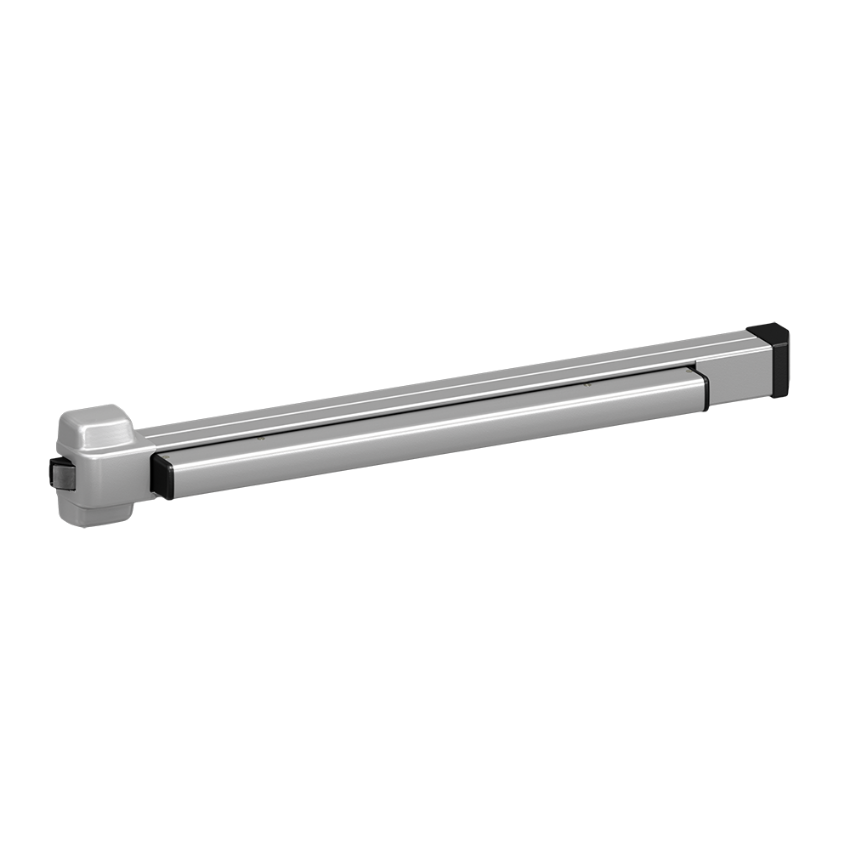
Von Duprin 22 Series rim exit device. View parts guide and order.
Rim devices are the most common panic hardware in commercial construction. The closer body and latch bolt mount on the door face. The entire mechanism is visible, surface-mounted, and directly accessible for maintenance. Fits single doors and paired doors with a center mullion. Available on the Von Duprin 22, 75, 88, 98/99, and 33/35A Series. For a complete guide to rim device maintenance, inspection cycles, and replacement parts, see the rim exit devices guide and the rim exit devices facility manager guide.
Surface vertical rod (SVR) devices add top and bottom engagement points via surface-mounted rods running vertically on the door face. Used on double door openings without a center mullion where rim device single-point engagement is insufficient. The 2227, 8827, and 9827/9927 configurations cover this application across Von Duprin series. For CVR-specific parts diagrams and replacement components, see the Von Duprin 9847 CVR guide and the Von Duprin 9947 CVR guide.
Concealed vertical rod (CVR) devices provide the same three-point engagement as SVR but route the rod hardware inside the door. Specified when surface-mounted rods are architecturally unacceptable: hotels, healthcare interiors, high-end commercial spaces. More installation-intensive and more costly to maintain.
Mortise devices integrate a full mortise lock body into the panic hardware chassis. The latch bolt is housed inside a mortise pocket cut into the door edge, providing maximum security depth alongside panic egress. The Von Duprin 98/9975 and 8875 configurations use the 7500 mortise lock body, which has been in service since approximately 1977 and measures 5-7/8 inches high by 4-1/2 inches deep by 1 inch thick.
Panic Bar Push Element Options
The physical bar element of a panic device also varies by specification. Understanding the three primary formats helps when matching a replacement device to an existing installation:
- Touchbar: A narrow, slender bar that runs across most of the door width. Provides a lighter, more refined appearance. Common on commercial office and healthcare applications.
- Crossbar: A wider, more robust bar element. More visible and durable for high-traffic and institutional applications. Standard on the 98/99 and 88 Series.
- Push pad: A flat plate format rather than a protruding bar. Used on recessed or low-profile applications where standard bar projection is not acceptable.
For a full comparison of Von Duprin series by push element type, traffic rating, and application, see the Von Duprin exit device series comparison.
Installation Requirements for Panic Hardware
Regardless of device type, the model codes and OSHA specify:
- Mounted between 34 and 48 inches above the finished floor or threshold
- Push bar must span at least half the door width
- Single-motion operation: one push releases the latch, no secondary action required
- No secondary locking device (chain, padlock) that would prevent operation
ADA requirements add a maximum 5-pound opening force for interior doors on accessible egress routes and single-motion operability without tight grasping, pinching, or twisting.
ANSI A156.3 Grade 1 certification requires the device to complete 2 million operating cycles without failure. Grade 1 is the minimum specification for commercial and institutional applications. For scheduled maintenance requirements to preserve Grade 1 performance across the service life, see the commercial door hardware maintenance checklist.
Electrified Options for Access Control Integration
The 98/99, 22, 33/35A, and 75 Series all support electrified integration at the device level:
- QEL (Quiet Electric Latch Retraction): Modular field-installable conversion that retracts the latch on an authorized signal, silently
- MEL (Motorized Electric Latch Retraction): Motor-driven retraction for applications where solenoid noise is unacceptable
- Chexit Delayed Egress: Holds the door latched for 15 seconds after push bar activation, with a local alarm during the delay
- ALK (Alarm Exit Kit): Converts the device to an alarmed exit; powered by a 9-volt battery, controlled by a mortise cylinder
- RX (Request to Exit): Switch in the push bar signals the access control system when the bar is pressed
For a direct comparison of QEL quiet electric latch retraction and MEL motor-driven retraction, including when each is specified and how field conversion works, see the Von Duprin QEL vs MEL guide and the QEL conversion kit guide. For integrating exit devices into a broader access control system, see the access control and commercial door hardware integration guide.
Outside Trim Function Codes for Panic Hardware
Outside trim function determines how entry is controlled from the non-egress side of the door. The function code suffix is part of the device part number and must be specified when ordering:
- EO (Exit Only): No outside trim. The door can only be opened from the inside by depressing the push bar. Standard on stairwells and perimeter egress doors where no re-entry is required.
- DT (Dummy Trim): Outside pull handle only; no lock function. Used where the outside appearance of a lever is needed but no access control is required.
- NL (Night Latch): Cylinder on outside locks and unlocks the push bar function. Standard for controlled-access employee entrances.
- TP (Thumbpiece): Thumbpiece on the outside unlocks the push bar. Used where key access is not required but basic entry control is needed.
- K (Knob) and L (Lever): Outside knob or lever trim. The lever version is the most common commercial specification when outside entry with a lever handle is required.
For part numbers, installation notes, and compatibility across all trim function codes by Von Duprin series, see the Von Duprin panic bar parts guide.
Panic Hardware Selection by Application
| Application | Fire-Rated | Traffic | Correct Series |
|---|---|---|---|
| Employee entrance, stairwell | Sometimes | Low to moderate | Von Duprin 22 Series |
| Standard commercial building | Often | Moderate | Von Duprin 75 Series |
| Institutional: hospital, school | Often | High | Von Duprin 98/99 Series |
| Correctional, behavioral health | Yes | High abuse | Von Duprin 88 Series |
| Aluminum storefront, glass door | Sometimes | Moderate | Von Duprin 33/35A or 78 Series |
| High-security perimeter door | Yes | Varies | Von Duprin 55 or 98/9975 mortise |
For a side-by-side comparison of all Von Duprin exit device series by function, occupancy, and hardware specification, see the Von Duprin exit device series comparison guide. For replacement parts organized by series with interactive diagrams, see the exit devices parts guide.
Selecting the correct panic hardware for commercial doors requires resolving four decisions in sequence: which code applies in the jurisdiction, what the calculated occupant load of the space is, whether the door is fire-rated (which determines the standard panic hardware vs fire exit hardware distinction), and which device type fits the door configuration. Security Parts organizes the complete Von Duprin panic hardware catalog by series with model-specific parts pages, interactive diagrams, and same-day shipping on stocked components. Pre-order support at 845-935-0301 for specification questions before the order is placed.
About the Author
This guide was written by the Security Parts team, a commercial door hardware specialist serving locksmiths, facilities managers, general contractors, and access control integrators since 2001. Security Parts carries the complete Von Duprin panic hardware catalog across all device types, series, and electrified configurations, with same-day shipping on stocked components and pre-order specification support at 845-935-0301.