 Trusted Since 2001





Quick Answer
Commercial door closers fall into four types, each serving a distinct application:
- Surface-mounted closers: Most common. Visible on the door or frame. Four arm configurations: regular, parallel, top jamb, and slide track. ANSI Grade 1 required on fire-rated openings.
- Overhead concealed closers: Hidden inside the frame or door rail. Specified for architectural interiors where surface hardware is not acceptable.
- Floor spring closers: Embedded in the floor beneath the door. Used on heavy glass doors and all-glass entries where no door-face mounting is possible.
- Automatic door operators: Motor-driven, triggered by push pad, motion sensor, or access control. Required under NFPA 101 in healthcare patient care areas and touchless entry applications.
ANSI Grade 1 with a UL fire door listing is non-negotiable on fire-rated assemblies. All-weather hydraulic fluid is required on exterior and temperature-exposed installations. For selection guidance by specific LCN series, see the LCN commercial door closer selection guide.
The Four Main Types of Commercial Door Closers
Commercial door closers are not interchangeable. The surface-mounted closer on an office interior door is a different device category from the overhead concealed closer on an architectural lobby entry, which is again different from the floor spring closer on a heavy all-glass storefront. ADA lawsuits related to door closer violations have increased in recent years, and the fire door inspection failure most commonly cited in commercial facilities involves a closer that is either the wrong ANSI grade for the assembly or incorrectly adjusted. Specifying or replacing the wrong type does not just create a maintenance problem. It creates a compliance liability. This guide covers every commercial door closer type, how ANSI/BHMA grades work, how the four hydraulic valve functions control the closing cycle, and how to match the right closer to the right application.
Surface-Mounted Closers
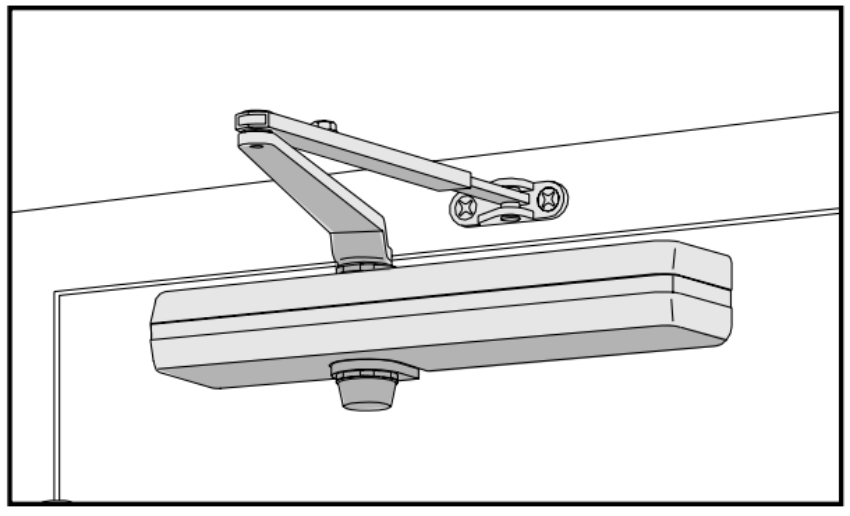
LCN 1460 surface-mounted commercial door closer. View model page.
Surface-mounted closers are the most common commercial installation. The closer body mounts to the face of the door or frame and is visible after installation. The mechanism inside most surface closers uses a rack-and-pinion system: a piston riding on a rack turns a pinion shaft connected to the spring. When the door opens, the spring compresses and stores energy. When released, hydraulic fluid controls how fast the spring drives the door closed.
Four arm configurations are available:
- Regular arm (pull side): Closer body on the pull side of the door, arm extends to the frame. Most common interior door setup. Strongest closing force, most visible projection.
- Parallel arm (push side): Closer body on the push side of the door, arm runs parallel to the frame when the door is closed. Lowest projection from the door face. Protects the arm from deliberate force. Standard on exterior commercial doors.
- Top jamb (push side frame): Closer body mounts on the frame head on the push side, arm connects to the door. Correct when the pull side is inaccessible or when the closer must mount on the frame. Common on aluminum storefront and narrow-top-rail glass doors.
- Slide track arm: The arm rides in a metal track on the frame rather than a fixed pivot, allowing the door to hold open at any position. Used in hospital corridors, loading docks, and any application requiring variable hold-open.
The most common arm geometry error in the field: the shoe mounted too far from the hinge side creates excessive stress on the arm pivot. Too close reduces mechanical advantage. The shoe must be set at the position specified in the manufacturer's template for the closer to perform correctly and last through its rated cycle life.
LCN has manufactured commercial door closers since 1877. The 1460 Series is the universal medium-duty closer for commercial and institutional applications, meeting ANSI/BHMA A156.4 Grade 1 and ADA requirements, with a 30-year limited warranty. The LCN patented Green Dial system on the 1460 removes the guesswork from spring power adjustment. The 4040XP is the heavy-duty specification for institutional and industrial openings. For parts and component diagrams across all LCN surface closer models, see the LCN 4000 series parts guide and the LCN 4040XP parts guide.
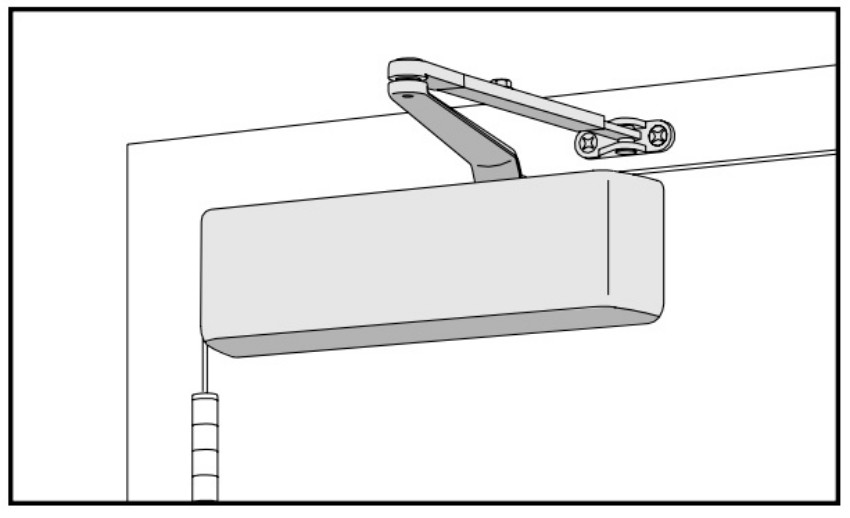
LCN 4040XP heavy-duty surface-mounted closer. View model page.
Overhead Concealed Closers
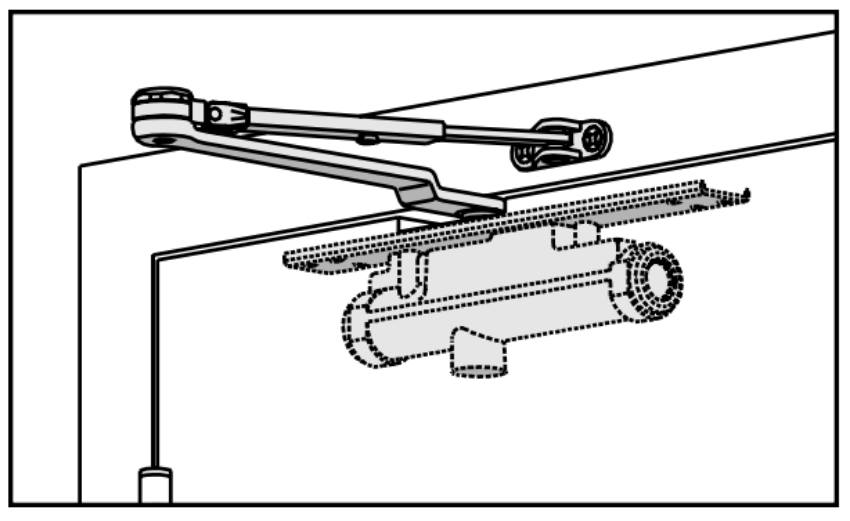
LCN 3030 overhead concealed door closer. View model page.
Overhead concealed closers mount inside the door frame transom or the top rail of the door, hiding the mechanism when the door is closed. These are specified on aesthetic-driven applications: hotel lobbies, healthcare interiors, high-end office buildings, and government facilities where surface hardware is architecturally unacceptable.
Installation requires greater precision than surface-mounted closers because the frame transom must accommodate the closer body and the door rail must accept the arm channel.
LCN's 3030/3130 Series is the Grade 1 overhead concealed closer for interior doors in medium to high-traffic applications. The 3030 uses an exposed double-lever arm. The 3130 uses a concealed single-lever arm with a low-friction track and roller assembly. Both carry ANSI/BHMA A156.4 Grade 1 rating and a 15-year limited warranty.
For institutional and high-traffic installations or those exposed to weather or abuse, the 2010/5010 Series provides heavy-duty concealed performance. The 2010 conceals both the body in the frame and the track in the door. The 5010 conceals the body in the frame with an exposed double-lever arm.
The 2210 Series is LCN's high-security concealed closer for correctional facilities and institutional buildings requiring vandalism resistance. It uses forged steel, a single-lever arm, a heavy steel mounting plate, and tamper-resistant components.
For parts and diagrams across the full LCN overhead concealed closer family, see the LCN 1000/2010/2030/3030 series parts guide.
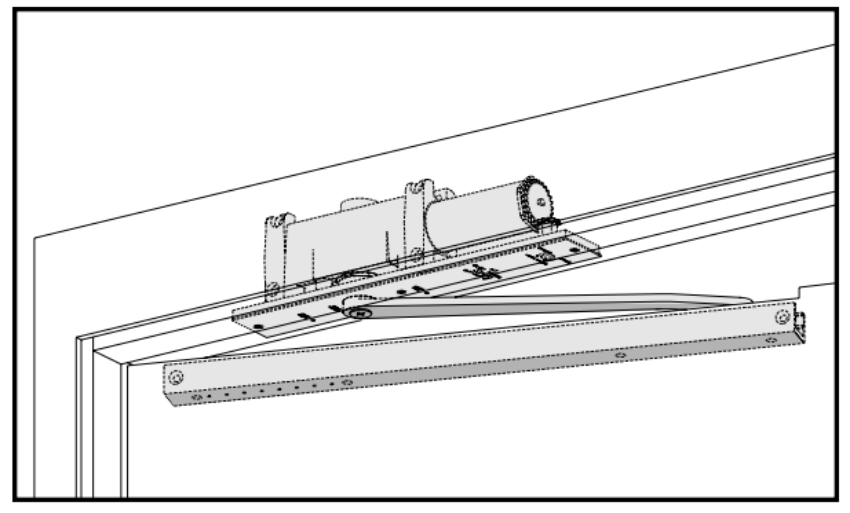
LCN 2010 heavy-duty overhead concealed closer. View model page.
Floor Spring Closers
Floor spring closers embed in a cement case in the floor beneath the door, placing the pivot mechanism at the door base rather than at the top. They are specified for heavy glass doors, balanced doors, all-glass rail and patch-fitted entries, and applications where no visible closer hardware is acceptable on the door or frame.
Some floor spring models support doors up to 300 pounds. They are the most durable and longest-lasting closer type for very heavy-traffic applications because the mechanism is protected inside the floor. The primary drawback is that installation requires cutting into the floor slab, making floor springs impractical for retrofits in most existing buildings.
Automatic Door Operators
Automatic operators use an electric motor triggered by a push pad, motion sensor, or access control signal. They are required under NFPA 101 in healthcare patient care areas, in assembly occupancies where conventional closers cannot achieve ADA compliance due to door weight and wind load, and in any touchless entry application. For parts and maintenance references covering LCN automatic operators, see the commercial door operators guide and the LCN Benchmark and Senior Swing automatic door operator parts guide.
ANSI/BHMA A156.4 Grades: What Each Grade Means for Commercial Door Closers
Grade 1: Rated for 2 million cycles. Required on all fire-rated door assemblies and high-traffic commercial openings. Grade 1 closers must also carry a UL fire door listing for use on fire-rated assemblies. At 500 cycles per day, a Grade 1 unit provides approximately 11 years of rated cycle life.
Grade 2: Rated for 1 million cycles. Suitable for moderate-traffic interior doors where no fire rating is required.
Grade 3: Rated for 500,000 cycles. Not appropriate for commercial applications with a fire door requirement. At the same 500 cycles per day, a Grade 3 unit reaches mechanical fatigue in under 3 years.
Most commercial closers combine a hydraulic system with a mechanical spring. Standard hydraulic fluid performs reliably in typical interior conditions. All-weather hydraulic fluid maintains consistent viscosity from -40 degrees Celsius to 80 degrees Celsius and is required on exterior doors, vestibule applications, and any installation exposed to temperature extremes. As temperature rises and standard hydraulic fluid thins, the closer may fail to latch. All-weather fluid prevents this.
For a full reference on ANSI/BHMA grading standards and how they apply across commercial door hardware, see the ANSI/BHMA door hardware standards guide. For NFPA 80 fire door compliance including annual inspection requirements for door closers, see the NFPA 80 inspection guide and the commercial door fire rating guide.
The Four Hydraulic Valve Functions on a Commercial Door Closer
Every hydraulic commercial closer has four adjustment valves. Understanding each prevents the most common installation errors.
Sweep speed: Controls door movement from fully open to approximately 12 to 15 degrees from closed. This is the longest phase of the arc and the one most responsible for slamming.
Latch speed: Controls the final degrees from 12 to 15 degrees to fully latched. Must be fast enough to engage the latch bolt positively. On fire doors, this latching is the code requirement.
Backcheck: Controls the hydraulic resistance against forceful opening beyond approximately 70 to 80 degrees, protecting hinges, frame, and wall from impact.
Delayed action: When present, holds the door open at approximately 70 degrees for an adjustable delay before the closing cycle begins. Used in healthcare and any application where equipment must clear the door frame.
Every closer should be adjusted in the field after mounting based on actual door weight, wind exposure, and latch requirements. Factory default settings rarely match field conditions. For step-by-step field adjustment procedures, see the how to adjust a commercial door closer guide. For fire door-specific adjustment requirements, see how to adjust a fire door closer.
ADA Compliance Requirements for Commercial Door Closers
The Americans with Disabilities Act requires:
- Maximum 5 pounds of opening force for interior non-fire-rated doors
- Minimum 5 seconds from 90 degrees open to 12 degrees open for closing speed
- California state ADA requires the 5-pound limit on both interior and exterior doors
A closer adjusted for fast latching on a busy corridor will typically fail the 5-second measurement. On accessible egress routes, the sweep speed valve must be set for the full 5-second minimum. Where door weight and wind load make the 5-pound opening force limit physically unachievable with a conventional closer, an automatic operator or balanced door system is the correct solution.
Door Closer Selection by Application
| Application | Fire-Rated Required | Traffic | Correct Type |
|---|---|---|---|
| Office interior door | No | Low to moderate | Surface-mounted, Grade 1 or 2 |
| Hospital corridor | Often | High | Surface-mounted or concealed, Grade 1, all-weather fluid |
| Architectural lobby | Often | High | Overhead concealed, Grade 1 |
| Aluminum storefront | Sometimes | Moderate | Surface-mounted, top jamb or parallel arm, Grade 1 |
| All-glass entrance | Rarely | High | Floor spring or overhead concealed |
| Correctional facility | Yes | High abuse | LCN 2210 concealed, Grade 1, tamper-resistant |
| Exterior entrance | Often | High | Parallel arm, Grade 1, all-weather fluid |
For a detailed sizing reference covering LCN power sizes by door width and weight, see the commercial door closer sizing guide. For installation guidance, see the how to install a commercial door closer guide.
Sourcing Parts for the Commercial Door Closer Already on Your Door
Every commercial door closer type and series in this guide has its own parts tree. The model number on an LCN closer is located under the cover on a sticker on the cylinder body. On mechanical closers, the manufacturing date is stamped near the packing nut at the base of the pinion shaft. This number determines which arm, which drop plate, and which cover plate applies to that specific device.
Security Parts organizes the complete door closer parts catalog by model across LCN 1000 Series, 4000 Series, and 3030/3130 concealed closers. The LCN door closer parts guide covers specific component categories with interactive diagrams on every model page. Pre-order compatibility support at 845-935-0301.
For series-specific parts guides, see:
- LCN door closer parts guide (all series)
- LCN 1000/2010/2030/3030 series parts guide
- LCN 4000 series and 2210 parts guide
- LCN 4040XP parts guide
- LCN 1450 parallel arm door closer parts guide
For ongoing maintenance requirements, see the commercial door hardware maintenance checklist and the commercial door hardware replacement and repair guide. For parts diagram reference, see the door closer parts diagram guide. For guidance on OEM versus replacement parts, see the OEM vs aftermarket commercial door hardware guide.
Commercial door closer selection in this commercial door closers types guide follows a clear sequence: fire rating requirement first, then aesthetics, then traffic level, then frame geometry and door material. ANSI/BHMA A156.4 Grade 1 with a UL fire listing is non-negotiable on rated fire door assemblies. Surface-mounted closers are the practical standard for most commercial applications. Overhead concealed closers address aesthetic requirements without sacrificing Grade 1 performance. Floor springs handle the heaviest glass and balanced door applications. The four hydraulic valve functions control operational quality and must be adjusted in the field. All-weather fluid is required for exterior and temperature-exposed installations. Sourcing replacement parts starts with the model number under the closer cover, not with a component name or brand search. Browse the complete commercial door closers catalog at Security Parts with model-specific diagrams and same-day shipping.
About the Author
This guide was written by the Security Parts team, a commercial door hardware specialist serving locksmiths, facilities managers, general contractors, and access control integrators since 2001. Security Parts carries the complete LCN door closer parts catalog across all surface-mounted, overhead concealed, and automatic operator series, with same-day shipping on stocked components and pre-order compatibility support at 845-935-0301.