 Trusted Since 2001





If you manage a commercial building, a school, a hospital, or really any facility with more than a handful of doors, you've worked with LCN door closers whether you knew it or not. They're everywhere. The LCN brand, owned by Allegion, has been the default spec for architects and facility managers for decades. Walk into most government buildings or hospitals built after 1970 and there's a good chance an LCN closer is quietly doing its job on every single door.
The problem is that most people only notice a door closer when something goes wrong. The door doesn't latch. There's a grinding sound. Oil is dripping down the door frame. By the time you're searching for LCN door closer repair help, you're usually already behind schedule.
This guide breaks down every major component inside an LCN door closer, what it does, what failure looks like, and when it makes sense to replace a part versus replacing the whole unit. Browse the complete LCN door closer parts catalog at SecurityParts.com, or explore the full commercial door closer parts selection.
What LCN Makes and Why It Dominates Commercial Buildings
LCN's catalog is deep. The 4040XP series is probably their most widely installed line, you'll find it on doors in office buildings, schools, and retail. The 4011 and 4111 series handle lighter-duty applications. The 1461 is their economy unit. Their heavy-duty concealed closer, the 2030 series, shows up in high-traffic entrances where aesthetics matter.
LCN closers are sized by ANSI/BHMA grade and door size. Grade 1 is the commercial standard, it means the unit is tested to 2 million open/close cycles. Most LCN units sold into commercial specs are Grade 1. For a full explanation of how ANSI grades apply to commercial door hardware, see the ANSI/BHMA door hardware standards guide.
The reason LCN dominates: they've been consistently specified into construction projects for so long that facilities teams are already trained on them. Parts are stocked by distributors nationwide. When something needs fixing, the institutional knowledge to fix it exists. For guidance on choosing the right LCN series for a specific application, see the LCN
commercial door closer selection guide.

LCN commercial door closer replacement parts at SecurityParts.com, OEM components for the 4040XP, 4011, 4111, 2030, and 1461 series. Same-day shipping on stocked parts.
The Core LCN Door Closer Parts: What Each Component Does
Most LCN closers share the same basic architecture. Understanding each part helps you diagnose problems quickly instead of guessing.
1. The Closer Body (Main Housing)
This is the cast iron or aluminum housing that contains everything else. It mounts to the door or the frame, depending on the installation type. The body itself rarely fails outright, what fails is what's inside it.
If the housing is cracked or dented from impact damage, replacement is the only real option. You can't repair cast iron in the field.
2. The Closing Spring
The spring is the engine. It stores energy when the door opens and releases it to pull the door shut. LCN sizes springs by tension number, typically 1 through 6, and the correct size depends on the door width, weight, and any wind pressure considerations.
Spring failure shows up in two ways. Either the door stops latching (spring has lost tension over time) or the closer slams shut violently even when speed valves are adjusted correctly (spring is too strong for the installation). Spring replacement is possible on some LCN models, but it requires disassembling the unit. Many facilities teams find it more cost-effective to replace the closer body entirely at that point.
3. Spindle and Pinion Assembly
The spindle is the shaft that connects the closer arm to the internal rack-and-pinion mechanism inside the housing. When the arm moves, the spindle turns. When the spindle turns, it drives the rack, which compresses or releases the spring.
Spindle wear causes slop or play in the arm. You'll feel it when you manually move the door, there's a loose, almost rattling quality to the action. A worn spindle should be addressed because it puts uneven stress on the arm and can eventually damage the housing threads.
4. The Cylinder Assembly
The cylinder assembly, also referred to as the main cylinder or hydraulic cylinder, is the heart of the closer's damping system. It houses the spring, the hydraulic fluid chamber, and the rack-and-pinion mechanism as a single integrated unit. On most LCN models, the cylinder assembly is sold as a complete replacement item rather than as individual internal components.
Key cylinder assembly part numbers by series: 4040XP-3071 (standard), 4041-3071DEL (with delayed action), 4011-3071 (standard for the 4011 series), 4011-3071DEL (delayed action), and 4111-3071 for the 4111 series. When ordering, always specify finish, size, and hand as required. For series-specific cylinder assembly and LCN door closer parts, see the LCN 4000 Series parts guide and the LCN 1000, 2010, 2030, and 3030 Series parts guide.
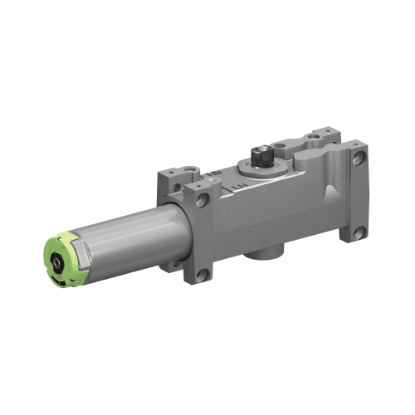
LCN 4011-3071 Standard Cylinder Assembly, OEM replacement for the 4011 and 4016 series. In stock at SecurityParts.com.
5. The Arm Assembly
The arm is what you see. It connects the closer body to the door or frame (depending on mounting) and translates the spring's energy into door movement. LCN makes several arm configurations:
- Standard parallel arm (e.g. 4040XP-3077): Mounts so the arm runs parallel to the door face when closed. Most common on commercial doors.
- Top jamb mount: Used when the closer is on the pull side of the door, the arm mounts to the top of the frame.
- Slide track arm (e.g. 4040XP-3077T): Instead of a pivot point, the arm rides in a metal track. Allows the door to be held open at any point along the track's range.
- Cush N Stop arm: Includes a built-in hold-open feature using a friction shoe.
- EDA (Extra Duty Arm): Heavy-duty arm for high-abuse openings. The 4040XP-3077EDA is the most commonly specified EDA arm for institutional environments.
Arm damage is common in high-traffic areas. Someone props the door open with a wedge, the arm gets stress-loaded in the wrong direction, and the casting cracks. Replacement arms are sold separately from the body, you don't need to replace the whole unit.
6. The Arm Shoe (Connecting Shoe)
The shoe is the part that attaches the free end of the arm to the door or frame. It's often overlooked, but it takes a lot of stress. If the shoe's threads strip or the casting cracks, the arm loses its connection point and the door won't close correctly.
Replacement shoes are model-specific. The 4040XP-62PA is the standard parallel arm shoe for the 4040XP series. Don't assume that because two LCN closers look identical their shoes are interchangeable, always cross-reference the model number on the body. Browse the LCN 4040XP-62PA parallel arm shoe at SecurityParts.com.
7. The Adjustment Valves
This is where most of the field tuning happens. LCN closers have between two and four valves, typically accessible from the end of the housing with a small hex wrench or flathead screwdriver:
- S valve (Sweep speed): Controls how fast the door moves from fully open to about 10 degrees from the latch. This is the main speed you adjust for ADA compliance, the door can't close too fast or people using mobility aids can't get through safely.
- L valve (Latch speed): Controls the final few degrees of closing, when the latch engages. You want this slightly faster than sweep to ensure positive latching, especially on fire doors.
- B valve (Backcheck): Creates resistance when the door is pushed open hard past a certain point, usually 70 degrees or so. This is the valve that protects walls and the closer itself from damage when a door is thrown open.
- D valve (Delayed action): Found on some LCN models. Creates a pause in the closing cycle, which is useful for ADA-accessible entrances where a person needs extra time to pass through.
Valves don't usually fail in isolation. But if you've adjusted them and can't get consistent performance, it often means there's a leak in the hydraulic fluid sealing around the valve, meaning the valve seat itself is damaged. At that point, a new closer is often more practical than trying to reseal an old one. For step-by-step valve adjustment procedures, see the how to adjust a commercial door closer guide.
8. Internal Hydraulic Fluid
LCN closers are hydraulic. The fluid inside the housing is what gives you adjustable, damped closing speed. When you see oil on the door frame or on the floor near a closer, that's hydraulic fluid leaking from a failed seal.
Hydraulic fluid doesn't get replaced in the field, LCN closers aren't designed to be refilled. A leaking closer is a closer that needs to be replaced. The fluid leak will get worse over time, and the closing action will become erratic as the fluid level drops.
9. Cover Plate, Screw Pack, and Mounting Hardware
Not glamorous, but important. The cover plate protects the internal components and is available in two configurations: standard cover (e.g. 4040XP-72, 4011-72) and metal cover (e.g. 4040XP-72MC, 4010-72MC). The metal cover is specified for high-abuse environments where the standard plastic cover is likely to be damaged.
Cover screws (e.g. 4040XP-31, 4010-31) and screw packs (e.g. 4040XP-SRT for wood applications, 4040XP-WMS for metal applications) are sold as separate line items. Mounting screws that are wrong-sized or stripped create play in the installation that accelerates wear on every other component. LCN specifies the correct fasteners for each application, wood door, metal door, metal frame. Using the wrong screw pack is a shortcut that creates problems.
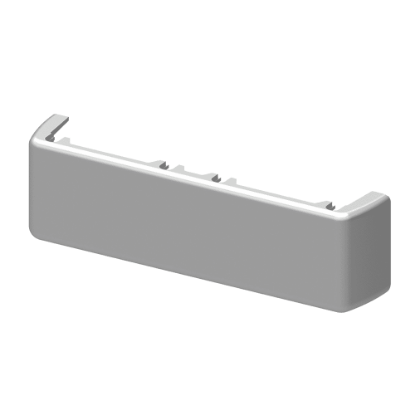
LCN 4010-72 Standard Cover, OEM cover plate for the 4010 and 4011 series. Part of the LCN door closer parts range stocked at SecurityParts.com.
10. Drop Plates and Specialty Mounting Brackets
Some installations require the closer to be mounted offset from its standard position, to clear a window, to accommodate a non-standard door frame, or to adjust the arm geometry. LCN makes a range of drop plates (also called mounting plates or adaptor plates) that change the closer's mounting position without requiring custom fabrication.
If you're replacing an older closer and the geometry seems off, check whether a drop plate was used in the original installation. Missing that step is a common source of arm binding and accelerated wear.
How to Read an LCN Door Closer Part Number
One of the most common ordering errors for LCN door closer parts is misreading the part number format. Each LCN part number follows a specific structure that encodes the series, the component type, and configuration options.
The format is: [Series]-[Suffix][Options]
For example, 4040XP-3077 breaks down as: series 4040XP, suffix 3077 (standard arm). Adding /PA gives you 4040XP-3077/PA, the same standard arm configured for parallel arm mounting. Adding EDA gives 4040XP-3077EDA, the extra duty arm version.
When ordering, always specify:
- Finish (F): The LCN finish code. AL = aluminum (689), DKBRZ = dark bronze (695), BRZ = bronze (690), BRNZ = brass (605). Many LCN door closer parts require finish specification before they can be ordered.
- Size (S): The spring size, 1 through 6, or the body size for arm components.
- Hand (H): Left hand (LH) or right hand (RH) where applicable, primarily relevant for track arms and specialty arm configurations.
For the manufacture date of your existing closer, check near the packing nut at the base of the pinion where the arm attaches. LCN stamps the month and year of manufacture on mechanical products. This date matters when ordering cylinder assemblies for older closers, as some earlier series have legacy component compatibility requirements.
LCN Door Closer Parts by Series: Where to Find Them
SecurityParts.com stocks LCN door closer parts for the most common commercial series. Each series has dedicated parts pages for cylinder assemblies, arms, shoes, covers, and hardware.
LCN 4040XP Series (Super Smoothee)
The 4040XP is LCN's flagship Grade 1 surface-mounted closer and the most widely specified commercial unit. Key replacement parts include the 4040XP-3071 cylinder assembly, 4040XP-3077 standard arm, 4040XP-3077/PA parallel arm, 4040XP-62PA parallel arm shoe, 4040XP-72 standard cover, and 4040XP-72MC metal cover. The 4040XPT variant adds a slide track arm system with its own track (4040XPT-3038) and track roller (4040XPT-3034) components.
LCN 4011 and 4111 Series (Smoothee)
The 4011 is the standard Grade 1 lighter-duty unit. The 4111 is the heavy-duty variant of the same platform. Key parts: 4011-3071 standard cylinder assembly, 4011-3071DEL delayed action assembly, 4011-3071TEL assembly with through-bolt mounting, 4010-72 standard cover, and 4010-72MC metal cover. The 4010-31 cover screw and 4010-SRT or 4010-WMS screw packs apply to both the 4011 and 4111 series.
LCN 1461 Series (Economy)
The 1461 is the economy closer in LCN's lineup, commonly installed on interior office doors and lower-traffic applications. It uses a simplified mechanism with fewer adjustment options than the 4040XP or 4011 series. For the 1461 parts catalog and related 1000, 2010, 2030, and 3030 series components, see the LCN 1000 Series, 2010, 2030, and 3030 Series door closer parts guide.
LCN 2030 Series (Concealed)
The 2030 is LCN's concealed door closer, it mounts inside the door frame rather than on the door face. It's specified in environments where visible hardware is architecturally unacceptable. The 2030 is mechanically similar to the surface-mounted series but requires different installation hardware and arm configurations. Parts are listed separately from the surface-mounted catalog. For the full 2030 series parts breakdown, see the LCN 2030 parts guide.

LCN surface-mounted door closer parts at SecurityParts.com, OEM components for the full LCN commercial series range. Browse by series at SecurityParts.com.
The Parts That Fail First: A Practical Ranking
Not all LCN door closer parts fail at the same rate. Based on typical commercial building usage, here's a realistic picture of what breaks first:
- Most common: Hydraulic seals (leak), the leading cause of closer replacement
- Second most common: Closer arm, bending, cracking, stripped threads in high-abuse locations
- Third: Spring, loss of tension after 10 or more years of service
- Fourth: Arm shoe, stripped threads, cracked casting from misuse
- Less common but progressive: Spindle wear, presents as play and looseness before full failure
- Often overlooked: Cover plate and mounting hardware, installation damage and wrong screw pack
The honest answer is that after about 8 to 12 years of heavy commercial use, a leaking or underperforming closer is usually better replaced than patched. The exception is the arm and arm shoe, those are external components that take abuse from misuse and can extend the life of a functioning body if replaced proactively. For OEM versus aftermarket guidance on door closer components, see the OEM vs aftermarket commercial door hardware guide.
How to Find the Right LCN Door Closer Parts
Getting the right part starts with getting the right model number. On most LCN closers, the model is stamped or printed on the body, usually on the top or side. It'll look something like "LCN 4040XP-REG" or "LCN 4011" followed by any mounting configuration code.
Once you have the model number, cross-referencing arm compatibility is direct. LCN's arm numbering system tells you the configuration: 4040XP-3077 is the standard parallel arm for the 4040XP series.
Where people get stuck is on older models where the stampings have worn off. In that case, measure the closer body length and the spindle diameter. LCN body sizes are relatively standardized, and a good distributor can help you narrow it down. Call 845-935-0301 for pre-order parts identification support at SecurityParts.com.
For all LCN door closer parts, browse the LCN door closer parts catalog or the complete commercial door closer parts section at SecurityParts.com.
Installing LCN Door Closer Parts: What to Know Before You Start
Arm replacement is the most common field repair, and it's pretty manageable. You'll need the correct replacement arm, a socket set, and a few minutes. The process: remove the arm from the closer body (usually a single fastener on the spindle), remove the arm from the door or frame connection, reverse the process with the new arm. For the complete step-by-step process, see the how to install a commercial door closer guide.
Spring tension adjustment on the body itself is different. Some LCN models have an external spring adjustment bolt, you can increase or decrease spring tension without disassembly. Others require removing the spring tension cap, which puts you in contact with a compressed spring. If you haven't done this before, it's worth reviewing LCN's installation documentation first. A spring under tension can cause injury if released suddenly.
Valve adjustment: Start with all valves fully closed (clockwise), then open them one turn at a time. Sweep speed first, then latch speed. Backcheck is usually set conservatively at the factory and rarely needs to be widened. For the complete valve adjustment procedure, see the how to adjust a commercial door closer guide.
For ADA compliance, the door should take at least 5 seconds to close from 90 degrees to a point 3 inches from the latch. Measure it, don't guess. ANSI A117.1 standard requires that door closing speed from 90 degrees to 3 inches from the latch takes a minimum of 5 seconds when set to the minimum opening force. Set your sweep valve first, then test with a stopwatch. This is the standard used in accessibility inspections.
LCN Door Closer Maintenance: Keeping Parts in Service Longer
Regular maintenance is the difference between a 10-year closer and a 20-year one. These practices apply across the LCN product line and are consistent with the recommendations in the commercial door hardware maintenance framework.
Monthly Checks
Inspect the closer body for oil stains on the door face or frame directly below the closer. A small oil stain that wasn't there last month is an early hydraulic seal failure, plan the replacement before the leak progresses and the closer fails completely. Check the arm for cracks at the casting points, particularly at the shoe connection and the spindle connection. Verify that the door latches positively every time without being slammed.
Annual Service
Verify all mounting screws are tight. Loose mounting hardware creates micro-movement at the closer body that accelerates internal wear faster than cycling does. Check valve settings with a timer, sweep speed from 90 degrees to the latch position should still meet your facility's ADA standard (minimum 5 seconds). Re-verify that the backcheck valve is engaging at the correct point. For a complete commercial door hardware maintenance schedule, see the commercial door hardware maintenance checklist.
Lubrication
The spindle and arm connection points are the primary lubrication points on a surface-mounted LCN closer. A light application of appropriate lubricant at the spindle reduces friction and slows wear at that pivot. Do not apply lubricant to the closer body itself, the housing is sealed, and external lubricant attracts dust and debris that abrade the spindle seal over time. For door closer adjustment and troubleshooting across the LCN line, see the commercial door hardware troubleshooting guide.
Why Choose SecurityParts.com for LCN Door Closer Parts
SecurityParts.com has supplied OEM commercial door hardware parts since 2001. The LCN catalog at SecurityParts.com covers the full surface-mounted and concealed closer range with genuine OEM replacement parts and same-day shipping from US warehouses on stocked components.
- OEM parts only: Every LCN door closer part at SecurityParts.com is genuine OEM. Non-OEM cylinder assemblies and arms may not carry the ANSI/BHMA Grade 1 certification required for fire-rated openings.
- Model-specific cross-referencing: The catalog is organized by LCN series, so you can identify the correct arm, shoe, cylinder assembly, and cover plate for your specific model without guessing.
- Pre-order support: If your model label is worn or you're unsure whether a part is compatible, call 845-935-0301. The pre-order support team can confirm the correct part before the order ships.
- Same-day shipping: Stocked LCN door closer parts ship same day from US warehouses. When a facility closer fails and the door is out of service, turnaround time matters.
Browse all LCN door closer replacement parts or explore the complete commercial door closers catalog at SecurityParts.com. For parts questions, call 845-935-0301 or visit the contact page.
About the Author
This guide is published by the commercial door hardware team at SecurityParts.com, a supplier of OEM LCN, Schlage, Von Duprin, Falcon, and Detex parts since 2001. The team supports facility managers, locksmiths, and contractors with parts identification, pre-order configuration support, and same-day shipping on stocked commercial door hardware components. For LCN door closer parts availability and ordering support, call 845-935-0301 or visit SecurityParts.com.