 Trusted Since 2001





Every commercial door relies on multiple hardware devices working together. An exit device controls egress. A door closer controls the closing arc. A lock controls access. An electric strike or deadbolt provides the final locking point. Each of these devices contains multiple components, and any one of those components can wear or fail independently.
The practical advantage of understanding security door parts at the component level is significant. A facility manager who can identify a worn dogging shaft on a Von Duprin exit device and order the correct replacement part by number avoids both a full device replacement cost and a multi-day wait for a distributor quote. A locksmith who knows the difference between a chassis assembly for an ND Series lock and one for an ALX Series completes a service call in one visit instead of two.
This guide covers every major category of commercial security door parts, what each component does, what wears out first, and how to identify and order the right replacement. Browse the complete commercial door hardware parts catalog at SecurityParts.com.
What Security Door Parts Are Found on a Commercial Opening
A complete commercial door opening typically contains six to eight distinct hardware devices. Each device has its own parts structure, its own wear pattern, and its own parts catalog. Understanding which device category you are working on is the first step to ordering the right component.
Exit Devices
Function: Code-compliant egress on fire-rated and high-occupancy doors
Brands on site: Von Duprin, Falcon
Key parts: Latch assembly, dogging assembly, end cap, strike plate, push bar, vertical rods (SVR/CVR)
Browse: Exit device parts guide
Door Closers
Function: Controls closing speed, force, and ADA compliance
Brands on site: LCN
Key parts: Closer arm, shoe bracket, spring cover, mounting hardware, body replacement
Browse: Door closer parts guide
Cylindrical Locks
Function: Primary access control on commercial doors
Brands on site: Schlage (ND, ALX, T Series), Falcon
Key parts: Chassis assembly, tailpiece, lever trim, latch assembly, strike plate, cylinder
Browse: Cylindrical lock parts guide
Mortise Locks
Function: Heavy-duty access control on institutional and high-security doors
Brands on site: Schlage (L Series, MA Series), Falcon
Key parts: Latch assembly, armor front, case cover screw, chassis, cylinder trim, thumbturn
Browse: Mortise lock parts guide
Electric Strikes
Function: Remote latch release for access control integration
Brands on site: Von Duprin
Key parts: Strike housing, keeper, solenoid assembly, mounting hardware
Browse: Electric strike parts catalog
Deadbolts
Function: Secondary locking on commercial doors requiring added security
Brands on site: Schlage (B Series), Falcon
Key parts: Deadbolt cylinder, strike plate, tailpiece, rose assembly
Browse: Deadbolt parts catalog
Exit Alarms
Function: Audible alarm on doors that should remain closed except for emergencies
Brands on site: Von Duprin, Detex
Key parts: Alarm housing, battery assembly, mounting hardware, magnet contacts
Browse: Exit alarm parts catalog
Door Operators
Function: Automated door operation for ADA compliance and high-traffic access
Brands on site: LCN
Key parts: Drive belt, motor assembly, sensor, push plate battery, mounting hardware
Browse: Door operator parts catalog
Exit Device Parts: What Wears Out and Why
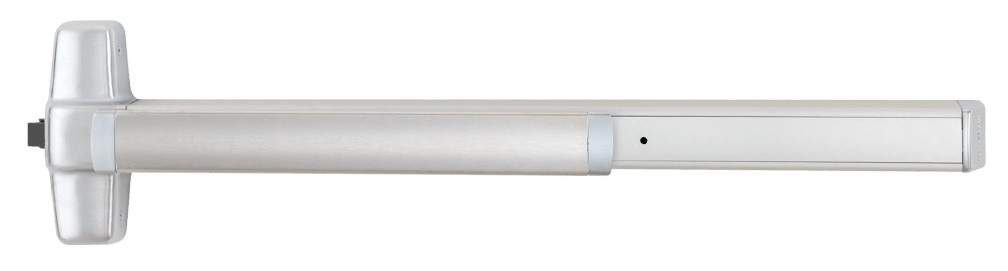
Exit devices are the most actively used hardware on any commercial door. On a high-traffic door in a school, hospital, or retail building, the push bar can be actuated hundreds of times per day. That cycle count is what determines which internal parts require attention first. For a full technical breakdown of exit device components by type and series, see the commercial exit device parts guide at SecurityParts.com.
Dogging Assembly
The dogging assembly holds the push bar depressed so the door operates as a push-pull entry without latching during business hours. The dogging shaft, dogging adapter, and dogging adapter spring are the three components that wear as a unit. The shaft strips under a poorly seated hex key. The adapter spring fatigues under repeated use. The adapter housing cracks under impact.
- Dogging shaft failure shows as a hex key that spins without engaging
- Spring failure shows as a device that will not hold in the dogged position
- Always replace the shaft, spring, and adapter together on a worn assembly
- Dogging is not available on fire-rated exit hardware (F-prefix models)
Latch Assembly
The latch assembly is the spring-loaded component that engages the strike and keeps the door latched when closed. The latch bolt, latch case, and latch return spring are the components that fail on high-cycle openings. A door that will not stay latched, or one that requires significant push bar force to disengage, almost always points to a worn latch assembly rather than a problem with the strike.
- Rim devices use a single latch at the frame jamb
- Vertical rod devices use top and bottom latches simultaneously
- Latch kits are sold separately for top and bottom on CVR devices
- Fire devices require different latch bracket quantities than panic devices
End Cap and Case Cover
The end cap is the plastic or metal component that closes the hinge-side end of the exit device body. It breaks under repeated contact with walls, carts, and equipment. When the end cap breaks, the cover plate slides off and exposes the internal mechanism. The 900397 impact-resistant metal end cap kit is the recommended upgrade over the original plastic version on high-use openings.
Strike Plate and Floor Strike
The strike plate receives the latch bolt on every door close. On rim devices, the strike mounts on the frame jamb. On surface vertical rod and concealed vertical rod devices, separate strikes mount at the door header and floor. The floor strike takes the most impact and wears first on vertical rod devices. A misaligned or worn strike often looks like a latch problem until the strike itself is inspected.
Door Closer Parts: The Most Active Component on the Door
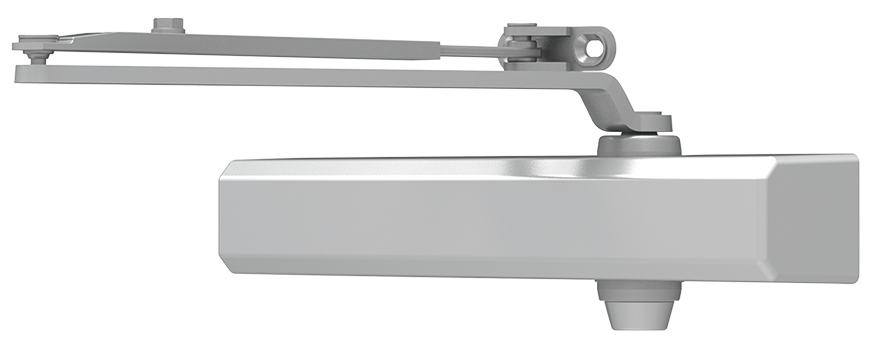
A door closer cycles every time the door opens and returns to closed. On a busy commercial entrance, that can mean 500 or more cycles per day. The arm assembly transmits mechanical load from the door to the frame on every single cycle, which is why arm components wear before the closer body itself. For detailed LCN closer component identification, see the door closer parts guide at SecurityParts.com.
Arm and Shoe Bracket
The arm assembly connects the closer body to the frame. The shoe bracket mounts on the frame and receives the forearm. The shoe bracket screws take the full mechanical load of every closing cycle, which is why loose bracket screws are the most common cause of arm damage. A bent forearm or a cracked arm body always requires an inspection of the shoe bracket before the new arm is installed.
- Regular arm, parallel arm, and top jamb arm configurations are not interchangeable
- 3-foot and 4-foot arm sizes apply to different door widths
- Fully tighten all shoe bracket screws before completing installation
Spring Cover and Mounting Hardware
The spring cover plate protects the spring tube on the closer body. A missing or cracked cover exposes the valve ports on exterior and vestibule closers. Mounting screws that strip in hollow metal doors are among the most common installation problems on replacements. Replacement mounting hardware and cover plates are available individually and are far less expensive than replacing the closer body.
Lock Parts: Cylindrical, Mortise, and Deadbolt Components
Commercial locks contain more individual components than any other hardware category, and the specific parts that apply depend entirely on the lock series and function. Getting the series right before ordering any lock component is the most important step in the parts identification process. For cylindrical lock component breakdown, see the cylindrical lock parts guide at SecurityParts.com. For mortise lock component identification, see the mortise lock parts guide at SecurityParts.com.
Chassis Assembly
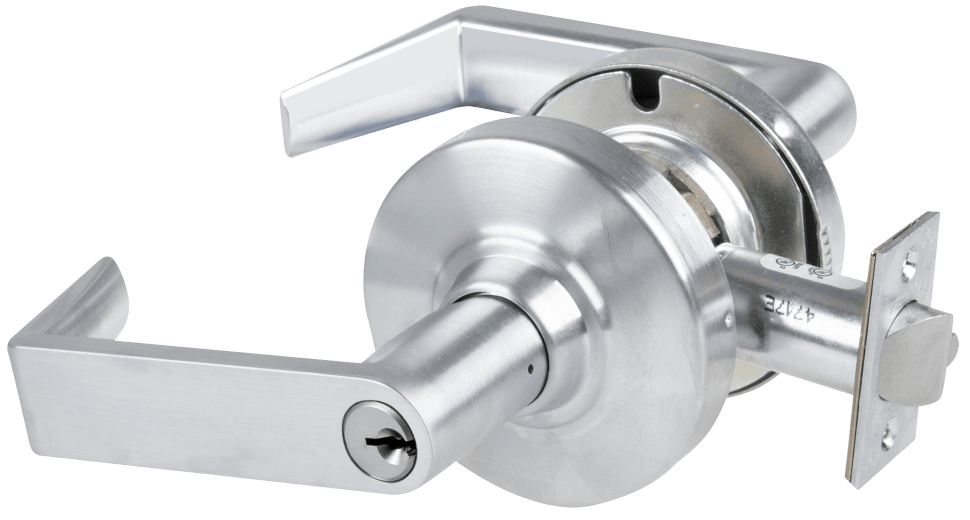
The chassis is the structural core of a cylindrical lock. It houses the latch mechanism, the lever return spring, and the tailpiece connection. When the chassis wears, the lock fails to latch reliably or the lever stops returning to position. Chassis assemblies are function-specific: a storeroom function chassis is not interchangeable with an office function chassis even within the same lock series. Always confirm the function code before ordering.
Tailpiece
The tailpiece links the cylinder to the internal lock mechanism and transmits key rotation to the latch or deadbolt. A failed tailpiece prevents the key from engaging the lock. Tailpieces are cylinder-format specific: FSIC (Full-Size Interchangeable Core) and SFIC (Small Format Interchangeable Core) tailpieces are different components and are not interchangeable. Confirm the cylinder format before ordering any tailpiece replacement.
Strike Plate (ANSI Strike)
The ANSI strike plate mounts on the door frame and receives the latch bolt on every door close. Strike plates wear at the latch pocket over time, particularly on high-traffic doors with heavy closing force. The 10-025 ANSI strike (4-7/8" x 1-1/4") is the most commonly replaced strike on commercial Schlage lock installations. Strike plates are one of the few security door parts that cross multiple lock series and brands.
Lever Trim and Rose Assembly
Lever trim is the finish-visible component that handles the most physical contact of any part on the lock. Levers that work loose, fail to return to position, or show finish wear are candidates for replacement before the lever shaft or chassis reaches the end of its service life. Rose assemblies hold the lever mechanism against the door face. Finish codes must match the installed hardware when ordering lever trim replacements.
Mortise Lock Components
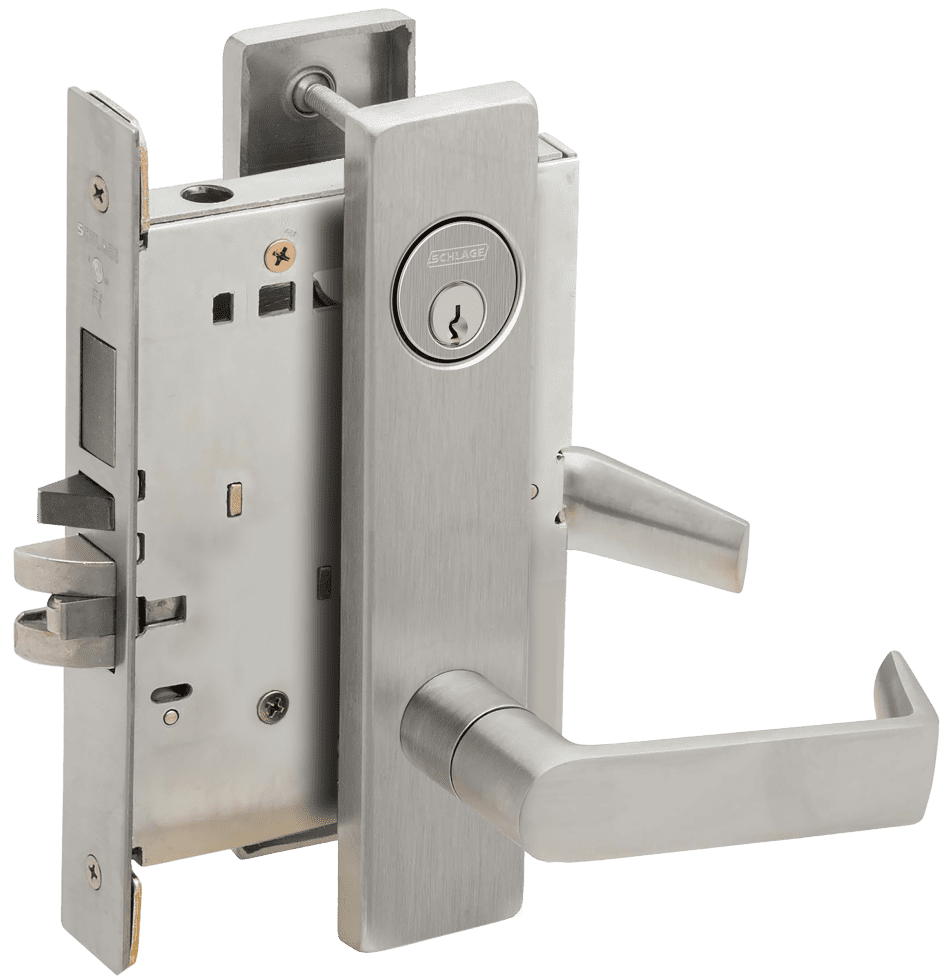
Mortise lock parts are more numerous and more model-specific than cylindrical lock parts. The Schlage L Series alone covers over sixty distinct model functions, and the chassis assembly, armor front, and cylinder trim components for an L9070 are different from those for an L9080. Confirm the exact model number stamped on the lock body before sourcing any mortise lock component. For the full breakdown by model and component category, see the Schlage L Series parts diagrams guide.
Electric Strike Parts and Deadbolt Parts
Electric Strike Parts
An electric strike replaces the standard strike plate and allows remote latch release as part of an access control system. The strike housing, keeper, and solenoid assembly are the main components. When an electric strike fails to release on a valid credential, the solenoid is typically the first component to check. When it fails to hold the door closed, the keeper and housing alignment need inspection before the solenoid is replaced. For a full component breakdown, see the electric strike parts guide.
Electric strikes are also used in access control integration alongside exit devices and locksets. For guidance on how electric strikes fit into a broader access control system, see the access control and commercial door hardware integration guide.
Deadbolt Parts
Deadbolts provide a secondary locking point on commercial doors where the primary lock function alone is not sufficient. The deadbolt cylinder, strike plate, tailpiece, and rose assembly are the main replacement components. Deadbolt strike plates are a frequent replacement on doors where the deadbolt is engaged under misalignment, which causes the strike pocket to elongate over time. For component identification on Schlage B Series deadbolts, see the deadbolt parts guide.
How to Identify Security Door Parts by Brand and Series
Correct parts identification is the difference between a repair completed in one service visit and a job that drags through two return trips and a wrong-part delay. Every security door part order should start with three pieces of confirmed information before any part number is looked up.
- Find the brand name on the device body The brand name is printed or stamped on the mechanism case, the closer body, or the lock chassis. On commercial hardware, the brand is almost always visible without disassembly. The brand determines which parts catalog applies.
- Confirm the series or model number The series designation appears near the brand name on a label or as a stamped code. For Von Duprin exit devices, this is a number like 98, 99, 22, or 88. For LCN closers, it is a four-digit number like 4040 or 1461. For Schlage locks, it is a letter-number combination like ND, L9070, or B60N. The series determines which specific parts apply and which parts do not cross-reference.
- Use a parts diagram to confirm the component Parts diagrams show the exploded view of the device with every component labeled and numbered. Identifying the failed component visually against the diagram confirms the part number before anything is ordered. SecurityParts.com provides interactive parts diagrams for every supported brand and series.
- Confirm finish if ordering visible trim components Lever trim, rose assemblies, end caps, and cover plates are finish-sensitive. The replacement must match the installed finish code. Sending back a satin chrome part when satin stainless was needed costs real time and money.
- Note manufacture date for older devices On older devices, the manufacture date affects which dogging parts apply. Von Duprin exit devices manufactured before August 1997 use different dogging replacement kits from current-specification parts. The manufacture date typically appears near the model number on the device label.
Brand and Series Reference for Security Door Parts
Security Door Parts for Fire-Rated Openings
Fire-rated door hardware operates under specific requirements that go beyond what applies to standard commercial hardware. Every security door part replaced on a fire-rated opening must preserve the UL listing of the complete assembly. For a full overview of fire-rated door hardware requirements, see the commercial door fire rating guide.
OEM Parts Are Required on Fire-Rated Doors
NFPA 80 requires that fire door hardware be maintained using parts that preserve the original UL listing. A non-OEM replacement part installed on a fire-rated exit device or lock voids the UL listing and creates a compliance failure at the next annual fire door inspection. The failed inspection is not the worst outcome: a fire door that does not latch because a non-OEM latch kit was installed creates a liability that goes well beyond the inspection report.
OEM vs Aftermarket Security Door Parts
On standard interior doors in low-traffic applications, aftermarket parts sometimes function adequately in the short term. The problems appear on high-cycle commercial openings and on fire-rated assemblies. An aftermarket latch kit that does not meet the dimensional tolerances of the original part produces inconsistent latch engagement over time. An aftermarket dogging shaft that is slightly undersized strips faster than the OEM equivalent.
The decision is clear: use OEM parts for all fire-rated hardware, all Grade 1 ANSI/BHMA certified hardware in high-traffic applications, and any device where a parts failure has a direct security consequence. For a complete analysis of the OEM versus aftermarket parts decision on commercial hardware, see the OEM vs aftermarket commercial door hardware parts guide.
SecurityParts.com stocks only OEM replacement parts. Every component in the catalog is manufactured to the original specification, maintaining ANSI/BHMA certification and UL listing integrity on fire-rated and Grade 1 hardware.
How to Order the Right Security Door Parts the First Time
Commercial door hardware returns are expensive and delay repairs on openings that may be critical to building security or life safety. A few consistent habits eliminate most ordering errors.
- Always confirm brand, series, and model number before looking up any part number. Never order by description alone.
- Use parts diagrams to confirm the specific component visually before placing the order. SecurityParts.com provides diagrams for every supported brand and series.
- Confirm finish code before ordering any trim component: lever trim, rose, end cap, or cover plate.
- Confirm whether the device is panic or fire-rated before ordering latch kits, dogging parts, or cover plates.
- Check the manufacture date on older devices before ordering dogging parts, where pre-1997 and post-1997 devices may require different components.
- Inspect adjacent components when replacing a worn part. A failed dogging spring often means the dogging adapter and shaft are also near the end of their service life.
For troubleshooting guidance when a security door part failure is not producing an obvious symptom, see the commercial door hardware troubleshooting guide. For code-compliance guidance on panic hardware, see the panic hardware for commercial doors guide.
For guidance on ANSI/BHMA Grade ratings and how they affect parts selection across every hardware category, see the ANSI/BHMA door hardware standards guide.
Why Choose SecurityParts.com for Security Door Parts
SecurityParts.com has supplied OEM commercial door hardware parts since 2001. The catalog covers Von Duprin exit devices, LCN door closers, Schlage and Falcon locks, and Detex exit alarms, with parts organized by brand, series, and component category.
- Parts diagram lookup for every supported series: Confirm the exact component visually before ordering. The interactive diagram shows where each part sits in the assembly and gives the part number directly.
- OEM parts only: Every component in the catalog is manufactured to the original specification, maintaining ANSI/BHMA certification and UL listing integrity on fire-rated and Grade 1 hardware.
- Parts for current and older series: The catalog covers devices still in service from older series alongside current production models. If a part is needed for an older device, call 845-935-0301 to confirm availability before ordering.
- Pre-order identification support: Call 845-935-0301 or email sales@securityparts.com to confirm the correct part for your specific device before the order ships. This is available for any supported brand and series.
- Same day shipping: Same day shipping on stocked OEM parts from US warehouses.
Browse exit device parts, door closer parts, cylindrical lock parts, mortise lock parts, electric strike parts, deadbolt parts, exit alarm parts, and door operator parts using the category links throughout this guide. For the complete catalog, visit all commercial door hardware parts at SecurityParts.com. Contact the team at 845-935-0301 or email sales@securityparts.com.