 Trusted Since 2001





Quick Answer
An exit alarm is a commercial door hardware device that sounds an audible alarm the moment a door is opened, without delaying or holding the door closed. It is used on secondary egress doors, utility exits, and service doors where unauthorized or casual use needs to be monitored but where immediate free egress is still required. The door opens freely when pushed. The alarm sounds immediately and continues until the door closes or is manually reset.
Exit alarms are a different product category from panic hardware and from delayed egress devices. Understanding the difference matters before specifying or replacing hardware on a commercial door.
What Is an Exit Alarm
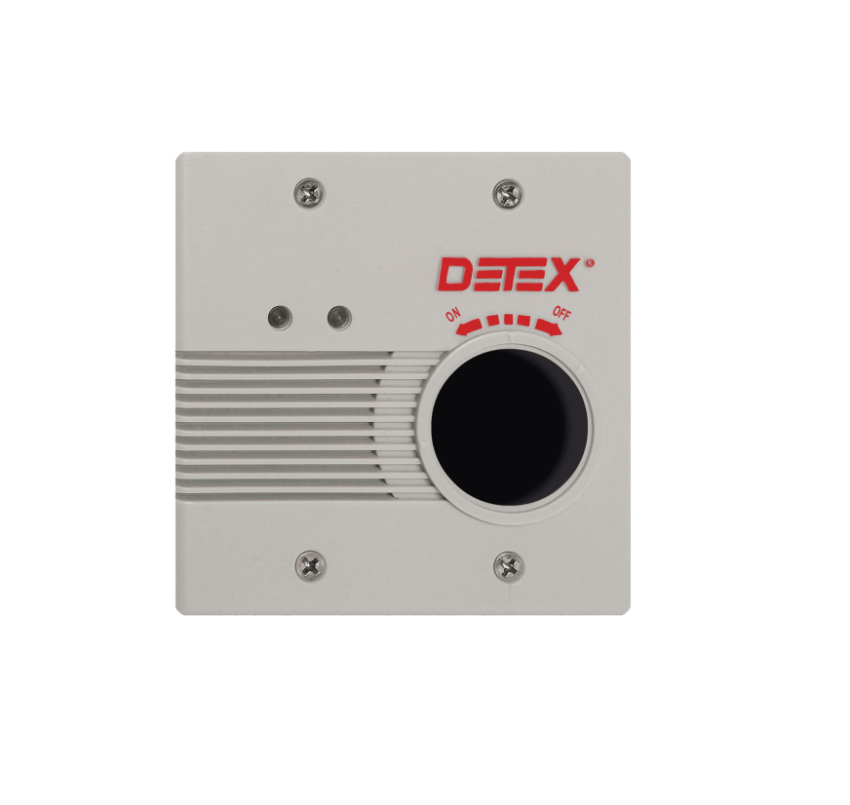
Detex EAX-2500S Surface Mount Exit Alarm. Installed on secondary egress and utility doors that require alarm monitoring without a delay. View product page.
An exit alarm is a locking and alarm assembly mounted on a commercial door. When someone pushes the door open, two things happen simultaneously: the door opens freely and an audible alarm sounds. There is no delay before the door releases. The alarm continues until the door closes and latches, or until an authorized person resets it with a key.
The primary purpose of an exit alarm is monitoring, not restriction. The device does not prevent a person from leaving. It creates an immediate audible alert that the door has been used, which allows staff or security personnel to respond. This makes exit alarms appropriate for doors where controlling casual or unauthorized access is the goal, rather than doors where panic hardware or delayed egress is required by code.
Exit alarm devices are most commonly installed on secondary egress doors, storeroom exits, loading dock doors, utility access doors, and service entrances in commercial buildings. They allow the building to maintain a primary egress path with proper panic hardware or fire exit hardware while monitoring secondary openings that see less regular traffic.
For a broader overview of exit device types and component categories, see the exit devices parts guide.
How an Exit Alarm Works
The sequence of events when an exit alarm door is opened is straightforward:
- Door contact: A person pushes the door open. The door opens freely with no resistance beyond normal door weight and closer spring.
- Immediate alarm: The alarm sounds within one second of the door opening. There is no grace period or delay before the alarm activates on a standard exit alarm device.
- Continuous alarm: The alarm continues for as long as the door remains open, or until a key reset is performed.
- Automatic reset: On most models, closing the door to the latched position stops the alarm and resets the device for the next use. Some models require a key reset by authorized staff.
The latch mechanism on an exit alarm device holds the door in the closed and latched position during normal operation. When the door is opened, the latch retracts and the alarm circuit activates. The alarm is integral to the device, typically a piezoelectric buzzer or speaker built into the device housing, producing a loud audible tone that can be heard from adjacent rooms or corridors.
Some exit alarm models also include a remote alarm output, allowing the alarm signal to be sent to a building management system, security panel, or remote annunciator. The Detex RLY24 and RLY12 relay kits are available for connecting exit alarm devices to remote monitoring systems, as covered in the wiring section below.
Exit Alarm vs Delayed Egress: Key Differences
Exit alarms and delayed egress devices are two distinct product categories that are sometimes confused because both include an alarm function. The differences are significant for specification and code compliance.
| Feature | Exit Alarm | Delayed Egress Device |
|---|---|---|
| Door opens | Immediately when pushed | After 15 or 30 seconds |
| Alarm activation | Sounds when door opens | Sounds when touchbar is pressed, before door opens |
| Delay period | No delay | 15 or 30 seconds before latch releases |
| Primary purpose | Monitoring unauthorized door use | Providing staff response time before egress |
| Fire alarm release required | Not required (no delay to release) | Yes -- must release immediately on fire alarm |
| Code basis | No code-mandated delay; used at specifier discretion | NFPA 101 Section 7.2.1.6 / IBC Section 1010.1.9.8 |
| AHJ approval required | Not typically required for exit alarm only | Required for every installation |
| Common applications | Secondary exits, utility doors, service entrances | Memory care, healthcare, schools, certain high-rise doors |
A delayed egress device holds the door locked for a code-permitted time period before releasing it automatically. An exit alarm releases the door immediately with no hold period. These devices are not interchangeable. If your project specifies delayed egress hardware, an exit alarm does not satisfy that requirement. For a full explanation of how delayed egress works and when it is required, see what is delayed egress.
Exit Alarm vs Panic Hardware: Key Differences
Panic hardware and exit alarms are also distinct products that serve different functions. They are sometimes found on different doors in the same building, and understanding which applies to which opening is important for specification and code compliance.
Panic hardware is a latch-releasing assembly that allows single-motion egress without a key and without sounding an alarm. It is required by both NFPA 101 and the IBC on egress doors serving assembly and educational occupancies with occupant loads of 50 or more, and on certain high-hazard occupancies. Standard panic hardware does not include an alarm function. It simply allows fast egress.
An exit alarm is a monitoring device. When the door opens, the alarm sounds. The exit alarm does not satisfy code requirements for panic hardware applications. You cannot substitute an exit alarm for code-required panic hardware.
In practice, a commercial building may have both: primary egress doors with panic hardware or fire exit hardware meeting code requirements, and secondary utility or service doors with exit alarm devices to monitor unauthorized use. The two product types serve different door types and different purposes within the same facility.
For a full explanation of panic hardware, exit device types, and code requirements, see the panic hardware for commercial doors guide and the exit device vs panic bar comparison guide.
Types of Exit Alarm Devices
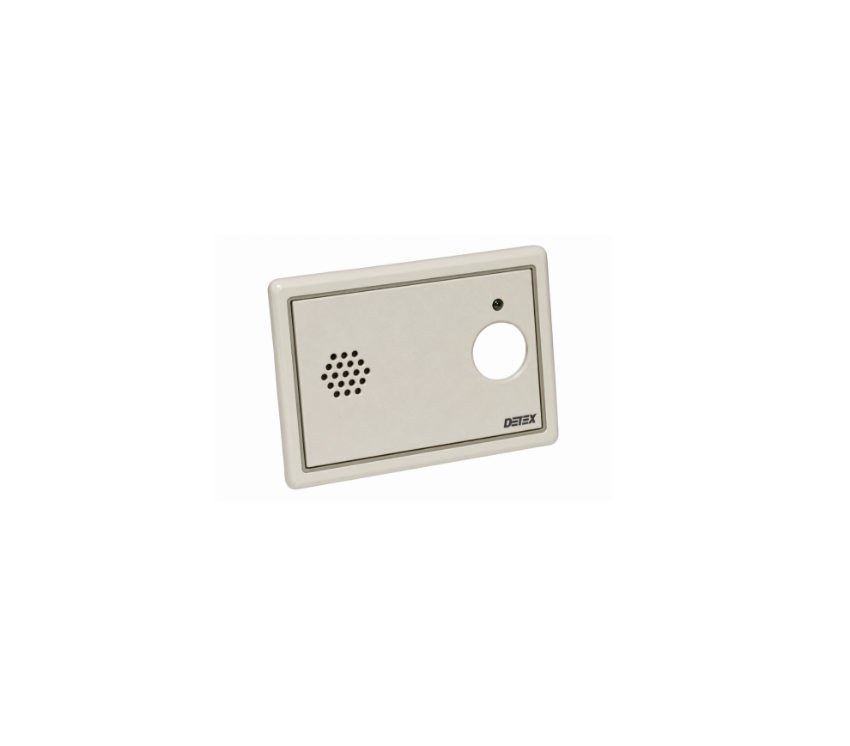
Detex EAX-4200SK Surface Mount Exit Alarm Door Prop Alarm Kit. Sounds when the door opens and continues if the door is propped open beyond the set time. View product page.
Exit alarm devices are available in several configurations. The right type depends on the door construction, mounting requirements, and whether door prop monitoring is needed.
Surface Mount Exit Alarm
A surface mount exit alarm attaches to the surface of the door and frame without requiring a door cutout or internal routing. The device chassis mounts on the door face and the strike or magnetic sensor mounts on the frame. Surface mount models are the most common choice for retrofit installations on existing doors because they do not require modification to the door itself.
The Detex EAX-2500S and EAX-2500SK are surface mount exit alarm units available as standalone devices and as complete kits including all required hardware for installation.
Flush Mount Exit Alarm
A flush mount exit alarm is recessed into a cutout in the door, resulting in a lower-profile installation where the device housing sits flush with the door surface rather than projecting outward. Flush mount models require door preparation and are more common in new construction or door replacement projects where the door can be prepared at the factory.
The Detex EAX-2500F and EAX-2500FK are flush mount exit alarm units for doors prepared for recessed installation.
Door Prop Alarm
A door prop alarm adds a timed threshold to the standard alarm function. The device does not sound immediately when the door opens. Instead, it allows a brief legitimate opening window (commonly 15 or 30 seconds) before the alarm activates. If the door closes within that window, no alarm sounds. If the door remains propped open past the threshold, the alarm activates.
Door prop alarms are useful on service doors and loading dock entrances where brief legitimate openings are routine but extended propping creates a security or energy problem. The Detex EAX-4200SK and EAX-3500SK include door prop alarm functionality with timed bypass capability.
Timed Bypass Exit Alarm
Some exit alarm models include a timed bypass function that allows authorized users to temporarily suppress the alarm for a set period. This is useful on high-traffic service doors during specific scheduled hours. The bypass is activated by an authorized key and expires automatically after the programmed time, restoring normal alarm operation without requiring staff to manually re-arm the device.
| Type | Alarm Triggers When | Mounting | Typical Use |
|---|---|---|---|
| Standard exit alarm | Door opens (immediately) | Surface or flush | Secondary exits, utility doors, storeroom exits |
| Door prop alarm | Door open past timed threshold | Surface | Service entrances, loading dock doors, delivery exits |
| Timed bypass alarm | Alarm suppressed for set period, then resumes | Surface | High-traffic service doors with scheduled access windows |
For a complete catalog of exit alarm parts and kits organized by product line, see the exit alarm parts and diagrams page.
Wiring and Power Options
Detex RLY24 24VAC Relay Kit for remote bypass on exit alarm systems. Allows the alarm output to be connected to a remote panel or monitoring system. View product page.
Exit alarm devices are available in battery-powered and hardwired configurations. The right choice depends on the availability of power at the door location and the monitoring requirements of the facility.
Battery-Powered Exit Alarms
Battery-powered exit alarm devices operate independently of building power and require no wiring beyond the device itself. They are the easiest to install on existing doors where running conduit or wire to the door location is impractical. Battery life depends on usage frequency and the specific model. Battery replacement is part of the maintenance schedule for battery-powered devices.
Battery-powered exit alarms are a common choice for retrofit installations on secondary doors in existing buildings where no low-voltage wiring is present at the door.
Hardwired Exit Alarms
Hardwired exit alarm devices connect to a low-voltage power supply in the building. Hardwired models are more suitable for new construction or for facilities where consistent power monitoring and integration with a building management system are required. Hardwired devices eliminate the need for periodic battery replacement and allow continuous power monitoring.
Remote Alarm Output and Relay Kits
Many exit alarm models support a remote alarm output connection, allowing the device to send an alarm signal to a remote panel, security system, or annunciator when triggered. The Detex RLY24 (24VAC) and RLY12 (12VAC) relay kits are available for connecting exit alarm devices to remote monitoring systems. The relay kit installs between the exit alarm device and the remote panel and passes the alarm signal through when the door is opened.
Remote monitoring integration is useful in facilities where security staff monitor multiple exits from a central location and need audible or visual notification when any monitored door opens. For a broader overview of access control integration with commercial door hardware, see the access control and commercial door hardware integration guide.
Required Exit Alarm Signage
Detex 102651-2 English/German Exit Alarm Door Sign. Code-compliant signage for exit alarm installations. Available in multiple languages. View product page.
Exit alarm doors require posted signage that alerts anyone approaching the door that opening it will trigger an alarm. The sign must be visible to a person approaching the door from the egress side before they push it open.
The specific code requirements for exit alarm signage vary by jurisdiction and the applicable code edition adopted locally. Consult the authority having jurisdiction (AHJ) for the sign format and placement requirements that apply to your project.
Security Parts stocks exit alarm door signs in multiple languages to meet the requirements of facilities serving multilingual populations or operating in jurisdictions with specific language requirements:
- English/German: Detex 102651-2
- Chinese (Simplified): Detex 102651-3
- Chinese (Traditional): Detex 102651-4
- French: Detex 102651-1
- Spanish: Detex EA-704-2
- German: Detex EA-561G
- French-Canadian: Detex EA-705
Signage is a required component of a compliant exit alarm installation, not an optional accessory. An exit alarm installation without the required posted sign may fail inspection even if the device itself is functioning correctly.
Where Exit Alarms Are Used: Building Type Applications
Exit alarms are appropriate across a wide range of commercial building types wherever secondary door monitoring is needed without the complexity of panic hardware or delayed egress devices.
| Building Type | Typical Exit Alarm Application | Notes |
|---|---|---|
| Retail and commercial | Back-of-house service doors, receiving exits, employee exits | Prevents unauthorized exit of stock; monitors staff exits |
| Schools and universities | Gym exits, cafeteria secondary doors, field access gates | Monitors unauthorized student exits on secondary doors |
| Healthcare facilities | Utility corridors, secondary exit stairwells, equipment room exits | Complements delayed egress on patient wing doors |
| Government buildings | Secure area secondary exits, file room service doors | Provides monitoring without requiring delayed egress approval |
| Industrial and warehouse | Loading dock pedestrian exits, yard access gates, storage exits | Door prop alarm variant often preferred for dock doors |
| Office buildings | Stairwell re-entry monitoring, server room exits, secondary lobby exits | Used where access control is not warranted but monitoring is needed |
For application-specific door hardware guidance, see the healthcare door hardware guide, the K-12 school door hardware guide, and the government buildings door hardware guide.
How to Choose the Right Exit Alarm
Selecting the right exit alarm configuration requires answers to five questions before ordering.
1. Is this a new installation or a retrofit?
New construction or door replacement allows for flush mount installation with the door prepared at the factory. Retrofit on an existing door typically requires a surface mount device to avoid door modification. Surface mount models (EAX-2500S, EAX-4200SK) work on most standard commercial doors without cutting or routing.
2. Is power available at the door?
If low-voltage wiring runs to the door location, a hardwired model is appropriate and eliminates battery maintenance. If no wiring is present, a battery-powered model provides a simpler retrofit installation. Confirm the power supply voltage matches the device requirements before ordering hardwired models.
3. Is door prop monitoring required?
If the concern is doors being held open for extended periods rather than brief openings, a door prop alarm model (EAX-4200SK, EAX-3500SK) is more appropriate than a standard exit alarm that sounds on every opening. Door prop alarms allow brief legitimate openings without triggering the alarm.
4. Is remote monitoring required?
If security staff need to be notified at a central location when a specific exit alarm door opens, a relay kit (RLY24 or RLY12) connects the alarm output to a remote panel or annunciator. Confirm the relay voltage matches the power supply before ordering.
5. What signage is required?
Confirm the required sign language and format with the AHJ before ordering. Security Parts stocks exit alarm door signs in seven language options. Order the sign as part of the installation rather than as a follow-up item to avoid an inspection issue on the first visit.
Exit Alarm Parts and Replacement Components
Exit alarm devices require periodic maintenance and occasional parts replacement. The most commonly replaced components are the battery (on battery-powered models), the door sign, and the latch or magnetic sensor assembly if damaged or worn.
When ordering replacement parts, identify the model number from the label on the installed device before contacting Security Parts. The model number determines which components are compatible. Security Parts stocks exit alarm parts and complete exit alarm kits across the Detex EAX series, including:
- Complete surface mount exit alarm units (EAX-2500S, EAX-4200SK, EAX-3500SK)
- Complete flush mount exit alarm units (EAX-2500F, EAX-3500FK)
- Complete exit alarm kits with all installation hardware (EAX-2500SK, EAX-2500FK, EAX-4200SK, EAX-3500SK, EAX-3500FK)
- Retrofit conversion kit for converting older EAX-2500F units (Detex 102640)
- Relay kits for remote alarm output (RLY24 for 24VAC, RLY12 for 12VAC)
- Exit alarm door signs in English/German, Chinese, French, Spanish, German, and French-Canadian
- Junction box with relay (JB-R)
- Slide-in filler kit for hardwired electric alarm installations (SIFV-EA)
For the complete exit alarm parts catalog, see the exit alarm parts and diagrams page. For troubleshooting an exit alarm that is not functioning correctly after installation, see the commercial door hardware troubleshooting guide. Call 845-935-0301 for pre-order compatibility support.
About the Author
This guide was written by the Security Parts team, a commercial door hardware specialist serving locksmiths, facilities managers, general contractors, and security integrators since 2001. Security Parts stocks exit alarm devices and replacement parts across the Detex EAX product line, with same-day shipping on stocked components. For related guidance, see the exit device vs panic bar guide, the delayed egress guide, and the Detex ECL parts guide.