 Trusted Since 2001





Quick Answer
Delayed egress is a code-permitted door locking system that holds a door locked for a short timed period after someone pushes the exit touchbar. The device triggers a loud audible alarm when touched, then automatically releases the latch and allows free exit after 15 or 30 seconds, depending on the code and occupancy type. It is not a means of preventing egress permanently. It is a life safety compromise that gives facilities time to respond to an unauthorized or unassisted exit attempt while still guaranteeing egress within the code-permitted window.
Delayed egress is most commonly found in memory care units, dementia wards, schools, government buildings, and certain healthcare facilities. It is governed by NFPA 101 Section 7.2.1.6 and IBC Section 1010.1.9.8. All delayed egress devices must release immediately when the fire alarm activates or when power is lost.
How a Delayed Egress Device Works
A delayed egress device looks similar to a standard exit device: a horizontal touchbar or push plate mounted across the door, connected to a latch mechanism that releases when pressed. The critical difference is the internal timing mechanism and alarm circuit.
Here is the sequence of events when someone pushes a delayed egress door:
- Touchbar contact: The person presses the touchbar or push plate. The door does not open immediately.
- Alarm activation: Within one second of touchbar contact, a built-in alarm sounds at the door. The alarm is loud enough to alert staff in an adjacent area. Some models also send a signal to a remote annunciator panel.
- Delay period: The door remains locked during the delay period. Under NFPA 101, the maximum permitted delay is 15 seconds. Under the IBC in jurisdictions that permit an extended delay, the maximum is 30 seconds for approved occupancy types.
- Automatic release: After the delay period expires, the latch retracts automatically and the door opens freely. The person does not need to maintain pressure on the touchbar throughout the delay. A single push is sufficient to start the timing sequence.
- Reset: When the door returns to the closed position, the device resets automatically to the locked state, ready for the next cycle.
The device must be powered, typically by 24VDC from the building's security or access control power supply. When power is removed, the device defaults to free egress with no delay (fail-safe). When the fire alarm activates, the device receives a release signal from the fire alarm panel and immediately retracts the latch, bypassing the delay entirely.
NFPA 101 Section 7.2.1.6: Plain-Language Explanation
NFPA 101, the Life Safety Code, is the primary code governing delayed egress in the United States. Section 7.2.1.6 sets the conditions under which a delayed egress locking system is permitted.
In plain terms, the code says the following:
- The delayed egress system is only permitted where the building is protected throughout by an approved automatic fire suppression system or an approved automatic fire detection system.
- The maximum delay is 15 seconds from the time the touchbar is pressed until the door releases.
- The device must sound an audible alarm at the door when the touchbar is pressed.
- The device must release immediately when the fire alarm system activates anywhere in the building, not just in the zone where the door is located.
- The device must release immediately when power to the device is lost.
- The door must be provided with a readily visible posted sign that tells users the alarm will sound and the door will open after the delay period. This sign is not optional.
- Only one such device may be installed on any egress path, meaning a person cannot be required to pass through more than one delayed egress door before reaching a public way or area of refuge.
The specific occupancy chapters of NFPA 101 also affect where delayed egress is permitted. The general rule in Section 7.2.1.6 permits delayed egress in specific occupancy types. The AHJ has authority to approve or deny the installation based on the occupancy classification and the building's fire protection systems.
IBC Section 1010.1.9.8: Plain-Language Explanation
The International Building Code (IBC), adopted in most US jurisdictions, addresses delayed egress in Section 1010.1.9.8. The IBC provisions are largely consistent with NFPA 101 but include one significant difference: the permitted delay can extend to 30 seconds in specific occupancy types when approved by the AHJ.
In plain terms, the IBC says the following:
- Delayed egress is permitted only where the building is equipped throughout with an automatic sprinkler system or an approved fire detection system.
- The locking system must release when a signal is received from the sprinkler system, the fire detection system, or a manual fire alarm initiation device.
- The system must release upon loss of power controlling the lock.
- The required signage must be posted on the door at an approved location and in an approved format.
- A 15-second delay applies by default. A 30-second delay is permitted for Group I-1 (assisted living, residential care), Group I-2 (hospitals, nursing facilities), Group I-3 (detention and correctional facilities), and Group R-1 (hotels) occupancies when specifically approved by the AHJ.
- Only one delayed egress device may be encountered on any single egress path to the public way.
The 15-Second vs 30-Second Delayed Egress Rule
The distinction between a 15-second and 30-second delay is one of the most common specification questions for delayed egress projects.
| Delay Setting | Code Authority | Typical Application | AHJ Approval Required |
|---|---|---|---|
| 15 seconds | NFPA 101, IBC (default) | Most commercial, educational, government, and healthcare buildings | Yes -- AHJ must approve delayed egress for the occupancy type |
| 30 seconds | IBC Section 1010.1.9.8 (extended) | Memory care units, dementia wards, assisted living, hospitals, detention facilities, hotels | Yes -- AHJ must specifically approve the 30-second delay for the occupancy group |
The 30-second delay exists primarily for memory care and dementia applications, where a resident may attempt to exit but will typically stop or turn back within 30 seconds when staff responds. In these settings, a 15-second delay may not give staff adequate response time before the door releases.
The Detex ECL-230X series supports both 15-second and 30-second delay settings. Confirm with the AHJ which setting is approved for the specific occupancy before specifying or installing the device. For detailed parts information on the ECL-230X series, see the Detex ECL parts guide.
Delayed Egress vs Free Egress: What Is the Difference
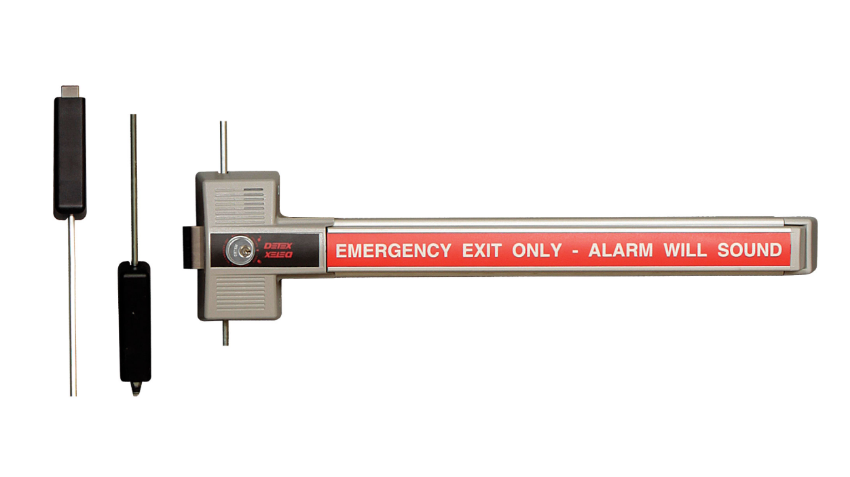
Detex ECL-230X-TDB 3-Point Delayed Egress Exit Control Lock. View product page.
Most commercial exit devices provide free egress: push the bar and the door opens immediately. Delayed egress is a specific modification to that behavior, permitted only in certain building types and only with AHJ approval.
| Feature | Free Egress Device | Delayed Egress Device |
|---|---|---|
| Door opens when | Immediately on touchbar contact | After 15 or 30 seconds |
| Alarm on touchbar contact | No (dogged devices are silent) | Yes -- within 1 second of contact |
| Fire alarm behavior | No change (already free egress) | Immediate latch release, no delay |
| Power failure behavior | No change | Immediate latch release, no delay |
| Required posted signage | Standard exit signage only | Code-compliant delayed egress sign required |
| AHJ approval | Not required for standard use | Required for every installation |
| Occupancy restriction | Most occupancy types | Specific occupancy types only |
| Per-egress-path limit | No limit | Maximum one delayed egress door per egress path |
For broader context on exit device types and how to select the right one for your opening, see the exit devices parts guide and the panic hardware for commercial doors guide.
What Happens During a Fire Alarm, Power Failure, and Reset
Fire Alarm Release
A delayed egress device must be wired to the building fire alarm panel. When the fire alarm activates anywhere in the building, the fire alarm panel sends a release signal to every delayed egress device in the system. All delayed egress doors release immediately and revert to standard push-to-exit operation with no delay and no alarm requirement. This release must happen regardless of whether a touchbar has been pressed or a delay sequence is in progress.
If the building's fire alarm panel trips during an active delay sequence, the delay is cancelled immediately and the door opens. People do not have to wait out the remaining delay during a fire event.
Confirm that the fire alarm integration wiring is completed and tested before the delayed egress system is put into service. A delayed egress device that is not connected to the fire alarm system does not meet the code requirements of NFPA 101 Section 7.2.1.6 or IBC Section 1010.1.9.8 and cannot be legally installed on an egress path.
Power Failure Release
Loss of power to the delayed egress device causes the latch to release and the door to revert to free egress. This fail-safe behavior is required by both NFPA 101 and the IBC. The device cannot hold the door locked without power.
The Detex ECL-230X series operates on 24VDC and requires continuous power to maintain the delayed egress locking function. When power is removed, the device releases within milliseconds and the door operates as a standard push-to-exit device.
Some ECL installations include battery backup to maintain alarm annunciation capability during brief power interruptions. However, battery backup does not change the fail-safe locking behavior: the door must release on power loss, even if the battery is powering auxiliary functions.
Reset After a Delay Cycle
After a completed delay cycle (when someone pushes the bar and the door opens after the delay), the device resets automatically when the door returns to the closed and latched position. No manual action is required to reset the device to the delayed egress state. The device is ready for the next cycle as soon as the door is closed.
Some ECL models require a manual reset by staff using an authorized key or credential if the device has been triggered. Confirm the reset behavior of the specific model when specifying or installing the device, since this affects how staff workflows are designed around the door.
Where Delayed Egress Is Used: Building Types and Applications
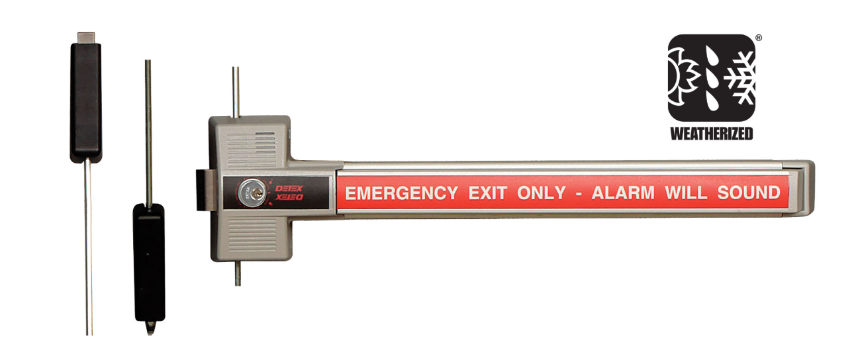
Detex ECL-230X-W-TDB Weatherized 3-Point Delayed Egress Lock for exterior applications. View product page.
| Building Type | Typical Application | Common Delay Setting | Notes |
|---|---|---|---|
| Healthcare -- Memory Care and Dementia Units | Perimeter exit doors, unit entry/exit doors | 30 seconds (IBC Group I-1/I-2) | Most common application; 30-second delay requires AHJ approval |
| Healthcare -- Hospitals and Nursing Facilities | Psychiatric unit doors, behavioral health exits | 15 or 30 seconds | Delay setting depends on occupancy classification and AHJ |
| K-12 Schools | Exterior exit doors, perimeter doors during school hours | 15 seconds | Used to monitor unauthorized student exits; alarms alert staff |
| Universities and Colleges | Dormitory perimeter doors, controlled campus exits | 15 seconds | Commonly installed with access control integration for after-hours monitoring |
| Government Buildings | Controlled area exits, file room perimeter doors | 15 seconds | Used to monitor exits from restricted areas without fully restricting egress |
| High-Rise Buildings | Stairwell re-entry doors, controlled floor exits | 15 seconds | Must meet NFPA 101 high-rise provisions; fire alarm integration is critical |
| Retail and Commercial | Loss prevention exits, back-of-house egress doors | 15 seconds | AHJ approval required; typically used on secondary egress paths only |
| Detention and Correctional Facilities | Controlled egress from detention areas | 15 or 30 seconds (IBC Group I-3) | Special IBC provisions apply for this occupancy type |
For application-specific guidance on commercial door hardware requirements, see the healthcare door hardware guide, the K-12 school door hardware guide, the universities door hardware guide, the government buildings guide, and the high-rise buildings guide.
Delayed Egress Signage: What the Code Requires
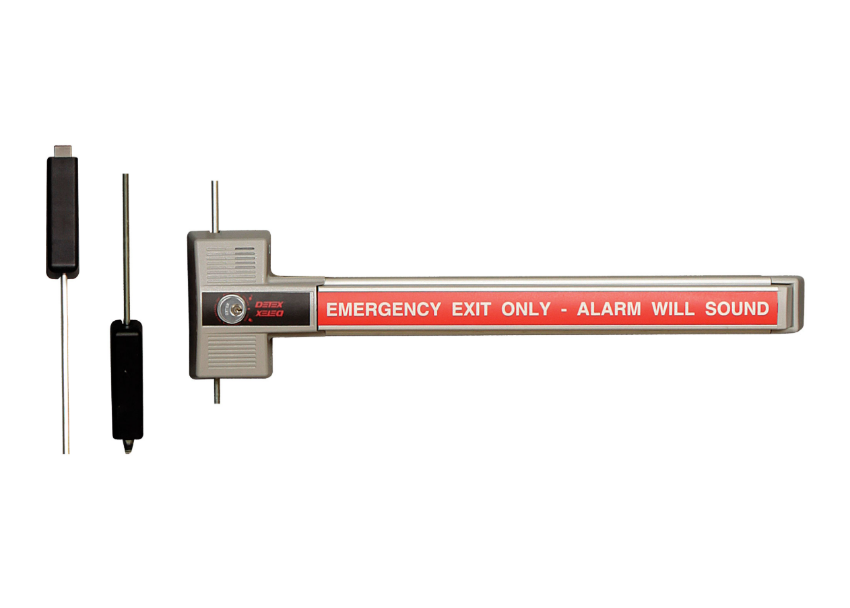
Detex ECL-230X-TB 2-Point Delayed Egress Exit Control Lock for interior applications. View product page.
Both NFPA 101 Section 7.2.1.6 and IBC Section 1010.1.9.8 require that a compliant sign be posted on every delayed egress door. The sign is not optional and is not satisfied by standard exit signage.
The required sign must communicate the following to anyone approaching the door:
- Pushing the bar will activate an alarm
- The door will open after a specified number of seconds (15 or 30, as applicable)
- The information must be clear, readable, and positioned where someone approaching the door will see it before pushing the bar
The Detex ECL-395 series provides code-compliant delayed egress door signs available in multiple languages: English, Spanish, French, French-Canadian, and German. These signs are listed by code as a requirement accompanying every delayed egress installation, not as an accessory upgrade. An installation that has a delayed egress device but lacks the required posted sign fails the code requirements of NFPA 101 and the IBC and will be flagged during any AHJ inspection.
The sign must be inspected annually to confirm it is intact, legible, and properly positioned. A torn, missing, faded, or obstructed sign is a code deficiency even if the device itself is functioning correctly.
2-Point vs 3-Point Delayed Egress: Which Model to Choose
The Detex ECL-230X series is available in two primary locking configurations: 2-point (single latchbolt) and 3-point (top, bottom, and latchbolt). Choosing the correct configuration depends on the door type and the security and code requirements of the opening.
2-Point Delayed Egress (ECL-230X-TB / ECL-230X-W-TB)
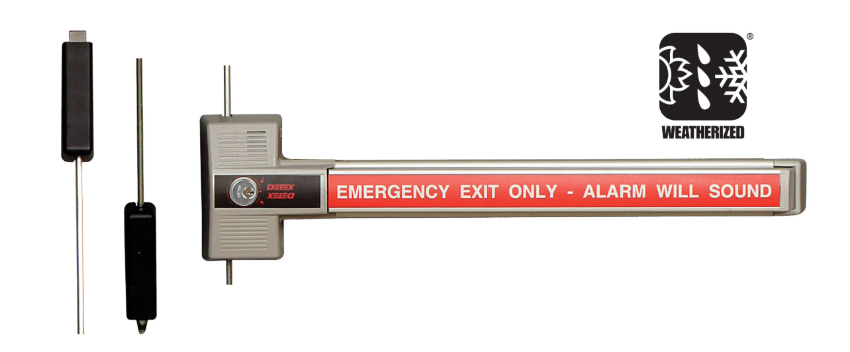
Detex ECL-230X-W-TB Weatherized 2-Point Delayed Egress Lock. View product page.
The 2-point model uses a single latchbolt at the device chassis, engaging one strike point on the door frame. This is the standard configuration for most interior delayed egress applications where the door and frame are in good condition and the single latch is sufficient to hold the door during the delay period. The weatherized version (ECL-230X-W-TB) is appropriate for exterior applications exposed to weather.
3-Point Delayed Egress (ECL-230X-TDB / ECL-230X-W-TDB)
The 3-point model adds top and bottom latching in addition to the chassis latch, providing three points of engagement against the frame. This configuration is used when additional door stability is required during the delay period, when the door gap is inconsistent due to door warping, or when the AHJ or security integrator requires multi-point engagement for higher-security delayed egress applications.
| Model | Latch Points | Weatherized | Typical Use | Product Page |
|---|---|---|---|---|
| ECL-230X-TB | 2-point | No | Interior doors | View |
| ECL-230X-W-TB | 2-point | Yes | Exterior / covered egress paths | View |
| ECL-230X-TDB | 3-point | No | Interior doors requiring multi-point engagement | View |
| ECL-230X-W-TDB | 3-point | Yes | Exterior doors requiring multi-point engagement | View |
For replacement parts, mechanism assemblies, strike kits, bar components, and accessory kits for all ECL-230X models, see the complete Detex ECL parts guide.
Annual Inspection and Testing Checklist for Delayed Egress Devices
NFPA 101 requires annual inspection and testing of life safety features including delayed egress systems. NFPA 80 also requires annual inspection of fire-rated door assemblies, which includes any delayed egress device installed on a fire-rated door. Written records of each inspection must be maintained and made available to the AHJ upon request.
For the complete commercial door hardware maintenance schedule, see the commercial door hardware maintenance checklist.
Functional Operation Test
- Push the touchbar and confirm the alarm activates within one second of contact
- Time the delay from touchbar contact to latch release. Confirm the measured delay matches the programmed setting (15 or 30 seconds)
- Confirm the door opens freely after the delay period without requiring a second push
- Allow the door to close and confirm it returns to the latched and delayed egress state automatically
Fire Alarm Release Test
- With the delayed egress device activated (during the delay sequence), trigger a test signal from the fire alarm panel
- Confirm the latch releases immediately upon receiving the fire alarm signal
- Confirm the door operates as a standard free egress device with no delay during the fire alarm signal
- Reset the fire alarm panel and confirm the delayed egress device returns to normal operation
- This test must be performed in coordination with the building fire alarm system contractor or the AHJ
Power Failure Release Test
- Disconnect power to the delayed egress device at the power supply
- Confirm the latch releases immediately and the door opens freely
- Reconnect power and confirm the device returns to normal delayed egress operation when the door is closed and latched
Signage Inspection
- Confirm the required delayed egress sign is present, intact, and legible
- Confirm the sign is positioned where it is visible to anyone approaching the door from the egress side
- Confirm the sign specifies the correct delay period (15 or 30 seconds as applicable)
- Replace any sign that is torn, faded, obstructed, missing, or specifies the incorrect delay period
Physical Inspection
- Inspect the touchbar or push plate for physical damage, wear, or looseness
- Check all mounting fasteners for tightness
- Inspect the strike kit and latch engagement for alignment and wear
- Confirm the alarm speaker is unobstructed and produces audible output at the required sound level
- Inspect all wiring connections at the device and at the power supply for corrosion or looseness
- Document all inspection results and note any deficiencies found and corrected
Where to Source Delayed Egress Hardware and Replacement Parts
Security Parts stocks Detex ECL-230X delayed egress exit control locks in all four configurations (2-point standard, 2-point weatherized, 3-point standard, 3-point weatherized) and stocks 59 ECL-series replacement parts including internal mechanism assemblies, bar and paddle components, strike kits, cover and shield assemblies, outside trim, cylinder components, accessory kits, and code-required delayed egress door signs.
For the complete parts catalog organized by component category, see the Detex ECL parts guide. For general exit device parts and component identification, see the exit devices parts guide. For guidance on exit device installation, see the exit device installation guide. For troubleshooting a delayed egress device that is not functioning correctly after installation, see the commercial door hardware troubleshooting guide.
Call 845-935-0301 for pre-order compatibility support when selecting replacement parts for an existing ECL installation.
About the Author
This guide was written by the Security Parts team, a commercial door hardware specialist serving locksmiths, facilities managers, general contractors, and security integrators since 2001. Security Parts stocks Detex ECL-230X delayed egress exit control locks in all configurations and 59 ECL-series replacement parts, with same-day shipping on stocked components and pre-order compatibility support at 845-935-0301. For related guidance, see the commercial door fire rating guide and the access control and commercial door hardware integration guide.