 Trusted Since 2001





A thumbturn cylinder is one of the most commonly specified components in commercial door hardware, yet it is one of the least explained. This guide covers what a thumbturn cylinder is, how it works mechanically, how it differs from a double cylinder and a coin turn, how it functions within mortise lock ANSI function codes, when building codes restrict its use on glazed openings, and how to identify a thumbturn cylinder that needs service or replacement.
SecurityParts.com stocks commercial deadbolts and mortise locks equipped with thumbturn cylinders across multiple Schlage product lines. Browse the commercial deadbolts catalog, the commercial mortise locks catalog, and the complete Schlage hardware parts catalog. For parts identification, call 845-935-0301 or visit the SecurityParts.com contact page.
What Is a Thumbturn Cylinder?
A thumbturn cylinder is the interior actuator component on a single-cylinder deadbolt or mortise lock that allows the occupant to operate the deadbolt from the inside without a key. The user grips a small wing- or oval-shaped knob, called the thumbturn, and rotates it to throw or retract the deadbolt. On the exterior side of the door, a standard keyed cylinder provides key-controlled entry.
The term "thumbturn cylinder" describes the complete interior assembly including the thumbturn knob, the housing or escutcheon that holds it, and the internal tailpiece or cam that transmits rotation to the lock mechanism. In deadbolt hardware, this interior assembly is a separate component from the exterior key cylinder. In mortise locks, both the exterior key cylinder and the interior thumbturn are independent components that mount into the mortise case from the door face.

Schlage commercial deadbolts and mortise locks with thumbturn cylinder configurations at SecurityParts.com
How a Thumbturn Cylinder Works
Inside the deadbolt or mortise lock case, a cam or tailpiece extends from the back of the lock cylinder. When the keyed exterior cylinder is turned with a key, the cam rotates and drives the deadbolt mechanism. When the thumbturn interior cylinder is rotated by hand, the same mechanism is driven from the opposite side through a separate internal linkage.
The thumbturn and exterior key cylinder are mechanically independent. Turning the thumbturn does not affect the exterior cylinder, and vice versa. This independent operation is what makes the single-cylinder configuration the standard for most commercial interior and exterior openings: occupants can lock or unlock from the inside at any time, while outside entry always requires a key.
How the Thumbturn Cylinder Differs From the Key Cylinder
A key cylinder requires a correctly cut key to operate. A thumbturn cylinder requires only a hand. The two components occupy the same position in the lock assembly but on opposite sides of the door. In most single-cylinder deadbolts, the key cylinder sits on the exterior rose or escutcheon and the thumbturn sits on the interior rose or escutcheon. In mortise locks, both cylinders thread into the mortise case body and are held in place by set screws.
The cam or tailpiece on the back of a thumbturn cylinder is typically identical to the cam on the key cylinder it pairs with. Both engage the same internal mechanism from their respective sides. The difference is only in how the operator interface works: cut-key versus hand rotation.
Single Cylinder vs Double Cylinder: When to Use Each
The choice between a single-cylinder deadbolt (thumbturn inside, key outside) and a double-cylinder deadbolt (key on both sides) is one of the most consequential decisions in commercial door hardware specification. Getting it wrong creates either a security vulnerability or a life-safety hazard.
Single Cylinder (Thumbturn Inside)
Interior operation: Thumbturn no key required for egress
Exterior operation: Keyed cylinder required for entry
IBC compliance: Required by IBC Section 1010 for most occupied spaces
Fire egress: Occupant can always exit without a key
Best for: Interior office doors, hotel room entry, storeroom, corridor doors, most commercial openings
Risk: Thumbturn can be operated through broken adjacent glass if within arm's reach
Double Cylinder (Key Both Sides)
Interior operation: Key required no thumbturn
Exterior operation: Keyed cylinder required for entry
IBC compliance: Permitted only on specific glass-adjacent openings per Section 1010.2.4
Fire egress: Occupant must have a key to exit significant life-safety concern
Best for: Glass-panel openings where thumbturn could be reached through broken glass
Risk: Occupant trapped inside during emergency if interior key is lost or unavailable
When IBC Section 1010 Permits Double Cylinder
IBC Section 1010.2.4 permits a double-cylinder deadbolt specifically when the opening is located within 40 inches of a panel of glass that could be broken to reach the interior thumbturn. The reasoning is that a thumbturn in that position creates a reach-through vulnerability: an intruder breaks the adjacent glass, extends an arm through the opening, and rotates the thumbturn to unlock the door from the outside.
Even when double cylinder is permitted, the authority having jurisdiction must approve the specification. The interior key must be kept immediately accessible to occupants, typically on a hook adjacent to the door. Double cylinder is never appropriate on a fire-rated egress door without specific approval from the local fire marshal, because NFPA 80 requires that fire doors open freely for egress.
The Reach-Through Risk and How to Mitigate It
The reach-through security risk applies when a thumbturn cylinder is installed on a door with breakable glass within arm's reach of the interior thumbturn. The four commercial mitigation strategies, in order of frequency of use, are:
- Double-cylinder deadbolt on openings where IBC and the AHJ permit it, with interior key maintained accessible
- Impact-resistant or laminated security glazing that holds together when struck and prevents arm entry through the opening
- Electronic access control replacing the deadbolt entirely so the interior device is a push-button or request-to-exit switch, not a thumbturn
- Relocating the lock to a position on the door or frame that is not reachable through the adjacent glass
Thumbturn Cylinder vs Coin Turn: Which to Specify
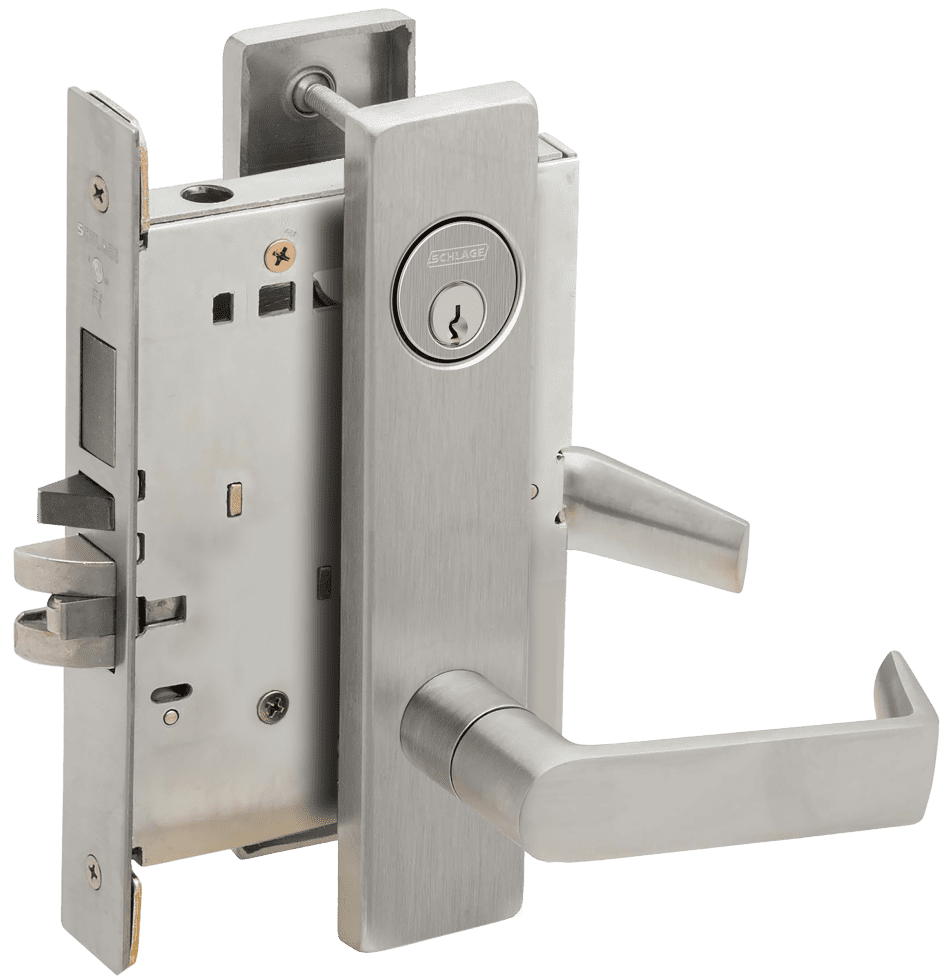
Schlage L Series mortise lock supports both thumbturn and coin turn interior cylinder configurations
A thumbturn and a coin turn perform the same mechanical function inside the deadbolt or mortise lock. The difference is entirely in how the user interface works. A thumbturn rotates easily with two fingers. A coin turn is a flat disc with a slotted face that requires a coin, a flathead screwdriver, or a proprietary tool to operate.
When to Specify a Coin Turn
Coin turns are specified in commercial and institutional settings where staff-only interior control is required without issuing keys to every occupant. The tool-requirement limits who can operate the lock from the inside without authorization. Common applications include:
- Patient room doors in behavioral health and psychiatric facilities where a patient operating a thumbturn from the inside without staff knowledge creates a safety concern
- Storeroom and secure-area doors where staff need to lock a door from the inside temporarily without issuing a key to every person who uses the room
- Accessible toilet room privacy locks in healthcare facilities, replacing a standard thumbturn to prevent patients from accidentally locking themselves in
- Server room and IT room doors where the interior control should require a deliberate tool-assisted operation rather than a casual thumbturn rotation
Coin Turn in the Mortise Lock Function Code
On Schlage L Series and other commercial mortise locks, the coin turn is available as an alternative to the thumbturn on specific function codes. In function codes where the interior cylinder controls the deadbolt or locks the outside trim, a coin turn can be specified in place of a thumbturn. The mortise case mechanism is identical. Only the interior interface component changes. Specify the coin turn at the hardware schedule stage, before the lock body is ordered, because field-converting a thumbturn mortise to a coin turn configuration requires the correct interior trim components for that specific function code.
Thumbturn Cylinder in Commercial Mortise Lock Function Codes
In commercial mortise locks, the thumbturn cylinder does not always perform the same function. The ANSI function code determines exactly what the thumbturn controls at each opening. Understanding this is essential for correct specification, because the wrong function code produces the wrong door behavior regardless of how the thumbturn itself is installed.
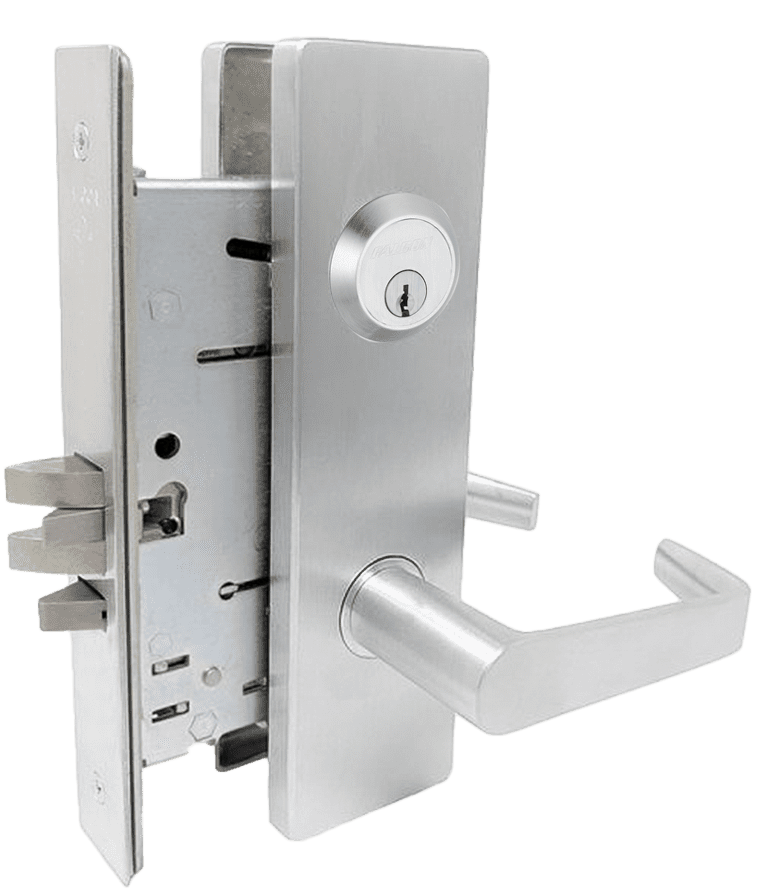
Schlage MA Series commercial mortise lock at SecurityParts.com available in ANSI function codes with thumbturn interior cylinder
- F02PrivacyThumbturn throws and retracts the deadbolt from inside. Outside has emergency release only. Used on restrooms, single-occupancy offices, dressing rooms.
- F04Entrance / OfficeThumbturn locks or unlocks the outside lever trim from the inside without a key. Inside lever always free. Used on office suite entry doors, retail entry doors.
- F09ApartmentKey inside required to control outside trim. Inside lever always free for egress. Thumbturn not the standard actuator coin turn or key cylinder inside. Used on apartment and dormitory entry doors.
- F13Hotel / ApartmentInside lever controls both deadbolt and latch. Thumbturn on the keyed side shows an occupied indicator. Outside always requires key. Used on hotel rooms, dormitories.
- F15Hotel / MotelThumbturn controls deadbolt from inside with occupied indicator visible from outside. Outside lever always key-operated. Used on hotel and motel room doors where room status needs to be visible from the corridor.
- F07StoreroomNo thumbturn on interior inside lever always free for egress, outside lever always locked and requires key. Used on storage rooms, server rooms, mechanical rooms.
For a complete guide to Schlage L Series mortise lock parts and function diagrams, see the Schlage L Series mortise lock parts diagrams. For mortise lock parts identification across all models, see the commercial mortise lock parts guide at SecurityParts.com.
Thumbturn Cylinder in Commercial Deadbolts
In commercial deadbolts, the thumbturn cylinder has a simpler and more consistent role than in mortise locks. The thumbturn throws or retracts the deadbolt. That is its only function. The exterior key cylinder performs the same operation from the outside. Together, the two cylinders give the occupant and the authorized key-holder independent control over the same bolt.
Schlage B Series Deadbolts and Thumbturn Cylinder Options
The Schlage B Series is the most widely specified single-cylinder commercial deadbolt line in the United States. Every single-cylinder model in the B Series includes a thumbturn on the interior side. The thumbturn on B Series deadbolts is a fixed-wing style that rotates 90 degrees to throw or retract the 1-inch deadbolt. The thumbturn assembly is part of the interior rose and tailpiece assembly.
Single-cylinder B Series models include the B250, B350, B360, B460, and related configurations. Double-cylinder models (no thumbturn, key on both sides) include the B252, B352, and related double-cylinder configurations. When ordering Schlage B Series hardware, confirm the correct configuration by identifying whether the model number suffix indicates single cylinder or double cylinder.
For complete parts identification on Schlage B Series deadbolts including thumbturn assemblies, interior roses, and tailpieces, see the Schlage B Series deadbolt parts guide. For visual component identification, see the Schlage deadbolt diagram. Browse the complete commercial deadbolts catalog at SecurityParts.com.
Thumbturn Cylinder in Cylindrical Locks
Cylindrical locks generally do not include a standalone thumbturn cylinder. The interior actuator on cylindrical privacy locks is a push-button or turn-button integrated into the interior lever or knob escutcheon. This is mechanically different from the thumbturn assembly found on deadbolts and mortise locks. In cylindrical lock terminology, the interior button activates a locking pin inside the lock body, not a separate cylinder cam. The thumbturn configuration in the commercial hardware context specifically refers to the mortise cylinder or deadbolt configuration, not the interior button on a cylindrical lock.
For cylindrical lock parts including interior button assemblies and lever trim, see the cylindrical locks catalog at SecurityParts.com.
Thumbturn Cylinder in Exit Device Outside Trim
Exit devices (panic bars) can be specified with an outside trim cylinder that includes a thumbturn on the interior side of the trim plate. This configuration is less common than a standard keyed outside trim, but it is specified on openings where the door must be locked and unlocked from the inside without a key, while still requiring a key for outside entry.
On Von Duprin and Falcon exit devices, outside trim options include rim cylinders, mortise cylinders, and thumbturn-equipped trim plates for specific functions. The thumbturn in this context operates the exit device's outside trim mechanism, not the push bar or latch retraction. The push bar always operates freely for egress regardless of how the outside trim is configured.
For Von Duprin exit device trim options and outside cylinder configurations, see the Von Duprin parts and series catalog. For Falcon exit device trim options, see the Falcon hardware catalog at SecurityParts.com.
How to Identify a Thumbturn Cylinder That Needs Service or Replacement
Thumbturn cylinders fail gradually in most cases, giving identifiable symptoms before they stop functioning entirely. Identifying the failure mode determines whether the fix is lubrication, adjustment, or replacement.
- Thumbturn is stiff and requires significant forceWorn internal components, corrosion inside the cylinder, or door misalignment putting lateral stress on the thumbturn assembly. Try dry graphite or dry PTFE lubricant first. If stiffness persists, check door alignment before replacing the thumbturn.
- Thumbturn rotates but bolt does not move consistentlyWorn or damaged cam or tailpiece connection between the thumbturn cylinder and the bolt mechanism. The cam has lost its positive engagement with the lock mechanism. Replace the thumbturn assembly or the cam.
- Thumbturn spins freely with no resistanceStripped cam, broken tailpiece, or disconnected internal linkage. The thumbturn is completely disengaged from the bolt mechanism. Replacement of the thumbturn assembly or the complete interior cylinder is required.
- Thumbturn requires more than one full rotation to move the boltCam slippage or worn spline engagement between the thumbturn and the lock spindle. The cam is no longer positively keying to the spindle and is rotating past the engagement point before driving the bolt.
- Thumbturn is loose and wiggles laterallyLoose mounting screws on the interior rose or escutcheon, or a worn interior spindle bearing. Tighten the interior rose screws first. If looseness persists after tightening, the interior housing has worn and the assembly needs replacement.
Thumbturn Cylinder Maintenance Best Practices
A thumbturn cylinder in a well-maintained commercial lock should operate smoothly for the full cycle life of the lock body. Most thumbturn failures on high-cycle commercial openings are caused by deferred maintenance rather than inherent component wear. Incorporating thumbturn inspection into the standard door hardware maintenance schedule prevents the majority of field failures.
- Test the thumbturn operation at every scheduled hardware inspection. Rotate through the full throw and retract arc and note any stiffness, inconsistency, or looseness. Catching early wear symptoms prevents a complete failure that leaves a door unable to lock.
- Inspect the cam engagement by removing the interior rose and observing the cam on the back of the thumbturn cylinder. The cam should engage the lock mechanism positively with no slippage at the start of rotation. A cam that requires significant rotation before engaging is worn.
- Check the interior rose screws for tightness at every inspection. Loose rose screws allow the interior housing to shift, which changes the cam alignment and eventually produces thumbturn slippage symptoms.
- On exterior-facing doors and doors in high-humidity environments such as laundry rooms, pool areas, and food service kitchens, increase inspection frequency. Moisture accelerates corrosion inside the thumbturn cylinder housing and at the cam interface.
- On high-traffic commercial openings, thumbturn cylinder service life is typically 5 to 10 years depending on traffic volume and maintenance frequency. Plan for proactive replacement rather than waiting for failure on any door that cannot be taken out of service quickly.
For a complete commercial door hardware maintenance schedule covering all hardware categories including deadbolts and mortise locks, see the commercial door hardware maintenance checklist at SecurityParts.com. For parts identification on deadbolts and mortise locks, see the deadbolt parts guide and the mortise lock parts guide.
Why Choose SecurityParts.com for Commercial Deadbolt and Mortise Lock Parts
SecurityParts.com has supplied commercial door hardware parts since 2001. The Schlage hardware catalog at SecurityParts.com covers the complete B Series deadbolt line with single-cylinder thumbturn and double-cylinder configurations, the Schlage L Series commercial mortise lock with every standard ANSI function code and interior cylinder option, and the Schlage MA Series and supporting product lines. Every product page includes an interactive parts diagram so you can identify the specific thumbturn assembly, interior rose, tailpiece, or cam needed before placing the order.
Browse the commercial deadbolts catalog, the commercial mortise locks catalog, the complete Schlage hardware parts catalog, the Schlage B Series deadbolt parts guide, and the Schlage L Series mortise lock parts diagrams. Browse all SecurityParts.com commercial door hardware parts. Call 845-935-0301 or visit the SecurityParts.com contact page for parts identification and same-day shipping support.
This thumbturn cylinder guide is maintained by the commercial door hardware team at SecurityParts.com. For parts identification on Schlage deadbolts and mortise locks with thumbturn configurations, call 845-935-0301 or browse the commercial deadbolts catalog and the commercial mortise locks catalog at SecurityParts.com.