 Trusted Since 2001





Quick Answer
The Von Duprin panic bar selection guide starts with four decisions that eliminate most specification errors before a series number is considered: device format (rim, SVR, CVR, or mortise), stile width (wide or narrow), fire rating, and electrification requirement. Here is the short version for the most common applications:
- Standard commercial, medium traffic: 22 Series (push pad, rim or SVR)
- Standard commercial, Grade 1 full depth: 75 Series (push pad, rim/SVR/CVR)
- Institutional, highest specification tier: 98/99 Series (push pad, all configurations, deepest electrified options)
- Aluminum storefront, touchbar: 33A/35A Series (narrow-stile, 1-3/4 in. stile minimum)
- Aluminum storefront, push pad: 78 Series (narrow-stile push pad)
- Correctional or high-abuse: 88 Series (wide-stile crossbar, mechanical-only)
- Concealed hardware required: 94/95 Series (CVR, rods inside door)
The full Von Duprin panic bar selection guide below covers each series in detail, explains the four pre-selection decisions, and provides a complete decision tree. For parts sourcing after selection, see the Von Duprin parts guide and the Von Duprin panic bar parts guide.
The Four Device Format Decisions That Come Before Series Selection
The Von Duprin panic bar lineup covers fourteen active series across push pad, touchbar, crossbar, and mortise configurations for single doors, paired doors, aluminum storefronts, correctional facilities, and every commercial application in between. Specifying the wrong series is not a cosmetic mistake. It produces a device that physically does not fit the door, fails code compliance on a fire-rated assembly, or creates an access control integration problem that does not surface until the opening is commissioned.
This Von Duprin panic bar selection guide matches every active series to the application it was engineered for, with the specific door requirements, stile width constraints, and selection criteria that determine which series is correct before the order is placed.
Choosing a Von Duprin series starts with four decisions that narrow the field immediately. Getting these right eliminates most specification errors before a series number is even considered.
Rim, SVR, CVR, or Mortise?
Rim devices latch at a single strike on the door frame, the simplest installation, suitable for single doors and pairs with a center mullion. Surface vertical rod (SVR) devices add a top rod engaging the frame header and a bottom rod engaging the floor, providing three-point engagement on double doors without a center post. Concealed vertical rod (CVR) devices run the same three-point engagement with the rod hardware inside the door, for applications where surface rods are architecturally unacceptable. Mortise devices integrate a full mortise lock body into the exit device chassis, providing the deepest security engagement at the door edge.
For a detailed explanation of how rim and SVR configurations differ at the hardware level, see the panic hardware guide for commercial doors.
Wide-Stile or Narrow-Stile?
Most commercial hollow metal doors use wide-stile devices. Aluminum storefronts and narrow-frame glass doors require narrow-stile devices with a minimum stile clearance as low as 1-3/4 inches. Using a wide-stile device on an aluminum storefront frame is a dimensional incompatibility: the fasteners run out of material before they engage. The series selection determines which stile width is supported.
Fire-Rated or Non-Fire-Rated?
Fire-rated configurations carry UL listing for fire door assemblies and remove the dogging function, because fire doors must latch automatically every time the door closes. Specifying a non-fire-rated device on a fire-rated opening fails the UL assembly listing. Specifying a fire-rated device on a non-fire-rated opening costs the dogging function unnecessarily. The "-F" suffix in the model number designates fire-rated configuration. For a complete reference on fire door hardware compliance, see the commercial door fire rating guide.
Electrified or Mechanical-Only?
Von Duprin produces electrified upgrade options including quiet electric latch retraction (QEL), motorized electric latch retraction (MEL), Chexit delayed egress, and Allegion Connect integration. These are available on most push pad and touchbar series. The crossbar series (55 and 88) are mechanical-only by design. If access control integration is required at the device level, the series selection must support electrified options. For a direct comparison of QEL and MEL electrification, see the Von Duprin QEL vs MEL guide.
The Push Pad Series: Matching Traffic Level and Institutional Requirement
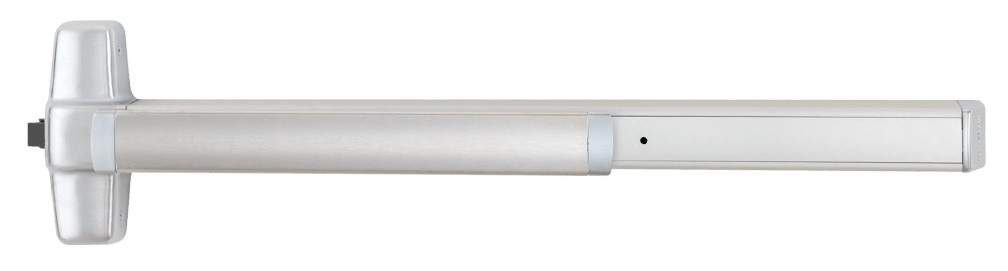
Von Duprin 98/99 Series exit device. Browse 98/99 Series parts.
Von Duprin 22 Series: Medium-Traffic Commercial Applications
The 22 Series is the cost-effective Grade 1 specification for medium-traffic commercial openings where proven reliability is needed without institutional-level specification depth. Employee entrances, parking stairwells, back-of-house retail doors, and multi-family corridors are its primary applications. It carries ANSI A156.3 Grade 1 certification and UL listing for panic and fire hardware. Available in rim and SVR configurations. Electrified options include ALK alarm kits, QEL modular conversion, and MEL motorized latch retraction.
Select the 22 Series when the opening is not a primary institutional egress point and the specification does not require the full electrified options depth of the 98/99 Series. For 22 Series replacement parts and model-specific diagrams, see the Von Duprin 22 Series exit device parts guide.
Von Duprin 75 Series: Standard Commercial Grade 1
The 75 Series is the specification for standard commercial buildings: healthcare facilities, offices, and light institutional openings that require Grade 1 performance without the full institutional specification weight of the 98/99. Rim, SVR, and CVR configurations are available. Electrified options include ALK, MEL, QEL modular conversion, and Allegion Connect. The 75 Series sits between the 22 and 98/99 in specification depth and cost, covering the wide middle ground of commercial construction.
Von Duprin 98/99 Series: Institutional Flagship
The 98/99 Series is the dominant institutional specification across North America. Schools, hospitals, universities, government buildings, and any opening where ANSI Grade 1 performance at the highest specification depth is required. The 98 Series has a smooth mechanism case; the 99 has a grooved case. Every internal component is interchangeable between the two.
Configurations: rim (9827/9927), SVR (9827/9927), CVR (9847/9947), WDC (wide door cable), and the 9875/9975 mortise device. Electrified options are the deepest in the Von Duprin lineup: QEL, MEL, Chexit delayed egress, Allegion Connect, signal switches, and electric power transfers. A mechanical 98/99 device specified today can be upgraded to electrified access control years later without replacing the device body. That forward compatibility is why architects and security consultants default to this series on complex institutional projects.
Select the 98/99 when the opening requires the highest specification tier, when electrified integration is required now or anticipated in the future, or when the facility is an institutional building with a contract hardware specification calling for the flagship series. For government building applications where BAA compliance is required, see the commercial door hardware for government buildings guide. For 98/99 Series replacement parts, see the Von Duprin 98/99 Series exit device parts guide.
The Touchbar Series: When the Full-Width Bar Changes the Function
Von Duprin 33/35A Series: Narrow-Stile Touchbar
The 33/35A Series is the touchbar device for aluminum storefronts and narrow-stile applications. The touchbar runs the full width of the door, engaging the release mechanism anywhere along its length, not just at a pad. The 35A has a smooth mechanism case; the 33A has a grooved case. Both fit door stiles as narrow as 1-3/4 inches, which is exactly the stile dimension of most aluminum storefront frames.
This is the series that resolves the most common specification error in commercial glass door hardware: attempting to install a 98/99 Series wide-stile device on an aluminum storefront frame. The 98/99 will not mount properly on a 1-3/4-inch aluminum stile. The 33A/35A is the narrow-stile sibling of the 98/99 family, engineered for that specific application. The 35A adds an integral door position switch.
Configurations cover rim, SVR, CVR, WDC, and the 360/E360 control trim variants. The electrified options catalog is second only to the 98/99 in depth, including Chexit, E7500 electrified mortise lock, pneumatic options, and Allegion Connect. Select the 33A/35A for aluminum storefronts, narrow-stile wood doors, or any application where a touchbar across the full door width is specified over a push pad.
The Crossbar Series: Heavy-Duty Mechanical Applications

Von Duprin crossbar series parts. Browse 88 Series parts.
Von Duprin 55 Series: Narrow-Stile Crossbar With Mortise Lock Body
The 55 Series is the narrow-stile crossbar device for applications requiring the visual and mechanical profile of a traditional crossbar with the security depth of a mortise lock body. It is constructed of cast brass or bronze plated to the specified finish, which gives it the aesthetic weight appropriate for historic renovations, ornate institutional lobbies, and architectural settings where a utilitarian push pad device would be out of place. The 7500 mortise lock body runs inside the chassis. Configurations include rim, CVR, and the 5575 mortise device.
Von Duprin 88 Series: Wide-Stile Crossbar for Abuse-Resistant Applications
The 88 Series is the heavy-duty wide-stile crossbar device for correctional facilities, behavioral health units, secure government floors, and any application where hardware faces sustained deliberate force. The crossbar has been in continuous production since the 1950s. It ships at 42 inches and is field-cut to door width. It is mechanical-only by design, with no electrified options at the device level. That is a deliberate engineering choice, not a limitation: in environments where electronic components can be targeted or defeated, mechanical robustness is the specification.
Configurations: rim (88/88-F), SVR (8827/8827-F), CVR (8847-F), and mortise (8875/8875-F). Fire-rated versions carry a 3-hour UL listing. The 88 Series is the answer when the application is institutional, the hardware will face abuse, and electrified options are neither required nor appropriate. For a detailed 88 Series specification and parts reference, see the Von Duprin 88 Series buyers guide.
The Narrow-Stile Push Pad Series
Von Duprin 78 Series: Aluminum Frame and Glass Storefront Push Pad
The 78 Series is the narrow-stile push pad device specifically engineered for aluminum-frame and all-glass storefront doors with stile widths as narrow as 1-3/4 inches. It is the push pad equivalent of the 33A/35A touchbar: the correct specification when a push pad format is required on a glass storefront door rather than a touchbar. Configurations include rim, SVR, CVR, and WDC. Electrified options include ALK, MEL, QEL modular conversion, and Allegion Connect. Parts from standard wide-stile series do not cross to the 78 Series.
If the opening is an aluminum storefront door and the specification calls for a push pad rather than a touchbar, the 78 Series is the correct selection.
The Mortise and Concealed Series
Von Duprin 94/95 Series: Concealed Vertical Rod for Aesthetic Applications
The 94/95 Series is the CVR device for applications where surface-mounted rods are not architecturally acceptable and the hardware must disappear inside the door. Hotels, premium healthcare interiors, high-end commercial spaces. Configurations cover the 94/9547 CVR device and the 9575 mortise device. Electrified options include the E7500 electrified mortise lock and QEL.
The CVR rods in the 9847 and 9947 configurations run inside the door stile, entirely out of sight. For 94/95 Series parts and model-specific diagrams, see the Von Duprin 94/95 Series exit device parts guide and the Von Duprin 9847 CVR exit device parts guide.
The Double Door Decision: When to Add a Mullion
On double door openings without a center post, the SVR configuration from the appropriate series handles three-point engagement at the header and floor. On openings where a center post is acceptable, the 54 Series Mullion provides the center strike point, allowing one leaf to run a rim device and the other to run an SVR, which is a cost-saving specification on some applications.
The 1609 strike is used specifically on double door applications without a center post, when one leaf uses an SVR and the other uses a rim device. The 1609 is not rated for fire doors, which matters on interior corridor specifications where fire rating is required. For compliance considerations on fire-rated double door assemblies, see the commercial door fire rating guide.
Von Duprin Series Comparison: Quick-Reference Selection Table
| Series | Type | Stile | Configurations | Electrified | Primary Application |
|---|---|---|---|---|---|
| 22 Series | Push pad | Wide | Rim, SVR | QEL, MEL, ALK | Medium-traffic commercial |
| 75 Series | Push pad | Wide | Rim, SVR, CVR | QEL, MEL, ALK, Connect | Standard commercial Grade 1 |
| 98/99 Series | Push pad | Wide | Rim, SVR, CVR, WDC, Mortise | QEL, MEL, Chexit, Connect, EPT | Institutional flagship |
| 33/35A Series | Touchbar | Narrow (1-3/4 in.) | Rim, SVR, CVR, WDC | Chexit, E7500, Connect | Aluminum storefront, touchbar |
| 55 Series | Crossbar | Narrow | Rim, CVR, Mortise | None | Historic/aesthetic applications |
| 88 Series | Crossbar | Wide | Rim, SVR, CVR, Mortise | None (mechanical-only) | Correctional, high-abuse |
| 78 Series | Push pad | Narrow (1-3/4 in.) | Rim, SVR, CVR, WDC | QEL, MEL, ALK, Connect | Aluminum storefront, push pad |
| 94/95 Series | Push pad | Wide | CVR, Mortise | QEL, E7500 | Concealed hardware, aesthetic |
The Complete Selection Decision Tree
Here is the framework that resolves most Von Duprin panic bar selection decisions:
- Is the door an aluminum storefront or narrow-stile frame?
Yes: 33A/35A (touchbar), 78 Series (push pad), or 55 Series (crossbar). No: continue below. - Is the application correctional, behavioral health, or high-abuse?
Yes: 88 Series (wide-stile crossbar, mechanical-only). No: continue below. - Is access control integration required now or anticipated?
Yes: 98/99 Series (deepest electrified options). No: continue below. - Is this a high-traffic institutional building?
Yes: 98/99 Series. Standard commercial, moderate traffic: 75 Series. Medium traffic, cost-sensitive: 22 Series. - Does the opening require concealed hardware?
Yes: 94/95 Series CVR, or CVR configuration within the appropriate series above.
For a full side-by-side comparison of all Von Duprin series including model number cross-reference, see the Von Duprin exit device series comparison. For access control integration planning across series, see the access control and commercial door hardware integration guide. For Division 8 specification compliance, see the how to specify commercial door hardware guide.
Source Von Duprin Panic Bar Parts at Security Parts

Von Duprin exit devices at Security Parts. Browse the full Von Duprin catalog.
Every series selection above has consequences for parts sourcing that compound over the device's service life. A 78 Series part will not fit a 33A/35A. An 88 Series center case kit does not cross to the 22 Series. Confirming the series at specification time is what makes every maintenance, repair, and upgrade decision for the life of the opening accurate.
Security Parts organizes the complete Von Duprin exit devices catalog by series and model, with interactive parts diagrams on every model page. The Von Duprin brand catalog covers all fourteen series with model-specific parts organization and same-day shipping on stocked components. Pre-order support at 845-935-0301 for specification questions before an order is placed.
For complete Von Duprin parts coverage by series, see the Von Duprin parts guide, the Von Duprin panic bar parts guide, and the exit device series comparison. For QEL conversion kits and electrified upgrade planning, see the Von Duprin QEL conversion kit guide. For ANSI/BHMA grading standards relevant to exit device specification, see the ANSI/BHMA door hardware standards guide.
The Von Duprin series lineup spans every commercial egress application from a standard office entry to an aluminum glass storefront to an institutional correctional facility. The 22, 75, and 98/99 Series cover the push pad spectrum from medium-traffic commercial through heavy institutional. The 33A/35A and 78 Series cover narrow-stile aluminum and glass doors in touchbar and push pad formats. The 55 and 88 Series cover crossbar applications in narrow-stile aesthetic and wide-stile abuse-resistant configurations. The 94/95 Series covers concealed vertical rod applications where surface rods are unacceptable.
Every series selection determines parts compatibility, electrified upgrade paths, and fire rating eligibility for the life of the opening. Start at the door type, confirm the stile width, determine the traffic and security tier, and the Von Duprin panic bar selection follows logically. Browse the complete Von Duprin series catalog with model-specific parts diagrams at Security Parts.
About the Author
This guide was written by the Security Parts team, a commercial door hardware specialist serving locksmiths, facilities managers, general contractors, access control integrators, and specifiers since 2001. Security Parts stocks the full Von Duprin exit device catalog across all fourteen active series, with same-day shipping on stocked items and pre-order specification support at 845-935-0301.