 Trusted Since 2001





Every commercial building relies on a coordinated system of commercial security hardware to control access, protect occupants, and meet code requirements. When one component fails, it affects the entire opening. Understanding what each type of hardware does, how the pieces work together, and where to find the right OEM replacement part is essential for facility managers, contractors, and building owners who maintain commercial properties.
This guide covers the major categories of commercial door security hardware, explains what each one does on a real opening, and connects you directly to OEM replacement parts at SecurityParts.com. For part identification and ordering reference by hardware type, see the companion security door parts guide.
Quick Answer
- Commercial security hardware includes exit devices, mortise locks, cylindrical locks, door closers, electric strikes, deadbolts, and access control hardware. Each serves a distinct function on a commercial opening.
- Most hardware is rated by ANSI Grade (Grade 1 = commercial/highest, Grade 2 = residential, Grade 3 = light duty). Always replace commercial hardware with the same grade or higher.
- New installation and maintenance are different tasks. New installation means specifying a complete hardware package. Maintenance means identifying the exact failed component and ordering the correct OEM replacement part for the installed model.
- On most commercial openings, multiple hardware categories work together: a lock controls access, an exit device handles egress, a door closer controls the swing, and an electric strike or deadbolt provides the final locking point.
- SecurityParts.com stocks OEM replacement parts for Schlage, Von Duprin, LCN, Falcon, and Detex. Browse the full parts catalog.
What Is Commercial Security Hardware
Commercial security hardware refers to the mechanical and electromechanical devices installed on commercial doors to control access, provide safe egress, and meet code requirements. It is distinct from residential hardware in three ways: it is built to higher durability standards, tested to ANSI grade classifications, and required to meet life safety codes that residential hardware is not.
In a commercial building, the hardware on any single door opening may include several devices: a lock, an exit device, a door closer, a strike plate or electric strike, and in access-controlled environments, electrified hardware connected to a credential reader. Every device is interdependent. A failed door closer puts mechanical stress on the lock. A misaligned strike plate causes bolt wear. Understanding the full system prevents misdiagnosis and wrong-part orders.
ANSI Grading: The Standard That Defines Commercial Hardware
The American National Standards Institute (ANSI), in collaboration with the Builders Hardware Manufacturers Association (BHMA), sets performance grades for commercial door hardware. These grades appear on every specification sheet and every product listing.
- Grade 1: The commercial standard. The highest level of durability, security, and cycle testing. Required on most exterior commercial doors and any opening subject to high daily use.
- Grade 2: The residential standard. Suitable for light commercial applications and interior doors with lower traffic.
- Grade 3: The minimum grade. Appropriate only for very low-use interior applications.
When replacing hardware on an existing commercial opening, always match or exceed the installed grade. Downgrading from Grade 1 to Grade 2 on a high-use door creates a performance and liability gap. For a full breakdown of ANSI/BHMA grading across all hardware categories, see the ANSI/BHMA door hardware standards guide.
Exit Devices: Commercial Egress Hardware
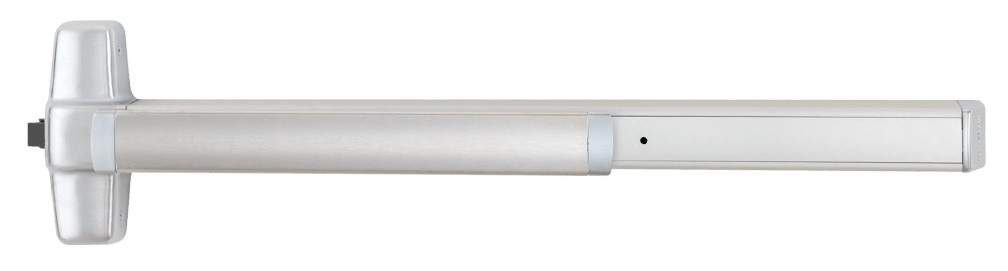
Von Duprin 98/99 series rim exit devices. One of the most widely installed exit device lines in commercial buildings. OEM replacement parts available at SecurityParts.com.
Exit devices, also called panic hardware or push bars, are the push-bar mechanisms installed on outswing doors that must allow emergency egress without any special knowledge or key. A single downward or horizontal push on the bar releases the door latch. This is a life-safety requirement on most commercial exit doors, codified under NFPA 101 and IBC requirements.
Exit devices are required on doors serving assembly occupancies, educational buildings, healthcare facilities, and any space with an occupant load above a set threshold defined by the local building code. They are also the most commonly maintained devices in commercial buildings because their frequency of use is high and they take significant mechanical stress.
Types of Exit Devices
Rim Exit Devices
Surface-mounted to the face of the door. The most common configuration on single exterior doors and the active leaf of double doors. Simple to service because all components are accessible without removing the device from the door. Von Duprin's 98/99 and 9800/9900 series are the industry standard.
Surface Vertical Rod (SVR) Exit Devices
Use vertical rods that run along the door surface to shoot bolts at the top and bottom of the door frame, instead of a rim strike. Used on double doors without a center mullion where rim devices on both leaves would conflict. Rods are exposed on the door surface.
Concealed Vertical Rod (CVR) Exit Devices
Operate the same way as SVR devices but the vertical rods run inside the door stile. Preferred where aesthetics matter and exposed rods are undesirable. Requires a mortised door preparation.
Mortise Exit Devices
Integrate the exit device function with a mortise lock chassis. Provide the highest security and function flexibility. Common on high-security openings where both panic egress and robust access control are required on the same door.
For replacement parts across all exit device types, see the exit devices parts guide and the Von Duprin parts catalog. For help selecting the right exit device configuration, see the panic bar selection guide.
Mortise Locks: High-Security Commercial Locksets
A mortise lock installs inside a pocket (the mortise) cut into the door edge. The entire lock chassis, including the latch, deadbolt function, and cylinder housing, is contained within the door. This design makes mortise locks significantly more resistant to forced entry than surface-mounted lock configurations.
Mortise locks are the standard on high-security commercial openings: hospital corridor doors, educational building exteriors, government facilities, and institutional buildings. The Schlage L-Series is the most widely installed Grade 1 mortise lock in North American commercial construction.
Why Mortise Locks Are Used in Commercial Buildings
- The lock chassis is fully enclosed within the door, eliminating exposed fasteners that surface-mounted locks present
- Supports a wide range of ANSI function codes, allowing a single platform to serve many different access control needs
- Cylinders, trim, and strike plates are independently replaceable without removing the lock case from the door
- Compatible with interchangeable core (IC) key systems, enabling rapid rekeying across large facilities
For mortise lock component identification and parts, see the mortise lock parts guide and the full commercial mortise locks guide. For a direct comparison between mortise and cylindrical lock platforms, see mortise locks vs cylindrical locks.
Cylindrical Locks: The Standard Commercial Lockset
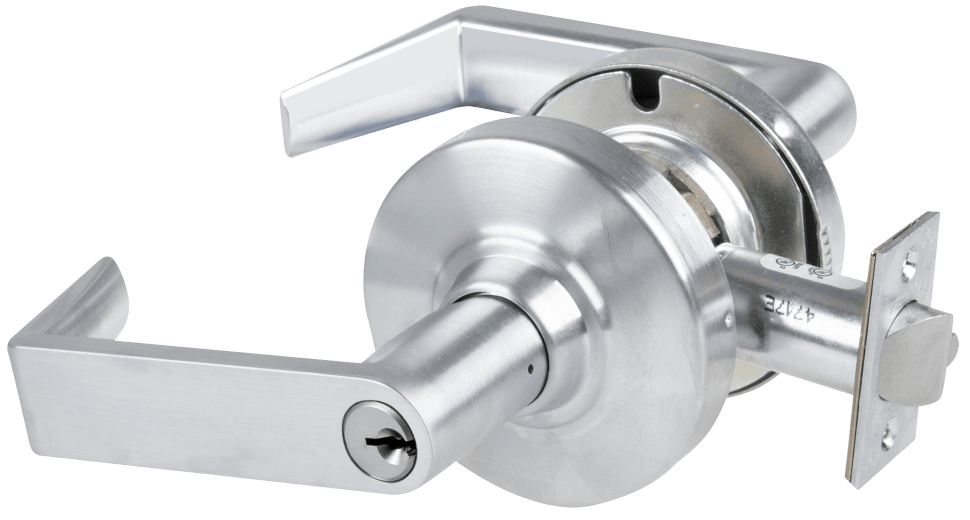
Schlage ND Series commercial cylindrical locks. A Grade 1 cylindrical lockset used across offices, classrooms, and interior corridors. OEM replacement parts available through the cylindrical locks catalog at SecurityParts.com.
Cylindrical locks install through two bored holes in the door face and edge. They are faster to install than mortise locks and are the standard for interior commercial doors, office suites, classrooms, storage rooms, and any opening that does not require the full function range of a mortise lock.
A cylindrical lock consists of the exterior trim (cylinder and lever or knob), the interior trim (lever, knob, or thumb turn), the chassis (which contains the latch and function mechanism), and the strike plate. Each component is independently serviceable.
ANSI Functions for Cylindrical Locks
Cylindrical locks are available in standardized ANSI function codes that define how the lock behaves from each side of the door. Common commercial functions include:
- Passage: Free passage from both sides. No locking function.
- Privacy: Push-button lock from inside. No key override. Common on single-occupancy restrooms.
- Storeroom: Always locked from outside, always free egress from inside. Key required for entry.
- Classroom: Interior lever always free. Outside lever locked by key from outside, without entering the room. The standard for school classroom doors.
- Entrance: Thumb turn on inside controls outside lever. Key can also lock or unlock from outside.
For cylindrical lock component identification and replacement parts, see the cylindrical lock parts guide.
Door Closers: Controlled Closing for Every Commercial Opening
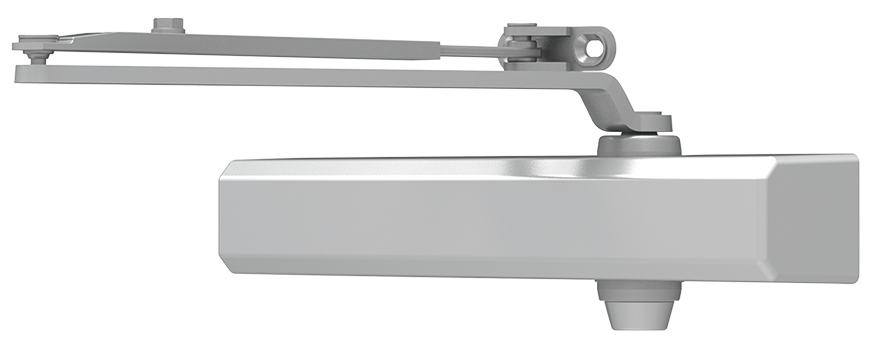
LCN 4000 Series surface-mounted commercial door closers. One of the most widely installed commercial closer lines in North America. OEM replacement parts available at SecurityParts.com.
A door closer is a hydraulic device that controls the speed and force with which a door closes. On any fire-rated door, a closer is mandatory: the door must close and latch automatically after every use to maintain the fire rating. On non-fire-rated doors, closers prevent door slamming, reduce wear on the lock and frame, and are required on ADA-compliant openings where the closing force must not exceed a specified resistance.
Types of Commercial Door Closers
Surface-Mounted Closers
Mounted on the surface of the door or frame. Visible hardware. The most common type in commercial buildings because they are easy to install, adjust, and service without removing the door from its hinges. LCN's 1000 and 4000 series are industry standards.
Concealed Closers
Installed inside the door or frame, invisible from the outside. Used where aesthetics are a priority and exposed hardware would be undesirable. Require specialized door preparation.
Electromechanical Closers and Hold-Open Devices
Surface-mounted closers with an electromagnetic hold-open function. The door is held open by the magnet and closes automatically when the fire alarm triggers, releasing the magnetic hold. Required in fire-exit corridors where free passage is needed during normal operation but the door must close on alarm activation.
For door closer component identification and replacement parts, see the door closers parts guide and the LCN door closer parts guide.
Electric Strikes: Electrified Locking for Access Control
An electric strike replaces the standard mechanical strike plate in the door frame. The strike has a moving keeper that, when electrically released, allows the latch bolt to pass through even though the lock lever is in the locked position. This enables a door to be unlocked remotely via a card reader, keypad, or intercom without modifying the lockset itself.
Electric strikes are one of the most common methods of integrating existing mechanical hardware into an access control system because they work with most cylindrical locks, mortise locks, and exit devices without changing the door or lock preparation.
Fail-Safe vs Fail-Secure Electric Strikes
This is the most important specification decision when selecting or replacing an electric strike:
- Fail-safe: The strike releases (unlocks) when power is lost. Used on egress doors where the door must be openable during a power outage or fire alarm, when the building's fire alarm system typically cuts power to all access-controlled doors.
- Fail-secure: The strike remains locked when power is lost. Used on high-security openings where unauthorized access during a power event is the greater risk.
The fail-safe or fail-secure decision is a life-safety consideration and must align with the building's fire alarm integration and local code requirements. Never substitute one for the other without verifying code compliance.
For electric strike component identification and OEM replacement parts, see the electric strike parts guide.
Deadbolts: Secondary Locking for Commercial Openings
A deadbolt provides a secondary locking point that is independent of the primary latch. Unlike a spring latch, a deadbolt cannot be retracted without deliberate action: turning a key from outside or operating a thumb turn from inside. The bolt is solid steel and engages a reinforced strike plate in the door frame.
In commercial buildings, deadbolts are used on exterior office doors, storage rooms, server rooms, and any opening where the primary cylindrical lock function alone is not sufficient security. They are also used in classroom deadbolt configurations (such as the Schlage B663) where the outside lever is always locked and the deadbolt is operated from inside to secure the room during a lockdown.
For deadbolt component identification and replacement parts, see the deadbolt parts guide.
Panic Hardware and Exit Alarms: Controlled Egress Devices
Beyond standard exit devices, two specialized categories address situations where egress must be monitored or delayed:
Alarmed Exit Devices
Exit devices equipped with a local battery-powered alarm that sounds when the door is pushed open without being disarmed. Used on secondary exit doors in retail stores, warehouses, and educational buildings where the door should only be used in emergencies. The Detex alarm exit hardware line is the standard for this application in North American commercial buildings.
For Detex alarm hardware parts, see the exit alarms parts and diagrams guide. Browse Detex parts at SecurityParts.com.
Delayed Egress Devices (Chexit)
Delayed egress devices are exit devices with a timed delay that sounds a local alarm and holds the door for a set period (typically 15 seconds) before releasing. They are used in memory care facilities, psychiatric units, and retail locations where unauthorized egress is a safety or loss-prevention concern. NFPA 101 regulates where delayed egress is permitted.
Von Duprin's Chexit option is the standard delayed egress modification for the 98/99 series exit device. For Chexit parts, see the Von Duprin 98/99 series parts guide.
For a broader overview of panic hardware applications and code requirements, see the panic hardware for commercial doors guide.
Electrified Hardware: Integrating Mechanical Locks with Access Control
Electrified hardware refers to mechanical door hardware that has been modified or designed to operate under electrical control. It is the bridge between traditional locksets and modern access control systems. A door can be mechanically sound and electrically controllable at the same time.
Common Electrified Hardware Types
Electric Latch Retraction (EL)
Allows the latch bolt on an exit device or mortise lock to retract electrically, enabling the door to swing open without mechanical operation of the push bar. Used on high-traffic controlled entries where doors must release remotely on demand.
Electrified Trim
Outside lever assemblies on mortise locks that can be electrically locked or unlocked while maintaining free egress from the inside. The credential is presented outside, power is applied or cut to the trim, and the lever operates or remains locked accordingly.
Motorized Latch Retraction
A motor-driven mechanism that retracts the latch bolt via an electrical signal. Used on high-security or high-traffic applications where consistent, mechanical-free operation is required. Schlage's L9580 motorized latch retraction is an example of this configuration.
For guidance on integrating electrified hardware with access control systems, see the access control and commercial door hardware integration guide.
How Hardware Categories Work Together on a Single Opening
On most commercial exit doors, several hardware categories are installed on the same opening and interact with each other. Understanding these relationships prevents misdiagnosis when something fails.
A typical controlled exit opening in a commercial building has:
- An exit device on the interior that provides panic egress
- An electric strike in the frame that provides the electronic locking point from outside
- A door closer at the top of the door that ensures the door closes and latches after every use
- An outside trim lever connected to the exit device that allows keyed entry from outside
- A credential reader that signals the electric strike to release on valid access
When a symptom appears, the question is always: which component in this chain has failed? A door that will not latch could be a misaligned strike (frame issue), a worn latch (exit device issue), or a closer that is not pulling the door all the way shut (closer issue). The hardware category determines which parts to inspect and which replacement parts to order.
For systematic troubleshooting across all hardware categories on a commercial opening, see the commercial door hardware troubleshooting guide.
New Installation vs Maintenance and Replacement
This distinction matters because it determines what you need to order and where to source it.
New Installation: Full Hardware Specification
Specifying hardware for a new commercial opening means selecting a complete hardware set: the lock function, the manufacturer, the finish, the handing, the grade, the closer type, and any electrification required. Every component is new and must be coordinated to work together. This is typically done by an architectural hardware consultant or a contractor working from a project hardware schedule.
Maintenance and Replacement: Component-Level OEM Parts
Maintaining existing installed hardware means identifying exactly which component has failed and ordering the correct OEM replacement part for the specific model installed. This is a different task from new specification. The lock case, the door preparation, and the surrounding hardware are already in place. Only the failed component is replaced.
This is SecurityParts.com's specialty. Whether the failed component is a dogging shaft on a Von Duprin exit device, a cylinder assembly on an LCN closer, a latch bolt on a Schlage mortise lock, or an electric box assembly on a Von Duprin electric strike, OEM parts are available by model and part number.
OEM parts are the correct choice for commercial hardware maintenance. Aftermarket substitutes may not meet the same tolerances, cycle ratings, or finish specifications as the original. For a detailed comparison, see the OEM vs aftermarket commercial door hardware parts guide.
How to Identify the Right OEM Replacement Part
Ordering the wrong part is the most common and most avoidable error in commercial hardware maintenance. The correct identification process follows the same three steps regardless of hardware category:
- Identify the manufacturer and model. The manufacturer name and model number are stamped on the device body, the cylinder face, or the closer arm. Never order by description alone. A "Von Duprin rim exit device" includes dozens of models with different part numbers.
- Identify the failed component by its function. Does the bolt not retract? That is a different component from a bolt that retracts but does not throw. Symptoms point to specific components. Comparing the symptom to the parts diagram for that model narrows the search.
- Confirm the part number before ordering. Every model page on SecurityParts.com includes the part number, a description, and compatibility information. Confirm the part number matches the installed model before adding to cart. If unsure, call 845-935-0301.
For a detailed guide to part identification by hardware category, see the security door parts guide.
Hardware Finishes on Commercial Openings
Commercial security hardware is available in a range of ANSI standard finishes. The finish code matters for replacement orders because the new part must match the existing installation visually and in corrosion resistance. Common commercial finishes include US26D (satin chrome), US10B (dark bronze), US32D (satin stainless), and US28 (satin aluminum).
For a full finish code reference and matching guidance across all hardware types, see the commercial door hardware finish guide.
Maintenance Schedules for Commercial Security Hardware
Commercial security hardware is designed for thousands of daily cycles, but it requires periodic maintenance to reach its rated lifespan. Deferred maintenance on a single component accelerates wear across every other component on the same opening.
The key maintenance intervals for commercial hardware:
- Every 6 months: Lubricate cylinder keyways with graphite or dry PTFE. Check door closer fluid. Verify latch engagement with the strike plate.
- Annually: Tighten all mounting fasteners. Check closer spring tension and adjust sweep and latch speeds. Inspect exit device push bar for play. Verify electric strike keeper operation.
- After any forced entry attempt: Inspect every component before returning the opening to service. Micro-fractures in bolts and frames are not always visible but will fail under subsequent loading.
For a complete, printable maintenance schedule organized by hardware category, see the commercial door hardware maintenance checklist.
OEM Replacement Parts for Commercial Security Hardware at SecurityParts.com
SecurityParts.com has supplied OEM commercial door hardware parts since 2001. The catalog covers Schlage, Von Duprin, LCN, Falcon, and Detex, organized by brand, model, and part number. Whether you need a replacement cylinder assembly for an LCN closer, a new push bar for a Von Duprin exit device, an electric box assembly for an electric strike, or trim components for a Schlage L-Series mortise lock, parts are available by the model-specific part number with same-day shipping on stocked components.
- Exit device parts
- Cylindrical lock parts
- Door closer parts
- Electric strike parts
- Schlage parts
- Von Duprin parts
- LCN parts
- Detex parts
- Browse the full parts catalog
For pre-order part identification assistance and same-day shipping availability, call 845-935-0301 or visit the SecurityParts.com contact page.
About the Author
This guide is published by the commercial door hardware team at SecurityParts.com, a supplier of OEM Schlage, Von Duprin, LCN, Falcon, and Detex parts since 2001. All hardware specifications, ANSI grade descriptions, and product references are verified against live SecurityParts.com product pages and manufacturer documentation. For part identification and same-day shipping on stocked OEM components, call 845-935-0301 or visit the SecurityParts.com contact page.