 Trusted Since 2001


Quick Summary
Key points
- Spring tension sets how hard the closer pulls the door shut. It is a different adjustment from the speed valves, and it is the one that changes opening force.
- Adjustable spring closers let you change the power without changing the unit. Fixed size closers do not, so the answer there is a different closer.
- Turn the spring up when the door will not latch from rest. Turn it down when the door is too heavy to open comfortably.
- Accessible openings limit opening force, so spring tension cannot simply be wound up to solve a latching problem. Fix the friction first.
- Arm type and mounting change how much of the spring force reaches the door, so the same setting behaves differently in different geometries.
| Adjustment | What it changes | Symptom it addresses |
|---|---|---|
| Spring tension or power | How hard the closer pulls shut and pushes back | Door will not latch, or is too heavy to open |
| Sweep valve | Speed through the main part of the swing | Door closes too fast or too slow overall |
| Latch valve | Speed in the last few inches | Door slams at the frame or stalls short |
| Backcheck | Resistance near full open | Door thrown into the wall |
| Delayed action | Pause before the sweep begins | Slow users need longer to pass |
In This Guide
- What Does the Spring in a Door Closer Do?
- When Should You Change Spring Tension Rather Than a Valve?
- How Is Spring Tension Actually Adjusted?
- What Limits How Far You Can Wind the Spring Up?
- How Does the Arm Change What the Spring Delivers?
- Does Where the Closer Mounts Affect the Setting?
- What About Hold Open Arms and Spring Tension?
- What Should You Check Before Ordering Parts?
- About the Author
Door closer spring tension adjustment is the control people reach for last and should often reach for first. The speed valves decide how the door moves. The spring decides whether it has enough force to finish the job at all.
This guide covers what the spring actually does, how adjustment differs from the valves, when to change it, what limits how far you can go, and how the arm and mounting change the result.
What Does the Spring in a Door Closer Do?
It stores the energy that closes the door, and it resists you while you open it.
Opening the door compresses the spring inside the closer body. That stored energy is what pushes the door shut when you let go. The hydraulic side does not provide any closing force at all; it only controls how quickly the spring is allowed to release what it holds.
That split explains most closer confusion. If a door closes too fast, the fluid is the problem. If a door closes slowly and then stops short of the frame, the spring has run out of authority before the job was finished. Our hydraulic door closer guide covers how the two halves work together.
Is spring tension the same as closer size?
They describe the same thing from different ends. Closer size is the power rating the unit is built to deliver, usually matched to door width and weight. Spring tension adjustment is how far you can move within that unit's range. An adjustable closer covers several sizes; a fixed size closer delivers one. Our closer sizing guide covers how the size is chosen in the first place.
When Should You Change Spring Tension Rather Than a Valve?
When the problem is force, not speed.
Work out which one you have by watching the door close from about thirty degrees with nobody touching it. If it moves at a reasonable speed and then stops just short of latching, or pushes the latch against the strike without seating it, that is a force problem and the spring is the control. If it reaches the frame but arrives too hard or too softly, that is speed and the valves are the control.
| What the door does | Control | Direction |
|---|---|---|
| Stops short of the latch | Spring tension | Increase |
| Latches but needs a shove to open | Spring tension | Decrease, after checking friction |
| Slams into the frame | Latch valve | Slow it |
| Crawls through the middle of the swing | Sweep valve | Speed it up |
| Hits the wall when thrown open | Backcheck | Increase resistance |
What should you rule out before touching the spring?
Friction, every time. A dragging weatherseal, a worn hinge, a carpet catching the leaf or a misaligned strike all absorb closing energy, and winding the spring up to overcome them makes the door harder to open without fixing anything. Our strike plate alignment guide covers the most common of those causes.
How Is Spring Tension Actually Adjusted?
On an adjustable closer, through a dedicated adjustment at the body, separate from the speed valves.
The important part is that it is separate. Speed valves are small needle adjusters, usually behind the cover or on the end of the body, and they meter fluid. The spring adjustment changes preload on the spring itself and needs noticeably more effort to turn. If an adjuster is easy to turn and changes how fast the door moves, you are on a valve.
Work in small increments and test between each one. Spring adjustment moves the behaviour of the whole swing at once, so a large change often overshoots in both directions: the door now latches firmly and is too heavy to open.
How do you know how far you have gone?
Count and write it down before you start. Note the starting position, count turns, and record where you finish. A closer that has been adjusted by several people without records ends up at a setting nobody chose. Our commercial closer adjustment guide covers the valve side with the same discipline.
What Limits How Far You Can Wind the Spring Up?
Opening force requirements, and they are not negotiable on an accessible route.
Accessible openings limit how much force a person should need to open the door. Spring tension is the single biggest contributor to that force, so a closer wound up to force a difficult door shut can take the opening outside what is acceptable. The door now latches and the people who need it most cannot open it.
That is why friction gets fixed first. Reducing what the closer has to fight lets the spring come back down, which keeps opening force within range while still closing the door properly. Our door clearance guide covers the requirements that apply to the opening as a whole.
| Step | What to do | Why it comes first |
|---|---|---|
| 1 | Check hinges and leaf alignment | A dropped door fights the frame all the way |
| 2 | Check seals and sweeps | Compression seals absorb a surprising amount |
| 3 | Check the strike and latch | A dragging latch is read as weak closing |
| 4 | Set the valves correctly | Speed faults can imitate force faults |
| 5 | Adjust spring tension | Last, with the opening already honest |
Does a fire door change the limits?
It changes the priority. A fire door has to close and latch from any position under its own closer, so there is a floor below which the spring cannot go however light the door needs to feel. Where that floor conflicts with opening force, the opening needs a different solution, such as a power operator, rather than a compromise setting.
How Does the Arm Change What the Spring Delivers?
Considerably, because the arm decides how spring force is turned into door movement.
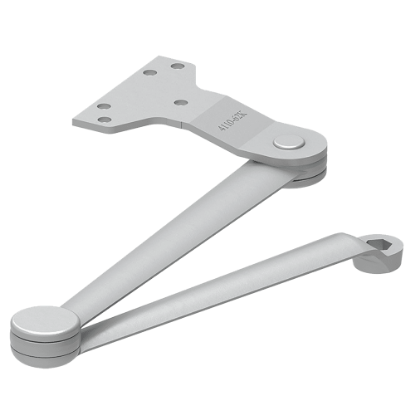
A regular arm pulls on the door from a position that gives it good mechanical advantage. A parallel arm mounted on the push side works at a less favourable angle and delivers less closing force to the leaf for the same spring setting. That is why the same closer, moved from one mounting to another, can go from closing firmly to stopping short.
Track arm and cush arm installations change it again. A cush arm includes a stop function and trades some of the swing for that control. Our parallel arm closer guide covers how those geometries compare.
Should the arm change instead of the spring?
Sometimes that is the better answer. If the door needs more closing force than the current mounting can deliver, moving to a geometry with better mechanical advantage achieves it without raising opening force as much as winding the spring up would. It is a part change rather than a setting, but it solves the cause.
Does Where the Closer Mounts Affect the Setting?
Yes, and a drop plate or bracket often matters more than people expect.
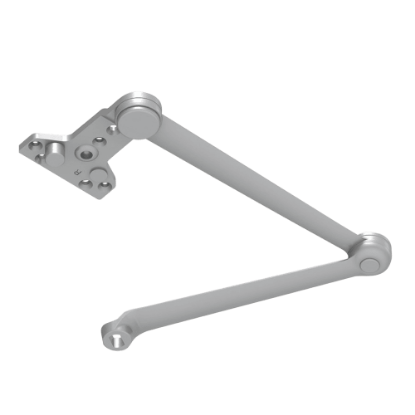
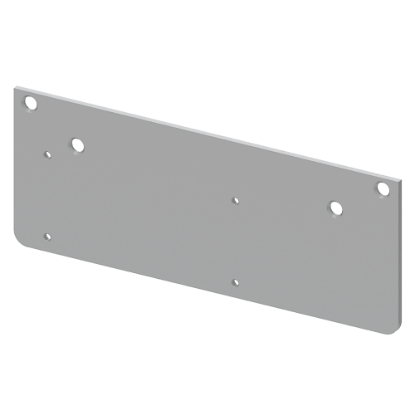
A closer mounted lower on the leaf, or further from the hinge, changes the leverage it works with. Drop plates exist because many frames do not give the closer the position it was designed for, and the plate restores a workable geometry rather than being an optional extra.
If a closer has been fitted in a compromised position, no spring setting will make it behave properly. The adjustment range is being used to compensate for geometry, which leaves nothing in reserve when the door seals stiffen in winter.
What if the door has a transom or narrow top rail?
Then the mounting options narrow and the plate or bracket becomes part of the specification rather than an accessory. Establish what the opening will physically accept before deciding how much closing force is available, because the mounting decides the ceiling. Our closer installation guide covers the mounting decisions in sequence.
What About Hold Open Arms and Spring Tension?
A hold open arm does not change the spring, but it changes how people treat the door.
The arm holds the leaf at a set position until somebody pushes it out of detent. The spring is still doing its normal job once released. The complication is that a door held open every day is a door whose closer is loaded differently, and users who force it out of hold open put a shock load into the arm and the body.
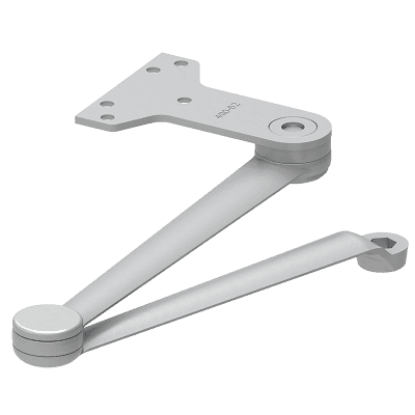
If a hold open door also has a latching problem, resist the temptation to wind the spring up to compensate for the extra distance it travels. The cause is usually the same friction as on any other door. Our door slamming guide covers the reverse case, where force is already too high.
Can you fit a hold open arm to a fire door?
Not as a mechanical hold open. A fire door has to close on alarm, so anything that holds it open has to release automatically when that happens. A plain mechanical detent arm does not, which is why rated openings use a different arrangement entirely.
What Should You Check Before Ordering Parts?
Whether the closer you have is adjustable at all, and what the opening actually needs.
Identify the model from the body or cover. Confirm whether it is an adjustable spring unit or a fixed size. Note the arm type and mounting, the door width and weight, whether the opening is fire rated or on an accessible route, and what the door is doing wrong in plain terms.
If the unit is fixed size and underpowered, no part will change that and a correctly sized closer is the answer. If it is adjustable and already at the top of its range, the same conclusion usually applies. Our LCN closer parts guide covers how arms, shoes and plates are listed.
How do you leave the door for the next person?
Set, tested and recorded. Release the door from thirty degrees, from ninety degrees and from full open, and confirm it latches from each without help. Then write down the final spring position and valve settings somewhere that survives, because the next person to look at this door will otherwise start from scratch.
About the Author
Security Parts has supplied repair parts for commercial door hardware since 2001, covering Von Duprin, LCN, Schlage, Falcon, Detex and Adams Rite at the component level. Our diagram based lookup exists so a technician can confirm a part before ordering it. This guide was written by the Security Parts team from supplier documentation and the questions our customers bring us.