 Trusted Since 2001


Quick Summary
Key points
- A slamming door is nearly always a door closer problem, and nearly always a valve that has been opened too far rather than a closer that needs replacing.
- Two separate adjustments control the swing. The sweep valve governs the main travel, the latch valve governs the last few degrees. Slamming is usually the latch valve.
- Turn valves in small increments and never wind one all the way out. A valve removed under pressure will dump the oil and finish the closer.
- If adjustment does nothing, the closer is leaking or worn internally. Oil anywhere on the body or the door face is the giveaway.
- Wind and stack pressure are a different problem from a mis-set valve, and the fix is usually a cush or spring stop arm rather than more valve.
| Adjustment | Part of the swing | Symptom when it is wrong |
|---|---|---|
| Latch speed valve | The final few degrees into the frame | Door bangs at the very end |
| Sweep speed valve | From around 90 degrees to about 15 degrees | Door rushes across the whole closing arc |
| Backcheck valve | Near the fully open position | Door flies open and hits the wall |
| Spring power | Force throughout the swing | Door too heavy to open, or too weak to latch |
In This Guide
- Why Does a Door Slam in the First Place?
- Does the Door Actually Have a Closer on It?
- Which Closer Adjustment Stops the Slam?
- How Do You Adjust the Sweep and Latch Valves Safely?
- What If the Door Still Slams After Adjustment?
- Can a Hold Open Arm Stop a Door Slamming?
- What Stops a Door Slamming in the Wind?
- Why Do Fire Doors Slam, and What Can You Change?
- What If There Is No Closer At All?
- Which Parts Do You Order to Fix a Slamming Door?
- About the Author
A door that slams is more than an annoyance. It wakes people, cracks frames, shortens the life of every piece of hardware on the opening, and on a fire door it is a sign something is out of adjustment on a door that has a job to do.
The good news is that the fix is usually a quarter turn of a small screw. This guide explains what is making the noise, which adjustment to touch, how to do it without destroying the closer, and what to do when adjustment is not the answer.
Why Does a Door Slam in the First Place?
A door slams when it arrives at the frame with more energy than the closer is taking out of it. That can happen for four different reasons, and they need different fixes.
The closer is set too fast, so the door is simply moving quickly when it arrives. The closer has failed internally, so it is no longer controlling the swing at all. Something external is pushing the door, usually wind or air pressure in the building. Or there is no closer on the door and the spring hinges are doing all the work.
Before touching anything, open the door to 90 degrees and let it go. Watch the whole arc. Where the door picks up speed tells you which valve to go to.
What should a correctly set door look like?
It should travel steadily from open to nearly closed, then move through the last few degrees firmly enough to latch, without noise. On an accessible opening the standard is that the door takes at least five seconds to travel from 90 degrees down to 12 degrees from the latch, which is slower than most people expect.
Does the Door Actually Have a Closer on It?
It sounds obvious, but it changes the whole answer, and a surprising number of slamming doors have nothing controlling them.
Look at the top of the door on both sides, and at the top of the frame. A surface closer is a visible rectangular body with an arm. A concealed closer is hidden in the frame head or the door itself, with only the arm visible. A floor closer sits in the threshold under the pivot.
If there is nothing at the head and nothing in the floor, the door is either on spring hinges or on nothing at all, and no amount of adjustment exists to be made. Our guide to the four types of commercial door closer covers how to tell which one you have.
Which Closer Adjustment Stops the Slam?
Start with the latch valve. On the overwhelming majority of slamming doors the problem is in the last few degrees, which is exactly what the latch valve governs.
If the whole closing arc is too quick, not just the end, the sweep valve is the one to move. If the door is fine closing but crashes into the wall on the way open, that is backcheck and a different complaint entirely.
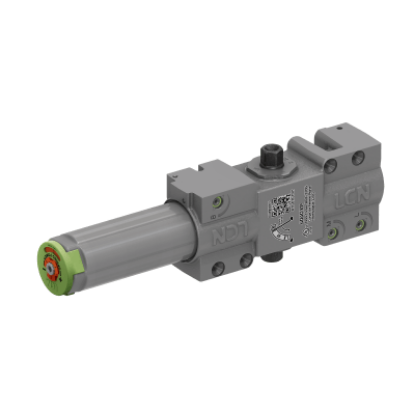
How do you find the valves on an unfamiliar closer?
They are small screws, usually on the end of the body opposite the arm, often under a plastic cover. Most are marked, commonly with a letter such as L for latch, S for sweep and B for backcheck, or with numbers keyed to a diagram in the template that came with the unit.
If the markings are worn away, work it out by testing rather than guessing: move one valve a quarter turn, operate the door, and see which part of the swing changed.
How Do You Adjust the Sweep and Latch Valves Safely?
The method matters more than the theory, because the common way to ruin a working closer is to over-adjust it.
Turn the valve clockwise to slow that part of the swing and anticlockwise to speed it up. Move it no more than a quarter to a half turn at a time, then operate the door and watch. Repeat until it is right.
Never wind a valve fully out. The closer is a sealed hydraulic unit under pressure, and a valve backed out past its thread can leave the body and take the oil with it. At that point the closer is finished and the part you need is the cylinder assembly, not a screw.
| Step | What to do | Why |
|---|---|---|
| 1 | Check the door swings freely with the arm disconnected | Binding hinges and dragging seals look like closer faults |
| 2 | Reconnect and set latch speed first | It is the cause of most slamming |
| 3 | Set sweep speed | Controls the main travel and the accessibility timing |
| 4 | Set backcheck if the door hits anything on opening | Protects the door, frame and closer |
| 5 | Confirm the door still latches every time | Too slow and the latch will not engage |
Our step by step guide to adjusting a commercial door closer goes through the same sequence on specific units.
What If the Door Still Slams After Adjustment?
Then the closer is not controlling the oil any more, and no valve setting will bring it back.
Look for oil. A film on the closer body, a drip mark down the door face, or a damp patch on the cover all mean the unit has lost its seal. A closer that has lost oil cannot meter anything, so the door is effectively swinging on spring power alone.
The other possibility is that the closer is undersized for the door. A unit that is too small for a heavy or wide leaf gets wound up to maximum spring power to make the door latch, and at that setting it has very little control left in reserve. Our closer sizing guide covers matching the size to the door.
Is it the closer or the door?
Disconnect the arm and swing the door by hand. If it binds, catches, or swings back on its own, the problem is the door, the hinges or the frame, and fixing the closer will not help. Hinge wear and a dropped leaf are common and they make every other adjustment unreliable.
Can a Hold Open Arm Stop a Door Slamming?
It can remove the problem on doors where the slamming happens because people are propping the door with whatever is to hand, then letting it go.
A hold open arm keeps the door at a set angle until someone pushes it past the detent. That means no wedge under the door, no bin holding it open, and no sudden release when the prop is kicked away.
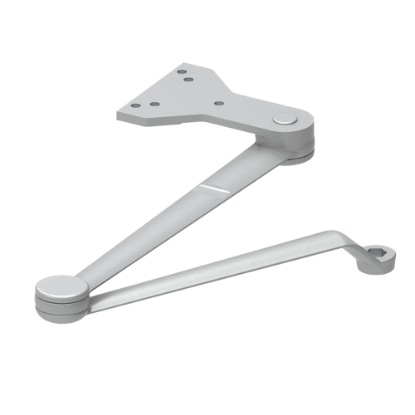
One important restriction: a plain hold open arm is not permitted on a fire door. A fire door may only be held open by a device that releases it automatically on alarm.
What Stops a Door Slamming in the Wind?
Wind and stack pressure are not a valve problem. The air is adding energy the closer was never sized to absorb, and winding the valves down further usually just makes the door fail to latch on calm days.
The usual answer is an arm with a cushioned stop built into it. A cush arm slows the door at the end of its opening swing instead of letting it hit a hard stop, and a spring cush version adds a spring that absorbs the shock of a door caught by a gust.
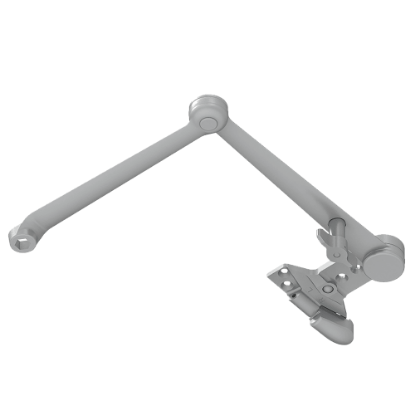
Backcheck is the other half of the answer. Set properly it slows the door before it reaches the fully open position, which is exactly where wind damage happens. Our parallel arm door closer guide covers the arm and shoe options in more detail.
Why Do Fire Doors Slam, and What Can You Change?
Fire doors slam more often than other doors because they are set up to do something other doors are not: latch positively, every single time, without exception.
That means the spring power cannot simply be reduced until the noise stops. If the door stops latching, the opening no longer does its job. The adjustment you have is the latch valve, slowing the approach without removing the force that drives the latch home.
Where that is not enough, the answer is usually mechanical rather than hydraulic: check the latch and strike alignment, check the seals are not adding drag, and check the hinges. A fire door that needs excessive spring power to latch normally has a mechanical problem somewhere. Our guide to adjusting a fire door closer covers the constraints.
What If There Is No Closer At All?
Then the choice is to fit one or to accept the noise, and on most commercial doors fitting one is the right answer.
Adding a closer is not only about noise. It controls the door for everyone who uses it, stops the leaf being blown against the wall, and on a door that needs to be kept shut for fire or security it is the only thing that reliably closes it.
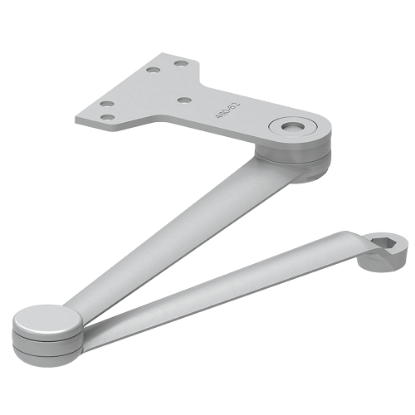
The guide to installing a commercial door closer covers mounting, and the closer selection guide covers choosing the unit.
Which Parts Do You Order to Fix a Slamming Door?
| What you found | What to order |
|---|---|
| Valves adjust correctly, door now quiet | Nothing, it was a setting |
| Oil on the body or door, adjustment does nothing | Cylinder assembly, or a replacement closer |
| Arm bent, or hold open no longer holds | Arm assembly, or the hold open stud |
| Door catches the wind and hits the wall | Cush or spring cush arm, plus backcheck set correctly |
| Closer too small for the door | Correctly sized closer for the leaf width and weight |
| Door binds with the arm disconnected | Hinges, seals or frame work before any closer part |
Before ordering, read the series stamping off the closer body. Arms, shoes, covers and cylinder assemblies are all series specific. Browse the door closer parts section, the LCN door closer parts guide, or the 4040XP parts guide if that is the unit on the door.
On accessible openings, remember that the slam fix and the accessibility requirement are linked. Slowing a door is fine, making it too heavy to open is not. Our ADA door clearance guide covers the force and timing limits.
About the Author
Security Parts has supplied repair parts for commercial door hardware since 2001, covering Von Duprin, LCN, Schlage, Falcon, Detex and Adams Rite at the component level. Our diagram based lookup exists so a technician can confirm a part before ordering it. This guide was written by the Security Parts team from supplier documentation and the questions our customers bring us.
If the closer is leaking or the markings on the valves have worn away, contact us with the series stamping and we will confirm which assembly you need, or browse the LCN parts range.