 Trusted Since 2001


Quick Summary
Key points
- The Von Duprin 990DT is dummy trim, meaning it is a fixed pull with no operating mechanism behind it.
- It is specified where the outside of a door needs something to pull on but no way to retract the latch.
- Dummy trim is most common on the inactive leaf of a pair and on exit only doors that still need a handle.
- The DT suffix appears across several trim shapes, so the number before it is what decides the appearance.
- Choosing dummy trim is a security decision as much as a hardware one, because it removes outside access entirely.
| Situation | Why dummy trim fits |
|---|---|
| Inactive leaf of a pair | No latch to retract from outside |
| Exit only door | Outside access is not wanted |
| Matching appearance on a pair | Both leaves look the same |
| Door with access control elsewhere | Entry handled by a reader and strike |
| Replacing broken functioning trim | Entry no longer required at that door |
In This Guide
- What Is the Von Duprin 990DT?
- How Does Dummy Trim Differ From Functioning Trim?
- Why Is Dummy Trim Used on the Inactive Leaf?
- What Other DT Parts Are There?
- Why Do Screw Packs Matter on Dummy Trim?
- When Should You Specify Dummy Trim?
- Does Dummy Trim Affect Egress?
- How Is Dummy Trim Fitted to the Door?
- What Should You Confirm Before Ordering?
- About the Author
Dummy trim gets specified more often than it gets understood. It is the part people reach for when a door needs a handle on the outside and nothing else, and it is the part people order by mistake when they actually needed outside entry.
This guide covers what the Von Duprin 990DT is, how it differs from functioning trim, where it belongs on a pair, what the related DT parts are, and what to confirm before ordering.
What Is the Von Duprin 990DT?
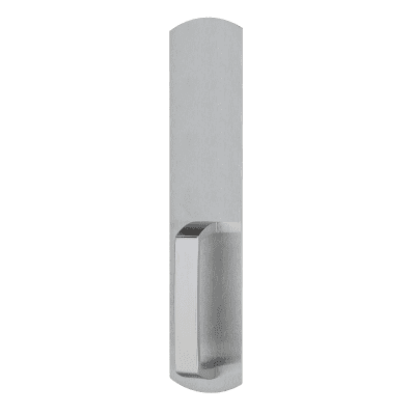
Dummy trim for an exit device opening. It fits the outside face of the door, gives somebody something to take hold of, and does nothing else.
Functioning outside trim has a mechanism that reaches through the door and retracts the latch of the exit device on the inside. Dummy trim has no such mechanism. It is fixed to the door and the handle does not move, so the door cannot be opened from the outside at all.
That is the whole distinction, and it is a deliberate one. Dummy trim exists for doors where outside access is not part of the plan. Our 98 and 99 Series parts guide covers the devices this trim is fitted alongside.
Does dummy trim lock the door?
Not in the sense of a lock, because there is nothing to lock or unlock. The door is held shut by the exit device latch, and dummy trim simply gives no way to retract that latch from the outside. The result looks like a locked door to anyone standing in front of it, but no key or credential will change it.
How Does Dummy Trim Differ From Functioning Trim?
In what happens when you pull the handle, and in nothing else that is visible.
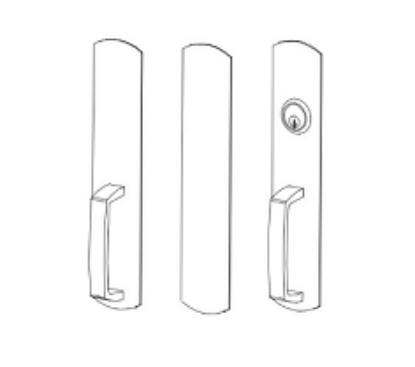
Functioning trim comes in several arrangements. Some are keyed, so a cylinder in the trim releases the lever or knob and allows entry. Some are always operable. Dummy trim sits at the far end of that range with no operation at all.
From outside the door the three can look almost identical, which is precisely why dummy trim gets ordered when functioning trim was wanted. The difference is in the function code, not the appearance.
| Arrangement | Outside entry | Typical use |
|---|---|---|
| Dummy | None | Inactive leaf, exit only door |
| Keyed | With a key | Controlled entry at the door |
| Always operable | Always | Doors that need free passage both ways |
| Electrified | On a signal | Access controlled openings |
Which one is on my door now?
Pull the handle. If it moves and the latch retracts, the trim is functioning. If it moves and nothing happens, the trim is functioning but something behind it has failed. If it does not move at all, it is dummy trim. Our lock function codes guide covers how these functions are named.
Why Is Dummy Trim Used on the Inactive Leaf?
Because the inactive leaf usually has nothing for outside trim to operate.
On a typical pair, one leaf is the active one and carries the device that gets used. The inactive leaf is held shut by flush bolts or by its own vertical rod device and is opened only when the full width is needed. There is no latch on that leaf for outside trim to retract, so functioning trim would have nothing to do.
Dummy trim gives that leaf a handle that matches the active one, so the pair looks right, without implying an operation that does not exist.
What if both leaves need to open from outside?
Then neither leaf takes dummy trim, and the pair usually needs a mullion or two functioning devices instead. Our mullion guide covers how a removable mullion changes what each leaf needs.
What Other DT Parts Are There?
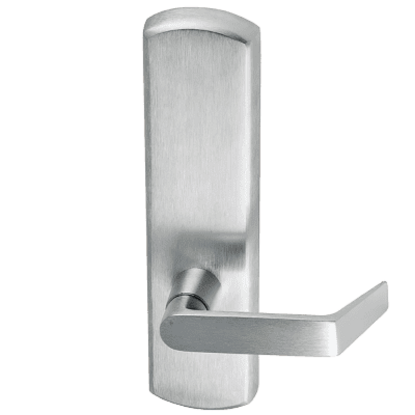
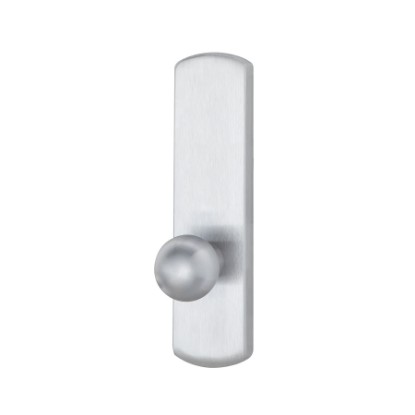
Several, because the DT suffix describes the function and the number in front of it describes the shape.
A lever dummy and a knob dummy do the same nothing as a pull dummy. What they change is how the outside of the door looks and feels, and whether it matches the other hardware in the building. On a corridor where every other door has a lever, a lever dummy keeps the set consistent.
Does the shape affect accessibility?
On functioning hardware it can, because levers are easier to operate than knobs for many people. On dummy trim nothing is operated, so the choice is about appearance and consistency rather than function. Our door clearance guide covers where operation requirements apply.
Why Do Screw Packs Matter on Dummy Trim?
Because the trim has no mechanism holding it in place, so the fixings are the whole installation.
Functioning trim is partly located by the spindle and mechanism that pass through the door. Dummy trim has none of that, which means the mounting hardware carries everything: the weight of the trim and the pull force of every person who grabs it expecting the door to open.
That is why dummy trim is often listed with its screw pack, and why using the specified fixings for the door thickness matters more here than it does on functioning trim.
What happens when dummy trim works loose?
It rattles first and then pulls away from the door face. Because people pull hard on a handle that does not move, loose dummy trim degrades faster than loose functioning trim. Retighten it as soon as movement appears rather than waiting for it to become a repair.
When Should You Specify Dummy Trim?
When the door genuinely should not open from outside, and when something still needs to be there to pull or to match.
The honest test is to ask who needs to get in through this door and how. If the answer is nobody, dummy trim is correct. If the answer is staff with a key, functioning keyed trim is correct. If the answer is anyone with a credential, the opening needs access control and dummy trim would block it.
Getting this wrong is awkward to fix later, because changing from dummy to functioning trim usually means new preparation in the door. Our panic bar selection guide covers choosing the device and trim together.
| Question | Dummy trim | Functioning trim |
|---|---|---|
| Does anyone enter here? | No | Yes |
| Is there a latch to retract? | Not on this leaf | Yes |
| Is access controlled elsewhere? | Often | Not usually |
| Does appearance need to match? | A common reason | Incidental |
| Future change likely? | Think twice | Easier to live with |
Is dummy trim ever a security risk?
The opposite, usually. It removes an outside operation entirely, so there is nothing to pick, force or manipulate at that point. The risk it creates is practical rather than criminal: a door people expect to open and cannot, which is why signage matters on exit only doors.
Does Dummy Trim Affect Egress?
No, and this is the point that matters most on any door carrying an exit device.
Egress is governed by the device on the inside, not by what is on the outside face. Push the bar and the door opens regardless of whether the outside has a lever, a pull, dummy trim or nothing at all. That separation is the reason dummy trim is acceptable on doors that must be escapable.
What does matter is that the inside device still works correctly and still latches the door on closing. Our panic hardware guide covers where exit devices are required, and our fire rating guide covers the latching requirement on rated openings.
Can dummy trim go on a fire rated door?
It is common on the inactive leaf of rated pairs, where the leaf is held by bolts or its own device and is not an everyday route. The rated assembly still has to latch and still has to allow egress from the inside, and neither of those depends on the outside trim.
How Is Dummy Trim Fitted to the Door?
Through the door face, using the preparation that already exists or a simpler pattern of its own.
On a replacement job the usual starting point is whatever is already there. If the leaf was prepared for functioning trim, the existing holes may be larger than the dummy needs, and the trim has to cover them properly rather than sit over an open cut. On a new leaf the preparation is simpler, because no spindle or cylinder has to pass through.
Fit it with the door closed and the device in place so the position can be checked against the rail on the inside. Dummy trim that sits too high or too low looks wrong immediately on a pair, where the eye compares it directly with the matching leaf. Our exit device installation guide covers the preparation on the inside face.
Can dummy trim cover an old cylinder hole?
Sometimes, depending on the trim plate size and where the hole sits. Check the footprint before removing the old trim rather than after, because a gap left exposed at a doorway gets noticed and is awkward to close neatly once the new trim is on.
What Should You Confirm Before Ordering?
Function first, then appearance, then the door itself.
Confirm that no outside entry is required at this leaf, because that is the decision dummy trim locks in. Then confirm the trim shape and finish so it matches the rest of the opening, the door thickness for the fixings, and the device series the trim is intended to sit alongside.
Photograph the existing trim and the device before you order. Trim shapes are much easier to match from a picture than from a description. Our Von Duprin series guide covers identifying the device, and our panic bar parts guide covers the components around it.
What is the most common mistake with DT parts?
Ordering dummy trim for a door that needed keyed trim. The parts look similar in a listing and the suffix is easy to overlook, but one gives controlled entry and the other gives none. Reading the function before the shape avoids it.
About the Author
Security Parts has supplied repair parts for commercial door hardware since 2001, covering Von Duprin, LCN, Schlage, Falcon, Detex and Adams Rite at the component level. Our diagram based lookup exists so a technician can confirm a part before ordering it. This guide was written by the Security Parts team from supplier documentation and the questions our customers bring us.