 Trusted Since 2001





Quick Summary
Key points
- A hydraulic door closer stores energy in a spring when the door opens, then releases it through oil forced past adjustable valves on the way closed.
- The spring decides how hard the door pulls. The oil decides how fast. Those are two different problems and two different fixes.
- The oil is why closers behave differently in winter. Cold oil is thicker, so a door that was fine in August can fail to latch in January.
- A leaking closer cannot be adjusted back to health. Once the fluid is going, the control is going with it.
- The body carrying the spring and the oil is sold as a cylinder assembly, and on many models it is adjustable across a range of sizes.
| What you notice | Spring or oil |
|---|---|
| Door is too heavy to push open | Spring, the closer is set too strong for the opening |
| Door closes too fast or too slow | Oil, the sweep valve is controlling that |
| Door slams in the last few inches | Oil, the latch valve controls that final section |
| Door closes but will not push the latch home | Spring, there is not enough energy left to beat the latch |
In This Guide
- How Does a Hydraulic Door Closer Actually Work?
- What Do the Valves on a Hydraulic Door Closer Control?
- Why Spring Size Is a Separate Decision From the Valves
- Why Does a Hydraulic Door Closer Behave Differently in Winter?
- What Happens When a Hydraulic Door Closer Leaks?
- Hydraulic, Pneumatic and Powered: What Is the Difference?
- What Is a Hold Open Hydraulic Closer?
- How Long Should a Hydraulic Door Closer Last?
- How Do You Identify the Hydraulic Closer on Your Door?
- What Maintenance Does a Hydraulic Door Closer Need?
- About the Author
Almost every commercial door closer you will touch is hydraulic. The word gets used so routinely that it stops meaning anything, which is a shame, because understanding what the oil is actually doing explains most of the faults people spend hours chasing.
This guide is about the mechanism rather than the model range. For the different types of closer and the grading system, see our guide to the four main types of commercial door closer.
How Does a Hydraulic Door Closer Actually Work?
There are two energy events in every cycle and it helps to keep them separate.
Opening. When somebody pushes the door, they are compressing a spring inside the closer body. All the energy that will later close the door is put in at this moment, by the person opening it.
The closer is not powered. It has no motor and nothing stored between uses.
Closing. When the door is released, the spring pushes back. If it were allowed to act freely the door would fly shut and slam.
So the spring has to drive a piston through a chamber of oil, and the oil can only escape through small passages. Those passages have needle valves in them, and how far each valve is open decides how quickly the oil gets out of the way.
That is the whole idea. The spring provides the force. The oil provides the timing. Almost every closer complaint resolves to one or the other, and telling them apart saves a great deal of fiddling.
What Do the Valves on a Hydraulic Door Closer Control?
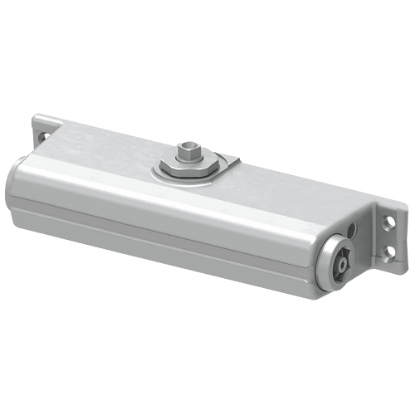
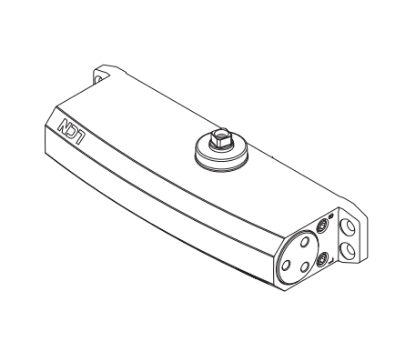
The adjustment screws on the end of the body are not volume controls or strength controls. Each one meters the oil through a different part of the swing.
| Valve | Part of the swing it controls | Symptom when it is wrong |
|---|---|---|
| Sweep | The main closing travel, from wide open down to roughly the last few inches | Door closes too fast or crawls |
| Latch | The final section, where the latch has to be driven home | Door slams, or stops short of latching |
| Backcheck | The opening direction, cushioning a door thrown open hard | Door hits the wall, or feels like it jams part way open |
Backcheck is the one people misunderstand. It is not a door stop and it is not a substitute for one. It cushions the final part of the opening swing so the door is not flung into the wall, but a door that is regularly forced past its intended limit still needs a physical stop.
For the adjustment sequence itself, see our guide to adjusting a fire door closer, which covers the same valves with the compliance constraints that apply on a rated opening.
Why Spring Size Is a Separate Decision From the Valves
Closer size refers to spring strength, and it is matched to the door, not to how the door feels on the day. A wider or heavier door needs more stored energy to close it, so it needs a stronger spring.
Many modern closer bodies are adjustable across a range rather than fixed. A cylinder assembly described as adjustable size 1 through 4 covers several door widths in one part, which is why distributors can stock one unit for a large share of openings instead of six.
What that adjustability does not do is fix a timing problem. Winding spring strength up to force a sticky door shut masks a binding leaf and makes the door harder for everybody to open. Our commercial door closer sizing guide works through sizes against door width.
Why Does a Hydraulic Door Closer Behave Differently in Winter?
Because oil gets thicker as it gets colder. A fluid that flows easily through a needle valve at room temperature moves more reluctantly near freezing, and the door takes longer to close.
This produces a seasonal pattern that confuses people. An exterior door that behaved perfectly through summer starts failing to latch when the weather turns, and nothing on the door has changed. The valve settings are the same. The oil is simply slower.
Two practical consequences. First, set valves on an exterior closer with the season in mind, and expect to revisit the setting. Second, a door that only fails to latch on cold mornings is telling you it has very little margin, which usually means the spring is under sized for the opening or the door is dragging.
What Happens When a Hydraulic Door Closer Leaks?
It is finished. This is the single most useful thing to know about hydraulic closers.
The oil is not a lubricant that can be topped up. It is the working fluid, and the volume of it is what makes the control possible. Once a seal has failed, the closer is losing the thing that controls the door. Adjusting the valves at that point just redistributes a shrinking amount of fluid, and the setting will not hold.
Signs to look for:
- A film of oil on the door face below the closer, or drips on the floor.
- Oil weeping around the valve stems rather than from the body seam.
- A valve setting that has to be reset every few weeks.
- A door that was controlled and is now progressively getting faster.
Weeping from the valve stems alone is sometimes just over tightened or damaged valve seats. Oil from the body seam is a dead closer. Either way, the fix is a part, not an adjustment.
Hydraulic, Pneumatic and Powered: What Is the Difference?
| Mechanism | How it controls the door | Where you find it |
|---|---|---|
| Hydraulic | Spring plus oil metered through needle valves | The overwhelming majority of commercial openings |
| Pneumatic | Spring plus air metered through a vent | Lighter duty doors, and some automatic operators |
| Electrohydraulic operator | Powered open, hydraulics still involved in the cycle | Automatic and accessible entrances |
| Spring only hinge | No metering at all | Light interior doors where control is not required |
Oil gives finer control than air, which is why it dominates commercial work. It also means the closer carries a fluid that can leak, which air cannot, and that is the trade. Powered openings still rely on controlled closing, so hydraulics often remain part of the picture even when the door opens itself. Our commercial door operators guide covers the powered side.
What Is a Hold Open Hydraulic Closer?
A hold open closer does everything described above and adds one function: at a chosen point in the swing, the door stays where it is put instead of closing.
Mechanically that is usually a detent in the arm or the track that catches the door at a set angle. The user swings the door past that point and it parks. Pull it back past the detent and the closer takes over again as normal.
Two things to know before specifying one. First, hold open is a property of the arm rather than the body on most surface mounted units, so the same closer can be ordered with or without it.
Second, mechanical hold open is not permitted on a fire rated opening. A rated door has to close on alarm, and a detent somebody has set does not release. Where hold open is genuinely needed there, it has to be an electrically released arrangement tied into the fire alarm.
Hold Open and the Latch Problem
A door parked at hold open for most of the day spends very little time actually closing, which hides a weakening closer. Nobody notices the door is losing power until the hold open is released during a drill and the door drifts shut without latching. Test rated doors from fully open with the hold open disengaged, not from the parked position.
How Long Should a Hydraulic Door Closer Last?
There is no single figure, because the answer depends on cycles rather than years. A closer on a store room used twice a day and one on a main corridor used two thousand times a day are not comparable, even if they are the same model fitted on the same date.
What is predictable is the order in which things go wrong.
| Stage | What you see | What it means |
|---|---|---|
| Early | Fixings working loose, arm connections developing play | Mechanical wear, repairable with screws and an arm |
| Middle | Valve settings drifting, needing more frequent adjustment | Seals beginning to pass, the closer is on notice |
| Late | Visible oil on the door or floor | Seal failure, the body is finished |
| End | Door no longer latches from fully open at any setting | Spring and hydraulic control both gone |
The useful thing about that sequence is the middle stage. A closer that needs resetting every few weeks is giving you several months of warning before it starts dripping on a corridor floor. That is the moment to order the part, not after the leak.
How Do You Identify the Hydraulic Closer on Your Door?
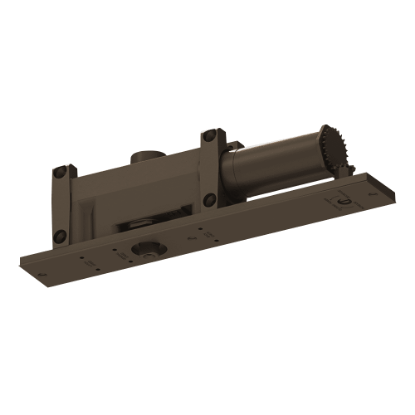
Take the cover off. The body almost always carries a stamped or cast model number, and that number is the fastest route to the right part.
If the stamping is gone, the arm and mounting position narrow it to a family, and the valve layout on the end of the body is the next clue. Three valves in a row is a different unit from two valves plus a separate backcheck on the side.
Our surface mounted door closer guide covers the identification sequence in detail, and the door closer component guide explains what each part does.
What Maintenance Does a Hydraulic Door Closer Need?
Very little, and that is part of the problem. Closers are ignored until they fail.
- Look for oil on the door face and the floor beneath, twice a year.
- Check the door still latches from a fully open position without being helped.
- Check the fixings are tight, particularly on hollow doors where screws work loose.
- Check the arm is straight and that its connections are not worn oval.
- Check there is a working door stop, because backcheck is not one.
- Retest exterior doors seasonally, because the oil behaves differently in cold weather.
For faults on the rest of the opening, our commercial door hardware troubleshooting guide covers latches, strikes and exit devices. Browse door closer parts for cylinder assemblies, arms and covers, or start from the full products and parts index.
About the Author
Security Parts has supplied repair parts for commercial door hardware since 2001, covering Von Duprin, LCN, Schlage, Falcon, Detex and Adams Rite at the component level. Our diagram based lookup exists so a technician can confirm a part before ordering it. This guide was written by the Security Parts team from supplier documentation and the questions our customers bring us.
For more on the closer, see the LCN door closer parts and service guide and the full LCN parts range.