 Trusted Since 2001





Quick Summary
Key points
- An automatic door opener is a powered operator that swings or slides the door for the user. The door still needs a closer function, because the operator has to control the door on the way back too.
- Low energy operators are the ones you see on accessible entrances. They move the door slowly and are activated by a person pressing or waving at something.
- The activation device is a separate decision from the operator. A push plate, a touchless wave sensor, a bollard and a wireless transmitter all do the same job in different ways.
- Safety sensors and a door position switch stop the door hitting people. If the door behaves erratically, suspect those before the operator.
- Almost every part of these systems is replaceable on its own, including arms, actuators, sensors and control boxes.
| Element | What it does |
|---|---|
| Operator | The powered unit that drives the door open and controls it closed |
| Activation | What tells the operator to go: a push plate, a wave sensor, a bollard, a credential |
| Safety | Sensors that stop or reverse the door when somebody is in the way |
| Control | The box and relays that decide what happens in which order |
In This Guide
- What Is an Automatic Door Opener and How Does It Work?
- Single, Double or Dual Egress: Why the Door Count Changes the Part
- What Activates an Automatic Door Opener?
- How Do the Safety Sensors Keep the Door From Hitting Somebody?
- What Connects the Operator to the Door?
- Can an Automatic Door Opener Go on a Fire Rated Door?
- Which Operator Series Is on Your Door?
- What Goes Wrong With Automatic Door Openers?
- What Should You Confirm Before Ordering Operator Parts?
- About the Author
An automatic door opener looks simple from the outside. Somebody presses a plate, the door swings, it closes again. Underneath there are four separate systems that have to agree with each other, and when one of them drifts the whole opening starts behaving strangely.
This guide covers how these systems fit together, the terminology that gets mixed up, and where the fault usually is when a powered door stops behaving. For the component level breakdown, see our door operator parts guide.
What Is an Automatic Door Opener and How Does It Work?
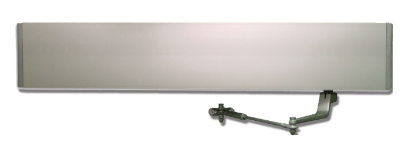
An automatic door opener, more properly called a door operator, is a powered unit mounted at the head of the opening that drives the door through its swing or slide. It replaces the push you would give the door yourself.
The important thing people miss is that the operator does not stop working once the door is open. It also controls the door coming back. A powered swing door still has to close at a controlled speed, latch properly, and not slam. So the operator contains or works alongside a closing mechanism, which is why the same manufacturers make both closers and operators and why the parts families overlap.
Operators are driven in different ways depending on the series. Some are electrohydraulic, some are pneumatic, and some are electromechanical. That difference decides what is inside the unit when it fails, and it decides which spares list you are working from.
Low Energy Versus Full Power
The term you will see constantly on accessible entrances is low energy. A low energy operator opens the door slowly and with limited force, and it is activated by a deliberate human action such as pressing a plate or waving at a sensor.
That is why low energy units can be used on an ordinary corridor or office door without a guard rail around them. Full power automatic doors, the sort that open as you walk at them, move faster and carry a different set of safety requirements. The products stocked for accessible entrances are explicitly described as low energy operators, supplied in single door, double door and dual egress versions.
Single, Double or Dual Egress: Why the Door Count Changes the Part
Operators are not ordered by the door, they are ordered by the opening. Three configurations come up and they are three different products.
| Configuration | The opening | What changes |
|---|---|---|
| Single door | One leaf in the frame | One operator, one arm, one set of safety sensors |
| Double door | A pair that both swing the same way | Two operators that have to be sequenced so the leaves do not collide |
| Dual egress | A pair where the leaves swing opposite ways | Handing and sequencing differ again, and the hardware is specific to it |
Dual egress is the one that catches people out. The two leaves swing in opposite directions, usually in a corridor, so what looks like an ordinary pair is actually a different opening with its own part number. Confirm which of the three you have before ordering anything.
What Activates an Automatic Door Opener?
Activation is a completely separate decision from the operator, and this is where most of the product choice actually happens. The operator does not care what tells it to open, it just needs a signal.
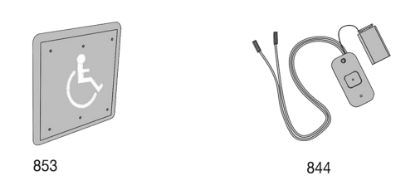
- Push plates. The traditional answer. A square or round plate on the wall, usually carrying a wheelchair icon, wired back to the operator.
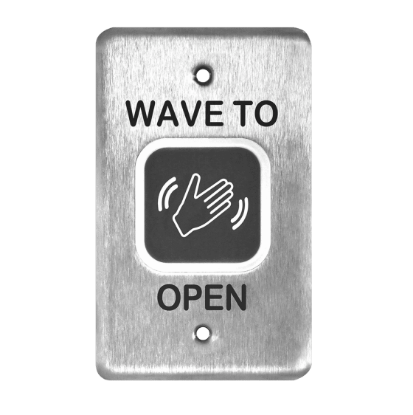
- Touchless actuators. The user waves a hand near the plate rather than pressing it. Stocked versions come in single gang and double gang sizes, with either a wave icon or a wheelchair icon and text.
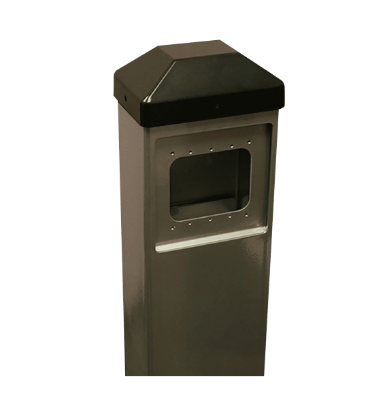
- Bollard posts. A free standing post in the approach path, used where there is no wall in a sensible position. Available in flush length and full length versions.
- Wireless transmitters. Battery or mains actuators that signal the operator without a cable run, which is the practical answer in a retrofit where chasing a wall is not an option.
Why Bollards Exist
A push plate needs a wall. Plenty of accessible entrances have glass on both sides, a long approach across open paving, or a route where the nearest wall is too far from the door to be useful. A bollard puts the actuator where the user actually is.
Bollards are ordered as full length or flush length, and as actuator only posts or as complete actuator and bollard packages. Wireless bollard versions remove the cable run entirely, which on an existing paved approach is often the difference between a one day job and a week of groundwork.
How Do the Safety Sensors Keep the Door From Hitting Somebody?
A powered door that cannot see people is a hazard, so the safety layer is not optional and it is usually where intermittent faults live.
Two kinds of sensing are involved. Approach side sensing watches the area the door swings into. Door mounted sensing rides on the leaf itself and watches the space immediately in front of it as it travels.
Those two cannot both be active all the time, because a door mounted sensor sweeps a different area as the leaf moves and would see the floor, the frame or the wall. That is the job of the door position switch. A surface mount position switch disables the approach side sensor when the door is closed, working together with the door mounted safety sensor and a relay module, so the operator knows which part of its cycle it is in.
The practical consequence: when a powered door starts stalling, reopening for no reason, or refusing to settle, check the sensors and the position switch before condemning the operator. Our guide to actuators, sensors and accessories for automatic operators covers those components individually.
What Connects the Operator to the Door?
The operator drives the door through an arm, and the arm is a wearing part in a way the operator body is not.
Push arms are ordered by length and by finish, so a 20 inch push arm exists in aluminium and in bronze as two separate part numbers. If the arm has been bent by somebody forcing the door, the replacement has to match both.
Track driven operators use a different arrangement again, with the arm running in a track rather than folding at an elbow. Sliding door operators like the SlidePro series replace the arm entirely with a belt and carrier system. Those are three different parts families, so identifying which one you are looking at is the first step in any repair.
Can an Automatic Door Opener Go on a Fire Rated Door?
Yes, with conditions, and the conditions are the same ones that apply to any powered hold open arrangement.
A fire rated opening has to close and latch when the alarm sounds. An operator that holds a door open, or that simply sits in the way of the door closing under its own spring, has to release and let the door do its job. That means the operator and its hold open function need to be tied into the fire alarm, not left as a mechanical catch somebody can set and forget.
The rating on the door also constrains what can be cut into it or bolted to it. Our commercial door fire rating guide explains what each rating requires of the opening.
Which Operator Series Is on Your Door?
Identifying the series matters more than identifying the brand, because the parts lists are organised by series.
Swing door operators run across several families, including units built around an electrohydraulic mechanism, pneumatic units, and the Benchmark and Senior Swing families. Sliding operators sit in their own series. Each has its own motor, control box, arm set and accessory range, and very little crosses between them.
Start by reading the label inside the header cover. If that is gone, photograph the header end plates, the arm, and the control board, and work from the diagrams. Our commercial door operators guide covers the main models and what distinguishes them, and the Benchmark and Senior Swing parts guide covers those two families specifically.
What Goes Wrong With Automatic Door Openers?
| Symptom | Likely cause | Check first |
|---|---|---|
| Door does not open when the plate is pressed | Activation signal not reaching the operator | The actuator itself, then its wiring or wireless pairing, before the operator |
| Door opens but will not close fully | Closing control, or a binding door | Whether the door closes by hand. A binding leaf is a hinge or frame problem |
| Door reopens for no reason | A safety sensor seeing something it should not | Sensor alignment, lens contamination, and whether the position switch is working |
| Door stops part way through its swing | Obstruction detection triggering | Anything in the swing path, then the door itself for drag |
| Pair of doors colliding | Sequencing lost between the two operators | The control and the interconnection between the leaves |
| Intermittent faults with no pattern | Power supply or a loose connection | Supply voltage under load, then every terminal in the header |
For faults on the mechanical side of the same opening, our commercial door hardware troubleshooting guide covers closers, latches and strikes.
What Should You Confirm Before Ordering Operator Parts?
- The operator series, read from the label inside the header.
- The configuration, single, double or dual egress.
- Swing or slide, because the parts families do not overlap.
- The activation device, including gang size, icon and whether it is wired or wireless.
- Arm length and finish, for anything that connects the operator to the door.
- Whether the opening is fire rated, which constrains hold open.
Everything here is stocked at component level. Browse door operator parts, the wider LCN parts range, or the full products and parts index if you already have a part number.
About the Author
Security Parts has supplied repair parts for commercial door hardware since 2001, covering Von Duprin, LCN, Schlage, Falcon, Detex and Adams Rite at the component level. Our diagram based lookup exists so a technician can confirm a part before ordering it. This guide was written by the Security Parts team from supplier documentation and the questions our customers bring us.
For the rest of the powered opening, see our door closer parts section and our guide to the four main types of commercial door closer.