 Trusted Since 2001


Quick Summary
Key points
- A mortise lock needs a strike built for a mortise latch, which means a deeper keeper and a backbox sized for the frame it sits in.
- The first number to collect is the latch throw. A strike listed for a 3/4 inch throw will not seat a longer latch correctly, and that single figure rules most options in or out.
- Deadbolts change the answer. An electric strike releases a latch, not a bolt, so a mortise lock whose deadbolt is thrown stays locked whatever the strike does.
- Fail secure keeps the door locked when power is lost, fail safe releases. Neither affects getting out, because egress is through the inside lever of the mortise lock.
- Faceplates, spring kits and sliders are stocked separately, so a damaged face or a sluggish keeper is a parts order rather than a new strike.
| Requirement | Why the mortise lock sets it | What goes wrong if ignored |
|---|---|---|
| Keeper depth | A mortise latch projects further than a cylindrical latch | Latch bottoms out or sits proud of the keeper |
| Latch throw | Fixed by the lock case, not adjustable | Latch does not seat, door rattles or fails to hold |
| Backbox depth | Decided by the frame the lock closes against | Strike will not fit the frame cavity |
| Deadbolt presence | A bolt is not released by any strike | Door stays locked when the strike releases |
| Faceplate size | Has to cover the existing frame preparation | Visible gap or fouling against the stop |
In This Guide
- What Changes When the Lock Is a Mortise Lock?
- Why Is Latch Throw the First Thing to Measure?
- Which Strike Suits a Mortise Lock on a Standard Frame?
- Why Will an Electric Strike Not Release a Deadbolt?
- Should the Strike Be Fail Safe or Fail Secure?
- What Is the Faceplate For and When Does It Change?
- Why Does My Electric Strike Buzz But Not Release?
- Does a Fire Rated Door Change the Strike Choice?
- What Should You Confirm Before Ordering?
- About the Author
An electric strike for a mortise lock looks like the same job as one for a cylindrical lock, and it is not. The latch is longer, the frame preparation is deeper, and the lock may carry a deadbolt that no strike will ever release.
This guide covers what changes when the lock is a mortise lock, how to choose the strike, which measurements decide it, and what goes wrong when the wrong unit is fitted.
What Changes When the Lock Is a Mortise Lock?
The latch does, and everything else follows from it.
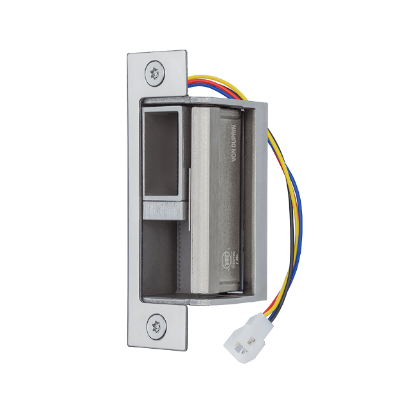
A mortise lock sits inside a pocket cut into the edge of the door, and its latch projects from the lock case rather than from a small cylindrical chassis. That latch is typically longer and squarer than a cylindrical latch, so the keeper it drops into has to be deeper and shaped to receive it. A strike that suits a cylindrical lockset will often accept the mortise latch partway and then stop. Our mortise lock repair guide explains what fails and what you can replace.
The second change is the frame. Mortise locks are common on openings with substantial frames, and the cavity behind the strike has to take a backbox deep enough for the mechanism. Our guide to commercial mortise locks covers how those locks are built, and the strike has to answer the geometry they create.
Does the lock function matter as well?
Yes, more than most people expect. A storeroom function presents a latch only. An office or entry function may present a latch and a deadbolt. A classroom security function changes which side the key controls. The strike only ever deals with the latch, so the function tells you whether releasing the latch is actually enough to open that door.
Why Is Latch Throw the First Thing to Measure?
Because it is fixed by the lock and it eliminates most of the catalogue in one step.
Latch throw is how far the latch bolt projects from the face of the lock when it is fully extended. Electric strikes are listed against a throw figure, and that figure is not advisory. A strike built for a 3/4 inch throw presented with a longer latch will either refuse the latch or hold it at an angle where it never seats properly.
Measure it with the door open and the latch fully out, from the face of the lock to the tip of the bolt. Do not measure the keeper you already have, because the existing strike may be the reason you are standing there.
| Measurement | Where to take it | What it decides |
|---|---|---|
| Latch throw | Lock face to bolt tip, door open | Which strikes will accept the latch at all |
| Latch height and width | Across the bolt face | Keeper opening size |
| Frame cavity depth | Inside the existing preparation | Which backbox will fit |
| Existing faceplate size | Across the frame face | Whether the prep is covered |
| Deadbolt projection | With the bolt thrown | Whether a strike alone solves the problem |
What if the latch has an anti friction tongue?
Many mortise latches carry a small secondary tongue ahead of the main bolt that reduces drag as the door closes. It has to clear the keeper lip cleanly. If the strike lip is set too far out, the tongue catches and the door checks against the frame before the latch arrives, which reads as a sticking door rather than a strike problem.
Which Strike Suits a Mortise Lock on a Standard Frame?
On most commercial openings, a heavy duty strike from a series built for mortise and cylindrical locks without deadbolts.
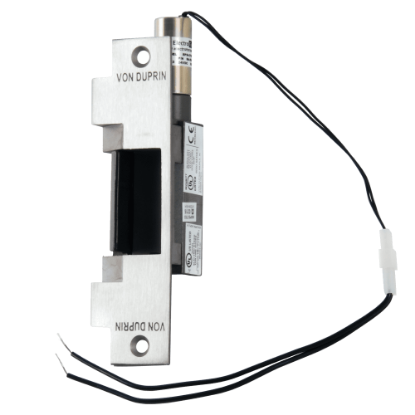
These units are designed around the latch a mortise lock presents, with a keeper deep enough to take the bolt and a body sized for a frame cavity. Within a series the variants differ by frame material and backbox depth rather than by how they work, so the choice is driven by the opening rather than by preference. Our 6211 electric strike guide works through that variant logic in detail on one unit. Our electric strike vs magnetic lock comparison explains which suits your door.
How do you pick between variants in the same series?
By the frame, in three steps. Establish the frame material, measure the cavity depth available behind the strike, and confirm the faceplate size needed to cover the existing preparation. Those three answers normally leave a single variant standing. Guessing between them is how a strike arrives that is correct in every respect except that it will not go into the hole.
Why Will an Electric Strike Not Release a Deadbolt?
Because a strike releases a keeper, and a deadbolt is not held by one.
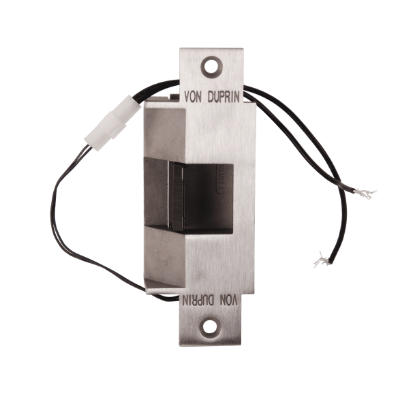
An electric strike works by letting its keeper swing out of the way so the latch can leave the frame. A latch is sprung and retracts under load. A deadbolt is driven out by the key or thumbturn and stays where it is put, so there is nothing for the keeper to release. If the bolt is thrown, the door stays shut no matter what the access control system does.
This matters most on office and entry functions, where users throw the deadbolt at night and the access control system appears to have failed the next morning. The system is working perfectly; the door is simply bolted. Where remote release has to work regardless, the answer is usually an electrified lock rather than a strike, and our electrified mortise lock against electric strike comparison covers that decision.
What do you do on a door that has to have a deadbolt?
Separate the two jobs. Let the deadbolt be the manual, after hours security and let the access control release the latch during the working day, with a clear instruction that the bolt stays retracted while the system is in use. Where that discipline cannot be relied on, the lock itself needs to change.
Should the Strike Be Fail Safe or Fail Secure?
Decide it from what the door must do when the power stops, not from what sounds safer.
Fail secure means the keeper stays locked without power, so the door remains secure and a key still works from outside. Fail safe means the keeper releases without power, so the door can be pushed open. Neither affects escape, because on a mortise lock the inside lever retracts the latch mechanically whatever the strike is doing.
| Opening | Usual choice | Reason |
|---|---|---|
| Store or plant room | Fail secure | Must stay locked in an outage |
| Office suite entrance | Fail secure | Key access is retained without power |
| Door on a fire alarm release | As specified by the design | Behaviour is set by the strategy, not the hardware |
| Door with continuous current concerns | Fail secure | Draws nothing while idle |
| Door that must release on power loss | Fail safe | No power means no holding |
Does the mode change the current draw?
Yes, and it is worth knowing before the power supply is sized. A fail secure strike is energised only while it is being released, so it draws nothing in its resting state. A fail safe strike has to be energised continuously to stay locked, which adds a standing load to every door fitted with one. Our complete electric strike guide covers the supply side in more detail.
What Is the Faceplate For and When Does It Change?
It covers the frame preparation and presents the keeper, and it changes whenever the existing cutout does not match the new strike.
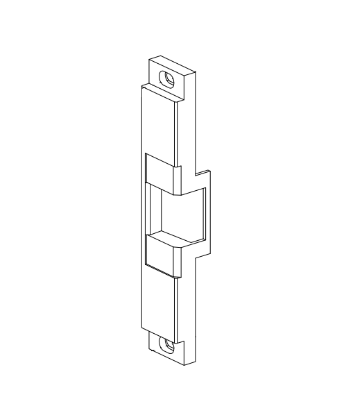
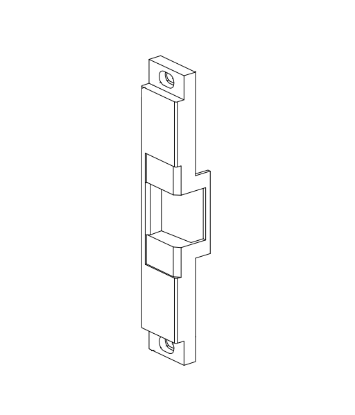
Faceplates are listed separately from the strike body for a practical reason: the frame in front of you was prepared for whatever was fitted first. A replacement strike with a different face leaves a gap or overlaps the stop. Ordering the correct faceplate turns a frame modification into a parts change.
Can you reuse the old faceplate?
Only when it is listed for the new strike. Plates look interchangeable and are not, because the keeper opening and the fixing positions are matched to the body behind them. A plate that is close but not correct holds the keeper slightly out of position, and the latch then lands on the edge of the opening instead of inside it.
Why Does My Electric Strike Buzz But Not Release?
Nearly always voltage at the strike or load on the latch, in that order.
A buzz means the coil is energised, so the signal has arrived. What it has not done is move the keeper. The two common reasons are that the voltage reaching the strike has dropped below what the unit needs after the run of cable, or that the door is pressed against the frame hard enough to load the latch into the keeper so it cannot swing clear.
Test both quickly. Measure at the strike terminals while somebody operates the release, not at the panel. Then ease the door against its swing to take the load off the latch and try again. If it releases with the load removed, the fault is alignment or door closing force rather than the strike.
| Symptom | Most likely cause | First check |
|---|---|---|
| Buzzes, does not release | Voltage drop or latch under load | Measure at the strike, then ease the door |
| Silent, no release | No signal or no supply | Supply at the unit, then the input |
| Releases but door does not open | Deadbolt thrown | Check the bolt, not the strike |
| Sluggish keeper return | Tired springs | Spring kit rather than a new strike |
| Door rattles when closed | Keeper too far out | Strike position and faceplate fit |
How do you tell a strike fault from an alignment fault?
Operate the strike with the door standing open. If the keeper moves freely with nothing touching it, the unit is working and the problem lives at the opening. If it does not move with no load at all, the fault is in the strike or its supply. That one test separates most callouts before any tools come out, and our hardware troubleshooting guide covers the rest of the opening.
Does a Fire Rated Door Change the Strike Choice?
It narrows it, because the strike becomes part of a listed assembly.
A fire rated opening is tested and listed as a complete set, and the strike is one of its components. The replacement has to be suitable for that use, and the door has to latch positively every time under its own closer. A strike that releases on loss of power is not normally appropriate on a door that has to stay latched in a fire, so fail secure is the usual answer on those openings.
Positive latching is the part that gets missed. A strike that holds the door closed but does not let the latch seat fully has not met the requirement, even though the door looks shut. Our fire rating guide covers what else on the opening is bound by the same listing.
What about an accessible opening?
Accessible routes limit the force needed to open a door, and a strike contributes to that in one specific way. If the keeper is set too far into the frame the latch has to be dragged out of it, which raises opening force. Setting the strike so the latch leaves cleanly is part of meeting the requirement rather than a refinement, and our door clearance guide covers the rest.
What Should You Confirm Before Ordering?
Six things, and five of them come off the door rather than out of a catalogue.
The lock series and function, so you know what the strike has to work with. The latch throw, measured rather than assumed. The frame material and the cavity depth behind the existing strike. Whether a deadbolt is present. The faceplate size needed to cover the current preparation. And the voltage available at the door, measured at the opening.
Record them before you look at part numbers. Every one of those answers removes options, and a strike chosen without them is a strike chosen on hope. For the parts side of the strikes themselves, our electric strike parts guide covers what is stocked separately.
What if the opening already has an electric strike that never worked properly?
Treat it as evidence rather than as a baseline. A strike that has never worked well is often the wrong throw or the wrong depth for the lock in front of it, and copying its part number repeats the mistake. Measure the lock, measure the frame, and let those numbers select the replacement. Our electric strike installation guide covers setting the new unit once it arrives.
About the Author
Security Parts has supplied repair parts for commercial door hardware since 2001, covering Von Duprin, LCN, Schlage, Falcon, Detex and Adams Rite at the component level. Our diagram based lookup exists so a technician can confirm a part before ordering it. This guide was written by the Security Parts team from supplier documentation and the questions our customers bring us.