 Trusted Since 2001





Quick Summary
Key points
- A strike plate is the metal plate in the frame that the latch or bolt enters. It takes every impact the door makes and it is the cheapest part of the opening to get wrong.
- The lip is the curved tab that guides the latch in. Lip length is a real dimension that has to suit the frame, and it is ordered as part of the number.
- ANSI strikes, square corner strikes, T strikes and rabbeted strikes are different shapes for different frames, not alternatives you pick by preference.
- Most strike complaints are alignment, not the strike. A latch that works with the door open and fails with it closed is telling you where the problem is.
- The box behind the strike matters. A plastic box and a metal box are different parts and different levels of resistance.
| Part | What it does |
|---|---|
| Faceplate | Sits flush in the frame and carries the fixing screws |
| Opening | Receives the latch bolt or deadbolt |
| Lip | Curved tab that guides the latch over the frame edge |
| Box or dust box | Encloses the space behind, keeps debris out and adds resistance |
In This Guide
- What Is a Strike Plate and What Does It Do?
- What Is the Lip on a Strike Plate and Why Does Length Matter?
- What Are the Different Types of Strike Plate?
- Does the Box Behind the Strike Matter?
- Why Will My Door Not Latch? Strike Alignment Explained
- What Is a Rabbeted Strike and When Do You Need One?
- Why the Screws Matter as Much as the Plate
- What Should You Check on a Strike During Routine Maintenance?
- Strikes, Deadlatches and Electric Strikes
- What to Confirm Before Ordering a Strike Plate
- About the Author
A strike plate costs a fraction of what the lock costs and decides whether the lock works. It is also the part most likely to have been replaced by whatever was in the van, which is why so many doors have a strike that nearly fits.
This guide covers what the strike does, the types you will meet, how to work out which one an opening needs, and why most strike problems are not actually the strike. For the part level breakdown, see our strike plates and deadlatches parts guide.
What Is a Strike Plate and What Does It Do?
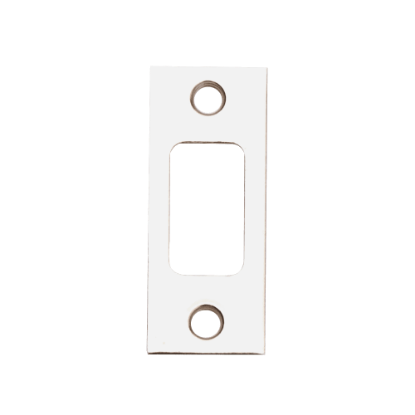
The strike plate is the metal plate fitted into the frame opposite the lock. It has an opening in it that the latch bolt or deadbolt enters when the door closes, and it is screwed into the jamb so that it sits flush with the frame face.
It does three jobs at once.
- It guides the latch. As the door swings closed, the sloped face of the latch runs along the lip of the strike and is pushed back into the lock. When it reaches the opening, it springs out again and the door is latched.
- It takes the load. Everything the door does, every slam, every pull against the lock, every attempt to force it, lands on the strike and its screws.
- It protects the frame. Without a plate, the latch would be hammering wood or thin steel on every cycle.
That first job explains why the lip exists and why its length matters so much.
What Is the Lip on a Strike Plate and Why Does Length Matter?
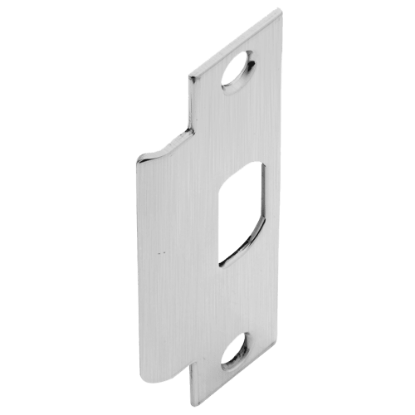
The lip is the curved tab that extends from the faceplate out over the edge of the frame. It is the ramp that pushes the latch back as the door closes.
Lip length is measured from the centre line of the strike to the end of the lip, and it is not a style choice. It has to be long enough that the latch meets it rather than meeting the frame or the architrave, and short enough that it does not project into the opening where people walk past it.
Get it too short and the latch catches on the frame edge instead of riding over the lip, so the door bangs rather than closing. Get it too long and the lip sticks out into the traffic, snags clothing, and gets bent by trolleys until it no longer guides anything.
This is why you will see the same strike offered in a range of lip lengths as separate part numbers. A T shaped square corner strike with a plastic box might be stocked in half a dozen lip lengths, and they are not interchangeable once the frame is built.
What Are the Different Types of Strike Plate?
| Type | Shape | Typical frame |
|---|---|---|
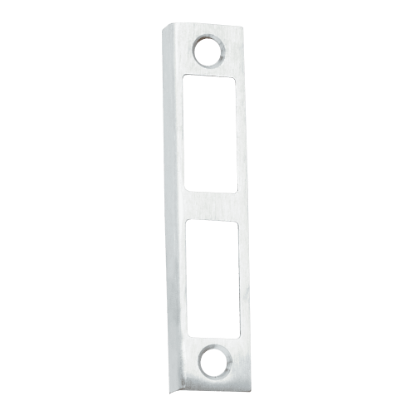
| ANSI strike | Long rectangular faceplate to a standard pattern | Hollow metal frames prepped to the standard |
| Square corner strike | Rectangular faceplate with square corners | Frames machined with a square corner router or chisel |
| T strike | Narrower at the ends than the middle | Frames where the full rectangle will not fit |
| Rabbeted strike | Stepped to follow a rabbeted frame profile | Rabbeted frames, where the stop is formed in the section |
| Double door strike | Designed to serve a pair rather than a single leaf | Pairs without a mullion, where the inactive leaf carries the strike |
These are not interchangeable. The frame has been prepared for one shape, and fitting a different one means either a visible gap or cutting the frame. On a rated opening, cutting the frame is not a casual decision at all.
The ANSI pattern is the one worth knowing because it is the common denominator. A frame prepped to the ANSI strike pattern will take any strike built to it, which is precisely the point of having a standard.
Does the Box Behind the Strike Matter?
Yes, more than most people expect.
Behind the opening in the strike there is a cavity in the frame. A box, sometimes called a dust box, lines that cavity. Its obvious job is keeping mortar, insulation and debris out of the space the latch has to enter, because a latch that cannot fully extend is a latch that can be pushed back.
Its less obvious job is resistance. Strikes are stocked both with plastic boxes and with metal boxes, and that is a deliberate difference. A plastic box is fine on an interior door where nothing is going to be attacked. On an exterior door or anything protecting value, a metal box adds real resistance behind the plate rather than just keeping the hole tidy.
When you order a strike, check whether the box is included and which kind it is. The part number usually tells you.
Why Will My Door Not Latch? Strike Alignment Explained
This is the complaint behind most strike work, and the first test takes ten seconds.
Open the door and operate the latch by hand. If the latch extends and retracts freely with the door open, the lock is fine. The problem is between the latch and the strike. If it binds with the door open, the problem is in the lock or the door prep and the strike is innocent.
Assuming the lock is fine, there are three ways the alignment can be out.
| Direction | What you see | Usual cause |
|---|---|---|
| Vertical | Latch hits above or below the opening, leaving a mark on the strike face | Door has dropped on worn hinges |
| Horizontal | Latch reaches the strike but will not go deep enough to spring out | Door or frame has moved, or weatherseal is holding the door off |
| Depth | Latch enters but the door rattles, or the deadbolt will not throw fully | Gap between door and frame has grown |
The marks tell you the direction. A strike face with a bright wear line above the opening is a door that has dropped, and the fix is at the hinges, not at the strike. Filing the strike opening bigger to accommodate a sagging door is the repair that comes back.
When Moving the Strike Is the Right Answer
Sometimes it genuinely is. Frames settle, buildings move, and a strike fitted square to a frame thirty years ago may no longer be square to the door. In that case the strike is relocated properly, with the old fixing holes filled so the new screws bite into solid material rather than spinning in enlarged holes.
What is not a repair is packing the strike out with washers, or enlarging the opening with a file until the latch finds its way in. Both work for a while and both leave an opening that is easier to force than it was.
What Is a Rabbeted Strike and When Do You Need One?
A rabbeted frame has the door stop formed as a step in the frame section rather than planted on as a separate strip. The door sits into that step when it closes.
A flat strike cannot follow that profile. Fitted into a rabbeted frame it either stands proud of the step or leaves the latch meeting a corner, and neither works. A rabbeted strike is stepped to match, so its face follows the frame and the latch meets a continuous surface.
You can identify a rabbeted frame in a second by looking at the jamb with the door open. If the stop is a separate piece of timber or steel pinned on, the frame is not rabbeted. If the stop is part of the same section, stepping back from the face, it is.
Getting this wrong is common on replacements, because a flat strike will physically screw into a rabbeted frame. It just will not latch reliably, and the symptom looks like an alignment fault rather than the wrong part.
Why the Screws Matter as Much as the Plate
A strike is only as good as what is holding it in, and this is where most of the real security is won or lost on an exterior door.
Short screws reach into the frame skin and nothing else. Under a kick, the screws tear through thin material and the whole strike comes away with a section of jamb, regardless of how strong the lock was. Longer fixings that reach past the frame into the structure behind change what has to fail before the door opens.
Three things worth checking on any strike you are working on:
- Are the existing holes still sound, or have they been enlarged by previous adjustment so the screws no longer bite.
- Is the strike sitting flat, or has it been packed out with washers to cover an alignment problem.
- Is the frame reinforced behind the strike, which on hollow metal usually means a strike reinforcement rather than bare skin.
None of that is expensive. All of it is invisible once the door is shut, which is why it gets skipped.
What Should You Check on a Strike During Routine Maintenance?
- Look for wear marks on the strike face, which show the latch is not arriving where it should.
- Check the lip is straight and has not been bent by trolleys or carts.
- Test the latch from a slow close, not a slam, because a slammed door will latch over a fault that a gentle close will not.
- Check the deadlatch lands on the strike face, not in the opening, on locks that have one.
- Check the screws are tight and that the holes have not opened up.
- Look into the box for debris, particularly on doors near building work.
The slow close test is the useful one. Most doors that have a developing strike problem will still latch if you let them slam, so a quick check during a walk round misses it. Close the door gently and see whether it latches on its own.
Strikes, Deadlatches and Electric Strikes
Three things get called strikes and they are not the same.
- A strike plate is passive. It is a shaped piece of metal with no moving parts.
- A deadlatch is part of the lock, not the frame. It is the small plunger beside the main latch that stops the latch being pushed back once the door is closed. If the deadlatch misses the strike face it is not doing its job, which is another reason strike alignment matters.
- An electric strike replaces the passive plate with a powered one that can release the latch on a signal. That is a different product with wiring, handing and fail safe or fail secure behaviour to decide.
For the powered version, see our electric strike schematic diagram and the electric strike parts section.
What to Confirm Before Ordering a Strike Plate
- The frame prep, which decides the shape: ANSI, square corner, T or rabbeted.
- Faceplate dimensions, measured off the existing plate.
- Lip length, measured from the centre line to the end of the lip.
- Whether a box is included, and whether it should be plastic or metal.
- What the strike has to receive, a latch bolt, a deadbolt, or both.
- The finish, matched to the rest of the hardware on the opening.
Browse cylindrical lock parts and mortise lock parts for the locks these strikes serve, or the full products and parts index if you already have a part number.
About the Author
Security Parts has supplied repair parts for commercial door hardware since 2001, covering Von Duprin, LCN, Schlage, Falcon, Detex and Adams Rite at the component level. Our diagram based lookup exists so a technician can confirm a part before ordering it. This guide was written by the Security Parts team from supplier documentation and the questions our customers bring us.
For related reading, see our commercial door hardware troubleshooting guide and the commercial door hardware finish guide.