 Trusted Since 2001


Quick Summary
Key points
- A door prop alarm sounds when a door stays open longer than a set delay. Unlike an exit alarm, it does not sound the moment the door opens, so normal use is never interrupted.
- It does not lock or delay the door. People enter and leave exactly as before. The alarm only reacts when someone holds or props the door open.
- The two main choices are battery powered units that install in minutes and hardwired units that can report to a security panel or access control system.
- The delay setting decides how useful the alarm is. Too short and staff learn to ignore it. Too long and a propped door stays open for minutes before anyone knows.
- Most false alarms come from the door not fully closing or the magnet drifting out of line, not from a faulty alarm. Fix the door before replacing the unit.
| Device | When it sounds | Typical door |
|---|---|---|
| Door prop alarm | After the door has been open longer than the set delay | Doors used in both directions that must not be left open |
| Exit alarm | As soon as the door is opened, unless bypassed | Emergency exits that should not be used day to day |
| Access control door held alarm | Reported to the system after a held open time | Card reader doors with a door position switch |
In This Guide
- What Is a Door Prop Alarm?
- Where Do You Need a Door Prop Alarm?
- Should You Choose a Battery or Hardwired Door Prop Alarm?
- How Long Should the Door Prop Alarm Delay Be?
- How Do Prop Alarms Work With Access Control?
- Why Does a Door Prop Alarm Keep Going Off?
- What Should You Confirm Before Ordering a Door Prop Alarm?
- About the Author
The loading dock door is wedged open with a block of wood because it is a hot afternoon. The side door to the staff parking lot is held with a fire extinguisher. Neither door is locked or alarmed, so nobody notices until something walks out or someone walks in.
A door prop alarm is the simplest fix for that problem. This guide explains how prop alarms work, how they differ from exit alarms, the battery and hardwired options, how to choose the delay, why they false alarm and what to confirm before ordering one.
What Is a Door Prop Alarm?
A door prop alarm watches whether a door is open or closed, usually with a magnet on the door and a sensor in the alarm or in a door contact on the frame. When the door opens, a timer starts. If the door closes before the timer runs out, nothing happens. If it stays open, the alarm sounds until the door is closed again.
That is the key difference from an exit alarm, which sounds the moment an emergency exit is opened. A prop alarm is designed for doors people are allowed to use, where the only problem is the door being left open. Our guide to what an exit alarm is covers the other side of that comparison.
Does a door prop alarm lock the door?
No. It does not lock, delay or restrict the door in any way, so it does not change how people get out of the building. It only makes a noise, and in some cases sends a signal, when the door is left open.
Where Do You Need a Door Prop Alarm?
Anywhere a door has to be usable but should never be left open.
- Secondary entrances and staff doors, where propping lets people bypass the main entrance and reception.
- Loading docks and delivery doors, where doors are opened often and left open easily.
- Card reader doors, where a propped door defeats the access control system entirely.
- Temperature controlled rooms and conditioned spaces, where an open door wastes energy or affects stored goods.
- Doors to secure areas, such as server rooms, stock rooms and pharmacies, where an open door is a security gap even with nobody passing.
Fire doors are a special case. A fire door should not be propped at all, and a prop alarm helps discourage it. Where a fire door genuinely needs to stand open, it should use a hold open device approved for the purpose that releases the door on a fire alarm, rather than a wedge.
Should You Choose a Battery or Hardwired Door Prop Alarm?
Battery units are the quickest fix. Hardwired units are the better choice when someone other than the people nearby needs to know.
Battery powered prop alarms
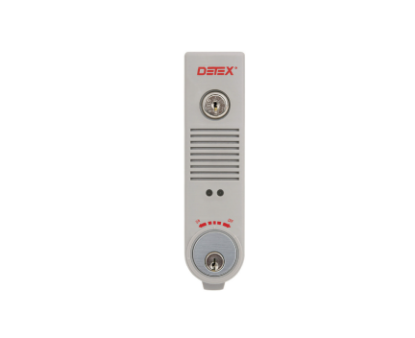
A battery unit mounts on the door or wall with no wiring. The Detex EAX-300, for example, runs on a 9V battery with a low battery alert, has field selectable door open times from 1 second to 4 minutes, and automatically senses where the door magnet is so it sets its own handing. A tapered cover lets it fit narrow stile doors, and wall mount kits add separate door contacts.
Hardwired prop alarms
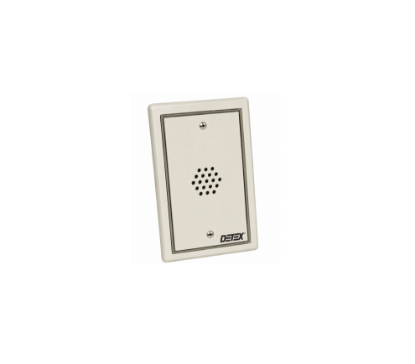
A hardwired unit takes low voltage power and usually provides a relay output for remote monitoring. The Detex EAX-411SK, for example, operates on 12 or 24 VAC or VDC, has an adjustable door open delay of 0 to 60 seconds, sounds an 80 dB local alarm, resets automatically when the door closes, and includes an alarm status relay for remote annunciation. The kit includes a back box, surface magnetic switch contacts and a 24VAC transformer.
Combined exit and prop alarms
Some doors need both behaviors. The Detex EAX-4200SK combines exit alarm, door prop and door forced detection in one surface mounted unit that can work alone or with an access control system, with a reset and bypass keyswitch using a standard rim cylinder. It suits doors where any unauthorized opening and any propping both need to be reported.
| Consideration | Battery powered | Hardwired |
|---|---|---|
| Installation | Minutes, no wiring | Needs low voltage power to the door |
| Remote monitoring | Local sounder | Relay output for a panel or security desk |
| Maintenance | Battery replacement when the low battery alert shows | Very little once wired |
| Best for | Retrofits and single problem doors | Monitored buildings and access controlled doors |
| Example | Detex EAX-300 | Detex EAX-411SK, Detex EAX-4200SK |
How Long Should the Door Prop Alarm Delay Be?
Long enough for the slowest legitimate use of the door, and no longer. Watch how the door is actually used before you set it.
- Pedestrian doors usually need only a short delay, enough for a person to pass and the closer to shut the door.
- Doors used with carts, wheelchairs or deliveries need longer, or the alarm will sound during normal use.
- Doors with a slow closer need the delay to cover the full closing time, otherwise the alarm triggers before the door has had a chance to close.
If staff regularly need the door open longer, such as for a delivery, a unit with a key bypass is better than a long delay. A long delay protects nothing most of the time, while a bypass keeps the short delay in force except when a key holder deliberately overrides it.
How Do Prop Alarms Work With Access Control?
An access controlled door already knows whether it is open, through its door position switch, and most systems can raise a door held open event. The weakness is that the event goes to a screen or a log, and nobody at the door hears anything. A local prop alarm adds the sounder that makes the person holding the door close it.
In practice the two are often combined. The access system reports the event and a local sounder or a combined alarm unit warns at the door. Our guide to door position switches and request to exit explains how the system knows the door state, and the access control hardware integration guide covers how the pieces of an opening work together.
Why Does a Door Prop Alarm Keep Going Off?
Most nuisance alarms are a door problem, not an alarm problem.
| Symptom | Likely cause | What to do |
|---|---|---|
| Alarms even though the door looks shut | Door not fully latching, or the gap between magnet and sensor too wide | Check that the door closes fully and realign the magnet |
| Alarms during normal use | Delay too short for how the door is used | Lengthen the delay or add a bypass |
| Alarms after the door closes slowly | Closer too slow or not closing the door | Adjust the closer sweep and latch speed |
| Chirps periodically | Low battery | Replace the battery |
| Never sounds | Battery dead, unit not armed, or magnet missing | Check power, the arming indicator and the magnet |
If the door is not closing properly, adjust or repair the closer before changing the alarm. Our door closer parts section covers the arms and bodies that usually need attention.
What Should You Confirm Before Ordering a Door Prop Alarm?
Six details settle it. Battery or hardwired, and if hardwired, the voltage available. Whether the alarm needs to report to a panel or access control system. The delay range you need for the way the door is used. The door type and stile width, because narrow stile doors need a slim unit or a wall mount kit. Whether you need a key bypass or reset. And whether the same door also needs exit alarm or door forced detection.
Browse the full range in our exit alarm parts section or go to Detex parts if you know the series. Our Detex exit alarm parts guide covers replacement components for existing units.
About the Author
Security Parts has supplied repair parts for commercial door hardware since 2001, covering Von Duprin, LCN, Schlage, Falcon, Detex and Adams Rite at the component level. Our diagram based lookup exists so a technician can confirm a part before ordering it. This guide was written by the Security Parts team from supplier documentation and the questions our customers bring us.
If you are not sure whether a door needs a prop alarm, an exit alarm or both, contact us with a photograph of the door and a short note on how it is used, and we will help you pick the right unit.