 Trusted Since 2001


Quick Summary
Key points
- A request to exit sensor tells the access control panel that somebody is leaving legitimately, so the door opening is logged as an exit rather than reported as a forced entry.
- Two families do the job. A switch inside the lock or exit device signals when the hardware is operated. A motion sensor above the door signals when somebody approaches.
- Passive infrared sensors look for the heat of a moving body. Microwave sensors look for movement itself. They fail for different reasons, which is why both exist.
- Whether a sensor may release an electrically locked door, rather than only signal the panel, is a code question with specific conditions attached and it is decided locally.
- Most false alarms on these doors are not the sensor failing. They are airflow, sunlight, traffic in the corridor or coverage aimed at the wrong area.
| Method | What triggers it | Where it sits |
|---|---|---|
| Request to exit switch | The lock, lever or exit device being operated | Inside the hardware on the door |
| Request to exit motion sensor | Somebody approaching the door from inside | Above the door on the secure side |
In This Guide
- What Is a Request to Exit Motion Sensor and Why Is It Fitted?
- What Happens If a Door Has No Request to Exit Signal?
- Motion Sensor or Switch: Which Type of REX Do You Need?
- How Does a PIR Request to Exit Sensor Work?
- When Is a Microwave Sensor the Better Choice?
- Where Should a Request to Exit Sensor Be Mounted?
- Can a Motion Sensor Release a Magnetic Lock on Its Own?
- How Is a Request to Exit Sensor Wired In?
- Why Do Request to Exit Sensors False Trigger?
- What Do You Need to Confirm Before Ordering?
- About the Author
A door with access control on it has an awkward problem. The reader knows who came in, but nothing tells the system who is going out, so every normal departure looks identical to somebody forcing the door.
Request to exit hardware solves that. This guide explains what the sensor is actually doing, how the motion sensing versions differ from the switch versions, where they go, and why so many of them end up being blamed for faults that are not theirs.
What Is a Request to Exit Motion Sensor and Why Is It Fitted?
It is a detector mounted above the door on the inside, aimed at the floor area somebody crosses on their way out. When it sees movement it closes a contact, and that contact tells the access control panel to expect the door to open.
The signal usually does two things. It suppresses the alarm that would otherwise be raised by the door position switch, and it creates a proper exit record in the log.
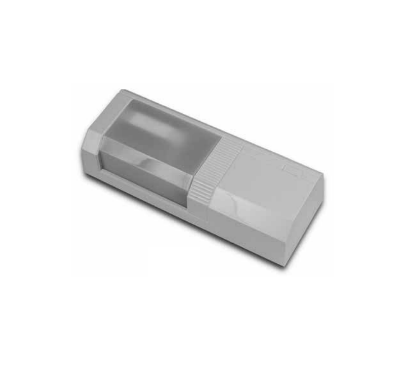
The reason it exists rather than just wiring a button is friction. A sensor asks nothing of the user, which matters on doors people go through with full hands, and on accessible routes where pressing a button may not be realistic.
What Happens If a Door Has No Request to Exit Signal?
Every legitimate exit is reported as a door forced open, and within a week nobody is reading the alarms any more.
That is the real cost of a missing request to exit signal. It is not that the door fails to work, it is that the monitoring becomes noise and a genuine forced door stops standing out from the thirty false ones that day.
The second effect is on records. Without an exit signal the system has entries but no departures, so occupancy reporting and roll call information are unreliable. Our door position switch and request to exit guide covers how the two signals work together.
Motion Sensor or Switch: Which Type of REX Do You Need?
They answer different questions, and on some doors you want both.
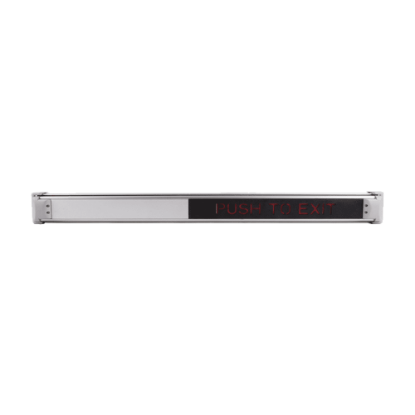
A switch inside the hardware signals that the device has actually been operated. It is precise. Nothing reports an exit unless somebody physically works the lever or pushed the bar.

A motion sensor signals that somebody is approaching. It is earlier, which matters when the panel has to release a lock before the user reaches the door, and it is less precise, because approaching is not the same as leaving.
| Consideration | Switch in the hardware | Motion sensor above the door |
|---|---|---|
| Triggers on | Hardware being operated | Movement in the detection area |
| Timing | At the moment of exit | Before the user reaches the door |
| False trigger risk | Very low | Higher, depends on the environment |
| Needs the user to touch anything | Yes, the lever or bar | No |
| Suits releasing a lock in advance | No | Yes |
On exit devices, the switch version is often built into the bar itself rather than added separately.
How Does a PIR Request to Exit Sensor Work?
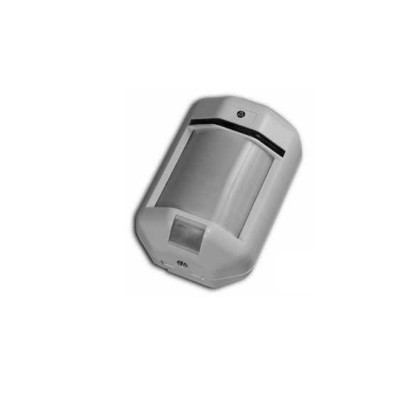
Passive infrared sensors detect the heat a human body gives off, and specifically detect it moving across the detection pattern.
The word passive matters. The sensor emits nothing. It simply watches for a change in the infrared energy reaching it, which is why these units draw very little power and why they do not interfere with anything else.
What does a PIR sensor struggle with?
Moving air at a different temperature, which is why a sensor near a heater, an air conditioning outlet or a draughty vestibule misbehaves. Direct sunlight across the detection area causes the same problem. So does a person approaching very slowly, because the sensor is watching for change rather than presence.
When Is a Microwave Sensor the Better Choice?
When the environment defeats infrared, or when you need detection through something.
Microwave sensors transmit a signal and watch for the shift that comes back from a moving object. They are not affected by air temperature, they are less troubled by sunlight, and they detect motion rather than heat.

The trade is containment. Microwave energy does not respect the boundaries you would like it to, so a badly set unit detects movement on the other side of a partition or in the corridor beyond. Setting the sensitivity properly is more of a job than it is with infrared.
Where Should a Request to Exit Sensor Be Mounted?
Above the door, on the secure side, aimed down at the area a person crosses immediately before reaching the door.
Three mistakes account for most poor installations. Mounting the sensor so the pattern reaches past the door into a corridor, which means passers by trigger it. Mounting it so the pattern does not reach far enough, so the lock does not release until the user is already pulling the handle. And mounting it where the door itself swings through the detection area, so the door triggers the sensor on its way closed.
How do you check the coverage is right?
Walk it. Approach the door at normal walking pace from the direction people actually use and note where the sensor picks you up. Then walk past the door without stopping and confirm it does not. Both tests matter, and most units are set using only the first.
Can a Motion Sensor Release a Magnetic Lock on Its Own?
This is the question that matters most and the one with the most careful answer.
Codes treat electrically locked egress doors as a special case, and sensor release of those doors carries specific conditions, which typically include a manual release device and a requirement that the lock fails unlocked on loss of power. Exactly what is permitted, and on which doors, is decided by the authority having jurisdiction.
So the honest answer is that a sensor can be part of a compliant arrangement, and is not by itself a substitute for a mechanical means of escape. Treat the sensor as one element of a designed egress solution, not as the solution.
Our electromagnetic lock parts guide covers the egress rules that apply to maglocks, and the delayed egress guide covers the case where the door is deliberately held.
How Is a Request to Exit Sensor Wired In?
Two connections matter: power to the sensor, and the contact back to the panel.
Power is usually taken from the same supply feeding the lock and the reader at that door. The contact is a dry relay output, and the panel expects it in a particular state, either normally open or normally closed. Getting that backwards produces a door that is permanently in request to exit, which suppresses the alarm the whole time and quietly removes the monitoring you installed the sensor to provide.
| Question | Why it matters |
|---|---|
| Normally open or normally closed input | Wrong state leaves the door permanently unmonitored |
| Voltage available at the door | Sensors are specified for a range, not any supply |
| Does the panel or the sensor hold the timing | Two timers fighting each other causes erratic behaviour |
| Is the sensor also releasing a lock | Changes both the wiring and the code position |
Why do these doors fail intermittently?
More often than not it is not the sensor at all. If anything electrified sits in the moving leaf, the wiring has to cross from the frame to the door, and that crossing is the part that fatigues. A fault that changes with door position is almost always the transfer route rather than the device. Our electric hinge guide covers why.
The other common cause is a supply that measures correctly at rest and sags when the lock operates. Measure voltage at the device while the door is actually working, not with everything idle.
Why Do Request to Exit Sensors False Trigger?
| Cause | How it shows up | What to do |
|---|---|---|
| Airflow across the pattern | Random triggers, worse when heating or cooling runs | Reaim away from vents, or move to microwave |
| Direct sunlight | Triggers at the same time each day | Reaim, shade the area, or change technology |
| Pattern reaching into the corridor | Triggers when nobody approaches the door | Reduce coverage or sensitivity |
| Door swinging through the pattern | A second trigger just after every exit | Reaim so the leaf stays out of the area |
| Microwave through a partition | Triggers from an adjacent room | Reduce sensitivity, confirm by walking the far side |
| Vibration on the mounting | Intermittent, worse on a loose frame | Secure the mounting before changing the unit |
The pattern across all of these is that the sensor is usually reporting exactly what it sees. Before replacing one, prove what is moving in the detection area.
What Do You Need to Confirm Before Ordering?
Six things settle the order. The technology, infrared or microwave, based on the environment. The output type the panel expects, and whether it needs a normally open or normally closed contact. The voltage available at the door. Whether a timer or adjustable hold is required. The mounting position and the coverage the opening actually needs. And whether the door is part of an electrically locked egress arrangement, because that changes what is permitted.
If you are specifying the whole opening rather than replacing one sensor, our access control hardware integration guide covers how the reader, the lock, the door position switch and the request to exit device fit together, and the electric strike parts section covers the locking side.
About the Author
Security Parts has supplied repair parts for commercial door hardware since 2001, covering Von Duprin, LCN, Schlage, Falcon, Detex and Adams Rite at the component level. Our diagram based lookup exists so a technician can confirm a part before ordering it. This guide was written by the Security Parts team from supplier documentation and the questions our customers bring us.
If a door is raising forced alarms on every exit and you are not sure what is fitted above it, contact us with a photograph of the head of the opening, or browse Detex parts for the sensor range.