 Trusted Since 2001


Quick Summary
Key points
- An electric hinge, also called an energy transfer hinge, carries concealed conductors through the knuckle so power can cross from the frame into a moving door leaf.
- It is one of three ways to get power into a door. The others are an electric power transfer fitted into the door edge and frame, and a surface mounted armored loop.
- The decision is driven by current draw and conductor count, not by looks. A motor driven latch retraction device asks far more of the route than a monitoring switch does.
- Door and frame preparation has to match the chosen route before anything is ordered, because a hinge route and a power transfer route need different cutouts.
- Almost every intermittent electrified door fault is a flex failure in the transfer route or a loose connection at one end of it, not a failed lock.
| Route | Where it sits | Visible on the finished door |
|---|---|---|
| Electric hinge | In place of one of the door hinges | No, the conductors run inside the knuckle |
| Electric power transfer | Mortised into the door edge and the frame | Only when the door is open |
| Armored door loop | Surface mounted across the hinge side | Yes, a flexible armored cable is visible |
In This Guide
- What Is an Electric Hinge and What Problem Does It Solve?
- How Does an Electric Hinge Actually Carry Power?
- Electric Hinge, Power Transfer or Armored Loop: Which Route Should You Use?
- How Many Conductors Do You Need?
- What Hardware on the Door Actually Needs Power?
- What Preparation Does the Door and Frame Need?
- Does an Electric Hinge Work on a Fire Rated Door?
- Why Do Electric Hinges Fail, and What Does Failure Look Like?
- How Do You Troubleshoot a Dead Electrified Door?
- What Should You Confirm Before Ordering?
- About the Author
Any time an electrified lock, a latch retraction device or a monitoring switch goes on a door, somebody has to answer an awkward question: how does the wire get from a frame that never moves into a leaf that swings a few hundred times a day without breaking?
The electric hinge is one answer, and often the neatest one. This guide covers how it works, when it is the right route, how to size it, and why most problems with electrified doors turn out to live in this part of the system rather than in the lock.
What Is an Electric Hinge and What Problem Does It Solve?
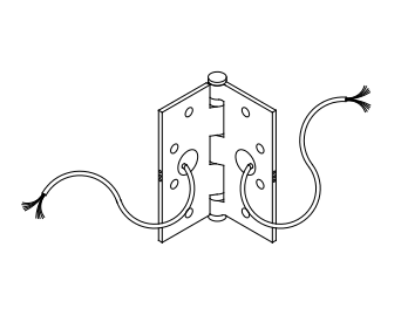
An electric hinge is a door hinge with conductors built into it. Externally it looks like a normal butt hinge. Internally, a set of small wires passes through the knuckle, so the two leaves of the hinge are electrically connected as well as mechanically connected.
The problem it solves is flex. A cable stretched between a frame and a door would be bent through the same arc at the same point thousands of times, and copper that is flexed repeatedly at a single point eventually breaks. Routing the conductors through the pivot axis means they twist rather than bend sharply.
The second thing it solves is appearance and tamper resistance. There is nothing on the surface to cut, catch or paint around, which matters on public facing entrances and on doors where a visible loop would invite interference.
How Does an Electric Hinge Actually Carry Power?
The conductors leave the hinge through a small opening at the back of each leaf. One set goes into the frame, where it joins the wiring from the power supply and the access control panel. The other set goes into the door, where it runs through a raceway drilled inside the leaf to whatever device needs it.
Inside the knuckle the wires are arranged so that opening the door twists them gently along their own axis rather than folding them. That is the whole trick, and it is why a hinge route lasts where a casually routed cable does not.
The hinge is still a hinge
It is easy to treat an electric hinge as an electrical component that happens to be hinge shaped. It is not. It still carries the weight of the door, so it has to suit the door size, weight and frequency of use exactly as a plain hinge would.
If the opening has three hinges and one is swapped for an electric version, the other two have to be in good condition. A sagging door puts a shearing load through the knuckle, and that is precisely where the conductors are.
Electric Hinge, Power Transfer or Armored Loop: Which Route Should You Use?
All three move power from frame to door. They differ in how much current they will carry, how much preparation they need and how visible they are.
| Consideration | Electric hinge | Power transfer | Armored loop |
|---|---|---|---|
| Concealed when closed | Yes | Yes | No |
| Concealed when open | Yes | No | No |
| Preparation required | Hinge mortise, door raceway | Door edge and frame cutout | Surface fixings only |
| Typical use | New or refurbished openings with good hinge access | Higher current loads, motorised devices | Retrofits where cutting is not practical |
| Retrofit difficulty | Moderate, the raceway is the work | Higher, both leaf and frame are cut | Lowest |
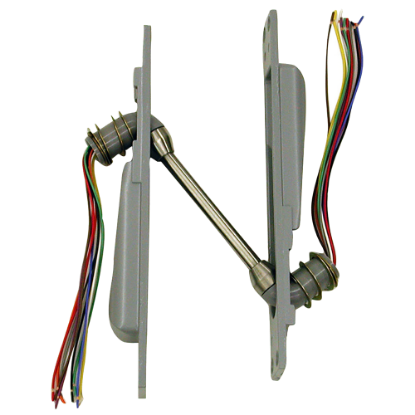
In practice the deciding question is what is at the far end. Monitoring switches and small solenoids are comfortable on a hinge. Motor driven devices usually push you towards a power transfer. Our electric power transfer guide covers that side in detail.
How Many Conductors Do You Need?
Count the devices in the door leaf first, then count the wires each one needs, then add spares. Counting devices and stopping there is how installers end up one pair short on the day.
| Device in the door | What it needs | Current character |
|---|---|---|
| Request to exit switch | A switched pair back to the panel | Signal only, negligible current |
| Latch monitoring switch | A switched pair back to the panel | Signal only |
| Electrified lock or trim | A supply pair, sometimes with a monitoring pair | Steady holding current |
| Motorised latch retraction | A supply pair sized for the motor | High inrush when the motor starts |
| Electrified exit device trim | A supply pair plus any status pairs | Depends on whether it is solenoid or motor driven |
Two rules keep people out of trouble. Always specify spare conductors, because adding a monitoring function later is cheap if the wires are there and expensive if they are not. And always check the inrush, not just the holding current, on anything with a motor in it.
What Hardware on the Door Actually Needs Power?
It helps to be precise about which side of the opening each device sits on, because only the devices in the moving leaf need the transfer route at all.
Electric strikes do not. A strike lives in the frame, so it is wired directly and needs no transfer. That single fact is why a strike is often chosen over an electrified lock when retrofitting an existing door.
Electromagnetic locks usually do not either, because the magnet mounts to the frame or header and only the armature plate goes on the door. Our electromagnetic lock parts guide covers the exceptions.
What does need the route is anything electrified inside the leaf: electrified lock bodies, electrified exit device trim, latch retraction devices, request to exit switches built into the device, and latch monitoring contacts. If you are weighing a door mounted option against a frame mounted one, our electrified mortise lock and electric strike comparison sets out the trade.
What Preparation Does the Door and Frame Need?
Three pieces of preparation have to line up, and all three have to be decided before anything is ordered.
The hinge mortise has to suit the hinge. Size, backset and screw pattern all follow the hinge model, and an electric hinge is not always dimensionally identical to the plain hinge it replaces.
The frame needs a route from the hinge pocket back to the point where the field wiring arrives. On a new frame this is designed in. On an existing frame it is often the hardest part of the job.
The door needs a raceway, a drilled path from the hinge pocket to the device location inside the leaf. On a hollow metal door this is factory work rather than site work, which is why electrified hardware is so much easier to specify at order time than to retrofit.
Weatherised and exposed openings
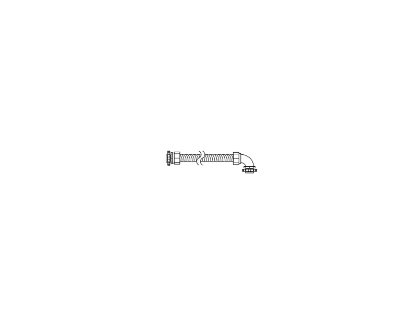
Exterior openings add a requirement the drawings often miss. Where the route is exposed, the cable itself needs protection against weather and against physical damage.
Does an Electric Hinge Work on a Fire Rated Door?
Fire rated openings can carry electrified hardware, but everything on the opening has to be compatible with the rating, and the hinge is part of the opening.
The constraints that matter are the ones that always matter on a fire door. The door has to self close and positively latch every time, and nothing fitted to the opening may prevent that. Hardware has to suit the rating of the assembly.
Practically, that means the fire rating of the assembly has to be checked against every component, the hinge included, before parts are chosen. Our commercial door fire rating guide covers how the labelling works and what it restricts.
Why Do Electric Hinges Fail, and What Does Failure Look Like?
Failures are almost always mechanical in origin even though they present electrically. The conductors are the thinnest part of the system and they live inside the part that moves.
| Cause | What the user reports | What to check |
|---|---|---|
| Conductor fatigue in the knuckle | Device works intermittently, often position dependent | Operate the door slowly and watch for the point it drops out |
| Door sagging onto the electric hinge | Gradual onset, worsens over months | Hinge condition across all hinges, not just the electric one |
| Pinched conductor in the raceway | Fault from the first day after installation | Continuity with the door open and closed |
| Loose connection at the frame end | Fault appears after other work in the frame | Terminations rather than the hinge |
| Undersized conductors for the load | Motor device sluggish or does not pull in | Voltage at the device while it operates, not at rest |
That last row deserves attention. A route that reads perfectly on a continuity test can still fail under load, because a thin conductor drops voltage once current flows. Always measure at the device while it is working.
How Do You Troubleshoot a Dead Electrified Door?
Work from the power supply towards the device, and prove each stage before moving on.
Start at the supply and confirm the output under load, not at rest. Then confirm the signal is arriving at the frame side of the transfer route. Then check continuity across the transfer with the door closed, and again with the door open, because a fatigued conductor often reads fine in one position and open in the other.
Only when the transfer route is proven should the device itself be suspected. Our commercial door hardware troubleshooting guide covers the rest of the sequence, and the access control integration guide covers how the panel side should behave.
What Should You Confirm Before Ordering?
| Item | Why it matters |
|---|---|
| Devices in the leaf and their current draw | Decides hinge against power transfer |
| Conductor count, including spares | Adding wires later means redoing the route |
| Door and frame material and existing preparation | Decides whether a retrofit is realistic |
| Hinge size and weight rating | The hinge still carries the door |
| Fire rating of the assembly | Restricts what may be fitted |
| Exposure to weather | Decides whether the run needs armored protection |
Get those six settled and the order is simple. Skip one and the usual outcome is a second visit, because transfer routes are not something you can change your mind about once the door has been cut.
About the Author
Security Parts has supplied repair parts for commercial door hardware since 2001, covering Von Duprin, LCN, Schlage, Falcon, Detex and Adams Rite at the component level. Our diagram based lookup exists so a technician can confirm a part before ordering it. This guide was written by the Security Parts team from supplier documentation and the questions our customers bring us.
To compare transfer options side by side, browse Detex parts and Von Duprin parts, or contact us with the device list and conductor count and we will confirm the route before you order.