 Trusted Since 2001





Quick Summary
Key points
- Keyed alike means several locks share one key. Every lock in the group opens with the same key, and that key opens nothing else.
- It is a flat arrangement with no hierarchy. Master keying is the opposite: a structure where higher level keys open more doors than lower ones.
- Keyed alike is the right answer for small groups of doors used by the same people. It becomes a liability once the group grows or the people change.
- The decision is made at the cylinder, not at the lock body, so different lock types can still share one key.
- Interchangeable core systems let you rekey by swapping the core rather than taking the lock apart.
| Arrangement | What it means | Where it fits |
|---|---|---|
| Keyed alike | One key opens every lock in the group | A handful of doors used by the same people |
| Keyed different | Every lock has its own key, none interchange | Doors with genuinely separate users and no shared access |
| Master keyed | Each lock has its own key, plus a higher key that opens many | Buildings where access has to be layered by role |
In This Guide
- What Does Keyed Alike Mean?
- How Is Keyed Alike Different From Master Keying?
- When Is Keyed Alike the Right Choice?
- When Does Keyed Alike Become a Problem?
- What Happens When You Need to Add a Door Later?
- How Do You Rekey a Keyed Alike Group?
- Which Cylinders Can Be Keyed Alike?
- Why Interchangeable Cores Change the Maths
- What to Confirm Before Ordering Keyed Alike Cylinders
- About the Author
Keyed alike is one of those phrases that gets used loosely, usually to mean "I want one key for everything". That is sometimes exactly right and sometimes the start of a problem that takes years to unpick. The difference is whether the group of doors will stay small and stable.
This guide covers what keyed alike actually is, how it differs from master keying, when it is the better answer and when it is not. For the hierarchical alternative, see our master key system design guide.
What Does Keyed Alike Mean?
Keyed alike means a set of locks has been pinned to accept the same key. Turn up with that key and every lock in the set opens. Turn up with any other key and none of them do.
Mechanically there is nothing clever about it. A pin tumbler cylinder is pinned so that one particular cut of key lifts its pins to the shear line. Pin a second cylinder the same way and it accepts the same key.
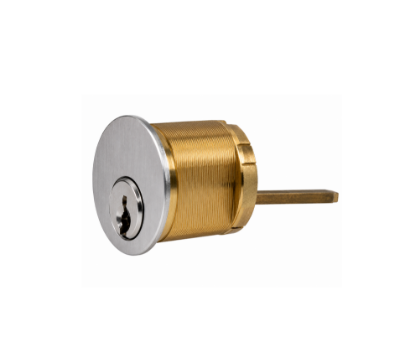
The locks need not be the same type, or even the same product. A deadbolt, a cylindrical lever lock and a padlock can all be keyed alike to each other provided they take compatible cylinders.
That last point is what people miss. Keying happens at the cylinder, not at the lock. The lock body determines the function, the cylinder determines the key.
How Is Keyed Alike Different From Master Keying?
They sound similar and they solve different problems.
Keyed alike is flat. There is one key and there are no levels. Everybody who holds it can open everything in the group, and nobody can be given access to part of it.
Master keying is hierarchical. Each lock keeps its own change key, and a higher level key is added that operates a defined set of locks. Each cylinder is pinned so that more than one key cut will reach the shear line.
A department head's key opens their floor, a facilities key opens more, and the grand master opens the building.
| Question | Keyed alike | Master keyed |
|---|---|---|
| Number of keys per lock | One | Two or more, by design |
| Can access be split by role | No | Yes, that is the point |
| Complexity to design | Almost none | Substantial, needs planning before pinning |
| Effect of losing a key | Every lock in the group is exposed | Exposure is limited to that key's level |
| Rekeying after a loss | Every cylinder in the group | Depends which level was lost |
| Best size | Small, stable groups | Buildings and estates |
They are not mutually exclusive. A master keyed building will often have small keyed alike groups inside it, so that a row of identical store cupboards share one change key while still sitting under the building's masters.
When Is Keyed Alike the Right Choice?
It works well when three things are true: the group is small, everybody who needs one door needs all of them, and that is unlikely to change.
- A suite of rooms used by one team. Office, store, and the door between them.
- Multiple entrances serving the same people. Front, rear and side doors of one unit.
- Equipment and enclosures. Cabinets, gates and padlocks that the same maintenance person opens on the same round.
- Doors with two locks. A lever lock and a deadbolt on the same leaf should almost always be keyed alike, so one key does the door.
That last one is worth calling out because it is the most common sensible use. A door with a deadbolt above the lockset is two locks, and if they take different keys then every entry and exit is a two key operation that nobody thanks you for.
When Does Keyed Alike Become a Problem?
The failure mode is always the same: the group grew, or the people changed.
Keyed alike has no way to withdraw access from part of the group. If one person should no longer have the store room, you cannot take the store room off their key. You can only take the key, which removes everything, or rekey the store room, which separates it from the group permanently.
Lost keys are the second problem. One key opens everything in the set, so losing one exposes every door at once. The remedy is rekeying every cylinder in the group, and the larger the group has quietly grown, the more expensive that morning becomes.
The third is drift. Keyed alike groups are rarely designed. They accumulate. Somebody adds one more door "while we are here", and five years later there are forty cylinders on one key and nobody is sure which doors are on it. At that point the building needs a key system rather than a habit. Our Schlage key systems guide covers what a designed system looks like.
What Happens When You Need to Add a Door Later?
This is where keyed alike groups quietly go wrong, so it is worth planning for on day one.
Adding a door to an existing keyed alike group is easy if you know the key code. A cylinder is pinned to that code, fitted, and the existing key works. It takes minutes and costs very little.
It is a different job if nobody wrote the code down. Then you are either taking an existing cylinder apart to read the pinning, or cutting a new key from an existing one and working backwards. Both are achievable and both cost more than the five seconds it would have taken to record the code when the group was created.
What to Record
| Record | Why it matters later |
|---|---|
| The key code or bitting | Lets you add a cylinder to the group without reverse engineering one |
| Every door in the group | Tells you the real cost of a lost key before it happens |
| Keyway and pin count | Stops somebody ordering a cylinder that cannot take the key |
| Cylinder format per door | Rim, mortise, key in knob or key in lever, so replacements are right first time |
| Who holds a key | The only way to know what a departure actually exposes |
| Date each cylinder was pinned | Useful when half the group has been rekeyed and half has not |
None of that needs software. A sheet of paper in the facilities file is enough, and it is the difference between a twenty minute job and a day.
How Do You Rekey a Keyed Alike Group?
The honest answer is that you rekey all of it or none of it, and that is the whole argument for keeping these groups small.
Because every cylinder accepts the same key, changing that key means changing every cylinder. Leaving one behind means the old key still opens one door, which is usually the door you were worried about.
Three routes, in order of how much they cost you.
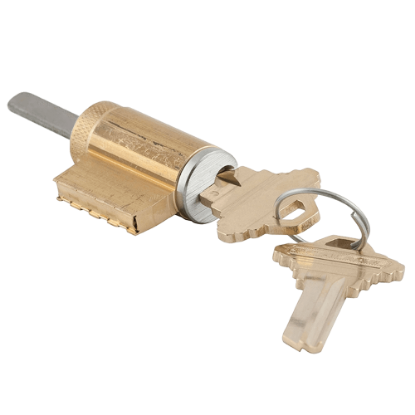
- Swap interchangeable cores. If the group is built on removable cores, a control key pulls each core and a pre pinned replacement goes in. Fastest by a wide margin.
- Repin conventional cylinders. Each cylinder comes apart and is repinned to a new code. Reliable, but it is a visit to every door.
- Replace cylinders entirely. Sometimes the quickest option when cylinders are worn anyway, or when the group is being redesigned rather than just rekeyed.
Whichever route, take the opportunity to write down the new code and the door list. The reason the group was painful to rekey is almost always that nobody did that last time.
Which Cylinders Can Be Keyed Alike?
Any set of cylinders that share a keyway and a compatible pinning can be keyed alike to each other. In practice that means three decisions.
| Factor | Why it matters |
|---|---|
| Keyway | The key blank has to physically enter every cylinder in the group |
| Pin count | Cylinders are offered in different pin counts and they have to agree |
| Cylinder format | Rim, mortise, key in knob and key in lever are different housings, but can share a key |
| Core type | Conventional, or an interchangeable core format that can be swapped as a unit |
Cylinder format being different is not an obstacle. A rim cylinder on an exit device and a mortise cylinder on a lock body are built completely differently, and both can be pinned to the same key. Our comparison of a mortise cylinder and a rim cylinder explains how the two differ physically.
Why Interchangeable Cores Change the Maths
On a conventional cylinder, rekeying means taking the cylinder apart and repinning it, which is a locksmith job done at the door or on a bench.
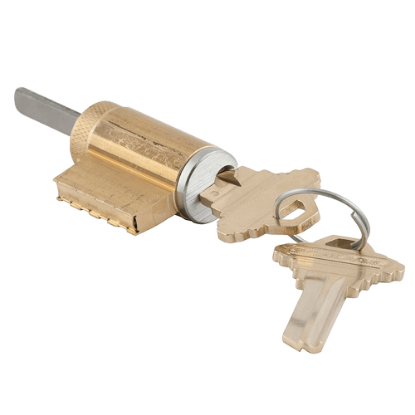
An interchangeable core system changes that. The core is removed as a unit with a control key and a new core goes in. Rekeying a door becomes a thirty second swap rather than a service visit, and the old core can be repinned elsewhere at leisure.
That matters most for exactly the situation where keyed alike goes wrong. If a key is lost on a twelve door keyed alike group, conventional cylinders mean twelve repinning jobs. Interchangeable cores mean twelve core swaps, which one person can do in an afternoon. Our master key system design guide covers the core formats and how they differ.
What to Confirm Before Ordering Keyed Alike Cylinders
- Which doors are actually in the group, written down rather than assumed.
- The keyway, so one blank fits everything.
- Pin count, consistent across the group.
- Cylinder format for each opening, rim, mortise, key in knob or key in lever.
- Whether the building already has a key system this group has to sit inside.
- How many keys are needed, and who will hold a record of them.
Browse Schlage parts for cylinders and cores, or the full products and parts index if you already have part numbers.
About the Author
Security Parts has supplied repair parts for commercial door hardware since 2001, covering Von Duprin, LCN, Schlage, Falcon, Detex and Adams Rite at the component level. Our diagram based lookup exists so a technician can confirm a part before ordering it. This guide was written by the Security Parts team from supplier documentation and the questions our customers bring us.
For related reading, see the thumbturn cylinder guide and our deadbolt parts and diagrams.