 Trusted Since 2001





Quick Answer
Rim exit devices require a three-tier maintenance schedule to stay compliant and functional across their full service life:
- Monthly: Visual check of push bar movement, latch retraction, strike plate alignment, and visible damage. Takes under two minutes per door.
- Quarterly: Tighten all mounting fasteners. Apply dry lubricant (graphite or PTFE-based only) to the latch bolt, dogging shaft, and push bar pivot points. Never use oil-based lubricants.
- Annual: NFPA 80 Section 5.2 inspection by a qualified person. Written documentation required, retained for a minimum of three years.
Six failure conditions require same-day action regardless of schedule. Every replacement part order starts with the model number stamped on the mechanism case. Security Parts carries the full Von Duprin rim exit devices parts catalog organized by series and model. Call 845-935-0301 for pre-order compatibility support.
What Makes Rim Exit Devices the Most Commonly Maintained Egress Hardware
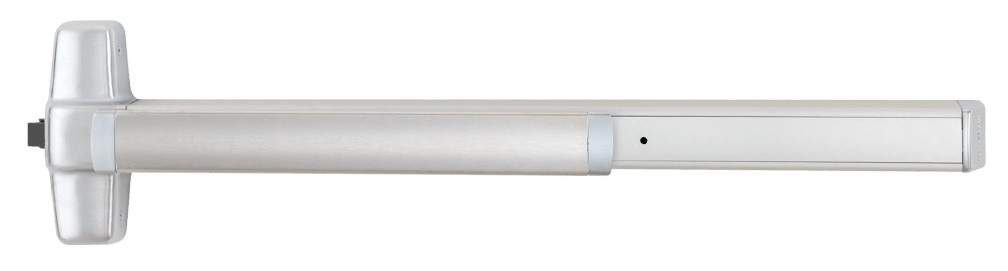
Von Duprin 98/99 Series rim exit device parts. Browse 98/99 Series parts.
A rim exit device is surface-mounted on the face of the door. The latch bolt projects from the device body itself, engages a strike plate on the frame, and the entire mechanism is visible, accessible, and exposed to daily operational conditions. That visibility is an operational advantage: problems are observable before they become failures. A stiff push bar, a latch that fails to retract cleanly, or a dogging mechanism that no longer holds are all diagnosable without disassembly.
ANSI A156.3 Grade 1 certified devices, which covers the Von Duprin 98/99, 22, and 75 Series running on the majority of commercial doors, are rated for 2 million operation cycles. That rating assumes correct installation, appropriate lubrication, and fastener integrity maintained over the device's service life. A consistent three-tier inspection schedule is what keeps the device performing to that standard.
For a broader reference on how rim exit devices compare to surface vertical rod and concealed vertical rod configurations, and guidance on which configuration fits each application, see the rim exit devices complete guide and the Von Duprin panic bar selection guide.
The Three-Tier Rim Exit Device Inspection Schedule
Monthly Visual Checklist
| Item | Pass | Fail |
|---|---|---|
| Push bar moves freely without stiffness | No binding | Bar resists or drags |
| Latch bolt retracts fully when bar is pressed | Full retraction | Partial retraction |
| Door opens without resistance when bar activates | Smooth swing | Door sticks or catches |
| No visible cracks, bends, or impact damage on body or bar | Clean surfaces | Any deformation |
| Strike plate flush with frame, no gap or misalignment | Flush mount | Gap visible |
| No rust, corrosion, or finish deterioration | Clean finish | Any oxidation |
| Dogging function holds correctly with hex key (non-fire devices only) | Holds position | Releases spontaneously |
Monthly inspections take under two minutes per door. The purpose is catching developing problems. A push bar showing early stiffness is a lubrication job. A push bar that is binding and failing to latch consistently is a code compliance issue. Catching the difference monthly prevents the second from appearing on an inspection report. For a comprehensive inspection framework covering all commercial door hardware, see the commercial door hardware maintenance checklist.
Quarterly: Fasteners and Lubrication
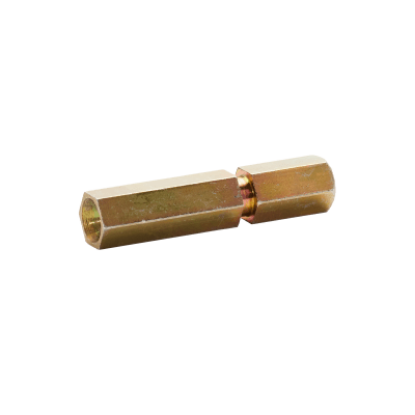
Von Duprin 090040 hex dogging shaft. View product page and order.
Every quarter, check and tighten all mounting fasteners on the device body, baseplate, and strike plate. Loose fasteners create play in the installation that accelerates wear on every internal component. Do not over-torque: fastener specifications are in the Von Duprin installation instructions for each series and are application-specific across wood door, hollow metal door, and metal frame installations.
Lubrication is the most frequently mishandled maintenance step on rim exit devices. Use a dry lubricant, typically a graphite or PTFE-based product, on the latch bolt, the dogging shaft, and the push bar pivot points. Do not use oil-based lubricants. Oil attracts dust and debris, which forms a paste in the mechanism over time and produces the binding behavior it was applied to prevent. On the Von Duprin 98/99 and 22 Series, the dogging shaft (part 090040) and the dogging hook (part 090044) are the highest-turnover components on high-cycle openings, and they benefit most from consistent dry lubrication.
Annual: NFPA 80 Inspection Requirements
For fire-rated doors, NFPA 80 Section 5.2 (2022 edition) requires an annual inspection of the complete fire door assembly by a qualified person. For the exit device specifically, the annual inspection must verify:
- The device is the correct UL-listed unit for the fire door assembly
- The device positively latches without manual assistance every time the door closes
- No field modifications have been made to the device or strike that would void the UL listing
- The door closer is present and operational (NFPA 101 Life Safety Code requires a closer on every fire door to prevent smoke and flame spread)
- No evidence of dogging on a fire-rated device (fire-rated devices carry the "-F" suffix in the model number and have no dogging function by design)
IBC Section 1010.2.8 covers panic hardware requirements in the means of egress. For assembly and educational occupancies with a calculated occupant load of 50 or more, doors equipped with a latch or lock must carry panic hardware across the entire means of egress path, not just the immediate room exit.
Documentation requirement: NFPA 80 requires written records of the annual inspection including the date, the inspector's name, a description of hardware inspected, and any deficiencies found and corrected. Most jurisdictions require these records retained for a minimum of three years and available to the authority having jurisdiction (AHJ) on request.
For a step-by-step annual inspection reference covering all door hardware including rim exit devices, see the NFPA 80 inspection guide. For fire door compliance requirements, see the commercial door fire rating guide. For ANSI/BHMA grade standards referenced in device specifications, see the ANSI/BHMA door hardware standards guide.
Six Rim Exit Device Failure Signs That Require Immediate Action
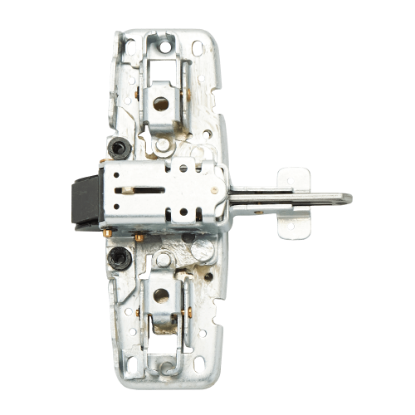
Von Duprin center case kit for 98/99 rim exit devices. View product page and order.
These conditions require action when observed, regardless of when the last scheduled inspection occurred:
Door fails to latch when released. On a fire-rated door, this is an immediate NFPA 80 violation. Caused by a worn latch return spring (090039), a damaged center case, or a deformed latch bolt.
Push bar does not return to the extended position. Indicates a failed internal spring or a stuck dogging assembly. The door will not latch after the next operation cycle.
Visible gap between latch bolt and strike plate. The 299 rim strike on Von Duprin 98/99 and 22 Series devices measures 1-1/4 inches wide by 2-7/8 inches high with 2-1/8-inch slotted hole spacing. A gap indicates strike shift or door sag.
Grinding or clicking during operation. Lubrication resolves noise temporarily. Persistent noise after dry lubrication indicates internal component wear requiring part replacement, not repeat lubrication.
Physical impact damage. A bent push bar, cracked casting at any pivot point, or body deformation compromises structural integrity and voids the 2 million cycle performance assumption.
Unauthorized modification. Wedges propping the door open, zip ties holding the push bar depressed, or any field modification to the device or strike voids the UL listing on a fire-rated assembly. Requires immediate correction and documentation.
For guidance on correcting hardware failures and sourcing correct replacement components, see the commercial door hardware replacement and repair guide and the exit devices parts guide.
ADA Compliance on Accessible Egress Routes
The ADA sets a maximum opening force of 5 pounds for interior doors on accessible egress routes. Exit devices must be mounted between 34 and 48 inches above the finished floor. Single-motion operation with no tight grasping, pinching, or twisting is required.
Where ADA compliance problems surface most often in practice: the door closer, not the exit device. A closer set to too high a closing force makes an otherwise-compliant device functionally non-compliant. Annual inspection of the device on an accessible route must include an opening force measurement at the closer, not just an inspection of the device itself.
Ordering Rim Exit Device Replacement Parts: Model Number First, Always
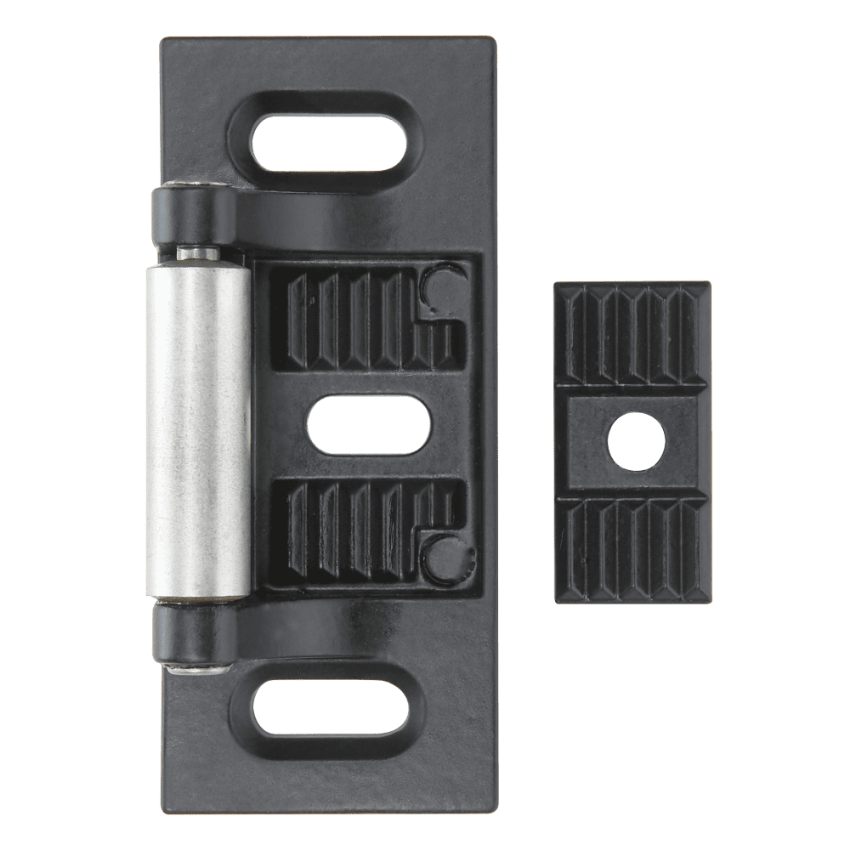
Von Duprin 299 rim strike. View product page and order.
The model number stamped on the mechanism case or baseplate is the sourcing key. It encodes the series, configuration, and trim function, all of which determine which replacement components apply. A center case kit for the 98/99 rim configuration is a different part from the center case kit for the 98/9947 CVR device. The 299 rim strike is not the same as the 299F fire-rated strike.
Security Parts organizes the complete Von Duprin parts catalog by series and model with interactive diagrams on every model page. Navigate to the specific series, including the 98/99 Series, 22 Series, and 88 Series, use the diagram to confirm the failing component visually, and place the order with the correct part number for that specific model. Pre-order compatibility support at 845-935-0301.
For series-specific parts guides covering the most common rim exit device models, see:
- Von Duprin 98/99 Series exit device parts guide
- Von Duprin 22 Series exit device parts guide
- Von Duprin 88 Series buyers guide
- Von Duprin panic bar parts guide
- Von Duprin parts guide (all series)
For general panic hardware specification and compliance context, see the panic hardware guide for commercial doors.
Rim exit devices are the most common and most maintained egress hardware in commercial facilities. Monthly visual checks catch developing problems early. Quarterly fastener tightening and dry lubrication prevent the premature component wear that shortens device service life. Annual NFPA 80 inspections cover fire-rated assemblies with documentation retained for three years. The six failure conditions require immediate action when observed. ADA compliance extends to the door closer, not just the device. And every replacement parts order starts with the model number on the mechanism case before the catalog opens. Running this schedule consistently is what keeps rim exit devices compliant, functional, and documented across the full service life of the hardware.
About the Author
This guide was written by the Security Parts team, a commercial door hardware specialist serving locksmiths, facilities managers, general contractors, and access control integrators since 2001. Security Parts carries the complete Von Duprin rim exit device parts catalog across all active series, with same-day shipping on stocked components and pre-order compatibility support at 845-935-0301.