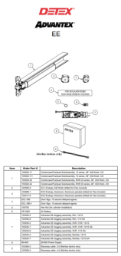
The Detex 104494-2 is an EE board replacement component for Detex Advantex 10 Series and 40 Series exit devices equipped with the Electric Dogging (EE) option.
The Detex 104494-2 is the OEM EE circuit board for the Advantex 10/40 Series delayed egress exit device. It is the printed circuit board only - the control board that manages the complete 15-second delayed egress sequence, alarm function, and pushpad monitoring in the Detex Advantex EE system. This is the field replacement when the EE board itself fails on an existing installation. It does not include the power supply, the complete EE assembly, or any mechanical components. Confirm the installed device is the Advantex 10 Series (wide stile rim) or Advantex 40 Series (narrow stile rim) with the EE delayed egress option before ordering.
The companion EE board for the Advantex 20/21/50/51 SVR devices and the Advantex 30 Mortise device are separate part numbers. The 104494-2 is specifically for the 10/40 rim device family.
Detex Advantex EE Delayed Egress System: What This Board Controls
The Detex Advantex EE is the Delayed Egress exit device system - a NFPA 101-compliant controlled exit solution for secondary and primary egress doors where unauthorized or impulsive exit creates security, loss prevention, or patient safety risks. When a person depresses the pushpad on an armed EE device, the sequence is immediate and irreversible: the 100dB alarm activates at the moment the pushpad is touched, and the door remains secured for 15 seconds. After the 15-second delay, the device releases automatically and allows exit. The alarm continues until the door closes and the device resets.
The 104494-2 EE board is the microprocessor-based control board that executes this entire sequence. It manages the timing circuit for the 15-second irreversible delay, the alarm activation at pushpad contact, the pushpad monitoring (EX request-to-exit function), the bypass and reset inputs, and the power supply interface. When the board fails - due to component degradation, power surge, humidity ingress, or age - the EE function stops operating correctly. The device either alarms continuously, fails to delay, fails to release after 15 seconds, or fails to alarm at all. Replacing the 104494-2 board restores all EE functions without replacing the complete exit device.
Detex Advantex 10 Series and Advantex 40 Series: Where This Board Is Used
The Detex Advantex 10 Series is the super-heavy-duty wide stile rim exit device. Minimum stile width for the Advantex 10 with EE option is 4-5/8" with a surface strike or 4-1/8" with an optional semi-mortise strike. The Advantex 40 Series is the super-heavy-duty narrow stile rim device for aluminum storefront and glass doors with narrower vertical stile members. Both the 10 and 40 Series rim devices share the same EE board (104494-2), because both devices share the same EE control system architecture in the rim configuration.
The Detex Advantex EE is UL listed for panic exit hardware, UL listed for fire exit hardware up to 3 hours on maximum 4'x10' single doors and pairs of 4'x8' with F90KR key-removable mullion, meets ANSI/BHMA A156.3 Grade 1, complies with NFPA 80 and NFPA 101 life safety requirements, and meets UL10C positive pressure fire rating.
Detex EE Board: NFPA 101 Compliance Context
The 15-second delay on the Detex Advantex EE is not a configurable setting - it is an NFPA 101 requirement for delayed egress hardware used in the life safety classification of Special Locking Arrangements. NFPA 101 Section 7.2.1.6 permits delayed egress in occupancies where the system meets three conditions: the alarm sounds immediately when the door is pushed, the delay does not exceed 15 seconds (or 30 seconds in certain occupancies by local amendment), and the system fails safe - releasing the door when building power fails.
The EE board manages all three of these compliance requirements in hardware. A board that fails on any of these functions creates a life safety compliance gap, which is why the 104494-2 board is a critical field service part rather than a discretionary one.
 Trusted Since 2001